Top 20+ M.Tech Project Ideas for 2026
By Faheem Ahmad
Updated on Apr 20, 2026 | 10 min read | 3.71K+ views
Share:

All courses
Certifications
More
By Faheem Ahmad
Updated on Apr 20, 2026 | 10 min read | 3.71K+ views
Share:
Table of Contents
MTech project topics for 2026 are centered around emerging technologies such as AI and machine learning, IoT, VLSI, and renewable energy. Popular focus areas include autonomous vehicles, cybersecurity, smart agriculture, and 5G networks. Key domains also cover deep learning for computer vision, low-power VLSI design, smart grid systems, and cloud computing applications.
In this guide, we’ve broken down 20+ project ideas into beginner, intermediate, and advanced levels to help you build something that truly stands out in your portfolio.
Build in-demand AI skills with upGrad’s Artificial Intelligence Courses. Learn machine learning, prompt engineering, and real-world tools through hands-on projects.
Popular upGrad Programs
These projects focus on foundational research and building solid, functional systems while helping you build a good understanding of the basics.
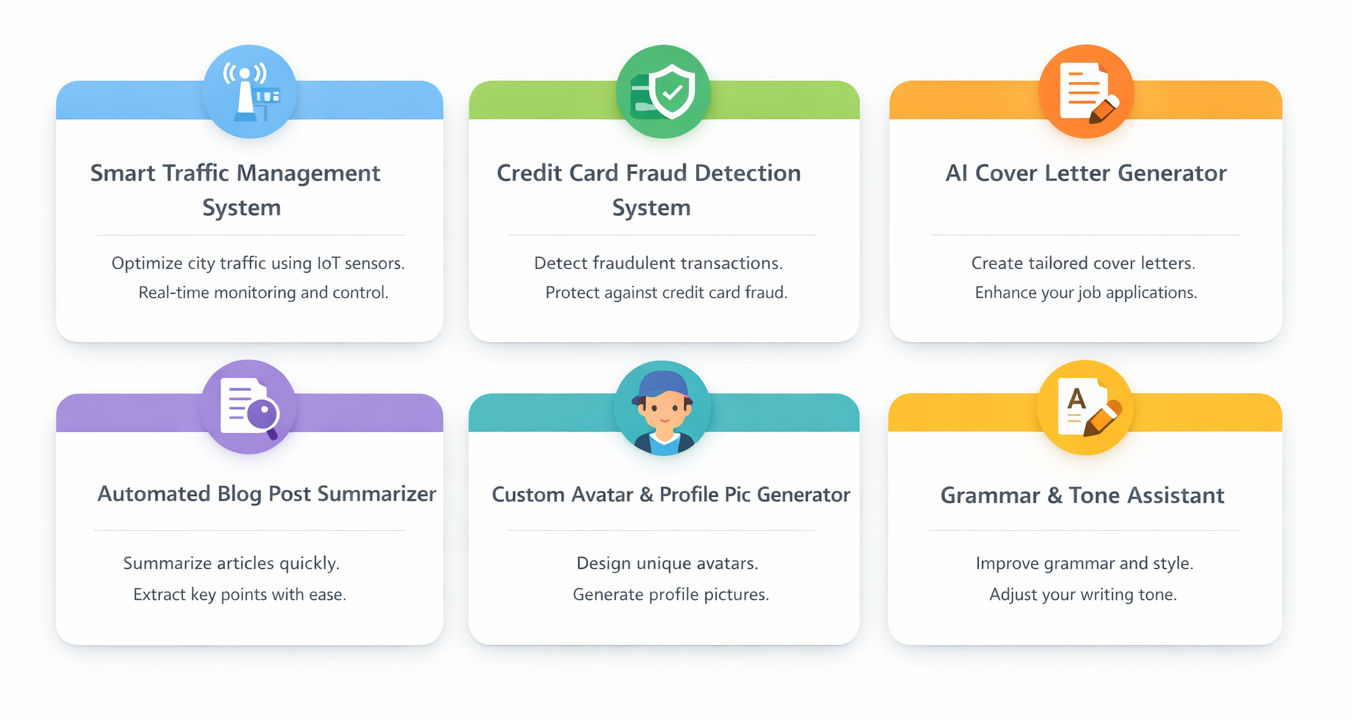
Traditional traffic lights use fixed timers, which often leads to unnecessary congestion. This project uses IR sensors and cameras to measure real-time traffic density at an intersection. The system then automatically adjusts signal timings to prioritize the busiest lanes, reducing wait times and fuel consumption significantly.
Tools and Technologies Used
How to Make It
Also Read: Top 25+ HTML Projects for Beginners in 2026: Source Code, Career Insights, and More
This project helps banks identify suspicious transactions before they are finalized. By analyzing past transaction patterns, like location, amount, and time, the system can flag anything that looks like an outlier. It’s a great way to learn about supervised machine learning and how to handle data imbalance in real-world scenarios.
Tools and Technologies Used
How to Make It
Also Read: Top 25+ AI Chatbot Project Ideas in 2026
This project introduces you to the fundamentals of prompt engineering and working with LLM APIs. You will build a web application where job seekers paste their resume and a target job description. The system then generates a highly tailored, professional cover letter, teaching you how to combine dynamic user inputs into a structured prompt.
Tools and Technologies Used
How to Make It
This project focuses on natural language processing and text reduction. You will create a tool that takes a long-form article or a URL and parses the text. It then utilizes an LLM to generate a concise, bulleted summary of the core concepts, highlighting key takeaways and action items for the reader.
Tools and Technologies Used
How to Make It
Also Read: Top Java Architect Interview Questions & Answers for 2026
This project dives into the world of image generation and diffusion models. You will build an interface where users type a physical description or a fantasy concept. The application then connects to a text-to-image model to generate a unique, high-resolution digital avatar based on those inputs.
Tools and Technologies Used
How to Make It
This project teaches you how to strictly constrain LLM outputs for specific editorial tasks. You will build a writing assistant that not only corrects grammatical errors but also allows the user to rewrite their text into different emotional tones. This includes options such as "Aggressive," "Diplomatic," or "Humorous".
Tools and Technologies Used
How to Make It
Also Read: Top Real Time Project Ideas Every Tech Student Should Try
Free Courses
Intermediate projects move beyond basic prompts and build structured, real-world applications using workflows like RAG and multi-step prompting.
This project is a deep dive into Retrieval-Augmented Generation (RAG), the foundational architecture of enterprise Al. You will build an application where users upload massive PDF documents and can ask a chatbot highly specific questions. The Al then answers based strictly on the document's contents.
Tools and Technologies Used
How to Make It
Also Read: Best Capstone Project Ideas & Topics in 2026
This project explores the rapidly advancing field of generative audio. You will build a studio-like application where users input text, select distinct voice personas, and generate incredibly realistic, human-sounding voiceovers. This is perfect for generating high-quality audio for videos or podcasts.
Tools and Technologies Used
How to Make It
This project requires orchestrating chained prompts and generating structured, multi-part outputs. You will build a marketing tool that takes a single business topic and automatically generates a month-long content calendar. This calendar is then tailored for different platforms like LinkedIn, Twitter, and Instagram.
Tools and Technologies Used
How to Make It
Also Read: 20+ Top Front-End Developer Tools in 2026: Uses, Benefits, and More
This project tackles the critical concept of LLM memory management. You will build a conversational agent that remembers the context of the user's past messages throughout a session. This allows for natural, multi-turn conversations without the Al losing the thread of the discussion.
Tools and Technologies Used
How to Make It
This project solves a major business pain point by allowing non-technical users to interact with databases. You will build an interface where a user asks a business question in plain English. The Al then generates the correct SQL query and executes it against a live database.
Tools and Technologies Used
How to Make It
Also Read: Full Stack Developer Tools To Master In 2026
This project focuses on multi-persona generation and dialogue formatting. You will build an application that takes an article URL and converts it into a lively, back-and-forth conversational podcast script. The script features a designated "Host" and an "Expert Guest" to discuss the topic.
Tools and Technologies Used
How to Make It
Recommended Courses to upskill
Explore Our Popular Courses for Career Progression
IIIT Bangalore
Executive Diploma in Machine Learning and AI360° Career Support
O.P.Jindal Global University
MBA from O.P.Jindal Global UniversityLive Case Studies and Projects
Advanced project ideas push you to build production-level systems with real-world impact, focusing on Al agents, multi-modal apps, and scalable architectures.
This project dives into the bleeding edge of agentic Al workflows. You will build a Python tool where you provide a high-level goal, such as building a game. The Al then autonomously writes the code, saves the files, runs the code, reads terminal errors, and debugs itself until the app works.
Tools and Technologies Used
How to Make It
Also Read: Top 30 Final Year Project Ideas for CSE Students in 2026
This project explores multi-modal AI and complex financial reasoning. You will build an enterprise tool that ingests complex quarterly earnings reports, including charts and graphs. The system then autonomously generates investment summaries and risk assessments based on that visual and textual data.
Tools and Technologies Used
How to Make It
This project moves into actual model training rather than just prompt engineering. You will take an open-source LLM and fine-tune it on a dataset of legal contracts. This allows the model to natively understand complex legal jargon and formatting without needing massive context prompts.
Tools and Technologies Used
How to Make It
Also Read: Top 20+ Internship Projects: Best Ideas for 2026
This project tackles extreme low-latency data streaming and pipeline optimization. You will build a mobile app that constantly listens to a foreign language, translates it, and speaks the translation back to the user almost instantaneously. It mimics a sci-fi universal translator.
Tools and Technologies Used
How to Make It
This project explores "UI as Code" generation. You will build a development tool where a user types a description of a web interface. The AI then generates the React code and visually renders the live interface immediately for the user to see.
Tools and Technologies Used
How to Make It
Do Read: Top 20+ Backend Projects: Best Ideas for 2026
This project tackles the heavy computational requirements of video generation models. You will build an interface that allows users to write a script, generate short video clips from text prompts, and arrange them on a playable timeline.
Tools and Technologies Used
How to Make It
Also Read: Top 20+ Generative AI Project Ideas in 2026
This project explores the power of specialized, interacting agents. You will build a system where you input a topic, and three distinct AI agents (a Proponent, an Opponent, and a Moderator) autonomously research the web and debate the topic in a chat.
Tools and Technologies Used
How to Make It
This project aims to help the hearing and speech-impaired communicate more easily. It uses a camera and a deep learning model to recognize hand gestures in real-time and converts them into spoken English. It involves high-speed image processing and natural language generation.
Tools and Technologies Used
How to Make It
Do Read: Top 25+ RAG Project Ideas in 2026
The secret to a great M.Tech project is picking a topic that solves clear problems and goes beyond basic prompts. Successful developers don't stop at basic chatbots; they create systems that connect data, automate tasks, and deliver real outcomes. Pick an idea that excites you, choose your tools wisely, and start building something that matters.
"Want personalized guidance on courses and upskilling opportunities? Connect with upGrad’s experts for a free 1:1 counselling session today!"
Related Articles:
To pick high-impact mtech projects for cse, focus on emerging fields like Generative AI or Cybersecurity. Look for builds that solve real-world industry gaps, as this makes your final thesis more valuable to tech recruiters and research institutions alike.
This path is ideal for those wanting to lead large engineering teams. It combines technical depth with leadership skills. While working on your research, you’ll learn to manage budgets and timelines, which are critical for high-level corporate roles.
Proper documentation involves a detailed literature survey, methodology, and result analysis. Whether you are doing an mtech in project management or technical research, following a structured report format ensures your work meets academic standards.
Yes, Blockchain is a popular niche. You can design secure voting systems or supply chain trackers. These types of builds demonstrate your ability to handle decentralized data, a skill highly sought after by modern fintech companies.
It focuses specifically on the lifecycle of engineering and technical ventures. Unlike a general MBA, it requires you to apply management theories to complex technical environments, ensuring a much deeper vertical expertise within the industry.
Typically, these span over the final two semesters. The first phase involves research and design, while the second focuses on implementation. Starting early allows enough time for rigorous testing and debugging of your software.
Most universities allow collaborative work, especially in interdisciplinary fields. For instance, a student might partner with another to oversee the development and deployment of a complex AI system, mimicking a real-world corporate team.
Choose a guide whose expertise matches your chosen field. A mentor who has published papers in your specific area can provide better insights. Their guidance is vital for refining your work and helping you get published in journals.
Yes, the skills learned are globally recognized. Large multinational firms need experts who can lead global mtech projects. Holding this degree proves you can manage diverse teams and complex technical roadmaps across different geographical regions.
Simulation is crucial for tasks involving networking or robotics. It allows you to test your logic in a virtual environment before physical deployment. Most advanced builds use simulators to validate data accuracy and system stability.
Many successful startups began as simple student builds. If your research solves a unique commercial problem, you can seek incubation. Combining your technical build with professional management skills provides a strong foundation for entrepreneurship.
77 articles published
Faheem Ahmad is an Associate Content Writer with a specialized background in MBA (Marketing & Operations). With a professional journey spanning around a year, Faheem has quickly carved a niche in the ...
Get Free Consultation
By submitting, I accept the T&C and
Privacy Policy
Top Resources
Certification
3 Months
Certification
6 Months
O.P. Jindal Global University
Masters in International Accounting and Finance (Accredited by ACCA, UK)Master's Degree
12 Months