AI Governance: Frameworks, Principles, Challenges & Best Practices in 2026
By Sriram
Updated on Jun 03, 2026 | 11 min read | 4.91K+ views
Share:

All courses
Certifications
More
By Sriram
Updated on Jun 03, 2026 | 11 min read | 4.91K+ views
Share:
Artificial Intelligence (AI) governance is the framework of policies, procedures, and oversight mechanisms that guide how AI systems are developed, deployed, and managed. Its primary goal is to ensure that AI technologies operate responsibly, remain transparent, and produce outcomes that are fair and reliable.
By establishing clear accountability and risk management practices, AI governance helps organizations address concerns such as bias, privacy, security, and compliance. It serves as a practical bridge between broader AI ethics principles and regulatory requirements, ensuring that AI systems are monitored and controlled throughout their entire lifecycle.
Build practical AI and ML skills and start creating real applications. Explore upGrad’s Artificial Intelligence courses to learn AI architecture, machine learning, and generative AI tools, and move toward roles in AI development and cloud-based ML systems.
Popular AI Programs
Imagine a large city with millions of people but no traffic rules, building codes, safety inspections, or law enforcement. At first, growth might seem fast and unrestricted. Over time, however, accidents increase, confusion spreads, and trust begins to erode.
AI development can face a similar problem.
When organizations deploy AI systems without clear oversight, different teams may build models using inconsistent standards, incomplete data, or poorly understood assumptions. The consequences may not be immediately visible, but risks accumulate over time.
AI governance establishes the rules that keep AI systems aligned with business goals, legal requirements, and ethical expectations.
Effective governance helps ensure AI systems remain:
AI governance is not the responsibility of a single department. It requires collaboration across the organization.
The table below describes the key stakeholders involved in AI governance and their respective responsibilities:
| Stakeholder | Responsibility |
| Executive Leadership | Strategic oversight and risk ownership |
| Data Teams | Data quality and governance |
| AI Engineers | Model design and implementation |
| Compliance Teams | Regulatory adherence |
| Security Teams | Protection of AI infrastructure |
| Business Units | Responsible operational use |
| End Users | Appropriate interaction and feedback |
Governance becomes especially important when AI systems influence decisions that affect people directly.
Also Read: Types of AI: From Narrow to Super Intelligence with Examples
Free Courses
Many organizations initially focus on AI's capabilities. Governance focuses on its consequences.
A recommendation engine suggesting movies carries relatively low risk. A model deciding whether someone qualifies for a mortgage carries much greater responsibility.
The more impactful the decision, the greater the need for governance.
Growing AI Risks
Modern AI systems can introduce challenges that traditional software rarely faced.
One major concern is bias.
If historical data contains unfair patterns, an AI model may unintentionally amplify those patterns. A recruitment system trained on years of hiring data, for example, could learn preferences that disadvantage qualified candidates from certain backgrounds.
Privacy creates another layer of complexity. AI models often require large volumes of data, which may contain personal or sensitive information. Poor governance can expose organizations to serious compliance issues.
Generative AI introduces additional concerns.
Organizations increasingly rely on AI assistants for content creation, coding, research, and customer support. While these tools can be highly effective, they can also generate inaccurate information, create misleading outputs, or reveal confidential data if not properly managed.
Business Impact
Poor AI governance can affect more than technical performance.
Potential consequences include:
Consider a financial institution that uses AI for credit assessments. If customers cannot understand why applications were rejected, transparency concerns emerge. If specific groups consistently receive unfavorable outcomes, fairness concerns arise. Both situations can attract regulatory scrutiny and public criticism.
Governance helps organizations identify and address these risks before they become costly problems.
Also Read: Top 20 Challenges of Artificial Intelligence: Key Issues and Solutions for 2026
AI Courses to upskill
Explore Artificial Intelligence Courses for Career Progression
Governance is often misunderstood as a collection of documents and policies.
In reality, it is an ongoing operational process.
Organizations that implement effective governance create systems that monitor AI from development through deployment and beyond.
Step 1: Define AI Policies
Governance begins with clear rules.
Organizations must establish:
Without clear policies, teams may apply AI inconsistently across different business functions.
Step 2: Establish Oversight Structures
Someone must be accountable.
Many organizations create dedicated governance committees that include representatives from:
These groups review AI initiatives and assess potential risks before deployment.
Step 3: Monitor Data Quality
AI systems are only as reliable as the data used to train them.
Governance processes often examine:
Even a highly sophisticated model can produce unreliable outcomes when trained on poor-quality data.
Step 4: Evaluate Models
Before deployment, organizations typically assess multiple dimensions of performance.
These include:
A model that achieves impressive accuracy but cannot explain its decisions may not be suitable for regulated industries.
Step 5: Continuous Monitoring
Deployment is not the finish line.
Customer behavior changes. Markets evolve. Regulations shift.
As a result, model performance can gradually deteriorate.
Governance programs establish ongoing monitoring to identify:
Continuous monitoring helps organizations detect problems before they affect business outcomes.
Also Read: Top 5 Machine Learning Models Explained For Beginners
Core pillars of AI governance define the fundamental principles that guide responsible AI development and deployment. These pillars ensure that AI systems operate in a trustworthy, transparent, and accountable manner. They help organizations maintain consistency in decision-making while addressing risks related to fairness, security, compliance, and long-term system reliability.
Here, the table shows how AI can work in each pillar :
| Pillar | Purpose |
| Accountability | Assign ownership and responsibility |
| Transparency | Explain AI decisions and processes |
| Fairness | Reduce discriminatory outcomes |
| Security | Protect systems from threats |
| Privacy | Safeguard personal information |
| Compliance | Meet legal and regulatory requirements |
| Monitoring | Maintain long-term performance |
| Reliability | Ensure consistent behavior |
| Auditability | Support independent review and verification |
These pillars provide the foundation for responsible AI operations.
A more engaging and structured approach would be to break the example into logical H3 subsections. This improves readability, SEO, and user experience.
As organizations increasingly integrate AI into their operations, structured governance frameworks and standards have become essential. These frameworks provide guidance for managing risks, ensuring compliance, improving transparency, and establishing accountability. They help organizations implement consistent practices for developing, deploying, and monitoring AI systems throughout their lifecycle.
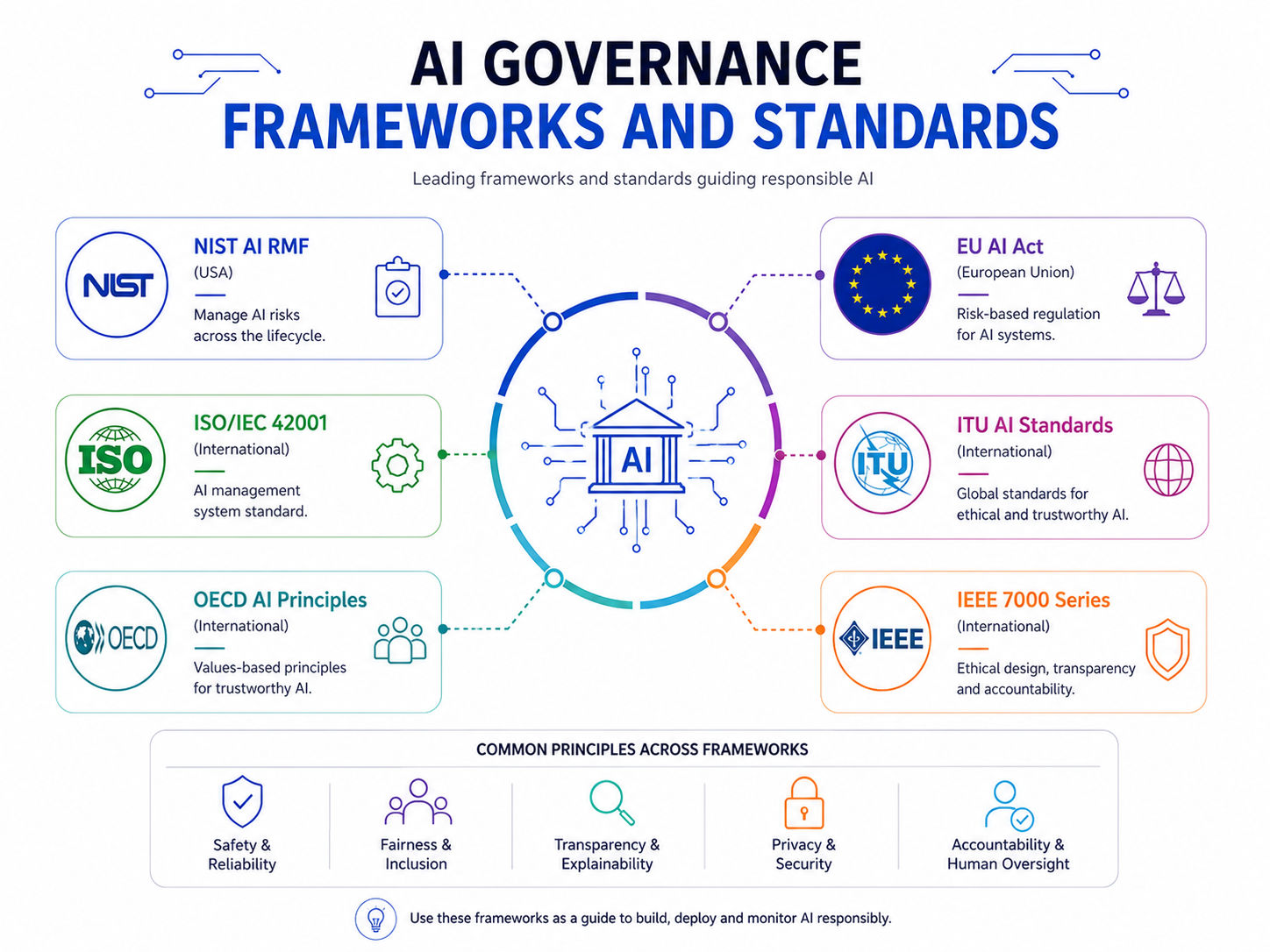
The NIST AI Risk Management Framework provides guidance for identifying, assessing, and managing AI risks throughout the system lifecycle.
Its emphasis on trustworthiness, accountability, and continuous improvement makes it one of the most widely referenced governance resources.
Organizations often use it as a practical starting point for building governance programs.
ISO/IEC 42001 introduces management system requirements specifically designed for AI.
Rather than focusing solely on technical controls, it addresses organizational processes, responsibilities, and governance structures.
For companies seeking formal certification, this standard offers a structured approach.
The OECD AI Principles emphasize human-centered AI development.
Key themes include:
Many governments and organizations reference these principles when developing internal policies.
The EU AI Act represents one of the most significant AI regulations introduced globally.
Rather than treating all AI systems equally, it categorizes applications based on risk levels.
Higher-risk systems face stricter requirements regarding transparency, documentation, testing, and oversight.
Its influence extends well beyond Europe because multinational organizations often apply consistent governance standards across global operations.
Also Read: Top 5 Machine Learning Models Explained For Beginners
AI governance is not a one-size-fits-all approach. Every industry uses AI differently, which means the risks, regulatory requirements, and oversight needs can vary significantly. From healthcare and finance to human resources and manufacturing, organizations must tailor their governance strategies to address industry-specific challenges while ensuring AI systems remain transparent, accountable, and compliant.
Healthcare
Healthcare organizations increasingly use AI for diagnostics, patient monitoring, and treatment recommendations.
Governance priorities include:
A diagnostic recommendation may assist a physician, but governance ensures that medical professionals remain responsible for final decisions.
Financial Services
Banks and financial institutions rely heavily on AI for:
Governance helps maintain fairness, explainability, and regulatory compliance.
Human Resources
AI-powered hiring tools can improve efficiency, but they also introduce concerns regarding discrimination and fairness.
Governance frameworks often require:
These safeguards help ensure hiring decisions remain equitable.
Manufacturing
Manufacturers use AI to optimize operations, predict equipment failures, and improve quality control.
Governance focuses on:
In industrial environments, AI errors can affect both productivity and worker safety.
AI governance is not straightforward as AI technologies are fast-evolving, regulatory requirements are changing, and managing risks across multiple systems is challenging. Organisations need to balance innovation and accountability while addressing issues such as transparency, fairness, compliance and continuous oversight throughout the AI lifecycle.
Fast-Paced Technological Change
AI moves faster than most governance programs.
Policies that seem adequate today can become obsolete within months of new models and capabilities emerging.
Organisations need to keep their governance processes up to date.
Limited Interpretability
Some more advanced AI systems are complex black boxes.
It can be hard even for experienced developers to understand why a model generated a particular output.
This presents challenges in regulated industries where explanations are often required.
Regulatory Intricacy
The AI regulations differ from country to country and industry to industry.
Organisations with a global footprint must navigate an ever more fragmented web of requirements.
What is satisfactory to one jurisdiction is not satisfactory to another.
Limited Resources
Large enterprises may have governance teams dedicated. Smaller organisations often lack the expertise, budget and staff. Meaningful investment is needed to implement governance at scale.
Fairness Definition
Fairness in practice means different things to different stakeholders. Sometimes optimising for one fairness metric can hurt another one. Governance teams have to walk a tightrope between conflicting goals.
Best Practices in AI Governance
Creating an effective AI governance program is more than just writing policies and procedures. Organisations require pragmatic measures that support accountability, transparency, compliance and risk management end-to-end of the AI life cycle.
1. Begin with Risk Classification
Not all AI applications are created equal in terms of risk.
A chatbot recommending FAQs shouldn’t need the same controls as a healthcare diagnostic model.
Risk-based governance is a more efficient way of allocating resources.
2. Keep Detailed Records
Documentation promotes transparency and accountability.
Organisations should record:
Clear records facilitate audits and investigations.
3. Form Cross-Functional Teams
The best way to govern is with the plurality of perspectives.
4. Develop Review Procedures
Major AI deployments should be preceded by structured reviews.
These reviews help to find issues that development teams might miss.
5. Continuously Monitor :
AI systems shouldn’t run indefinitely without any supervision.
Regular monitoring can identify:
6. Provide Employee Training
Technology alone cannot ensure responsible use of AI.
Employees need to be trained on:
In the next couple of years, how organisations manage AI could change dramatically.
Regulators worldwide are rolling out more AI-specific requirements.
At the same time, organisations are investing in automation of governance.
Already, the new tools can:
Organizations that build strong governance foundations today will be better positioned to innovate responsibly tomorrow.
Must read : Big Data Analytics in Government: Applications and Benefits
AI governance has become a business necessity rather than an optional consideration.
As artificial intelligence becomes embedded in critical decisions, organizations need structured ways to manage risk, ensure accountability, and maintain public trust.
Strong governance does not prevent innovation. In many cases, it enables innovation by creating clear rules, improving transparency, and reducing uncertainty.
The organizations that gain the most value from AI in the coming years will likely be those that treat governance as an integral part of their AI strategy rather than an afterthought.
Looking to build expertise in AI, machine learning, or responsible AI practices? Explore industry-focused training programs and connect with an advisor to identify the learning path that aligns with your career goals.
Want personalized guidance on AI and upskilling? Speak with an expert for a free 1:1 counselling session today.
AI ethics focuses on broad moral principles like fairness, transparency, and human rights, while AI governance turns those ideas into enforceable systems, policies, and workflows. Governance is more operational, meaning it defines who is responsible, how decisions are reviewed, and what processes ensure AI systems actually follow ethical expectations in real-world deployments.
Most organizations start by identifying where AI is already being used across teams and then classifying each use case based on risk level. After that, they define approval workflows, assign ownership, and document model usage. A simple starting point often works better than complex frameworks that are hard to maintain early on.
AI systems don’t remain stable forever because real-world data keeps changing. User behavior shifts, market conditions evolve, and new patterns appear that the model may not have seen during training. Continuous monitoring helps detect performance drops, unexpected behavior, or bias drift before these issues start affecting real decisions.
Data quality directly shapes how reliable an AI system is in practice. If training data is incomplete, outdated, or biased, the model will likely reflect those flaws in its predictions. Governance ensures data is properly validated, sourced responsibly, and regularly reviewed so that decisions remain accurate and consistent over time.
Bias is usually addressed through a combination of data review, testing, and ongoing evaluation. Teams check whether certain groups are being unfairly treated and adjust datasets or model logic where needed. In many cases, human review is also added for sensitive decisions to ensure outcomes remain balanced and socially responsible.
AI model auditing is the process of reviewing how a model makes decisions, what data it uses, and whether it aligns with expected standards. It is important because it adds accountability and helps organizations prove that their systems are working as intended. Audits are often required in regulated industries like finance and healthcare.
Yes, but it usually starts in a lightweight form. Small businesses don’t need complex governance boards, but they should still define basic rules for data usage, model approval, and monitoring. Even simple documentation and periodic checks can significantly reduce risk when using AI tools for customer service, marketing, or operations.
AI governance helps organizations align their systems with legal and regulatory expectations by embedding compliance into everyday processes. Instead of treating compliance as a one-time task, governance ensures ongoing checks for transparency, documentation, and accountability. This becomes especially important as AI regulations continue to evolve across different regions.
Without governance, AI systems can become inconsistent, hard to trust, and difficult to control. Decisions may vary unexpectedly, bias can go unnoticed, and compliance risks increase. Over time, this can lead to customer dissatisfaction, regulatory scrutiny, and internal confusion about how AI-driven decisions are actually being made.
AI governance is likely to become more automated and standardized as organizations scale AI usage. More tools will handle monitoring and compliance checks automatically, while regulations will push companies toward stricter accountability. At the same time, generative AI will introduce new governance needs around content accuracy, data privacy, and responsible usage.
Organizations often use model monitoring platforms, data lineage tools, and automated reporting systems to support governance. Some tools track performance drift, while others focus on bias detection or compliance reporting. The goal is not just tooling itself, but building a system that makes oversight easier and more consistent across teams.
727 articles published
Sriram K is a Senior SEO Executive with a B.Tech in Information Technology from Dr. M.G.R. Educational and Research Institute, Chennai. With over a decade of experience in digital marketing, he specia...
Speak with AI & ML expert
By submitting, I accept the T&C and
Privacy Policy
Top Resources
Master's Degree
18 Months
Executive Diploma
12 Months
IIIT Bangalore
Executive Programme in Generative AI & Agentic AI for LeadersIndia’s #1 Tech University
Dual Certification
5 Months