Top 25+ RAG Project Ideas in 2026

By Rahul Singh

Updated on Apr 16, 2026 | 11 min read | 3.5K+ views

Share:

RAG project ideas range from simple personal assistants to advanced enterprise systems that handle large-scale data and complex queries. You can start with a personal note search app using tools like Pinecone or FAISS, and then move to more advanced builds like a multimodal PDF analyzer that understands charts, tables, and text together.

More advanced RAG project ideas include GraphRAG systems that map relationships between data, agent-based research assistants, real-time data ingestion pipelines, and domain-specific bots for finance or legal use cases. These projects focus on building accurate, context-aware systems that work with live and structured data.

In this guide, you will find 28 highly descriptive RAG project ideas divided into four distinct categories. 

Build real-world skills with upGrad’s Agentic and Generative AI courses. Learn prompt engineering, AI agents, vector databases, RAG through hands-on projects.

Agentic AI Courses to upskill

Explore Agentic AI Courses for Career Progression

Certification Building AI Agent

360° Career Support

Executive Diploma12 Months

Beginner Friendly RAG Project Ideas

These projects introduce you to the core fundamentals of the RAG pipeline: document ingestion, text splitting, generating mathematical embeddings, and performing simple similarity searches. They are perfect for developers looking to build their first context-aware AI tools.
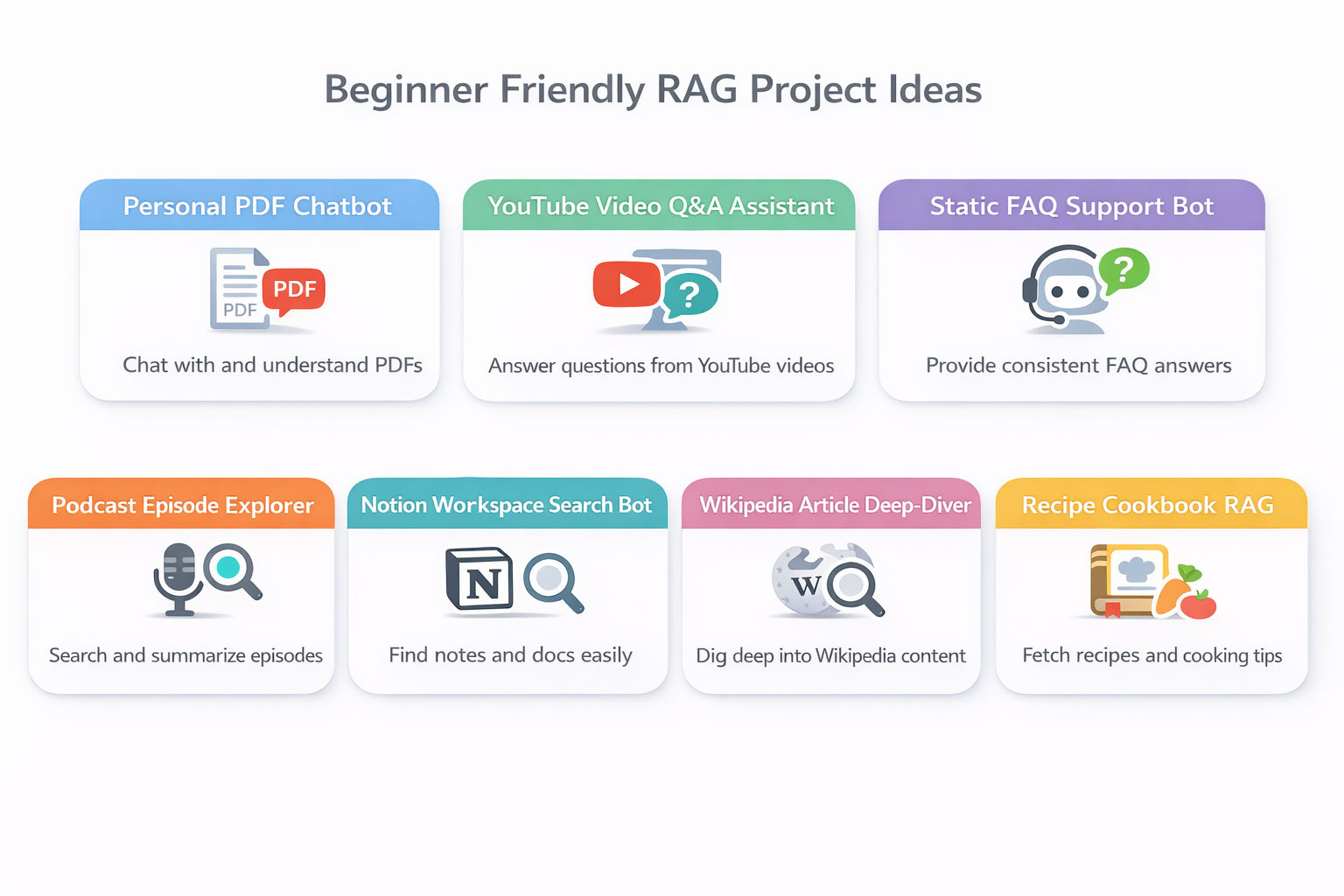
1. Personal PDF Chatbot

This project teaches the absolute basics of the RAG pipeline. You will build a local application where a user uploads a single PDF document, and the AI answers questions based strictly on the text found within that specific file.

Tools and Technologies Used

  • LangChain framework
  • ChromaDB (Local vector store)
  • OpenAI Embeddings and GPT-3.5

How to Make It

  • Build a simple web interface using Streamlit or Gradio that accepts a PDF file upload.
  • Use a document loader to extract the raw text from the PDF and a RecursiveCharacterTextSplitter to break the text into 1000-character chunks with a 200-character overlap.
  • Pass these text chunks through an embedding model and store the resulting vectors in an in-memory ChromaDB instance.
  • Accept a user's question, embed it, perform a similarity search against the database, and pass the top three retrieved chunks to the LLM to generate the final answer.

Also Read: Top 20+ Generative AI Project Ideas in 2026

2. YouTube Video Q&A Assistant

This project introduces handling unstructured multimedia data. You will build a tool that accepts a YouTube URL, downloads the auto-generated transcript, and allows the user to ask specific questions about the video's content.

Tools and Technologies Used

How to Make It

  • Create an input field where the user can paste a standard YouTube video link.
  • Write a backend script to fetch the video's timestamped transcript, stripping away the timestamps to leave a clean block of spoken text.
  • Chunk the transcript and vectorize it using an open-source embedding model, storing it in a lightweight FAISS index.
  • When the user asks a question, retrieve the relevant transcript sections and instruct the LLM to answer the question using only the retrieved dialogue.

3. Static FAQ Support Bot

This project focuses on handling structured, tabular data. You will build a customer support chatbot that reads from a static CSV file containing hundreds of frequently asked questions and their official answers.

Tools and Technologies Used

  • Pandas (for CSV parsing)
  • Pinecone (Cloud vector database)
  • Anthropic Claude API

How to Make It

  • Prepare a clean CSV file with two columns: "Question" and "Answer" covering generic business policies.
  • Iterate through the CSV rows, combining the question and answer into a single text string before embedding it into Pinecone.
  • Build a chat interface where users can type their support queries.
  • Query the vector database for the most semantically similar FAQ pair and pass it to Claude to format a polite, conversational response for the user.

Also Read: 15 Best Full Stack Coding Project Ideas & Topics For Beginners 

4. Podcast Episode Explorer

This project helps you manage massive blocks of conversational text. You will build an application that ingests the transcripts of a long-form podcast, allowing users to search for specific themes or quotes mentioned during the episode.

Tools and Technologies Used

  • OpenAI Whisper API (for transcription)
  • LlamaIndex (for data ingestion)
  • React frontend

How to Make It

  • Upload an audio file of a podcast to the Whisper API to generate a highly accurate text transcript.
  • Use LlamaIndex to process the document, specifically tuning the chunk size to account for conversational pauses and speaker changes.
  • Store the vectorized chunks locally and build a frontend search bar.
  • Retrieve the relevant chunks based on the user's query and instruct the LLM to summarize what the podcast hosts concluded about that specific topic.

5. Notion Workspace Search Bot

This project introduces integrations with popular productivity tools. You will build a script that exports a user's Notion workspace and makes it completely searchable via a conversational AI interface.

Tools and Technologies Used

  • Notion API
  • LangChain Document Loaders
  • Supabase (for vector storage)

How to Make It

  • Authenticate with the Notion API to programmatically pull down all pages within a specific workspace as Markdown text.
  • Clean the Markdown files to remove unnecessary formatting artifacts before chunking the text.
  • Push the embedded chunks to a Supabase PostgreSQL instance utilizing the pgvector extension.
  • Build a chat UI where users can ask questions about company policies or project notes, retrieving the answers directly from their synced Notion data.

Also Read: Top 30 Django Project Ideas for Beginners and Professionals 

6. Wikipedia Article Deep-Diver

This project focuses on automated web scraping and instant knowledge retrieval. You will build a tool that fetches a Wikipedia article based on a user's topic, vectorizes it instantly, and allows for rapid Q&A.

Tools and Technologies Used

  • Wikipedia API Python wrapper
  • Cohere Embeddings
  • Next.js

How to Make It

  • Build a frontend input field asking the user for a specific historical event or scientific concept.
  • Use the Wikipedia API to fetch the raw text of the requested article on the backend.
  • Chunk the article, embed it using Cohere, and temporarily store the vectors in a local array.
  • Allow the user to ask deep-dive questions, utilizing the temporary vector store to provide highly accurate, hallucination-free answers based on the article.

7. Recipe Cookbook RAG

This project requires handling lists and structured instructions. You will build an AI chef that searches through a massive dataset of recipes to answer specific culinary questions or suggest ingredient substitutions based on the text.

Tools and Technologies Used

  • Open-source recipe dataset (JSON or CSV)
  • Qdrant (Vector database)
  • Google Gemini API

How to Make It

  • Parse a large JSON file containing thousands of recipes, extracting the title, ingredients list, and cooking instructions.
  • Embed each recipe as a distinct chunk and store them in Qdrant.
  • Build an interface where users can ask complex questions like "How do I substitute eggs in a cake recipe?"
  • Retrieve the most relevant baking recipes and instruct the Gemini API to formulate a specific, actionable answer based on the retrieved cooking techniques.

Also Read: Top 21+ Next.js Project Ideas in 2026

Popular Agentic AI Programs

Intermediate Level RAG Project Ideas

These projects require a deeper understanding of metadata filtering, tracking source citations, and managing multiple documents simultaneously. They represent robust AI applications capable of handling complex business logic.

1. Multi-Document Research Assistant

This project tackles the complexity of managing and querying across dozens of distinct files. You will build an application where analysts can upload a batch of PDFs and receive answers that explicitly cite which document the information came from.

Tools and Technologies Used

  • LlamaIndex
  • ChromaDB
  • PyPDF2

How to Make It

  • Implement a multi-file upload system that ingests several PDFs into a single vector database.
  • Ensure that during the chunking phase, you attach strict metadata to every single chunk, explicitly recording the source file name and the page number.
  • When the user asks a query, retrieve the top chunks and pass them to the LLM with a strict prompt demanding that every claim be followed by an inline citation.
  • Parse the LLM's output on the frontend to render the citations as clickable links that reveal the exact source text and page number.

Also Read: Top 45+ Nodejs Project Ideas for Beginners and Professionals 

2. E-commerce Product Recommender

This project introduces hybrid querying using both vectors and metadata filters. You will build a retail chatbot that understands semantic queries while strictly respecting filters like price ranges or brand names.

Tools and Technologies Used

  • Pinecone (with metadata filtering enabled)
  • OpenAI API
  • Express.js backend

How to Make It

  • Ingest an e-commerce product catalog, embedding the product descriptions while storing attributes like price, category, and in_stock strictly as metadata.
  • Build a chat interface featuring traditional UI dropdowns for budget and category alongside a natural language text input.
  • When a user searches for "durable hiking boots for winter," execute a vector similarity search but apply a strict Pinecone metadata filter (e.g., price < 150 AND category == 'shoes').
  • Pass the pre-filtered, highly relevant products to the LLM to format a friendly recommendation response for the shopper.

3. GitHub Repository Code Chatter

This project requires specialized text splitting for programming languages. You will build a tool that ingests an entire software codebase, allowing developers to ask architectural questions or find specific functions instantly.

Tools and Technologies Used

  • LangChain Language text splitters
  • Weaviate (Vector database)
  • Anthropic Claude API (excellent at coding tasks)

How to Make It

  • Clone a target GitHub repository locally and iterate through the directory structure to read all source code files.
  • Use LangChain's specialized code splitters (e.g., for Python or JavaScript) which respect function and class boundaries rather than blindly splitting text by character counts.
  • Store the vectorized code chunks in Weaviate along with metadata detailing the exact file path.
  • Build an interface where developers can ask "Where is the authentication logic handled?" and have the LLM retrieve the exact files and explain the code structure.

Also Read: Top 36+ Python Projects for Beginners in 2026

4. Legal Contract Analyzer

This project deals with dense, highly structured text requiring absolute precision. You will build a tool for legal teams to upload contracts and instantly extract specific clauses regarding liabilities or termination terms.

Tools and Technologies Used

  • OpenAI GPT-4
  • LlamaIndex (SentenceWindowNodeParser)
  • PostgreSQL

How to Make It

  • Upload massive legal contracts and utilize a sentence window parser. This technique embeds a single sentence for highly accurate search, but retrieves the surrounding sentences during generation to provide the LLM with full context.
  • Build a dashboard featuring quick-action buttons for common legal queries (e.g., "Summarize the termination clause" or "Identify any indemnity liabilities").
  • Retrieve the highly specific legal chunks based on the query and prompt the LLM to extract the exact terms, outputting them in a clean, bulleted list.
  • Store the analyzed contracts and their extracted metadata in a relational DBMS for long-term record keeping.

5. Medical Paper Assistant

This project requires utilizing domain-specific embedding models rather than generic ones. You will build a research tool that queries hundreds of PubMed abstracts using embeddings explicitly trained on biomedical data.

Tools and Technologies Used

  • BioBERT (via Hugging Face)
  • Milvus (Vector database)
  • Streamlit

How to Make It

  • Download a dataset of open-source medical abstracts and research papers.
  • Utilize BioBERT, a model fine-tuned on biomedical literature, to generate the mathematical embeddings, ensuring complex medical terminology is accurately mapped in the vector space.
  • Store the high-dimensional vectors in Milvus, a database built for massive-scale similarity search.
  • Build an interface for medical students to query complex symptoms or drug interactions, forcing the LLM to synthesize an answer based exclusively on the retrieved peer-reviewed papers.

Also Read: 35+ Android Projects with Source Code You MUST Try in 2026 (Beginner to Final-Year) 

6. Discord Community Support Bot

This project involves continuous data ingestion and interacting with a live platform API. You will build a Discord bot that listens to server conversations, vectorizes the history, and automatically answers repeated community questions.

Tools and Technologies Used

  • Discord.js
  • Supabase (pgvector)
  • Cron jobs for continuous syncing

How to Make It

  • Register a bot application in the Discord Developer Portal and invite it to your server with message-reading permissions.
  • Write a script that routinely scrapes the last 24 hours of messages from the "help" channels, chunking and embedding the resolved Q&A threads into Supabase.
  • Implement an event listener so that when a user tags the bot with a new question, it intercepts the message.
  • Perform a similarity search against the historic Discord messages, retrieving past solutions and using the LLM to provide an immediate answer directly in the chat channel.

7. Financial Earnings Call Analyzer

This project requires the extraction of specific numerical data from long-form transcripts. You will build a dashboard where investors can chat with the latest quarterly earnings reports of public companies.

Tools and Technologies Used

  • SEC EDGAR database (or similar financial API)
  • LangChain
  • ChromaDB

How to Make It

  • Fetch the massive, unstructured text transcripts of quarterly earnings calls for major companies.
  • Chunk the data, ensuring you attach metadata indicating the specific company ticker, quarter, and year.
  • Build a query interface allowing users to ask questions like "What were the major risks mentioned regarding supply chain issues?"
  • Retrieve the exact paragraphs where executives discussed the topic and pass them to the LLM to generate a summarized financial insight report.

Also Read: 30 Best Cyber Security Projects Ideas in 2026 

Advanced Level RAG Project Ideas

These projects push the boundaries of current AI architecture. They involve complex routing, self-correction, multi-modal ingestion, and knowledge graphs, representing the absolute bleeding edge of enterprise Generative AI.

1. GraphRAG Enterprise Knowledge Engine

This project moves beyond standard vector similarity by utilizing Knowledge Graphs to understand complex, multi-hop relationships between entities. You will build an engine that maps an entire company's internal wiki.

Tools and Technologies Used

  • Neo4j (Graph DBMS)
  • LlamaIndex (Knowledge Graph abstractions)
  • OpenAI GPT-4

How to Make It

  • Ingest the enterprise documentation and prompt an LLM to extract core entities (people, projects, departments) and define their explicit relationships.
  • Store these entities as nodes and their relationships as edges within Neo4j.
  • Accept a complex user query (e.g., "Which engineers in the London office have worked on Project X?") and use the LLM to translate this natural language into a precise Cypher graph query.
  • Traverse the graph database to fetch the highly specific interconnected data, returning a factual answer that a standard vector search would completely fail to synthesize.

Also Read: 15+ Web Development Projects 

2. Hybrid Search Internal Wiki Bot

This project combines the exact keyword matching of traditional search with the semantic understanding of vector search to achieve massive accuracy improvements. You will build an ultimate search tool for company documentation.

Tools and Technologies Used

  • Elasticsearch (for BM25 keyword search)
  • Pinecone (for dense vector search)
  • Cohere Rerank API

How to Make It

  • Ingest all company documents, storing the raw text in Elasticsearch and the vector embeddings in Pinecone.
  • When a query is received, execute two simultaneous searches: one keyword-based search in Elasticsearch (great for exact product names) and one semantic search in Pinecone (great for conceptual questions).
  • Combine the retrieved chunks from both databases, creating a pool of potentially relevant context.
  • Pass this entire pool of chunks to the Cohere Rerank model, which mathematically re-scores and re-orders the chunks based on their absolute relevance to the query, passing only the top three to the LLM for generation.

3. Agentic RAG with Web Search Fallback

This project introduces autonomous decision-making to the pipeline. You will build an intelligent agent that attempts to answer a question using local vector data, but autonomously decides to search the live internet if the local data is insufficient.

Tools and Technologies Used

  • LangChain Agents
  • Tavily Search API
  • Local Vector Database

How to Make It

  • Set up a standard RAG pipeline connected to a local vector store containing your specific documents.
  • Define a LangChain Agent equipped with two specific tools: QueryLocalDatabase and QueryWebSearch.
  • Provide the agent with a strict system prompt explaining how to route tasks. When a user asks a question, the agent first executes the local database tool.
  • Program the agent to evaluate the retrieved local chunks. If the chunks do not contain the answer, the agent must autonomously trigger the Tavily Search API to fetch the missing information from the live internet before generating its final response.

Also Read: GitHub Project on Python: 30 Python Projects You’d Enjoy 

4. Multimodal RAG for Architecture Blueprints

This project handles non-text data, a massive leap in RAG complexity. You will build an application that ingests PDFs containing both text and complex images (like charts or blueprints) and allows the user to query both simultaneously.

Tools and Technologies Used

  • OpenAI GPT-4o (Vision)
  • CLIP Embeddings
  • Multi-vector retriever architecture

How to Make It

  • Parse a complex PDF document, utilizing libraries to explicitly separate the raw text blocks from the embedded images.
  • Pass the extracted images to a vision model to generate highly detailed text summaries of what the image depicts (e.g., "A blueprint showing a two-story floor plan").
  • Embed both the original text chunks and the newly generated image summaries into the vector database, linking the image summary vectors to the raw image files via metadata.
  • When a user queries the system, retrieve the relevant text chunks and the relevant raw images, passing both the text and the image files into a multimodal LLM to generate a comprehensive answer.

5. Self-Reflective RAG (CRAG) System

This project tackles the issue of poor retrieval quality ruining LLM outputs. You will build a Corrective RAG (CRAG) system that grades its own retrieved documents and rewrites the user's query if the search results are poor.

Tools and Technologies Used

  • LangGraph (for cyclic workflows)
  • OpenAI API
  • Advanced prompt engineering

How to Make It

  • Build a standard retrieval pipeline, but instead of passing the retrieved chunks directly to the generator, pass them to a "Grader" LLM node first.
  • Instruct the Grader to evaluate whether the retrieved chunks actually contain the answer to the user's query (outputting a binary yes/no).
  • Use LangGraph to build conditional logic: if the Grader says "yes", proceed to generation. If the Grader says "no", route the workflow to a "Query Rewriter" node.
  • Have the Query Rewriter mathematically alter the user's original search terms and re-execute the vector database search to find better documents before finally answering the user.

Also Read: Top 20 Real-Time React Projects and Ideas for Beginners in 2026

6. Real-Time Streaming News RAG

This project manages a constantly shifting, high-velocity database. You will build an intelligence dashboard that ingests live global news feeds, vectorizes them on the fly, and allows executives to ask questions about events that happened minutes ago.

Tools and Technologies Used

  • RSS Feed parsers
  • Apache Kafka (for streaming data ingestion)
  • SingleStore or fast updating vector database

How to Make It

  • Set up a backend service that continuously polls dozens of major news RSS feeds, pulling in raw text articles the moment they are published.
  • Push the raw text through Kafka into a real-time embedding pipeline, storing the vectors and their publication timestamps in a high-speed database.
  • Build a frontend dashboard where users can query breaking news.
  • Implement aggressive metadata filtering to ensure the vector search heavily prioritizes articles published within the last 24 hours, guaranteeing the LLM's response is based strictly on breaking developments.

7. SQL + RAG Financial Dashboard

This project merges structured tabular querying with unstructured text retrieval. You will build an ultimate financial tool where a user can ask a natural language question, and the system executes an exact mathematical query alongside a semantic text search.

Tools and Technologies Used

  • PostgreSQL DBMS
  • LangChain SQLDatabaseChain
  • Pinecone

How to Make It

  • Store hard financial numbers (revenue, expenses, user counts) in a strict relational PostgreSQL database.
  • Store the unstructured management commentary (PDF reports, executive memos) in Pinecone.
  • Build a routing agent that receives the user's query. Instruct the agent to write and execute a strictly capitalized SQL query against the DBMS to get the exact numerical data.
  • Simultaneously, have the agent execute a semantic search against Pinecone to get the context behind the numbers. Feed both the exact SQL output and the retrieved text chunks to the final LLM to generate a cohesive, mathematically perfect summary.

Also Read: 40 Must-Try JavaScript Project Ideas for Developers of All Levels

Micro-SaaS RAG Project Ideas

Micro-SaaS projects are highly focused, niche software applications built to solve one specific problem exceptionally well. By wrapping a RAG pipeline in a subscription model, you can create powerful, automated B2B businesses with minimal overhead.
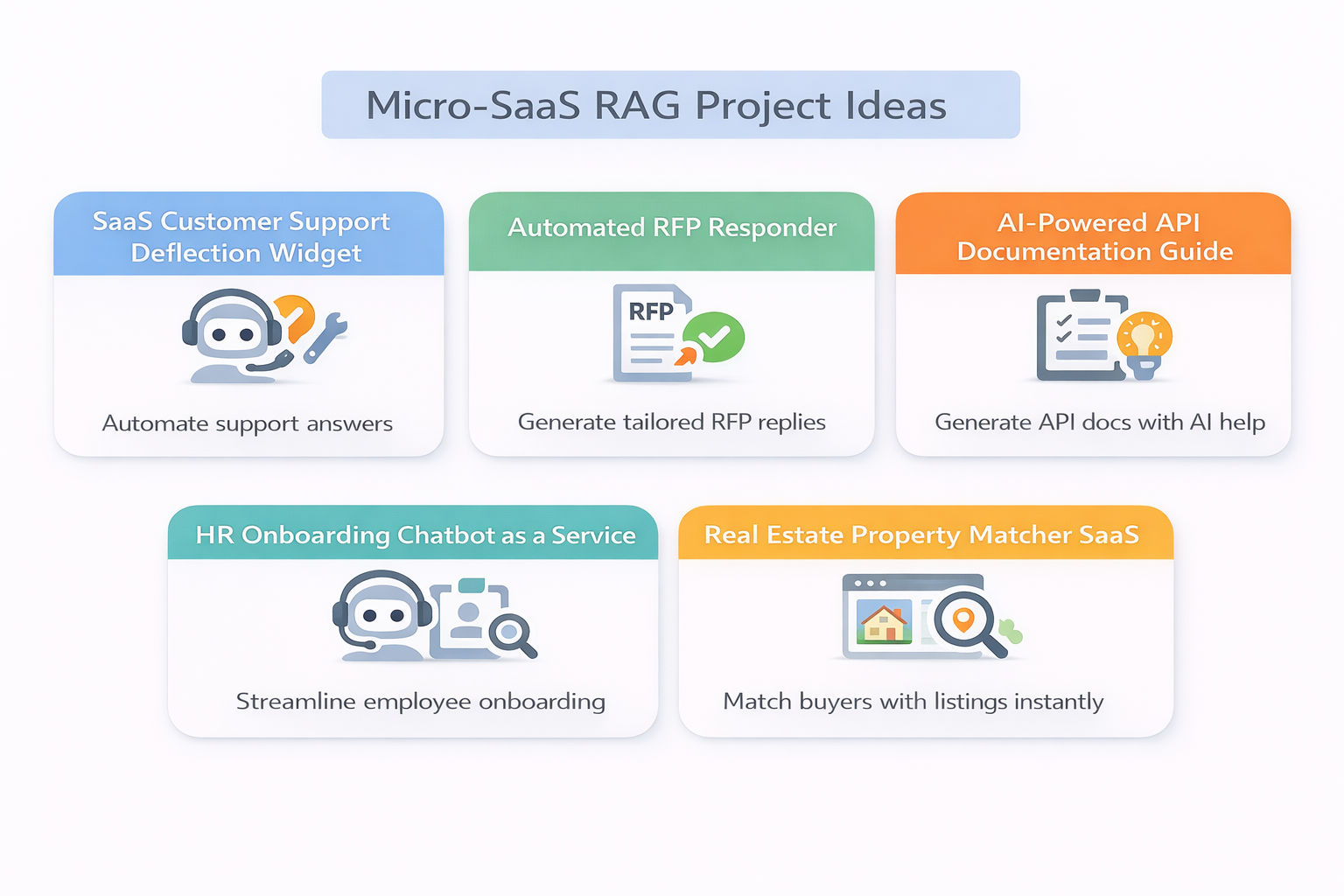
1. SaaS Customer Support Deflection Widget

This project focuses on reducing support ticket volume for other businesses. You will build a platform where a company uploads their specific product manuals, and you generate an embeddable AI chat widget for their website.

Tools and Technologies Used

  • Vanilla JavaScript (for the embeddable widget)
  • Supabase
  • Stripe

How to Make It

  • Build a multi-tenant backend architecture ensuring strict data isolation between different client companies.
  • Provide an admin dashboard where clients upload their PDFs or scrape their existing Zendesk help center URLs to build their specific vector index.
  • Generate a unique JavaScript snippet for the client to paste into their website's <body> tag, rendering a floating chat icon.
  • Charge clients a monthly subscription fee based on the total number of AI messages generated by their website visitors.

Also Read: Top 25+ SaaS Project Ideas in 2026

2. Automated RFP Responder

This project automates a notoriously tedious B2B sales process. You will build a tool for sales teams to upload their historic Request for Proposal (RFP) answers, using RAG to instantly draft answers for new, incoming RFP questionnaires.

Tools and Technologies Used

  • Document parsers (DOCX and PDF)
  • Qdrant
  • OpenAI GPT-4

How to Make It

  • Build a secure workspace where a sales team uploads all of their previously won proposals and technical security documents.
  • Vectorize these documents meticulously, focusing on chunking by specific questions and answers.
  • Create an interface where a user can upload a new, blank RFP spreadsheet.
  • Iterate through the blank questions, performing a vector search against the historic data for each row, generating a highly accurate, company-approved draft response that the sales rep simply has to review.

3. AI-Powered API Documentation Guide

This project targets developer experience (DX). You will build a SaaS that ingests a complex software company's technical documentation and provides an interactive, coding-focused chatbot for their developers.

Tools and Technologies Used

  • Web crawling tools (Cheerio)
  • Weaviate
  • Vercel

How to Make It

  • Build an ingestion pipeline that takes a root URL (e.g., docs.stripe.com) and crawls all subpages, specifically parsing out code blocks and endpoint descriptions.
  • Vectorize the documentation and store it in Weaviate.
  • Build a frontend chat interface optimized for displaying formatted code snippets and JSON payloads.
  • Sell this as a white-labeled service to tech companies looking to dramatically improve their developer onboarding without building their own AI infrastructure.

Also Read: 50 Java Projects With Source Code for Beginners 

4. HR Onboarding Chatbot as a Service

This project focuses on internal company operations. You will build a platform for HR departments to upload massive employee handbooks and benefits guides, giving new hires an AI assistant to answer their specific HR questions privately.

Tools and Technologies Used

  • LlamaIndex
  • Pinecone
  • Next.js App Router

How to Make It

  • Build an admin panel where HR managers can drag-and-drop massive PDF policy documents, instantly updating the company's vector database.
  • Implement a secure login portal for employees to access the chatbot, ensuring the queries are kept private and secure.
  • Configure the system prompt to explicitly refuse to answer non-HR related questions or provide personal legal advice.
  • Market the SaaS to mid-sized companies looking to automate the repetitive questions new hires ask during their first week.

5. Real Estate Property Matcher SaaS

This project applies RAG to complex, unstructured inventory. You will build a tool for high-end real estate brokerages to instantly match a client's highly specific, conversational request with the perfect property listing.

Tools and Technologies Used

  • OpenAI Embeddings
  • PostgreSQL with pgvector
  • React frontend

How to Make It

  • Connect to a brokerage's inventory feed, embedding massive paragraphs of unstructured property descriptions, neighborhood vibes, and architectural details.
  • Build a simple search interface where agents can type complex client requests like "A quiet, modern home with a large kitchen suitable for an amateur chef and lots of natural light."
  • Execute a semantic search to bypass rigid MLS filters, retrieving properties whose unstructured descriptions perfectly match the lifestyle requirements of the query.
  • Display the top matches to the agent, providing a one-click button to generate a customized pitch email to the client based on the retrieved data.

Conclusion

RAG project Ideas help you build AI systems that go beyond basic generation by using real, updated data. Start with simple use cases like document search, then move to advanced systems with multi-source retrieval and real-time data.

Focus on accuracy, speed, and relevance. The more you work with real data and structured pipelines, the stronger your RAG applications and practical AI skills will become.

"Want personalized guidance on AI and upskilling opportunities? Connect with upGrad’s experts for a free 1:1 counselling session today!"  

Similar Reads: 

Frequently Asked Question (FAQs)

1. What are some RAG project ideas for beginners to start with?

You can begin with simple apps like a PDF question-answering tool or a FAQ chatbot. These RAG project ideas help you understand how retrieval and generation work together. Start small and focus on clean data flow before moving to more complex systems.

2. Which projects are suitable for final year students?

Final year students can build projects like research paper assistants, internal knowledge bots, or document search systems. These projects show practical skills in handling data, APIs, and AI workflows, making them strong additions to academic submissions.

3. Where can you find working code examples for building RAG apps?

You can explore platforms like GitHub and open-source communities for complete implementations. Many repositories include step-by-step setups, making it easier to understand how retrieval pipelines and AI models are connected in real applications.

4. What are some real-world applications of RAG systems?

RAG systems are used in customer support bots, enterprise search tools, legal assistants, and financial analysis platforms. These applications rely on real-time data and accurate retrieval to provide reliable and context-aware responses.

5. How do RAG Project Ideas help in learning modern AI systems?

RAG Project Ideas help you understand how AI interacts with external data sources. You learn embeddings, vector databases, and prompt design. This hands-on approach makes it easier to build applications that are accurate and useful in real scenarios.

6. Are these projects suitable for students with basic coding knowledge?

Yes, students with basic Python knowledge can start with simple projects. Many tools provide easy integration, so you can focus on understanding concepts like retrieval and generation without dealing with complex system setup at the start.

7. What tools are commonly used in building RAG-based applications?

Common tools include LangChain for workflows, vector databases like Pinecone or FAISS, and APIs for language models. These tools help manage data retrieval and response generation efficiently in AI applications.

8. What are some advanced RAG Project Ideas for real-world use cases?

Advanced RAG Project Ideas include multi-source retrieval systems, GraphRAG for relationship mapping, and agent-based research tools. These projects involve handling large datasets, improving accuracy, and building scalable systems used in real environments.

9. How long does it take to complete a RAG-based project?

Simple projects can take a few days, while intermediate ones may take a few weeks. Advanced systems with multiple data sources and real-time processing can take longer depending on your experience and the complexity of features.

10. How can RAG Project Ideas improve your portfolio and job chances?

RAG Project Ideas help you build applications that use real data and solve practical problems. Recruiters value these projects because they show your ability to work with modern AI systems and handle real-world scenarios effectively.

11. What mistakes should you avoid while building RAG applications?

Avoid using poor-quality data or skipping preprocessing steps. Do not rely only on generation without proper retrieval. Focus on improving accuracy, testing outputs, and keeping your system simple before adding advanced features.

Rahul Singh

11 articles published

Rahul Singh is an Associate Content Writer at upGrad, with a strong interest in Data Science, Machine Learning, and Artificial Intelligence. He combines technical development skills with data-driven s...

Speak with AI & ML expert

+91

By submitting, I accept the T&C and
Privacy Policy
