Top 25+ SaaS Project Ideas in 2026

By Rahul Singh

Updated on Apr 16, 2026 | 10 min read | 5.95K+ views

Share:

In 2026, profitable SaaS project ideas focus on AI agents, niche automation, and security-first products. Instead of broad tools, you build focused solutions that solve one clear problem for a specific audience.

High-growth ideas include AI negotiators for sales teams, niche recruitment platforms, and self-hosted tools. Micro-SaaS products around sustainability reporting, remote team well-being, and automated content repurposing are also gaining strong demand.

In this guide, you will find beginner to advanced SaaS project ideas along with Micro- SaaS Projects to help you build practical, production-ready applications.

Build in-demand AI skills with upGrad’s Artificial Intelligence Courses. Learn machine learning, prompt engineering, and real-world tools through hands-on projects.  

Beginner Friendly SaaS Project Ideas

These projects introduce you to the core fundamentals of SaaS, such as basic authentication, simple database operations, and handling monthly subscriptions. They are perfect for developers looking to launch their first revenue-generating web application.
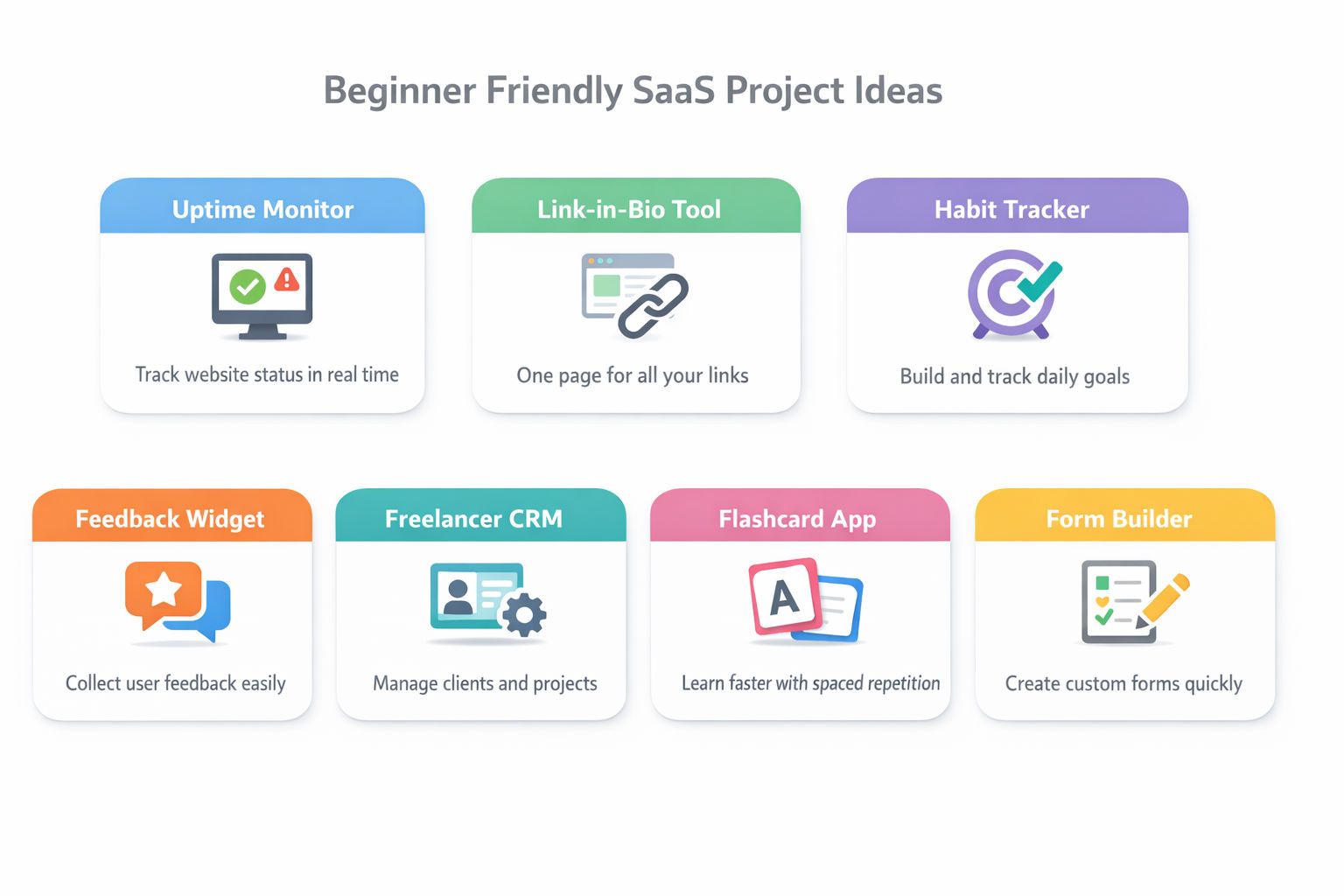
1. Uptime & Website Monitoring Tool

This project teaches you how to handle background tasks and automated email notifications. You will build a service where users can input their website URLs, and the application will ping those servers at regular intervals, notifying the user immediately if their site goes offline.

Tools and Technologies Used

  • Node.js with Node-Cron: To schedule and execute the automated server pings.
  • Axios or Fetch: To execute HTTP requests to the user-provided URLs.
  • SendGrid or Resend API: To securely deliver downtime alert emails to the user.

How to Make It

  • Build a simple dashboard where authenticated users can add, edit, or delete URLs they want to monitor.
  • Create a backend cron job that runs every 5 minutes, iterating through the database of URLs and sending a GET request to each.
  • Write error-handling logic so that if a URL returns a 404 or 500 status code (or times out), the system logs the downtime event in the database.
  • Trigger an automated email alert to the account owner using your email API, and display the historical uptime percentage on their frontend dashboard.

Also Read: Top 30 Final Year Project Ideas for CSE Students in 2026

2. Social Media Link-in-Bio Builder

This project focuses on generating dynamic, publicly shareable user pages (similar to Linktree). You will build a platform where influencers or creators can create a single landing page to house all their social media and product links, gated behind a premium subscription for custom styling.

Tools and Technologies Used

  • Next.js or React: For fast, SEO-friendly public profile pages.
  • Tailwind CSS: To allow users to select different pre-built color themes.
  • Stripe Payment Links: To handle the upgrade to a premium tier.

How to Make It

  • Create an onboarding flow where users claim a unique username, which becomes their public URL slug (e.g., myapp.com/username).
  • Build a settings dashboard allowing users to input multiple URLs, rearrange them using basic drag-and-drop, and select a visual theme.
  • Implement a dynamic routing system on the frontend that queries the database for the username parameter and renders the customized link list.
  • Gate advanced features, like custom background images or analytics on link clicks, behind a monthly Stripe subscription check.

3. Personal Habit & Goal Tracker SaaS

This project introduces data visualization and daily user engagement. You will build an application where users can define daily habits, track their completion over time, and view premium analytical charts showing their consistency.

Tools and Technologies Used

  • Vue.js or React: For a highly interactive, state-driven frontend.
  • PostgreSQL: To reliably store user accounts and daily habit logs.
  • Chart.js or Recharts: To render visual progress graphs.

How to Make It

  • Design a clean, calendar-based interface where users can easily check off their daily habits with a single click.
  • Define a relational database schema linking Users to Habits, and Habits to Logs (containing the date and a completion boolean).
  • Write backend logic to calculate "streaks" (consecutive days completed) and overall success percentages for the week or month.
  • Offer a free tier with a limit of 3 habits, and integrate a payment gateway allowing users to pay a small monthly fee for unlimited habits and advanced data export.

Also Read: Best Computer Science Project Ideas (2026) for CSE Students

4. Embeddable Customer Feedback Widget

This project teaches you how to create third-party scripts that run on other people's websites. You will build a SaaS tool that generates a small snippet of JavaScript; when clients paste this snippet into their site code, it renders a floating "Leave Feedback" button.

Tools and Technologies Used

  • Vanilla JavaScript: For the lightweight, embeddable widget script.
  • Express.js API: To safely receive the feedback data from external domains.
  • CORS Middleware: To securely manage cross-origin requests.

How to Make It

  • Build a dashboard where your SaaS user can customize the text, color, and position of their feedback widget, generating a unique API key for their account.
  • Write a vanilla JavaScript file hosted on your server that constructs the HTML/CSS for a floating button and a modal form when injected into a website.
  • Configure your backend to accept POST requests containing the feedback text and the user's unique API key, ensuring you configure CORS to allow requests from the client's registered domain.
  • Display the collected feedback messages in the user's SaaS dashboard, allowing them to mark messages as read or archive them.

5. Minimalist Freelancer CRM

This project tackles standard CRUD operations and relational data architecture. You will build a customer relationship manager tailored for solo freelancers, allowing them to track clients, active projects, and upcoming deadlines.

Tools and Technologies Used

  • Ruby on Rails or Django: For rapid, convention-over-configuration backend development.
  • Bootstrap or Tailwind: For a clean, professional dashboard layout.
  • JWT (JSON Web Tokens): For secure user session management.

How to Make It

  • Set up a database architecture with tables for Clients, Projects (linked to clients), and Tasks (linked to projects).
  • Build a kanban-style dashboard where freelancers can view their projects moving from "Lead" to "In Progress" to "Completed".
  • Implement search and filtering functionality so users can quickly find a specific client's contact information or project history.
  • Add a premium tier feature that allows users to export their monthly project data as a clean, formatted PDF for tax purposes.

Also Read: Top Real Time Project Ideas Every Tech Student Should Try

6. Digital Flashcard & Study Platform

This project focuses on state management and algorithms. You will build an educational SaaS where students can create custom flashcard decks, utilizing spaced repetition algorithms to optimize their studying, with premium features for collaborating with classmates.

Tools and Technologies Used

  • Next.js: For application structure and routing.
  • SuperMemo-2 (SM-2) Algorithm logic: To calculate when a card should be reviewed next.
  • MongoDB: To handle flexible, document-based storage of varying card data.

How to Make It

  • Create an interface where users can type a question on the front of a digital card and the answer on the back, organizing these cards into specific subject decks.
  • Implement a study mode utilizing CSS 3D transforms to physically "flip" the card when clicked.
  • Write backend logic based on spaced repetition: if a user marks a card as "Easy," schedule it to appear further in the future; if "Hard," show it again sooner.
  • Implement a shared database feature for premium subscribers, allowing them to publish their decks via a secret link so study groups can access the same material.

7. Custom Form & Survey Builder

This project challenges you to build a dynamic, user-generated UI. You will create a platform where non-technical users can drag and drop input fields to create custom surveys, collect responses, and view the data.

Tools and Technologies Used

  • React DnD or dnd-kit: To handle the complex drag-and-drop interface.
  • Firebase Firestore: To instantly store and sync the varied structure of custom form responses.
  • Tailwind CSS: For styling the generated forms.

How to Make It

  • Build a sandbox UI where users can drag elements like "Text Input," "Multiple Choice," and "Dropdown" into a central canvas to construct their form.
  • Save the form structure as a JSON object in your database, defining the field types, labels, and required status.
  • Create a dynamic rendering component that reads this JSON object and outputs a live, functional HTML form on a public, shareable URL.
  • Capture the submitted form data and display it in the creator's dashboard via a clean data table, offering CSV exports for paid users.

Also Read: Top Hackathon Project Ideas for Fast, Scalable Prototypes

Intermediate Level SaaS Project Ideas

These projects require a deeper understanding of web architecture, third-party API integrations, and robust database management. They represent fully functional B2B (Business to Business) tools that solve specific operational problems.

1. Automated Social Media Scheduler

This project introduces you to OAuth flows and rate-limiting. You will build a marketing tool allowing businesses to connect their Twitter, LinkedIn, and Facebook accounts, write posts in advance, and schedule them to publish automatically at specific times.

Tools and Technologies Used

  • OAuth 2.0: For secure authentication with external social media platforms.
  • BullMQ or Celery: For robust, Redis-backed background job queuing.
  • Official Social Media APIs: (X/Twitter API, LinkedIn API).

How to Make It

  • Implement strict OAuth flows allowing users to securely grant your application permission to post on their behalf without storing their raw passwords.
  • Build a calendar-based user interface where marketers can draft text, attach images, and select a future date and time for publication.
  • Save the scheduled post in your database and push a task to your background queue (like BullMQ) scheduled for the user's selected time.
  • When the queue triggers the task, use the stored OAuth access tokens to execute a POST request to the respective social media API, updating the post status to "Published" in your dashboard.

Also Read: Top 40 AI Project Ideas

2. Client Portal & File Approval System

This project handles secure file storage, permissions, and client-agency communication. You will build a white-labeled portal where creative agencies can upload design files, and their clients can log in to leave comments and approve the work.

Tools and Technologies Used

  • AWS S3 or Google Cloud Storage: For secure, scalable file hosting.
  • Next.js API Routes: To handle secure file upload streams.
  • Role-Based Access Control (RBAC): To separate Agency logic from Client logic.

How to Make It

  • Create an authentication system with two distinct roles: 'Admin' (the agency) and 'Viewer' (the client).
  • Build an upload interface that directly streams large assets (like PDFs or images) to an AWS S3 bucket, storing only the secure file URL in your database.
  • Design a workspace where clients can view the uploaded assets and utilize a threaded comment system to request revisions.
  • Implement an "Approve" button that digitally logs the client's timestamped sign-off, locking the file from further comments and notifying the agency via email.

3. Subscription Billing Management Portal

This project dives deep into financial APIs and webhook handling. You will build a dedicated portal where businesses can allow their customers to easily upgrade, downgrade, or cancel their subscriptions without contacting support.

Tools and Technologies Used

  • Stripe Billing & Webhooks: To handle the complex logic of proration and recurring charges.
  • React or Vue.js: For the frontend customer portal.
  • Express.js: To securely listen for and verify Stripe events.

How to Make It

  • Set up products and pricing tiers within your Stripe developer dashboard.
  • Build a frontend interface that displays the user's current active plan, their next billing date, and buttons to switch to higher or lower tiers.
  • Implement backend logic to utilize the Stripe API to safely update the user's subscription, ensuring you pass the correct proration parameters so customers are billed fairly for mid-month changes.
  • Set up a highly secure webhook endpoint on your server that listens for events like invoice.payment_failed, automatically emailing the customer to update their credit card and temporarily restricting their app access.

Also Read: 35+ Mini Project Ideas for CSE Students in 2026

4. Internal Knowledge Base & Wiki Builder

This project requires complex rich-text editing and hierarchical data structures. You will build a documentation platform (similar to a lightweight Notion) where companies can write, organize, and search their internal SOPs and employee handbooks.

Tools and Technologies Used

  • Quill.js or ProseMirror: For building a robust, block-based rich text editor.
  • PostgreSQL (Recursive Queries): To handle deeply nested folder/page structures.
  • Elasticsearch or Algolia: To provide instant, typo-tolerant search across all documents.

How to Make It

  • Design a flexible database schema where a Page can have a parent_id, allowing users to infinitely nest documents inside of other documents to create a folder tree.
  • Integrate a rich-text editor allowing users to format text, insert code blocks, and upload inline images.
  • Implement a sidebar navigation component that recursively renders the nested document tree, allowing users to expand and collapse sections natively.
  • Sync all saved text to a search engine like Algolia, building a global search bar that instantly highlights the requested keywords within the company's entire document repository.

5. Online Course Hosting & LMS SaaS

This project tackles video streaming security, progress tracking, and user access gating. You will build a platform where creators can upload video modules and sell access to their educational content.

Tools and Technologies Used

  • Mux or AWS MediaConvert: For professional video encoding and adaptive bitrate streaming.
  • Stripe Connect: To handle payouts to the creators while taking a platform fee.
  • Next.js: For SEO-friendly course landing pages.

How to Make It

  • Build an instructor dashboard where creators can define a course syllabus, create modules, and upload raw video files to your video processing provider.
  • Implement database logic that tracks a student's enrollment_status and records their progress (e.g., saving the timestamp of where they paused a video).
  • Restrict access to the actual video player page using backend middleware; if a user does not have a valid, paid enrollment record for that specific course ID, redirect them to a checkout page.
  • Build a dynamic progress bar that fills up as the student marks modules as "Complete," triggering a generated PDF certificate upon 100% completion.

Also Read: Top 25+ DBMS Project Ideas for Students in 2026 [With Source Code]

6. Email Newsletter & Broadcasting Platform

This project explores mass data processing and compliance with email delivery standards. You will build a SaaS allowing creators to collect email subscribers and send beautifully formatted HTML broadcasts.

Tools and Technologies Used

  • Amazon SES or Mailgun: For high-volume, reliable email sending.
  • MJML (Mailjet Markup Language): To build responsive HTML emails that look correct in all clients (Outlook, Gmail, Apple Mail).
  • Redis: For managing the broadcasting queue.

How to Make It

  • Create an embeddable subscribe form that creators can put on their blogs to capture user emails into a specific audience list.
  • Build an email composer utilizing MJML to ensure that the user's drag-and-drop design translates into robust, table-based HTML that won't break in legacy email clients.
  • Write a queueing system that, upon pressing "Send," batches the audience list into chunks of 50 and pushes them to your email provider via API, preventing your server from timing out on large lists.
  • Include mandatory compliance features, such as injecting a unique one-click unsubscribe link into the footer of every generated email and processing bounce webhooks.

7. Virtual Event & Webinar Ticketing

This project deals with real-time video integration and capacity management. You will build a platform where hosts can schedule live webinars, sell a limited number of tickets, and securely stream the event.

Tools and Technologies Used

  • WebRTC or Agora SDK: For low-latency live video broadcasting.
  • PostgreSQL: To handle transactional ticketing and inventory locks.
  • Socket.io: For a real-time attendee chat room.

How to Make It

  • Build an event creation wizard where hosts set a date, a ticket price, and a strict maximum capacity.
  • Implement a highly secure checkout flow; when a user attempts to buy a ticket, use database transactions to lock one unit of inventory to prevent double-booking before processing the payment.
  • Integrate a video broadcasting SDK allowing the host to share their camera and screen from the browser, while attendees view the stream securely.
  • Add a side panel featuring a live Socket.io chat room where attendees can ask questions in real-time without interrupting the video stream.

Also Read: Top 35 MERN Stack Project Ideas of 2026 [With Source Code]

Machine Learning Courses to upskill

Explore Machine Learning Courses for Career Progression

360° Career Support

Executive Diploma12 Months
background

Liverpool John Moores University

Master of Science in Machine Learning & AI

Double Credentials

Master's Degree18 Months

Advanced Level SaaS Project Ideas

These projects represent enterprise-grade software. They require sophisticated architectural planning, master-level state management, extreme security protocols, and highly optimized database querying to remain performant at scale.

1. Marketing Automation Workflow Engine

This project mimics the core functionality of Zapier. You will build a highly complex visual builder where users can define trigger events (like receiving an email) that automatically execute a series of actions (like adding a row to a database or sending a Slack message).

Tools and Technologies Used

  • React Flow: To build the interactive, node-based visual canvas.
  • Node.js (Event Emitters): To process the complex, asynchronous execution logic.
  • OAuth 2.0 & Webhooks: To ingest triggers from and push actions to external APIs.

How to Make It

  • Design a drag-and-drop canvas using React Flow where users can connect "Trigger" nodes to multiple "Action" nodes using visual bezier curves.
  • Save this visual graph as a complex JSON object in your database, strictly defining the sequence of operations and the data mapping between nodes (e.g., passing the email subject line into the Slack message text).
  • Build a robust webhook ingestion engine that catches payloads from external services, identifies which user's workflow should be triggered, and initiates the process.
  • Write an asynchronous execution engine that traverses the JSON graph step-by-step, making outbound API calls and logging successes or fatal errors at every single node.

Also Read: 40 Best BCA Final Year Project Topics & Mini Project Ideas

2. AI-Powered Customer Support Helpdesk

This project integrates advanced LLMs directly into high-pressure business operations. You will build a shared team inbox that aggregates customer emails, automatically categorizes them by urgency, and uses AI to draft highly accurate suggested replies based on the company's documentation.

Tools and Technologies Used

  • OpenAI API or Anthropic Claude: For text analysis and response generation.
  • LangChain & Pinecone (RAG): To ground the AI in the company's specific data.
  • PostgreSQL: For managing support tickets and team assignments.

How to Make It

  • Connect to an email provider (like SendGrid Inbound Parse) to ingest raw customer emails and convert them into internal "Tickets" within your database.
  • Implement a RAG (Retrieval-Augmented Generation) pipeline: when a company signs up, they upload their FAQ documents, which are vectorized and stored in Pinecone.
  • Upon a new ticket arriving, trigger the LLM to analyze the customer's intent, query Pinecone for the relevant company policy, and silently generate a draft response.
  • Present the ticket to the human support agent with the AI's draft pre-populated in the text editor, allowing the agent to simply review, edit, and click send, drastically reducing resolution time.

3. Cloud-based Point of Sale (POS) & Inventory System

This project handles critical financial data, multi-location synchronization, and complex mathematical calculations. You will build a web-based register system for retail stores that syncs inventory in real-time across multiple physical locations.

Tools and Technologies Used

  • React or Next.js: For a highly responsive, tablet-optimized frontend UI.
  • PostgreSQL (ACID compliance): Crucial for preventing inventory discrepancies during simultaneous sales.
  • Stripe Terminal API: To interface with physical credit card card readers.

How to Make It

  • Design an interface optimized for iPad touchscreens, featuring a fast product lookup grid, a barcode scanner input listener, and a live cart calculation.
  • Architect a deeply normalized database mapping Products, Variants (size/color), Locations, and InventoryLevels (a bridging table tracking exact stock per location).
  • Implement strict SQL transaction logic during the checkout phase: instantly deduct the purchased quantities from the specific store's inventory, applying correct localized tax rates before finalizing the receipt.
  • Build an admin dashboard that aggregates data from all store locations, alerting the manager when specific product variants fall below their reorder threshold.

Also Read: Top 28 Robotics Project Ideas for Students in 2026

4. Enterprise Project Management Suite (Gantt & Resource)

This project focuses on complex UI rendering, mathematically calculating dependencies, and strict access controls. You will build a heavy-duty management tool featuring interactive Gantt charts, workload balancing, and cross-team collaboration.

Tools and Technologies Used

  • DHTMLX Gantt or custom D3.js: For rendering complex, interactive timelines.
  • GraphQL: To efficiently query deeply nested project, task, and user data.
  • Redis: For caching massive enterprise queries.

How to Make It

  • Build an architecture supporting workspaces, portfolios, projects, and heavily detailed tasks (including dependencies, milestones, and estimated hours).
  • Integrate a professional Gantt chart library, mapping your backend task data to the timeline. Write logic so that if a user drags a parent task to a later date, all dependent child tasks are automatically rescheduled sequentially.
  • Create a resource management view that aggregates the estimated hours assigned to each employee across all active projects, visually highlighting employees who are over capacity (>40 hours/week).
  • Implement rigorous enterprise security, ensuring contractors can only view the specific tasks they are assigned to, while managers can view entire portfolio financials.

5. Multi-Tenant E-commerce Storefront Builder

This project involves dynamic subdomains, massive data isolation, and highly customizable UI generation. You will build a SaaS (similar to Shopify) where entrepreneurs can sign up, select a template, and instantly launch their own standalone e-commerce website.

Tools and Technologies Used

  • Next.js Middleware: For seamless dynamic routing and subdomain management.
  • Supabase (Row Level Security): To absolutely guarantee data isolation between different tenant stores.
  • AWS S3: For hosting thousands of user-uploaded product images.

How to Make It

  • Configure wildcard DNS records and use Next.js Middleware to inspect incoming requests, extracting the subdomain (e.g., mystore.yoursaas.com) to serve the correct database content.
  • Design a rigorous database schema using tenant_id foreign keys on every table (Products, Orders, Customers) combined with strict Row Level Security policies to prevent data leakage.
  • Build a visual theme editor where store owners can change primary colors, typography, and upload logos, saving these preferences as JSON to dynamically style their public storefront.
  • Implement a centralized checkout flow that processes payments via Stripe Connect, routing the funds directly to the specific store owner while deducting your platform's transaction fee.

Also Read: 50 IoT Projects for 2026 to Boost Your Skills (With Source Code)

6. Real-Time Collaborative Whiteboarding Tool

This project explores the cutting edge of modern web architecture, Operational Transformation and real-time canvas rendering. You will build an infinite canvas where remote teams can draw, add sticky notes, and diagram together simultaneously without lag.

Tools and Technologies Used

  • HTML5 Canvas / WebGL (via Fabric.js or PixiJS): For rendering thousands of interactive objects smoothly.
  • WebSockets / Yjs (CRDTs): To sync precise mouse movements and object states without conflicts.
  • Node.js: For the WebSocket signaling server.

How to Make It

  • Initialize an infinite panning and zooming canvas interface that captures precise X/Y mouse coordinates and click-and-drag events to draw shapes or lines.
  • Connect the application to a Yjs server (Conflict-free Replicated Data Type), which mathematically ensures that if two users edit the same sticky note at the exact same millisecond, the application seamlessly merges the changes without crashing or overwriting.
  • Broadcast live cursor positions via WebSockets, rendering colored pointers with user names on the canvas so everyone can see where their teammates are looking.
  • Implement a robust saving mechanism that periodically serializes the entire canvas state into a JSON blob or an SVG string, storing it in the database for later retrieval.

7. Automated Financial Forecasting & Analytics

This project tackles massive data ingestion, complex accounting mathematics, and high-level data visualization. You will build a SaaS for CFOs that connects to their accounting software, ingests their ledger, and predicts future cash flow runway.

Tools and Technologies Used

  • Xero API or QuickBooks API: To securely pull raw financial transaction data.
  • Python (Pandas & Scikit-learn): For running heavy predictive algorithms on the backend.
  • Tremor or Nivo: For building beautiful, dashboard-ready financial charts.

How to Make It

  • Build a secure OAuth integration flow allowing the SaaS to connect to the business's existing accounting software and securely clone their historical chart of accounts and transaction history.
  • Write a Python microservice that uses the Pandas library to clean the raw data, calculating standard SaaS metrics like MRR (Monthly Recurring Revenue), Churn Rate, and Customer Acquisition Cost automatically.
  • Apply basic machine learning models (like linear regression or ARIMA) to historical spending patterns to forecast future cash flow, visually mapping the exact month the company might run out of money based on current burn rates.
  • Render these complex insights on a highly secure, read-only dashboard utilizing interactive line and bar charts, allowing executives to toggle different hiring or spending scenarios to see how it affects their runway.

Micro-SaaS Project Ideas

Micro-SaaS refers to highly focused, niche software built usually by a solo developer or a tiny team. These projects solve one very specific problem incredibly well, rather than trying to be a massive, all-in-one platform. They are characterized by low overhead, specific target audiences, and highly automated operations.

1. Newsletter Referral Program Widget

This project provides a hyper-specific marketing tool for writers. You will build a plugin that integrates with popular platforms like Substack or Mailchimp, automatically generating unique referral links for readers and tracking their successful invites to unlock rewards.

Tools and Technologies Used

  • Next.js: For the core dashboard and API endpoints.
  • PostgreSQL: To track the relational data of Referrers and Referees.
  • Third-Party Email APIs: To verify subscriber status.

How to Make It

  • Build a dashboard where a newsletter author defines their reward milestones (e.g., "5 referrals = free sticker", "10 referrals = premium post").
  • Generate a unique tracking link for every subscriber on the author's list.
  • Create a lightweight, embeddable widget that the author places on their site; when a new reader signs up through a tracking link, log the event in your database and credit the original referrer.
  • Provide an automated email trigger system that notifies the author and the reader the moment a specific reward milestone is achieved.

2. Video Testimonial Capture Tool

This project focuses on streamlining a painful B2B process. You will build a white-labeled tool that allows companies to send a simple link to their happy customers, guiding them to easily record a video testimonial directly from their browser or smartphone without downloading any apps.

Tools and Technologies Used

  • MediaRecorder API: Native browser API for capturing audio and video securely.
  • AWS S3: For storing the heavy video blobs.
  • Tailwind CSS: For generating clean, company-branded recording pages.

How to Make It

  • Build an interface where a business owner inputs their logo, brand colors, and the specific question they want their customer to answer, generating a unique, public URL.
  • Develop the recording page utilizing the browser's MediaRecorder API, requesting camera permissions and providing a simple "Start/Stop Recording" UI.
  • Upload the finalized video blob directly to AWS S3, ensuring you process it to a standard MP4 format for universal playback.
  • Present the collected videos in the business owner's dashboard, providing them with an embed code so they can easily display the video on their own marketing site.

Also Read: Best 39+ MCA Final Year Project Topics for Students

3. Dynamic Open Graph Image Generator API

This project is a pure infrastructure utility for developers and marketers. You will build an API service that automatically generates beautiful, text-overlaid preview images (Open Graph images) for blog posts or products based solely on URL parameters.

Tools and Technologies Used

  • Puppeteer or Playwright: Headless browsers to render HTML to images.
  • Vercel Edge Functions: For lightning-fast, globally distributed execution.
  • Redis: For caching the generated images.

How to Make It

  • Create a Next.js API route that accepts query parameters such as ?title=Hello&author=John&theme=dark.
  • Write a function that takes these parameters and injects them into a highly styled HTML/CSS template (e.g., a dark background with large white typography and a logo).
  • Use a headless browser instance (like Puppeteer) in the background to render the HTML template, take a pixel-perfect screenshot, and output it as a JPEG buffer.
  • Implement a strict caching layer using Redis so that if the exact same URL parameters are requested twice, the image is served instantly from the cache rather than re-rendering the browser.

4. Browser Extension for AI Text Expansion

This project bridges local browser execution with cloud subscription models. You will build a Chrome extension that allows users to type short trigger words (like /intro) which instantly expand into long-form, AI-optimized paragraphs synced across all their devices.

Tools and Technologies Hall

  • Chrome Extensions API (Manifest V3): For background scripts and DOM manipulation.
  • Firebase: For real-time cloud syncing of user snippets.
  • OpenAI API: For an optional premium feature to auto-generate the snippets.

How to Make It

  • Build a popup dashboard within the extension where users can log in and define their personal "Shortcuts" and the corresponding "Expanded Text."
  • Write a content script that injects into every web page the user visits, constantly listening to keystroke events in text areas.
  • If the script detects a sequence of characters matching a defined shortcut, programmatically delete the trigger word and insert the expanded text string directly into the DOM.
  • Connect the extension to a Firebase backend so a user's snippets are securely stored in the cloud and instantly available whether they log into their work computer or personal laptop.

Also Read: Top 35+ DSA Projects With Source Code In 2026

5. AI-Powered Resume Tailoring Tool

This project caters specifically to job seekers applying to Applicant Tracking Systems (ATS). You will build a tool where a user uploads their master resume and a target job description, and the system generates a tailored version of the resume optimized for those specific keywords.

Tools and Technologies Used

  • Anthropic Claude API: Excellent at following strict formatting instructions.
  • React: For a side-by-side comparison UI.
  • jsPDF or react-pdf: To generate the final downloadable document.

How to Make It

  • Build a clean UI with upload zones for a base PDF resume and a text area for pasting the target job description.
  • Extract the text from the resume and construct a prompt instructing the LLM to rewrite bullet points to highlight skills matching the job description, explicitly commanding it not to invent fake experience.
  • Display the original resume and the AI-suggested changes side-by-side, allowing the user to accept, reject, or manually edit the modifications.
  • Utilize a PDF generation library to compile the approved, text-based layout back into a clean, ATS-friendly PDF file for download.

Conclusion

SaaS project ideas give you a clear path to build real, usable products. Start with simple apps to understand core features, then move to advanced systems with authentication, payments, and scalability.

Focus on solving one specific problem well. Build, test, and improve with each project. The more real-world use cases you handle, the stronger your skills and portfolio become.

"Want personalized guidance on AI and upskilling opportunities? Connect with upGrad’s experts for a free 1:1 counselling session today!"  

Similar Reads: 

Frequently Asked Question (FAQs)1. What are the best SaaS project ideas to build

1. What are the best SaaS project ideas to build in 2026?

SaaS project ideas in 2026 focus on niche solutions like AI tools, automation platforms, and productivity apps. Instead of building broad products, you should target specific problems such as workflow automation or content generation to create more useful and scalable applications.

2. How do you start building a SaaS product from scratch?

Start by identifying a real problem. Then define core features and build a simple version of your app. Focus on user authentication, database setup, and basic UI. Once the core works, you can add advanced features like payments and analytics.

3. Which tech stack is best for building SaaS applications?

Common stacks include React or Next.js for frontend, Node.js for backend, and databases like PostgreSQL or MongoDB. You can also use tools like Firebase for faster development. The choice depends on your project size and complexity.

4. Are SaaS projects good for portfolios and job roles?

Yes, SaaS projects are highly valued because they show real-world skills. Building a working product with users, authentication, and deployment proves that you can handle full application development, which is important for many tech roles.

5. How do SaaS project ideas help in learning full-stack development?

SaaS project ideas let you work on both frontend and backend together. You learn how to manage data, handle users, and build complete systems. This helps you understand how real applications function in production environments.

6. What are some beginner-friendly SaaS applications to build?

You can start with simple tools like a task manager, note-taking app, or subscription tracker. These projects help you learn CRUD operations, basic UI, and user handling without dealing with complex system design.

7. How long does it take to build a SaaS project?

Simple projects can take a few days, while intermediate ones may take a few weeks. Advanced SaaS applications with features like billing, scaling, and real-time updates can take months depending on your experience and goals.

8. What are some advanced SaaS project ideas for real-world use?

Advanced SaaS project ideas include AI platforms, multi-tenant systems, and automation tools. These projects involve complex architecture, user management, and scalability, helping you build production-level applications used by real users.

9. Do you need backend knowledge to build SaaS applications?

Yes, backend knowledge is important because SaaS apps handle data, users, and business logic. You need to understand APIs, databases, and authentication to build a complete and functional application.

10. How can SaaS project ideas improve your chances of getting a job?

SaaS project ideas help you build real products that show your skills. Recruiters look for candidates who can create and manage applications. A strong SaaS project demonstrates problem-solving, coding ability, and understanding of real systems.

11. What mistakes should you avoid while building SaaS apps?

Avoid building too many features at the start. Focus on a simple version first. Do not ignore testing or user feedback. Keep your code clean and structured to make future updates easier and more manageable.

Rahul Singh

11 articles published

Rahul Singh is an Associate Content Writer at upGrad, with a strong interest in Data Science, Machine Learning, and Artificial Intelligence. He combines technical development skills with data-driven s...

Speak with AI & ML expert

+91

By submitting, I accept the T&C and
Privacy Policy

India’s #1 Tech University

Executive Program in Generative AI for Leaders

76%

seats filled

View Program

Top Resources

Recommended Programs

LJMU

Liverpool John Moores University

Master of Science in Machine Learning & AI

Double Credentials

Master's Degree

18 Months

IIITB
bestseller

IIIT Bangalore

Executive Diploma in Machine Learning and AI

360° Career Support

Executive Diploma

12 Months

IIITB
new course

IIIT Bangalore

Executive Programme in Generative AI for Leaders

India’s #1 Tech University

Dual Certification

5 Months
