Top 20+ Flutter Project Ideas in 2026

By Rahul Singh

Updated on Apr 14, 2026 | 8 min read | 4.82K+ views

Share:

In 2026, Flutter project ideas are shifting toward AI-powered apps, hyper-local services, and immersive experiences like AR and VR. Developers are building smarter apps that adapt to user behavior instead of just displaying static content.

With improvements in the Impeller rendering engine and tighter integration with Firebase and AI tools, Flutter now supports faster performance and more advanced features, making it easier to build intelligent, real-world applications.

In this guide, you will find 20+ highly descriptive Flutter project ideas divided into beginner, intermediate, and advanced levels.

Build in-demand AI skills with upGrad’s Artificial Intelligence Courses. Learn machine learning, prompt engineering, and real-world tools through hands-on projects. 

Beginner Friendly Flutter Project Ideas

By using these flutter project ideas, you can build up your good understanding in basics completing in 2-3 hours, for intermediate and advanced level projects. If you are good at your basics you can skip these and jump to intermediate or advanced projects.
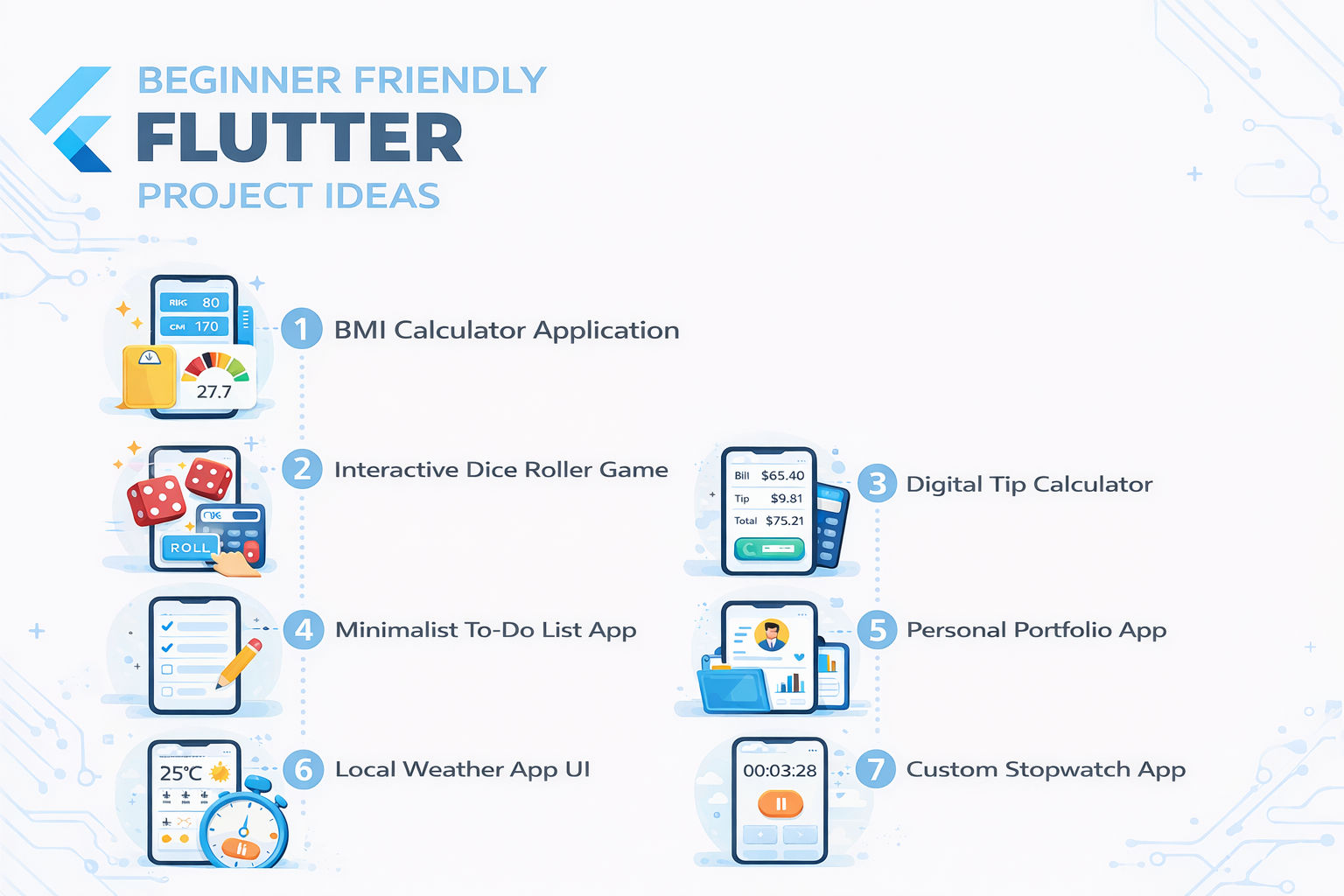
1. BMI Calculator Application

This project is an excellent starting point for understanding how Flutter manages user inputs and local component state. You will build an interactive health utility that calculates a user's Body Mass Index based on their height and weight, providing instant visual feedback regarding their health category.

Tools and Technologies Used

  • Flutter SDK (Core UI framework)
  • Dart (Mathematical logic and variable state)
  • Custom Google Fonts (For typography and visual hierarchy)

How to Make It

  • Create a visually appealing user interface utilizing Flutter's Slider widget for height and floating action buttons for weight increments.
  • Implement a stateful widget to instantly capture and update the height and weight variables as the user interacts with the sliders and buttons.
  • Write a Dart function that applies the standard BMI mathematical formula when a "Calculate" button is pressed.
  • Design a dynamic results screen that changes its background color and text output (e.g., green for "Normal", red for "Overweight") based on the final computed integer.

Also Read: Top 30 Final Year Project Ideas for CSE Students in 2026

2. Interactive Dice Roller Game

This project focuses on basic animation handling and random number generation within Dart. You will build a simple, engaging application where tapping the screen simulates rolling a pair of six-sided dice, accompanied by fluid UI changes.

Tools and Technologies Used

  • Dart math library (For randomizing outputs)
  • Flutter Image asset handling
  • StatefulWidget lifecycle methods

How to Make It

  • Import six high-quality PNG images representing the faces of a standard die and register them in your pubspec.yaml file.
  • Build a centered column layout that displays two die images side-by-side using the Expanded widget to ensure proper scaling on all devices.
  • Write a function utilizing Random().nextInt(6) + 1 to generate a random number upon a screen tap.
  • Use the setState() method to dynamically swap the displayed PNG assets to match the newly generated random integers.

3. Digital Tip Calculator

This project helps you master form validation, text controllers, and numerical parsing. You will create a restaurant utility app that takes a total bill amount, applies a custom tip percentage, and splits the final cost among a specified group of people.

Tools and Technologies Used

  • Flutter TextField and TextEditingController
  • Dart string-to-double parsing logic
  • Flutter Container and Decoration classes for styling

How to Make It

  • Construct an input form containing styled text fields restricted to numerical keyboards for entering the total bill and the number of people.
  • Create a row of selectable percentage buttons (e.g., 10%, 15%, 20%) that update a local state variable when tapped.
  • Implement defensive programming logic to ensure the app does not crash if a user leaves a field blank or enters invalid characters.
  • Display the final calculated tip amount and the exact split cost per person in large, easily readable typography at the bottom of the screen.

Also Read: Top Real Time Project Ideas Every Tech Student Should Try

4. Minimalist To-Do List App

This project introduces you to managing dynamic lists and persisting data across app restarts. You will build a daily task manager where users can type new chores, swipe to delete them, and check them off upon completion.

Tools and Technologies Used

  • Flutter ListView.builder (For rendering dynamic lists)
  • Shared Preferences plugin (For lightweight local data storage)
  • Flutter Dismissible widget (For swipe-to-delete functionality)

How to Make It

  • Design a clean interface featuring an AppBar, a dynamic list area, and a floating action button that opens a bottom sheet for text entry.
  • Utilize the ListView.builder widget to efficiently render task items onto the screen, ensuring the app remains fast even with dozens of tasks.
  • Wrap each list tile in a Dismissible widget to allow users to intuitively swipe tasks off the screen to permanently delete them.
  • Integrate the Shared Preferences package to encode your task array into a JSON string, saving it locally so tasks remain when the app is completely closed and reopened.

5. Personal Portfolio App

This project is essentially a digital resume that teaches you complex layout structures and external linking. You will build a professional mobile application that showcases your biography, technical skills, and links to your GitHub and LinkedIn profiles.

Tools and Technologies Used

  • Flutter SliverAppBar (For scrolling header effects)
  • url_launcher package (To open external web browsers)
  • Flutter GridView (To display skill icons)

How to Make It

  • Implement a CustomScrollView featuring a SliverAppBar that elegantly collapses a large header image into a standard navigation bar as the user scrolls down.
  • Organize your personal information using beautifully padded Card widgets equipped with subtle drop shadows to create depth.
  • Use a grid layout to display SVG or PNG icons of the programming languages and tools you are proficient in.
  • Import the url_launcher package and attach it to social media buttons, allowing hiring managers to tap an icon and instantly open your GitHub repository in their native browser.

Also Read: Top 40 AI Project Ideas

6. Local Weather App UI

This project introduces you to asynchronous programming and JSON parsing. You will build the frontend interface of a weather application, fetching live temperature and climate data from a public REST API.

Tools and Technologies Used

  • Flutter FutureBuilder (For handling loading states)
  • http package (For executing network requests)
  • OpenWeatherMap API (For real meteorological data)

How to Make It

  • Register for a free OpenWeatherMap API key and review their documentation regarding endpoint structures and JSON responses.
  • Write an asynchronous Dart function using the http package to execute a GET request and parse the incoming JSON payload into custom Dart objects.
  • Wrap your main UI in a FutureBuilder to automatically display a circular loading spinner while the network request is processing.
  • Render the fetched data onto the screen, matching specific weather conditions (like "Rain" or "Clear") with corresponding vector icons or background gradients.

7. Custom Stopwatch App

This project requires mastering Dart's timing functions and continuous UI repainting. You will build an athletic timer application featuring start, stop, lap, and reset functionalities with high-precision millisecond tracking.

Tools and Technologies Used

  • Dart Stopwatch and Timer classes
  • Flutter ListView (For lap recording)
  • Custom floating action buttons

How to Make It

  • Initialize a Dart Stopwatch object and a periodic Timer that triggers a setState refresh every few milliseconds.
  • Format the raw millisecond output into a highly readable MM:SS:ms string format using Dart string interpolation.
  • Implement an array to store "Lap" times, allowing the user to press a button while the timer is running to record a timestamp without stopping the main clock.
  • Display the array of recorded lap times in a scrollable list below the main clock interface.

Also Read: Top Hackathon Project Ideas for Fast, Scalable Prototypes

Intermediate Level Flutter Project Ideas

Intermediate Flutter project ideas help you move beyond basic apps and start building real-world features with backend integration.

You work with APIs, databases, authentication, and structured app architecture while creating more practical and scalable applications.

1. Personal Expense Tracker App

This project introduces data visualization and local relational databases. You will build an application where users log daily financial transactions, categorize them, and view their spending habits through interactive charts.

Tools and Technologies Used

  • SQLite and sqflite plugin (For robust local data storage)
  • fl_chart package (For drawing pie and bar charts)
  • Flutter DatePicker dialogs

How to Make It

  • Configure a local SQLite database complete with raw SQL queries to create tables, insert transactions, and fetch grouped data.
  • Build a floating action button that opens an intuitive modal sheet containing text inputs, category dropdowns, and a native date picker for logging expenses.
  • Write a complex SQL query to sum expenses grouped by specific categories (e.g., Groceries, Rent) over a selected seven-day period.
  • Feed the queried data into the fl_chart library to render an interactive, colorful bar chart at the top of the screen that dynamically updates when new transactions are added.

2. E-commerce Product Catalog UI

This project tackles complex routing, hero animations, and complex state passing between screens. You will build a highly polished storefront interface featuring product grids, detailed item pages, and a persistent shopping cart.

Tools and Technologies Used

  • Provider or Riverpod (For state management)
  • Flutter Hero widget (For seamless image transitions)
  • Custom complex layouts using Stack and Positioned

How to Make It

  • Design a homepage utilizing a custom sliver app bar alongside a horizontal scrolling carousel for featured products and a vertical grid for standard inventory.
  • Implement Hero animations on the product thumbnail images, so when a user taps a shoe or shirt, the image smoothly expands and flies into its position on the detail screen.
  • Set up Provider to manage a global cart state, allowing users to add items from the detail page and instantly see the cart badge counter update in the main navigation bar.
  • Build an interactive cart screen that calculates total prices dynamically and allows users to swipe items away to remove them.

Also Read: 35+ Mini Project Ideas for CSE Students in 2026

3. Audio/Music Player App

This project requires handling continuous background processes and processing media files. You will build a fully functional music player capable of playing local MP3 files, displaying album art, and controlling volume.

Tools and Technologies Used

  • audioplayers package (For audio stream control)
  • on_audio_query package (To fetch local device media)
  • Flutter Slider (For track seeking)

How to Make It

  • Request explicit storage permissions from the user to scan their device directories for valid audio files.
  • Build a media library screen that lists all discovered tracks, utilizing metadata extraction to display track names, artist details, and embedded album art.
  • Implement the audio player logic to handle play, pause, next track, and previous track functionalities flawlessly.
  • Sync a custom visual slider component with the audio stream's current position, allowing the user to scrub forward or backward through the song in real-time.

4. Interactive Quiz Game

This project tests your ability to engineer complex state machines, manage timers, and calculate final results based on sequential inputs. You will build a highly interactive trivia application complete with countdown timers and scoring logic.

Tools and Technologies Used

  • Provider (For application state and scoring)
  • Open Trivia Database API (For fetching questions)
  • Flutter AnimationController (For visual timers)

How to Make It

  • Fetch a batch of remote questions via an API, storing them securely in the application state and randomizing the order of the multiple-choice answers.
  • Build a custom linear progress indicator synced to an AnimationController that visually drains over a 15-second period for each question.
  • Implement strict logic that automatically navigates to the next question if the timer expires, or accurately registers a user's tap as correct or incorrect.
  • Design a final results page that calculates the overall percentage, displays custom congratulatory or encouraging messages, and provides a button to restart the state machine.

Also Read: Top 25+ DBMS Project Ideas for Students in 2026 [With Source Code]

5. Habit Tracking & Consistency App

This project introduces complex calendar interfaces and daily streak logic. You will build an application where users can define daily goals (like drinking water or reading) and track their consistency on a visual calendar matrix.

Tools and Technologies Used

  • table_calendar package
  • Hive (For high-speed, lightweight NoSQL local storage)
  • Custom painting and progress indicators

How to Make It

  • Set up a fast, local NoSQL Hive box to store custom habit objects containing unique IDs, titles, and arrays of completed dates.
  • Integrate the table_calendar widget, customizing the UI builder to highlight specific days green if all selected habits were completed on that date.
  • Build an algorithm to calculate the user's current consecutive "streak" of completed days, updating the UI dynamically to motivate the user.
  • Design a daily checklist view that allows users to swiftly tap checkboxes to mark their daily routines as finished.

6. Cryptocurrency Live Tracker

This project focuses on handling high-frequency data updates, complex mathematical formatting, and REST API polling. You will build a financial dashboard tracking live market prices of various cryptocurrencies.

Tools and Technologies Used

  • CoinGecko REST API
  • intl package (For complex currency formatting)
  • http package (For frequent data polling)

How to Make It

  • Set up a secure network service class that pings the CoinGecko API to retrieve the top 50 cryptocurrencies by market cap alongside their 24-hour price changes.
  • Utilize the intl package to strictly format massive numerical values into readable currency strings with correct comma placements and decimal limits.
  • Build a comprehensive list view where each item displays the coin logo, current price, and a percentage change indicator colored green for positive or red for negative trends.
  • Implement a pull-to-refresh mechanism using RefreshIndicator so users can manually force an API call to get the most up-to-the-second pricing data.

Also Read: Top 35 MERN Stack Project Ideas of 2026 [With Source Code]

7. Recipe & Cookbook Application

This project provides excellent practice for managing search parameters, handling deeply nested JSON data, and utilizing dynamic routing. You will build a culinary platform where users can discover, search, and save detailed recipes.

Tools and Technologies Used

  • Spoonacular API (For comprehensive food data)
  • SQFlite (For saving favorite recipes locally)
  • Cached Network Image package (For aggressive image optimization)

How to Make It

  • Construct a visually engaging homepage centered around a prominent search bar and horizontal scroll categories for cuisines like Italian, Mexican, or Vegan.
  • Write a robust API integration that parses deeply nested JSON responses to extract arrays of ingredients, HTML-formatted instructions, and high-resolution thumbnail URLs.
  • Utilize the cached_network_image package to ensure heavy food photography is downloaded once and saved to the device cache, drastically improving load times on subsequent views.
  • Implement a "Favorite" button on the recipe detail page that executes an SQL INSERT command, saving the recipe ID to a local database for offline viewing.

Recommended Courses to upskill

Explore Our Popular Courses for Career Progression

360° Career Support

Executive Diploma12 Months
background

O.P.Jindal Global University

MBA from O.P.Jindal Global University

Live Case Studies and Projects

Master's Degree12 Months

Advanced Level Flutter Project Ideas

Advanced Flutter project ideas push you to build full-scale apps with complex features and real-world use cases.

You focus on performance, scalability, real-time systems, and building production-ready mobile applications.

1. Full-Stack Delivery App (UberEats Clone)

This project simulates a complete, enterprise-grade on-demand logistics business. You will build an application featuring distinct user roles, live GPS tracking, and secure payment processing for ordering food from local restaurants.

Tools and Technologies Used

  • Google Maps API & geolocator package
  • Firebase Cloud Functions & Firestore
  • Stripe Payment Gateway SDK

How to Make It

  • Design three separate application flows within the same codebase: one for the hungry Customer, one for the Restaurant owner managing the menu, and one for the Delivery Driver.
  • Integrate the Google Maps SDK to display live, moving markers representing the driver's current location relative to the customer's delivery address, calculating ETA based on live traffic data.
  • Set up Firebase Cloud Functions to securely orchestrate server-side logic, such as calculating final totals with tax and dispatching push notifications when an order status changes to "Out for Delivery."
  • Integrate Stripe to securely tokenize credit card information and process live transactions without ever routing sensitive financial data through your own database.

Also Read: Top 28 Robotics Project Ideas for Students in 2026

2. Complete Social Media Platform (Instagram Clone)

This project tackles the immense complexity of handling heavy media uploads, complex relational data feeds, and real-time social interactions. You will build a platform where users can post photos, follow others, and leave comments.

Tools and Technologies Used

  • Firebase Auth, Firestore, and Firebase Storage
  • image_picker and image_cropper packages
  • Provider or BLoC (For deep state management)

How to Make It

  • Implement a robust authentication system including email verification, profile picture uploading to Firebase Storage, and username uniqueness validation.
  • Build an image creation flow that allows users to open their device camera, snap a photo, crop it to a specific aspect ratio, apply a basic color filter, and attach a text caption.
  • Engineer a complex "Feed" algorithm utilizing Firestore queries to aggregate and chronologically sort posts exclusively from the specific accounts the current user is actively following.
  • Implement instant, optimistic UI updates for interactions like "Liking" a post, instantly turning the heart icon red on the frontend while silently updating the database integer in the background.

3. Multi-Vendor E-commerce Marketplace

This project pushes database architecture to the limit by managing inventory from multiple independent sellers. You will build an enterprise shopping platform with complex admin dashboards, order tracking, and sophisticated product filtering.

Tools and Technologies Used

  • Flutter App Architecture (Clean Architecture or MVC)
  • Supabase (Open-source PostgreSQL backend)
  • Algolia (For lightning-fast, typo-tolerant search)

How to Make It

  • Design a rigorous relational database schema in Supabase utilizing SQL that strictly links Buyers, Sellers, distinct Shops, Products, and unified Orders.
  • Integrate Algolia to handle massive product catalogs, allowing users to type search queries and instantly receive highly relevant, filtered results even if they misspell brand names.
  • Build a specialized Vendor Dashboard where sellers can view their graphical sales analytics, update inventory counts, and mark specific orders as shipped.
  • Implement a secure, multi-step checkout wizard that seamlessly handles shipping address validation, applies discount promo codes, and calculates varied shipping rates based on location.

Also Read: Best 39+ MCA Final Year Project Topics for Students

4. Real-Time Video Calling Application

This project dives into the complexities of WebRTC and peer-to-peer data streaming. You will build a communication platform capable of high-fidelity audio and video transmission between two users across the globe.

Tools and Technologies Used

  • Agora RTC SDK or direct WebRTC implementation
  • Firebase Cloud Messaging (For incoming call alerts)
  • Native device permission handling

How to Make It

  • Register for an Agora developer account to handle the complex backend signaling servers required to connect two distinct IP addresses.
  • Request and manage strict native permissions for both the device microphone and the front-facing camera on iOS and Android.
  • Build an incoming call screen that utilizes Firebase Cloud Messaging to wake the recipient's phone and trigger a ringing animation even when the app is totally closed.
  • Implement the live video room interface featuring full-screen remote video rendering, a picture-in-picture local preview, and functional buttons to mute audio or disable the camera feed.

5. Smart Home IoT Controller

This project requires interacting with external hardware devices over local networks or Bluetooth. You will build a centralized dashboard application to control smart lights, thermostats, and security cameras.

Tools and Technologies Used

  • flutter_blue_plus (For Bluetooth Low Energy communication)
  • MQTT client package (For lightweight IoT messaging)
  • Custom, highly animated knob and slider widgets

How to Make It

  • Implement a Bluetooth scanning interface that aggressively searches for compatible BLE devices in the immediate vicinity and displays their signal strength.
  • Establish a secure, persistent connection to a target device (like an Arduino or Raspberry Pi) and discover its available read/write characteristics.
  • Design a visually stunning, futuristic dashboard featuring custom-painted rotary knobs that users can physically drag in a circle to adjust the brightness of a connected smart bulb.
  • Write a robust communication layer that rapidly sends byte arrays over the MQTT protocol to toggle relays, switch thermostat modes, or lock smart doors instantaneously.

Also Read: 50 IoT Projects for 2026 to Boost Your Skills (With Source Code)

6. AI-Powered Virtual Assistant

This project introduces you to integrating cutting-edge Large Language Models and device speech recognition. You will build a voice-activated assistant capable of answering complex questions, summarizing text, and generating ideas.

Tools and Technologies Used

  • OpenAI API (GPT-4) or Google Gemini API
  • speech_to_text package
  • flutter_tts (Text-to-Speech)

How to Make It

  • Integrate the native speech-to-text plugin to constantly listen for a specific wake word or activate immediately upon pressing a large microphone button, converting the user's spoken words into a raw text string.
  • Send the transcribed string securely to the OpenAI backend API along with a custom system prompt instructing the AI on how it should behave and format its responses.
  • Render the AI's response in a chat-like interface, utilizing packages capable of parsing Markdown so that code snippets or bold text are formatted correctly.
  • Pipe the final text response into the flutter_tts engine so the device physically speaks the answer back to the user in a natural-sounding digital voice.

7. Interactive Fitness & Wearable Sync App

This project explores bridging mobile applications with external health APIs and complex mathematical aggregations. You will build a comprehensive fitness tracker that syncs step counts directly from the user's smartwatch or native health OS.

Tools and Technologies Used

  • health package (To interface with Apple HealthKit and Google Fit)
  • Advanced charting libraries
  • Background fetch services

How to Make It

  • Configure the rigorous entitlement profiles and permission dialogs required by Apple and Google to legally access a user's deeply sensitive physiological data.
  • Write background tasks that silently aggregate the user's daily step counts, active calories burned, and resting heart rate data even while the phone is sitting in their pocket.
  • Design an energetic, highly motivating dashboard utilizing massive typography and circular progress rings (similar to the Apple Watch interface) to display daily goal completions.
  • Build a workout tracking mode that utilizes the device GPS to draw a live polyline on a map representing the exact route the user took during a run or cycling session.

Also Read: Top 35+ DSA Projects With Source Code In 2026

Conclusion

Most developers don’t struggle with Flutter; they struggle with finishing real apps. The ones who grow faster don’t just build UI screens; they ship complete products that handle data, performance, and user flow smoothly. That’s what stands out. If your Flutter projects solve real problems and work end to end, you move ahead.

"Want personalized guidance on AI and upskilling opportunities? Connect with upGrad’s experts for a free 1:1 counselling session today!

Similar Reads:

Frequently Asked Question (FAQs)

1. What are the best Flutter project ideas for beginners in 2026?

Flutter project ideas for beginners include apps like a to-do list, weather app, and notes manager. These help you understand UI, navigation, and basic logic. Start small and focus on completing projects to build confidence and strong fundamentals.

2. Where can you find real app examples to learn Flutter faster?

You can explore GitHub repositories that provide full Flutter apps with clean structure and working features. These examples help you understand real development patterns, UI design, and backend integration, making it easier to build your own apps.

3. Which projects should you build to improve your mobile development skills?

Focus on apps that include real-world features like login systems, APIs, and data storage. Projects like expense trackers, chat apps, and e-commerce apps help you gain practical experience and improve your understanding of mobile app development.

4. Are Flutter apps good enough for professional portfolios?

Yes, Flutter apps are widely accepted in portfolios. If your app solves a real problem and includes features like authentication and API integration, it shows practical skills. A well-built app can help you stand out during job applications.

5. How do Flutter project ideas help in learning real-world development?

Flutter project ideas allow you to work on complete apps from UI to backend. You learn how to handle data, manage state, and build features that users interact with. This hands-on approach improves your understanding of real app development.

6. What tools should you use while building mobile apps?

You should use Flutter and Dart for development, along with Firebase for backend services. Tools like Hive or SQLite help with local storage. These tools make it easier to build, test, and manage mobile applications efficiently.

7. How long does it take to complete mobile app projects?

Simple apps can take a few days, while intermediate apps may take a couple of weeks. Advanced apps with real-time features and backend systems can take a month or more, depending on your experience and the features you include.

8. What are some advanced Flutter project ideas to build in 2026?

Advanced Flutter project ideas include apps like food delivery platforms, social media apps, and AI-powered assistants. These projects involve real-time updates, backend integration, and scalable architecture, helping you build production-level applications.

9. Do you need backend knowledge to build mobile apps?

Basic backend knowledge is helpful but not required at the start. You can begin with frontend-focused apps and later add backend features like authentication and databases as you gain more experience.

10. How can Flutter project ideas improve your chances of getting a job?

Flutter project ideas help you build a strong portfolio with real apps. Recruiters look for practical experience, and projects show your ability to solve problems, design apps, and work with real tools used in the industry.

11. What mistakes should you avoid while building mobile apps?

Avoid starting with complex ideas too early. Do not skip planning or testing. Focus on clean UI, proper structure, and completing projects instead of leaving them unfinished. Consistent practice leads to better results over time.

Rahul Singh

6 articles published

Rahul Singh is an Associate Content Writer at upGrad, with a strong interest in Data Science, Machine Learning, and Artificial Intelligence. He combines technical development skills with data-driven s...

Get Free Consultation

+91

By submitting, I accept the T&C and
Privacy Policy

Top Resources

Recommended Programs

upGrad

upGrad

Management Essentials

Case Based Learning

Certification

3 Months

IIMK
bestseller

Certification

6 Months

OPJ Logo
new course

Master's Degree

12 Months
