Top 20+ LLM Project Ideas in 2026

By Rahul Singh

Updated on Apr 20, 2026 | 11 min read | 5.63K+ views

Share:

High-impact LLM project ideas focus on building practical applications that solve real problems using large language models. You can create RAG-based document chatbots, automated content generators for blogs or scripts, sentiment analysis tools, and personalized AI learning assistants.

To build these LLM project ideas, you can use tools like LangChain, LlamaIndex, vector databases such as ChromaDB, and models from Hugging Face. These projects help you gain hands-on experience with Retrieval Augmented Generation, API integration, and real-world AI workflows.

In this guide, you will explore beginner to advanced LLM project ideas, tools to use, and practical ways to build useful AI applications. 

Ready to build practical skills in modern AI and work with technologies like LLMs? Explore Generative AI & Agentic AI Courses to gain hands-on learning and industry-ready expertise. 

Agentic AI Courses to upskill

Explore Agentic AI Courses for Career Progression

Certification Building AI Agent

360° Career Support

Executive Diploma12 Months

Beginner Friendly LLM Project Ideas

These projects introduce you to the core fundamentals of working with LLMs, including basic API integrations, zero-shot and few-shot prompt engineering, and managing structured outputs. They are perfect for developers writing their first AI-powered applications.
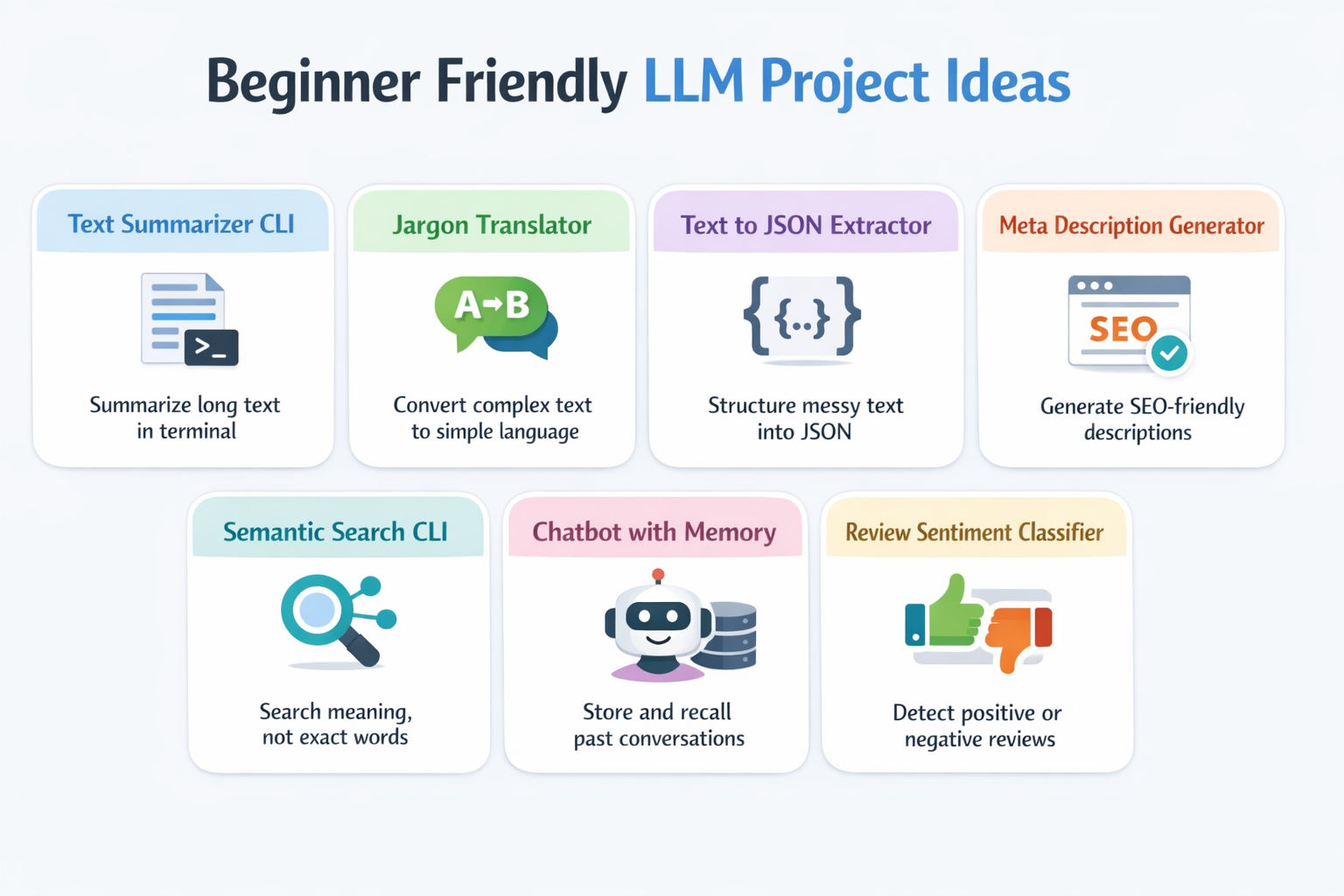
1. Terminal-Based Text Summarizer

This project teaches you the absolute basics of interacting with an LLM API and handling standard input/output. You will build a Python command-line interface (CLI) tool where a user can pass a large text file, and the LLM returns a concise, formatted summary.

Tools and Technologies Used

  • Python argparse: For building the command-line interface.
  • OpenAI API or Google Gemini API: For text generation and summarization.
  • dotenv: To securely load and manage your private API keys.

How to Make It

  • Set up a Python script that uses argparse to accept a file path as an execution argument (e.g., python summarize.py document.txt).
  • Use Python's built-in file handling to read the contents of the target text file into a string variable.
  • Construct a system prompt instructing the LLM to act as an expert editor, summarizing the provided text into exactly three bullet points.
  • Send the prompt and the file content to the LLM API, wait for the response, and print the generated summary cleanly to the terminal.

Also Read: Top 10 Agentic AI Project ideas 

2. Jargon to Plain English Translator

This project focuses on tone modification and context switching. You will build a web application that takes overly complex corporate, legal, or medical jargon and translates it into simple language that a fifth-grader could understand.

Tools and Technologies Used

  • Streamlit: For rapidly deploying a Python-based web UI.
  • Anthropic Claude API: Known for excellent nuance and tone control.
  • Prompt Engineering (Few-Shot): To provide examples of desired outputs.

How to Make It

  • Build a Streamlit interface featuring a large text area for input and a read-only text box for the output.
  • Design a "few-shot" prompt by explicitly providing the LLM with 2-3 examples of complex jargon alongside their simplified translations, teaching the model exactly how you want it to behave.
  • Add a slider to the UI allowing the user to select the "Simplicity Level" (e.g., High Schooler, Middle Schooler, Kindergartner) and pass this variable dynamically into the prompt.
  • Make the API call and render the simplified text, ensuring you handle API loading states so the user knows the model is "thinking."

3. Unstructured Text to JSON Extractor

This project teaches you how to force LLMs to output strictly formatted data for programmatic use. You will build a utility that takes a messy block of text (like a raw email) and extracts specific entities into a clean JSON object.

Tools and Technologies Used

  • OpenAI API (JSON Mode): To guarantee valid JSON formatting.
  • Pydantic (Python): For data validation and schema definition.
  • FastAPI: To wrap the utility in a callable web endpoint.

How to Make It

  • Define a strict Pydantic model outlining the data you want to extract (e.g., a CustomerOrder model requiring customer_name, product_id, and quantity).
  • Write a prompt instructing the LLM to read a messy email string and extract the information, explicitly commanding it to output only a JSON object matching your Pydantic schema.
  • Enable response_format={ "type": "json_object" } in your API call to prevent the model from generating conversational filler text like "Here is your JSON:".
  • Parse the returned string through your Pydantic model to guarantee the data types are correct before saving it or printing it.

Also Read: Top 25+ RAG Project Ideas in 2026

4. SEO Meta Description Generator

This project introduces batch processing and marketing automation. You will build a tool that takes a list of blog post titles and keywords, generating highly optimized, click-worthy SEO meta descriptions under 160 characters.

Tools and Technologies Used

  • Next.js: For building a fast, modern frontend.
  • Google Gemini API: For high-speed text generation.
  • Tailwind CSS: For styling the dashboard.

How to Make It

  • Build a UI where content marketers can input a blog post title, primary keyword, and target audience.
  • Construct a prompt that enforces strict constraints: the LLM must naturally include the primary keyword, use an active voice, and absolutely not exceed 160 characters.
  • Implement a character counter function on the frontend that automatically checks the LLM's output length, visually highlighting the text in red if the model accidentally hallucinated a longer response.
  • Add a "Copy to Clipboard" button next to the generated text for easy export.

Also Read: Top 21+ Next.js Project Ideas in 2026

5. Simple Semantic Search CLI

This project is an introduction to vector embeddings, the foundation of advanced LLM retrieval. You will build a script that converts a list of sentences into numbers, allowing you to search for concepts by meaning rather than exact keyword matches.

Tools and Technologies Used

How to Make It

  • Create an array of 20-30 distinct sentences (e.g., facts about space, animals, and technology).
  • Iterate through the array, passing each sentence to the Embeddings API to generate a high-dimensional mathematical vector (typically 1536 dimensions), and store these vectors in a local FAISS index.
  • Prompt the user via the terminal to enter a search query (e.g., "Tell me about dogs").
  • Embed the user's search query using the exact same model, then use FAISS to perform a cosine similarity search against your index, printing out the sentence mathematically closest in meaning to the user's query.

6. LLM-Powered Chatbot with Local Memory

This project tackles the stateless nature of LLM APIs. You will build a conversational chatbot that can remember your name and what you talked about three messages ago, without relying on complex external databases.

Tools and Technologies Used

  • LangChain: For memory abstraction.
  • Python Dictionaries: For local, session-based storage.
  • OpenAI GPT-3.5: For fast conversational responses.

How to Make It

  • Initialize a LangChain ConversationBufferMemory object in your script.
  • Set up an LLM Chain that seamlessly combines your system prompt, the stored memory buffer, and the user's new input into a single API request.
  • Create a while loop for continuous chatting. When the user types a message, pass it through the chain; LangChain will automatically append the response to the memory buffer.
  • Test the memory by telling the bot your name, asking an unrelated question, and then asking "What is my name?" to ensure the context window is functioning correctly.

Also Read: 15+ Web Development Projects 

7. E-commerce Review Sentiment Classifier

This project demonstrates how LLMs can be used for classification rather than generation. You will build an analytics script that reads hundreds of customer reviews and strictly categorizes them as Positive, Neutral, or Negative.

Tools and Technologies Used

  • Hugging Face Inference API: Utilizing a smaller, open-source model optimized for classification.
  • Pandas: To read and write CSV files.
  • Python: For the iteration logic.

How to Make It

  • Download a sample CSV dataset of raw e-commerce product reviews.
  • Use Pandas to load the CSV into a DataFrame. Write a function that iterates over the "Review Text" column.
  • Construct a prompt forcing the LLM to output exactly one word: "POSITIVE", "NEUTRAL", or "NEGATIVE" based on the text. Set the temperature to 0.0 to eliminate creative variance.
  • Append the model's output to a new column in your DataFrame and export the final dataset to a new CSV file for analysis.

Popular Agentic AI Programs

Intermediate Level LLM Project Ideas

These projects require orchestrating multiple tools, handling complex system prompts, integrating third-party APIs, and securely managing context windows. They solve real-world problems by combining LLMs with traditional software engineering.

1. NL-to-SQL (Natural Language to SQL) Generator

This project breaks down the barrier between non-technical users and relational databases. You will build an interface where a user asks a business question in plain English, and the LLM writes the exact SQL query to fetch the data.

Tools and Technologies Used

  • LangChain SQL Agent: For database introspection.
  • PostgreSQL: As the target database.
  • OpenAI GPT-4: Essential for complex coding and logic tasks.

How to Make It

  • Set up a local PostgreSQL database populated with mock business data (e.g., Users, Orders, and Products tables).
  • Connect LangChain to your database utilizing the SQLDatabaseToolkit. This tool autonomously inspects your database, reading the schema, table names, and column data types, feeding this context into the LLM.
  • When a user asks, "Which 5 customers spent the most money last month?", the LLM analyzes the schema, writes the correct JOIN and ORDER BY statements, and outputs the raw SQL string.
  • Execute the generated SQL securely (in read-only mode) and display the resulting data table to the user on the frontend.

2. Audio Meeting to Action Items Pipeline

This project involves chaining different AI models together. You will build a backend pipeline that takes an audio recording of a meeting, transcribes it, and uses an LLM to extract the core decisions and assigned action items.

Tools and Technologies Used

  • Whisper API: For state-of-the-art Speech-to-Text transcription.
  • Anthropic Claude API: Excels at handling large context windows.
  • Express.js: For the backend server processing.

How to Make It

  • Build an Express endpoint that accepts a .mp3 or .wav file upload using a library like Multer.
  • Send the audio buffer to the Whisper API, receiving a massive block of raw, unformatted transcribed text.
  • Pass this entire transcript to Claude, utilizing a prompt that demands a specific markdown format: "Meeting Summary," "Key Decisions," and a bulleted list of "Action Items" noting who is responsible for what.
  • Return the perfectly formatted markdown string to the client so they can paste it directly into Slack or Notion.

Also Read: GitHub Project on Python: 30 Python Projects You’d Enjoy 

3. Automated Code Documenter

This project integrates LLMs deeply into the developer workflow. You will build a tool that reads undocumented source code and autonomously generates professional docstrings and inline comments explaining the logic.

Tools and Technologies Used

  • Python AST (Abstract Syntax Tree): To parse code structurally.
  • OpenAI API (Code-optimized model): For understanding complex logic.
  • GitHub API: To fetch raw code files.

How to Make It

  • Write a script that uses the GitHub API to download a specific .py or .js file from a public repository.
  • Use an Abstract Syntax Tree library to programmatically break the code down, isolating individual functions and classes rather than sending the entire file blindly.
  • Send each isolated function to the LLM with a prompt instructing it to act as a Senior Staff Engineer, generating a comprehensive JSDoc or Python Docstring explaining the inputs, outputs, and time complexity.
  • Stitch the AI-generated comments back into the original source code structure and output the fully documented file.

4. Context-Aware Email Drafter

This project introduces secure email integration and contextual drafting. You will build an application that connects to a user's Gmail account, reads an incoming email thread, and drafts a highly contextual reply.

Tools and Technologies Used

  • Gmail API (OAuth 2.0): For secure read/write access.
  • LangChain: To manage the email thread context.
  • React: For the user interface.

How to Make It

  • Implement a secure OAuth flow allowing the user to log in with Google and grant your application permission to read their emails.
  • Fetch the specific email thread via the Gmail API, parsing out the HTML to extract only the raw text of the conversation history.
  • Present the user with a UI to select a "Reply Intent" (e.g., "Agree and schedule a meeting," "Politely decline," "Ask for more information").
  • Feed the email history and the chosen intent to the LLM, generating a professional draft response that the user can review and send directly from your app.

Also Read: Top 19 Spring Boot Projects with Source Code 

5. Semantic Router for Customer Queries

This project solves the latency and cost issues of using heavy LLMs for everything. You will build a routing engine that uses fast, cheap vector embeddings to classify a user's intent before deciding which expensive LLM tool to trigger.

Tools and Technologies Used

  • Semantic Router (or custom embedding logic): For intent classification.
  • FastAPI: To build the routing endpoint.
  • Cohere Embeddings: For fast vectorization.

How to Make It

  • Define several "Routes" based on semantic meaning (e.g., a "Sales Route", a "Technical Support Route", and a "Chit-Chat Route").
  • For each route, provide 10-15 example phrases (e.g., Sales: "How much does this cost?", "Pricing plans"). Embed all these examples into a vector space.
  • When a user submits a query, embed it and calculate its proximity to your defined route clusters.
  • If the query falls into the "Sales" cluster, route the request to a specific prompt chain optimized for sales conversions. If it hits "Chit-Chat," route it to a cheaper, faster model like Llama 3 8B to save API costs.

6. Multilingual Podcast Script Writer

This project explores multi-persona generation and language switching. You will build an application that takes a news article and generates a conversational podcast script featuring two distinct hosts speaking in different languages.

Tools and Technologies Used

  • Google Gemini Pro: Excellent at multilingual reasoning and formatting.
  • Cheerio: To scrape article text from URLs.
  • Next.js: For the full-stack application.

How to Make It

  • Build an input field accepting a URL to a news article. Use Cheerio on your backend to scrape the <p> tags and extract the core text.
  • Construct a complex system prompt defining two personas: Host A (who speaks English and asks questions) and Host B (who speaks Spanish and provides expert answers).
  • Instruct the LLM to digest the article and write a back-and-forth dialogue script, formatting the output so the speaker names are bolded and the languages alternate seamlessly.
  • Render the resulting script on the frontend using React Markdown for easy readability.

7. Basic RAG Document Q&A

This project is the fundamental stepping stone into enterprise AI. You will build a Retrieval-Augmented Generation (RAG) pipeline that allows users to upload a PDF and ask questions, forcing the LLM to answer using only the document.

Tools and Technologies Used

  • LlamaIndex: To handle document parsing and chunking.
  • ChromaDB: A lightweight, local vector database.
  • Streamlit: For the chat interface.

How to Make It

  • Use LlamaIndex to ingest a user-uploaded PDF, breaking the document into 500-token chunks to ensure they fit neatly into an LLM context window.
  • Vectorize these chunks and store them in your local ChromaDB instance.
  • When the user asks a question via the Streamlit chat UI, embed the query, perform a similarity search to pull the top 3 most relevant chunks, and inject them into the LLM prompt.
  • Write a strict constraint in the prompt: "Answer the question using ONLY the provided context. If the answer is not in the context, say 'I do not know'."

Also Read: Top 20 Interesting Final Year Computer Science Project Ideas & Topics [2026] 

Advanced Level LLM Project Ideas

These projects push into the territory of Senior AI Engineering. They require understanding model weights, building autonomous agentic workflows, implementing complex graph structures, and establishing rigorous evaluation pipelines.
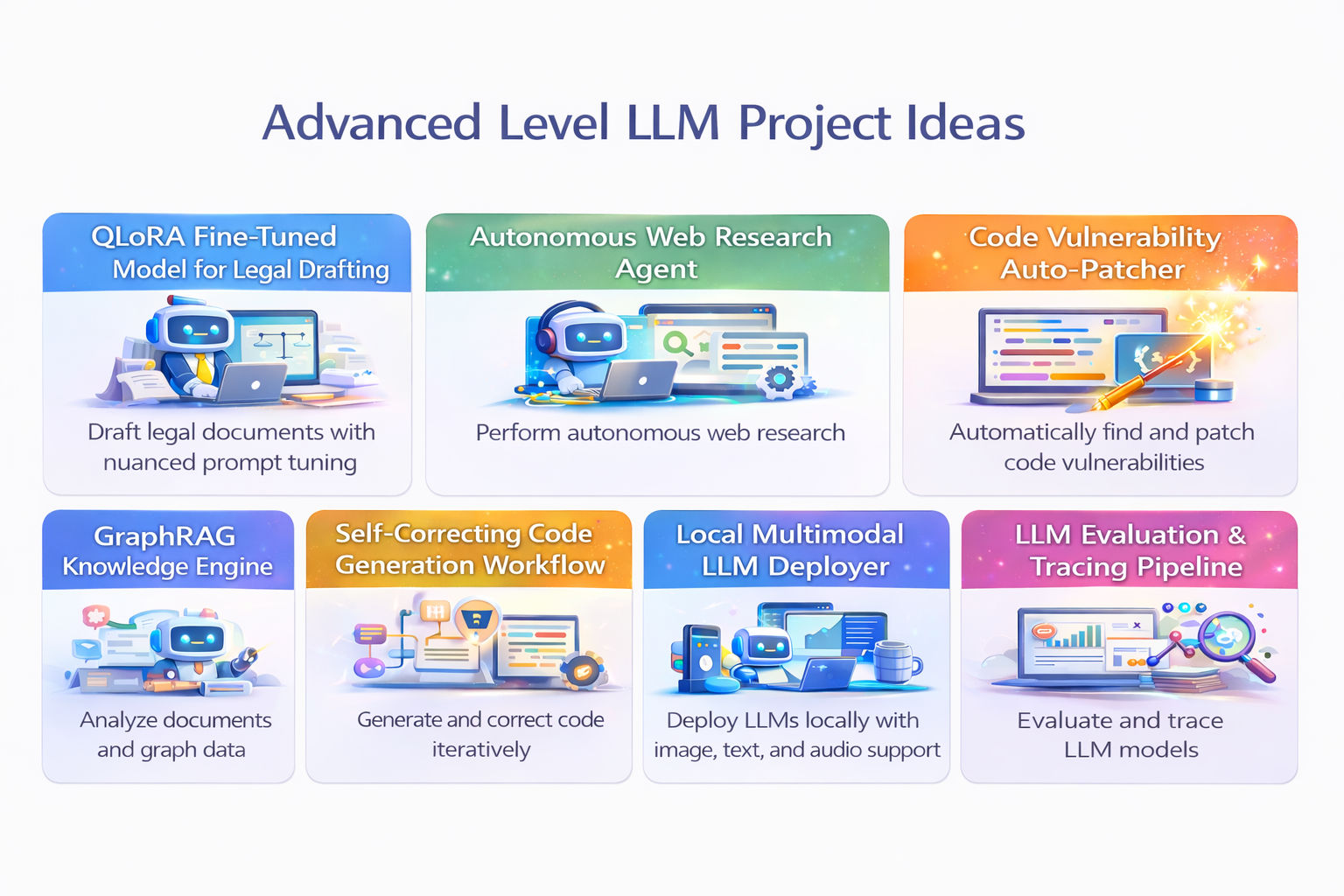
1. QLoRA Fine-Tuned Model for Legal Drafting

This project moves beyond prompt engineering into altering actual model weights. You will fine-tune an open-source LLM on a dataset of legal contracts so it naturally generates highly accurate legal clauses without needing massive context prompts.

Tools and Technologies Used

  • PyTorch & Hugging Face PEFT: For managing the fine-tuning process.
  • Unsloth: To drastically speed up the training on consumer GPUs.
  • Llama 3 (8B): As the base open-source model.

How to Make It

  • Curate a dataset of hundreds of legal clauses, formatting them strictly into JSONL prompt-completion pairs (e.g., {"instruction": "Write an NDA clause", "output": "The Receiving Party agrees..."}).
  • Load the quantized base model into a Google Colab notebook to ensure it fits within a 16GB GPU VRAM limit.
  • Apply QLoRA (Quantized Low-Rank Adaptation) via Unsloth to train a small adapter model over your dataset, adjusting the weights to favor legal terminology and formatting.
  • Export the merged model weights and run inference locally to test the model's new, native legal capabilities.

2. Autonomous Web Research Agent

This project explores agentic loops and tool calling. You will build an autonomous AI agent that takes a broad research topic, independently searches the web, reads multiple articles, and compiles a comprehensive research report.

Tools and Technologies Used

  • LangChain Agents or Microsoft AutoGen: For orchestrating the autonomous loop.
  • Tavily API or Google Custom Search: To provide the LLM with live internet access.
  • OpenAI GPT-4o: For high-level reasoning and planning.

How to Make It

  • Define an agent equipped with a WebSearch tool and a WebScrape tool.
  • Provide a high-level goal (e.g., "Research the current state of solid-state batteries in EVs"). The agent will autonomously generate a search query, execute the WebSearch tool, and analyze the returned URLs.
  • The agent will decide which URLs are relevant, trigger the WebScrape tool to read the article text, and store the findings in its scratchpad memory.
  • If the agent determines it needs more information, it will loop back and search again. Once satisfied, it compiles all gathered data into a heavily cited markdown report.

Also Read: 50 Java Projects With Source Code for Beginners 

3. Code Vulnerability Auto-Patcher

This project combines Static Application Security Testing (SAST) with LLM code generation. You will build a tool that scans a codebase, identifies security flaws, and autonomously generates a git pull request with the patched code.

Tools and Technologies Used

  • Python AST & SAST Tools (e.g., Bandit): To find the vulnerabilities.
  • LLM Code Models (e.g., DeepSeek Coder): To write the patches.
  • GitPython & GitHub API: To orchestrate the version control.

How to Make It

  • Run a traditional SAST tool over a local repository to output a report detailing exact file paths and line numbers of suspected vulnerabilities (like SQL injections).
  • Extract the vulnerable code blocks and pass them to the LLM, prompting it to act as a Senior Security Engineer to rewrite the code securely without changing its core functionality.
  • Use GitPython to programmatically create a new branch locally and overwrite the original files with the AI-generated patched code.
  • Push the branch to the remote repository and utilize the GitHub API to open a Pull Request, detailing the security flaw and the AI's proposed solution for human review.

4. GraphRAG Knowledge Engine

This project resolves the limitations of standard vector similarity by understanding interconnected relationships. You will build an engine that maps complex documentation into a Knowledge Graph for multi-hop reasoning.

Tools and Technologies Used

  • Neo4j: The industry standard Graph Database.
  • LlamaIndex (Knowledge Graph abstractions): For data ingestion.
  • Cypher Query Language: To traverse the graph.

How to Make It

  • Ingest unstructured text (like Wikipedia articles) and prompt an LLM to extract "Entities" (e.g., Steve Jobs, Apple) and "Relationships" (e.g., FOUNDED).
  • Store these extracted triples into Neo4j as Nodes and Edges.
  • When a user asks a complex question (e.g., "Who founded the company that created the iPhone?"), standard vector search might fail. Instead, prompt the LLM to translate the natural language query into a precise Cypher query.
  • Execute the Cypher query against Neo4j to traverse the graph, returning the exact relational context needed for the LLM to synthesize a factual answer.

Also Read: 15 Best Full Stack Coding Project Ideas & Topics For Beginners 

5. Self-Correcting Code Generation Workflow

This project tackles LLM hallucinations in coding tasks. You will build a cyclical workflow where the AI writes code, executes it in an isolated environment, reads the error traceback, and rewrites the code until it runs successfully.

Tools and Technologies Used

  • LangGraph: To build cyclic, state-based agent workflows.
  • Python subprocess: For executing the generated code safely.
  • OpenAI API: For code generation and reflection.

How to Make It

  • Define three nodes in LangGraph: Coder, Executor, and Reviewer.
  • The user provides a prompt (e.g., "Write a Python script to calculate the Fibonacci sequence"). The Coder node generates the initial script.
  • The Executor node takes the script, runs it using Python's subprocess module, and captures the terminal output (either success or a traceback error).
  • If an error occurs, the state routes to the Reviewer node, which analyzes the traceback, pinpoints the bug, and passes instructions back to the Coder node to try again, repeating the cycle until execution is successful.

6. Local Multimodal LLM Deployer

This project focuses on privacy, infrastructure, and vision models. You will build a local API server that runs a vision-language model entirely on your own hardware, capable of analyzing images without sending data to OpenAI.

Tools and Technologies Used

  • Ollama: For easily running heavy LLMs locally.
  • LLaVA (Large Language-and-Vision Assistant): The open-source multimodal model.
  • FastAPI: To wrap the local model in a REST API.

How to Make It

  • Install Ollama on your local machine and pull the LLaVA model weights.
  • Build a FastAPI backend that accepts a base64 encoded image and a text prompt via a POST request.
  • Inside the endpoint, structure the request to interface with Ollama's local port, passing the image buffer and prompt to the LLaVA model.
  • The local GPU will process the image and stream back the text analysis (e.g., describing the contents of a photograph). Return this response to your frontend, achieving a 100% private, offline vision AI tool.

Also Read: Top 30 Django Project Ideas for Beginners and Professionals 

7. LLM Evaluation & Tracing Pipeline

This project addresses the critical issue of "Vibe Checks" in AI development. You will build an automated evaluation pipeline that rigorously tests your LLM application for hallucination, relevance, and toxicity using mathematical metrics.

Tools and Technologies Used

  • LangSmith or Arize Phoenix: For tracing LLM execution steps.
  • RAGAS (RAG Assessment): For specialized evaluation metrics.
  • Pytest: To automate the evaluation runs.

How to Make It

  • Instrument your existing RAG or LLM chain with LangSmith callbacks to log every single token, prompt, and retrieval step to a dashboard.
  • Curate a "Golden Dataset" of 50 complex questions and their objectively correct answers.
  • Write a Pytest script that iterates through the dataset, passing the questions to your LLM pipeline.
  • Use the RAGAS framework to programmatically evaluate the LLM's outputs against the Golden Dataset, scoring metrics like "Context Precision" and "Answer Faithfulness" from 0.0 to 1.0, failing the CI/CD pipeline if the scores drop below a certain threshold.

Also Read: Top 45+ Nodejs Project Ideas for Beginners and Professionals 

Conclusion

LLM project ideas help you build practical AI applications that solve real problems. Start with simple projects to learn prompts and APIs, then move to RAG systems, agents, and multi-step workflows.

Focus on useful LLM project ideas that improve accuracy, handle real data, and scale well. This approach helps you build strong skills and create impactful AI applications.

"Want personalized guidance on Generative AI and upskilling opportunities? Connect with upGrad’s experts for a free 1:1 counselling session today!"  

Similar Reads: 

Frequently Asked Question (FAQs)

1. What are some LLM project ideas for students to start with?

LLM project ideas for students include simple apps like text generators, chatbots, and summarizers. These projects help you understand prompts, APIs, and basic workflows while building practical skills that are useful for real-world AI applications and academic projects.

2. Where can you find LLM projects with source code for learning?

You can explore GitHub and open-source communities to find complete implementations. These repositories often include setup instructions, helping you understand how models, APIs, and data pipelines work together in real applications.

3. Which tools are commonly used in building LLM applications?

Popular tools include LangChain, LlamaIndex, Hugging Face models, and vector databases like ChromaDB. These tools help you manage workflows, handle data retrieval, and build scalable AI systems efficiently.

4. What are good LLM project ideas for final year students?

Final year students can build advanced systems like RAG-based chatbots, AI assistants, or content generation platforms. These projects demonstrate your ability to handle real-world use cases and complex workflows.

5. How do LLM project ideas help in learning real-world AI systems?

LLM project ideas help you understand how models interact with data and users. You learn prompt design, retrieval systems, and API integration, which are essential for building useful and accurate AI applications in real scenarios.

6. Do you need coding experience to build LLM-based applications?

Basic coding knowledge is helpful, especially in Python. Many frameworks simplify development, so you can start small and gradually improve your coding skills while building projects step by step.

7. What are some beginner-friendly LLM applications to build?

You can start with simple tools like email generators, FAQ bots, or text summarizers. These projects help you understand how prompts work and how models generate responses without dealing with complex systems.

8. What are some advanced LLM project ideas for real-world use?

Advanced LLM project ideas include agent-based systems, multi-modal applications, and enterprise assistants. These projects involve handling large datasets, improving accuracy, and building scalable systems used in real environments.

9. How long does it take to complete an LLM project?

Simple projects can take a few days, while intermediate ones may take weeks. Advanced systems with multiple integrations and real-time features can take longer depending on your experience and project complexity.

10. How can LLM project ideas improve your portfolio?

LLM project ideas help you showcase real applications like chatbots or automation tools. These projects demonstrate your ability to solve problems using AI, making your portfolio stronger and more relevant for job roles.

11. What mistakes should you avoid while building LLM applications?

Avoid building overly complex systems at the start. Do not ignore prompt quality or testing. Focus on solving one problem well and ensure your outputs are accurate before adding more features.

Rahul Singh

19 articles published

Rahul Singh is an Associate Content Writer at upGrad, with a strong interest in Data Science, Machine Learning, and Artificial Intelligence. He combines technical development skills with data-driven s...

Speak with AI & ML expert

+91

By submitting, I accept the T&C and
Privacy Policy
