Scale AI: The Data Infrastructure Powering Modern AI Systems
By upGrad
Updated on Jun 10, 2026 | 8 min read | 3.26K+ views
Share:

All courses
Certifications
More
By upGrad
Updated on Jun 10, 2026 | 8 min read | 3.26K+ views
Share:
Table of Contents
Scale AI has become one of the most important companies in the AI ecosystem. From training large language models to supporting autonomous vehicles and enterprise AI applications, Scale AI helps organizations build better AI systems with high-quality data, evaluation frameworks, and human feedback loops.
In this guide, you'll learn what Scale AI is, how it works, why enterprises use it, its core products, benefits, challenges, and its role in the future of AI development. Whether you are a beginner, AI professional, or business leader, this article will help you understand why data infrastructure has become one of the most valuable layers in artificial intelligence.
Explore Artificial Intelligence Courses on upGrad to understand how Scale AI powers data labeling and annotation to build more reliable, production-ready AI systems.
Popular AI Programs
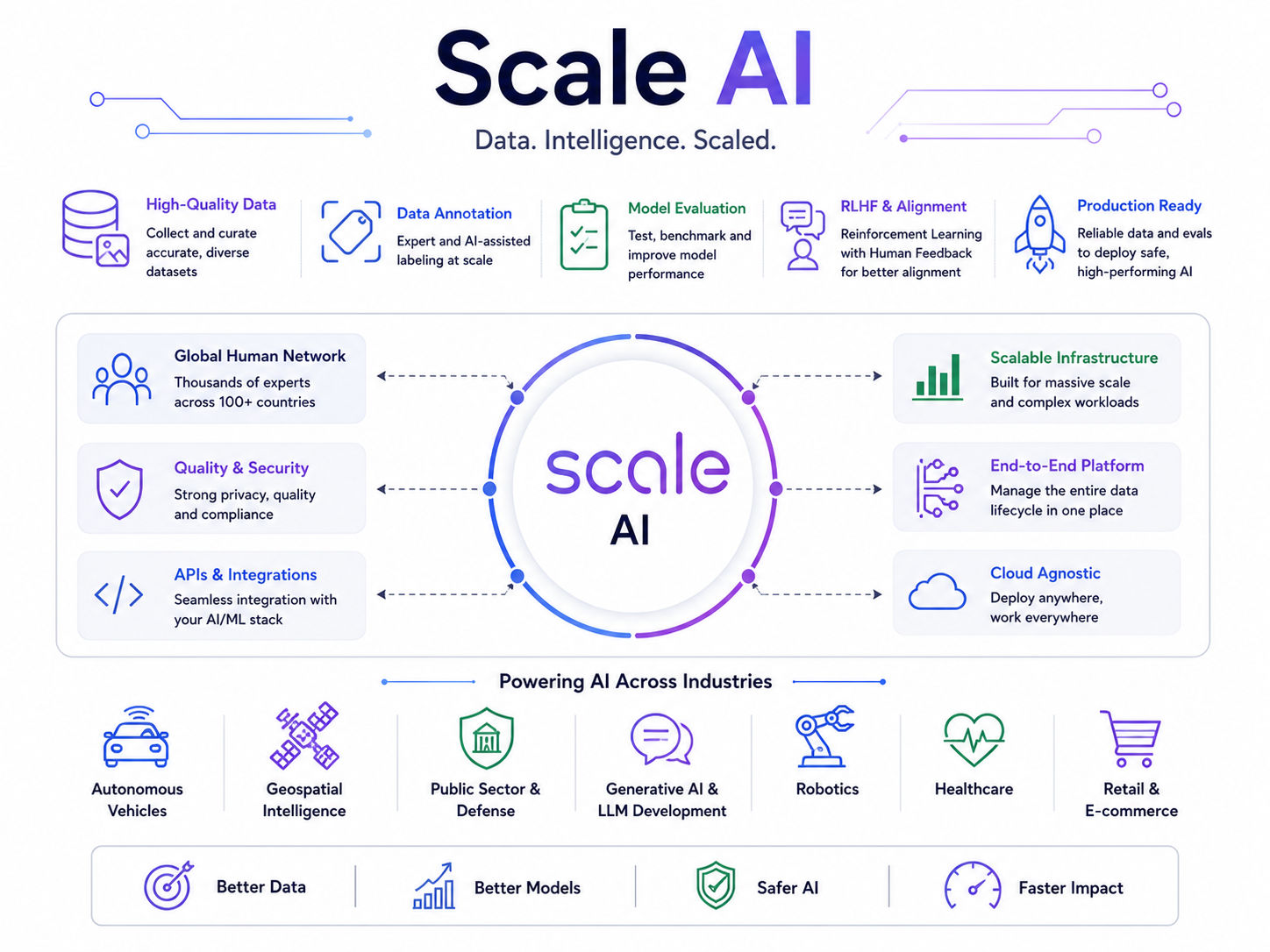
Scale AI is an AI infrastructure company that helps organizations create, manage, and improve the data required for machine learning systems. Founded in 2016, the company started with AI data annotation and data labeling services but has expanded into a broader ecosystem that includes Generative AI & LLM Evaluation, model fine-tuning, and enterprise AI deployment.
In recent years, Scale AI has moved far beyond traditional data labeling. It now provides a complete AI infrastructure platform that supports model training, AI model evaluation, enterprise deployment, and reinforcement learning with human feedback (RLHF).
At its core, Scale AI focuses on creating high-quality ground truth data. Ground truth data refers to accurately labeled information used to train and validate AI models.
According to publicly available reports, Scale AI generated significant growth by supporting AI labs, enterprises, and government organizations working on advanced AI systems.
Also Read: AI Tutorial Made Simple: Learn Artificial Intelligence from Scratch
AI models learn patterns from data. If the data is inaccurate, incomplete, or poorly labeled, the model will produce unreliable outputs.
Common examples include:
Without strong data curation and validation, even advanced AI models struggle to perform consistently.
One reason Scale AI gained attention is its ability to combine automation with human-in-the-loop AI workflows. Human experts review outputs, correct mistakes, and help generate more reliable training data.
Function |
Purpose |
| AI data annotation | Labels images, text, audio, and video |
| Data curation | Improves dataset quality |
| AI model evaluation | Measures model performance |
| RLHF systems | Aligns models with human preferences |
| Model benchmarking | Compares AI system performance |
| AI guardrails | Improves safety and reliability |
Scale AI supports several industries:
Also Read: Getting Started with Data Exploration: A Beginner's Guide
Free Courses
Building AI models is no longer the hardest part. Many organizations now struggle more with managing data quality, evaluation processes, and deployment reliability.
This is where Scale AI's enterprise ecosystem becomes valuable.
Modern enterprises work with enormous volumes of information:
Scale AI provides enterprise data annotation solutions that transform raw information into structured training datasets.
The process typically includes:
Many AI systems still require human oversight.
Scale AI integrates human-in-the-loop AI processes into training workflows. Human reviewers:
Large language models often require customization before business deployment.
Organizations use Scale AI for:
For example, a financial institution may need a chatbot trained specifically on regulatory documents and compliance policies.
Also Read: LLM Examples: Real-World Applications Explained
Recent industry discussions increasingly focus on AI reliability rather than model size alone. Several AI leaders now consider evaluation and data quality among the biggest challenges in AI adoption.
The result is a growing demand for platforms that manage not only model development but the complete target data lifecycle management process.
Benefit |
Impact |
| Better training data | Higher model accuracy |
| Faster deployment | Reduced development cycles |
| Stronger evaluation | Lower production risks |
| Human feedback | Improved reliability |
| Scalable infrastructure | Enterprise-ready operations |
Also Read: How to Build Your Own AI System: Step-by-Step Guide
AI Courses to upskill
Explore Artificial Intelligence Courses for Career Progression
One of Scale AI's most important contributions to modern AI is its work in reinforcement learning with human feedback (RLHF).
Many leading language models rely on RLHF techniques to improve helpfulness, accuracy, and safety.
RLHF combines machine learning with human feedback.
The workflow generally follows these steps:
This process helps AI systems better align with human expectations.
Research on RLHF datasets shows that human preferences play a major role in determining AI behavior and alignment outcomes.
Without human feedback, models may:
Also Read: Reinforcement Learning in Machine Learning: How It Works, Key Algorithms, and Challenges
Scale AI also provides advanced Generative AI & LLM Evaluation services.
These evaluations test:
Also Read: What is Generative AI? Understanding Key Applications and Its Role in the Future of Work
Red-teaming involves intentionally challenging models with difficult prompts to identify vulnerabilities.
Examples include:
Organizations deploying AI at scale need robust controls.
Scale AI supports:
These capabilities help businesses reduce deployment risks while maintaining performance.
As AI adoption grows, evaluation systems may become as important as model training itself. Industry experts increasingly view reliable evaluation pipelines as critical AI infrastructure.
Evaluation Area |
Purpose |
| Model benchmarking | Compare performance |
| Safety testing | Detect risks |
| RLHF review | Improve alignment |
| Red-teaming | Find vulnerabilities |
| Human review | Validate outputs |
Scale AI supports far more than chatbot development. Its technologies power AI systems across multiple sectors.
Autonomous driving requires massive amounts of annotated sensor data such as accurate ground truth data to identify roads, pedestrians, and obstacles.
Scale AI helps create:
Scale AI has expanded into government-focused AI programs.
Its public sector AI data engine initiatives support:
Many organizations use Scale AI for:
Businesses increasingly adopt AI through:
Industry |
Application |
| Automotive | Autonomous vehicles |
| Healthcare | Medical imaging |
| Finance | Risk analysis |
| Retail | Customer support AI |
| Defense | Intelligence systems |
| Logistics | Route optimization |
Despite its success, Scale AI faces challenges:
There have also been broader industry discussions regarding labor practices in large-scale annotation ecosystems and the balance between automation and human oversight.
Scale AI has evolved from a data labeling company into one of the most influential AI infrastructure providers in the market. As organizations race to build reliable AI products, high-quality data is becoming a competitive advantage. Scale AI addresses one of the biggest challenges in artificial intelligence: turning raw information into trusted, production-ready systems.
Whether supporting autonomous vehicles, enterprise AI platforms, government programs, or large language models, Scale AI sits at the center of the modern AI ecosystem. Its focus on ground truth data, safety, and evaluation highlights a growing reality in AI: better data often matters as much as better models.
Want personalized guidance on Scale AI? Speak with an expert for a free 1:1 counselling session today.
Scale AI provides AI infrastructure solutions that help organizations create, label, curate, and evaluate data for machine learning models. The company combines human expertise and automation to build high-quality datasets, conduct AI model evaluation, and support production-ready AI systems.
Traditional data labeling services mainly focus on annotation tasks. Scale AI extends beyond annotation by offering Generative AI evaluation, model benchmarking, AI guardrails, enterprise deployment support, and reinforcement learning with human feedback (RLHF) workflows for modern AI systems.
Enterprise data annotation ensures that machine learning models learn from accurate and structured information. High-quality annotations reduce errors, improve model performance, and create reliable ground truth data that supports better business outcomes.
RLHF is a training approach where human reviewers evaluate AI responses and provide feedback. This feedback helps models align with human expectations, improve reasoning quality, reduce harmful outputs, and enhance overall user experience.
Scale AI supports LLM development through data curation, model fine-tuning, AI model evaluation, Generative AI & LLM Evaluation, and LLM red-teaming. These services help organizations build safer and more accurate language models.
Industries using Scale AI include automotive, healthcare, finance, retail, logistics, government, and defense. Many organizations rely on its infrastructure platform to manage machine learning data pipelines and AI deployment workflows.
Ground truth data refers to accurately labeled information used to train and validate AI systems. It acts as a reliable reference point that helps models learn correct patterns and improve prediction accuracy over time.
Scale AI supports AI safety and alignment through human review processes, AI guardrails, model benchmarking, red-teaming exercises, and Generative AI evaluation frameworks. These methods help identify risks before deployment.
Machine learning data pipelines are structured workflows that collect, clean, annotate, validate, and deliver training data to AI systems. Effective pipelines improve efficiency, consistency, and scalability across AI projects.
LLM red-teaming involves testing language models with challenging prompts to uncover vulnerabilities, biases, and unsafe behaviors. Organizations use these evaluations to strengthen AI safety and improve system reliability before deployment.
Yes. As AI systems become more complex, organizations need stronger data curation, evaluation frameworks, and human-in-the-loop AI processes. Scale AI's infrastructure helps bridge the gap between research models and real-world deployment at enterprise scale.
972 articles published
We are an online education platform providing industry-relevant programs for professionals, designed and delivered in collaboration with world-class faculty and businesses. Merging the latest technolo...
Speak with AI & ML expert
By submitting, I accept the T&C and
Privacy Policy
Top Resources
Master's Degree
18 Months
Executive Diploma
12 Months
IIIT Bangalore
Executive Programme in Generative AI & Agentic AI for LeadersIndia’s #1 Tech University
Dual Certification
5 Months