Agentic AI Roadmap: Skills, Tools, Frameworks, and Career Guide
By Sriram
Updated on Sep 29, 2026 | 6 min read | 6.81K+ views
Share:

All courses
Certifications
More
By Sriram
Updated on Sep 29, 2026 | 6 min read | 6.81K+ views
Share:
Table of Contents
An Agentic AI roadmap helps learners progress from basic AI applications to building intelligent systems that can plan, reason, and take actions independently. It starts with foundational skills such as Python programming, machine learning concepts, and understanding large language models (LLMs).
As you advance, the focus shifts to retrieval systems, tool integration, memory, and agent frameworks. By following a structured learning path, you can build autonomous AI agents that execute multi-step tasks, collaborate with other agents, and solve complex real-world problems across industries.
This Blog explains the skills, technologies, frameworks, and learning path required to understand and build AI agents. You'll learn how agentic systems work, what technologies power them, which tools to learn, and how to progress from fundamentals to advanced implementations.
Build an Agenti AI and AI programs with Up Grad’s to develop practical skills in large language models (LLMs), generative AI, machine learning, model evaluation and data-driven decision-making.
Agentic AI Courses to upskill
Explore Agentic AI Courses for Career Progression
IIIT Bangalore
EPGP in Applied AI and Agentic AIIIIT Bangalore
Executive Diploma in Machine Learning and AI360° Career Support
Learning agentic AI can feel intimidating because it is multidisciplinary: programming, machine learning, large language models, systems design, and more. A structured Agentic AI Roadmap helps break this journey down into manageable stages.
Using a step-by-step approach, learners can first build strong fundamentals and then gradually progress toward creating intelligent agents that can plan, reason, and complete complex tasks autonomously.
Focus on:
Goal: Understand how modern AI systems generate and process information.
Create projects such as:
Goal: Learn model interaction and API usage.
Build:
Goal: Learn retrieval pipelines and vector databases.
Create agents capable of:
Goal: Move beyond one-time interactions.
Build projects using:
Goal: Create structured workflows and multi-agent systems.
Examples include:
Different agents handle specialized tasks while collaborating toward a common objective.
Learn:
This stage often separates experimental projects from enterprise-ready solutions.
Do read: Agentic AI Engineer: Skills, Career & How to Become One
For professionals seeking an industry-recognized credential, upGrad offers Agentic AI programmes in collaboration with leading institutions. These programmes combine academic certification with hands-on training in AI agents, multi-agent workflows, deployment, and real-world capstone projects, helping learners build job-ready skills aligned with industry requirements.
The rapid growth of agentic AI has introduced numerous tools, frameworks, and learning resources. An Agentic AI roadmap helps learners navigate this landscape by providing a structured path. It builds foundational knowledge in programming, machine learning, and LLMs before advancing to agent orchestration, memory systems, tool usage, and multi-agent workflows.
An Agentic AI roadmap also helps learners:
Here is the clear Roadmap for Agentic AI for Learner :
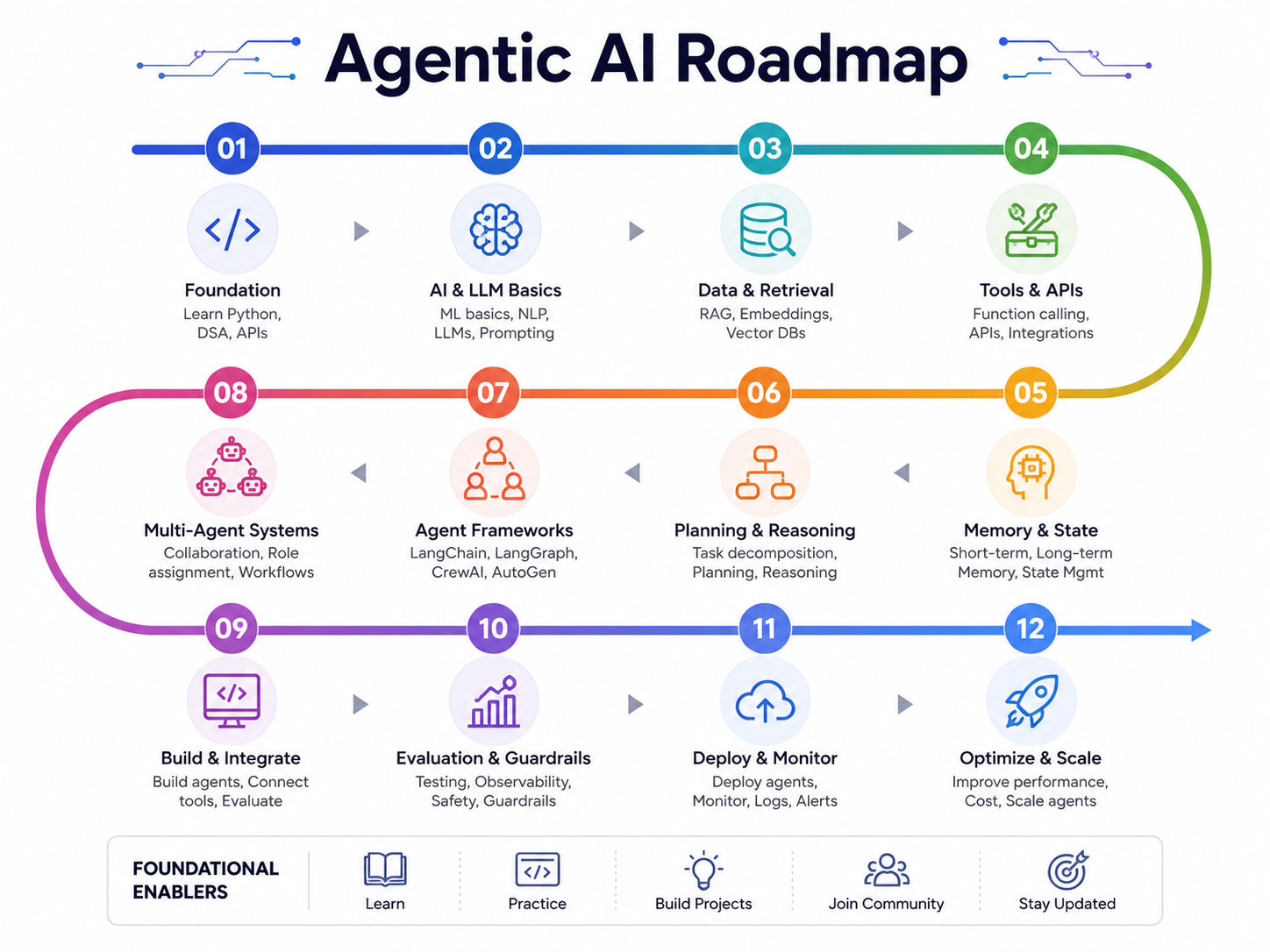
Many learners jump directly into frameworks such as LangGraph or CrewAI. That often creates gaps in understanding.
Strong fundamentals make advanced agent development significantly easier.
Python remains the dominant language for AI development.
Focus on:
AI agents constantly interact with external systems, making API integration especially important.
You don't need to become an ML researcher, but understanding the basics helps.
Learn:
These concepts explain how modern AI systems process and retrieve information.
LLMs serve as the reasoning engine behind most agentic systems.
Important topics include:
Understanding how models reason helps developers design more reliable agents.
Most AI agents spend a large portion of their time interacting with external tools.
Examples include:
An agent becomes significantly more useful once it can access real-world systems.
Agentic workflows often require long-term information storage.
Learn:
Popular vector databases include:
Without effective retrieval systems, agents struggle with memory and context management.
Once you've covered the roadmap fundamentals, the next step is applying them in real-world scenarios. An Agentic AI course with hands-on labs and mentorship can help you build production-ready AI agents using LLMs, RAG, multi-agent workflows, and deployment projects while receiving guidance from industry experts.
Modern agentic AI systems are a blend of frameworks, model providers, memory layers, and orchestration tools. These technologies are a key component of any Agentic AI Roadmap because they allow agents to reason, leverage tools, and perform complex workflows.
There are always new tools being released, but a handful of time-tested frameworks have emerged as the foundation for developing and deploying production-quality AI agents.
Start with leading model providers:
Each platform offers unique capabilities and pricing models.
These frameworks simplify agent orchestration.
| Frame work | Primary use |
| LangGraph | Stateful agent workflows |
| LangChain | LLM application development |
| CrewAI | Multi-agent collaboration |
| AutoGen | Agent conversations |
| Semantic Kernel | Enterprise AI orchestration |
Memory distinguishes simple assistants from sophisticated agents.
Types of Memory Common types of memory include:
For example, a customer support agent might remember past interactions, product information, and customer preferences across multiple sessions.
Most production agents depend heavily on Retrieval-Augmented Generation (RAG).
RAG enables agents to:
This is critical when building enterprise A.I. solutions.
Modern agents frequently rely on tools like:
Tool calling lets agents do things, not just write text.
For example, a coding agent can write code, run tests, debug errors, and verify outputs before responding.
Hands-on Agentic AI training typically includes projects that mirror real business workflows. Learners build AI research assistants, customer support agents, document intelligence systems, coding assistants, workflow automation agents, and multi-agent applications that coordinate tasks using frameworks like LangGraph or CrewAI. These projects help learners apply concepts such as RAG, tool integration, memory, and agent orchestration in production-oriented scenarios rather than isolated demos.
Demand continues to grow for professionals who know about agentic systems.
Organizations require AI systems that can automate increasingly complex workflows, rather than isolated tasks.
Some of the popular roles are:
A lot of companies are looking for people who know about agent orchestration, RAG pipelines, and multi-agent architectures.
Yes. As businesses increasingly adopt AI agents to automate workflows, professionals with Agentic AI skills can freelance or consult on use cases such as AI workflow automation, custom agent development, prompt engineering, and AI integration.
Building a portfolio of real-world projects, understanding business problems, and mastering tools like LangGraph, CrewAI, and MCP can significantly improve your consulting opportunities. upGrad's Agentic AI programs emphasize hands-on projects to help learners develop these practical, client-ready skills.
Agentic systems are already appearing across:
For example, software development teams increasingly use AI coding agents to assist with code reviews, documentation, testing, and debugging.
There are a number of trends that are impacting the next generation of AI agents:
As AI models grow more capable, agents will be more like digital coworkers and less like simple assistants.
Professionals who are following a structured Agentic AI Roadmap today will be more prepared for this transition.
The best Agentic AI course online with certification in 2026 should help you build AI agents that are ready for production, not just grasp the concepts. A strong program mixes AI basics with hands-on projects, giving you the skills to design, test, and deploy AI systems for real-world use.
Look for a course that includes:
If you want a structured learning path, upGrad offers:
Both programs mix practical learning with real-world projects to get you ready for roles as an AI Engineer, LLM Engineer, and Agentic AI Developer.
Agentic AI Course for Beginners vs Advanced Learners
The right Agentic AI course depends on your existing technical knowledge and career goals.
Beginners should look for programmes that start with Python, AI fundamentals, LLMs, prompt engineering, and RAG before introducing agent development.
Advanced learners can benefit from courses covering multi-agent systems, agent orchestration, deployment, and production-grade AI applications.
The emergence of agentic systems is a paradigm shift in the way artificial intelligence operates. AI agents can reason, plan, use tools, retrieve information, run multi-step workflows, etc. not just generate isolated responses.
A successful Agentic AI Roadmap begins with a solid foundation in Python, machine learning, and large language models. From there, learners should go on to RAG systems, memory architectures, agent frameworks, and production deployment practices. At every stage, the construction of real-world projects is instrumental in converting theoretical knowledge into practical expertise.
As businesses start to adopt more and more autonomous AI solutions, professionals with an understanding of agent design, orchestration and deployment will be at the forefront of the future of AI-powered systems.
Ready to start your journey? Book a free consultation with upGrad today to find the best path for your career.
Not necessarily. A basic understanding of machine learning concepts helps, but many learners start with Python and large language models first. The key is understanding how AI systems process information and make decisions. As you progress through an Agentic AI Roadmap, you can gradually learn topics like embeddings, retrieval systems, and model evaluation without becoming a machine learning specialist.
Generative AI focuses on creating content such as text, images, code, or audio. Agentic AI goes a step further by enabling systems to plan tasks, use tools, retrieve information, and complete objectives autonomously. An Agentic AI Roadmap includes Generative AI concepts but also covers memory, orchestration, tool integration, and workflow automation.
Python remains the most practical choice because most AI frameworks, libraries, and agent development tools support it extensively. It also offers strong integrations with APIs, vector databases, and machine learning ecosystems. While other languages can be used, Python provides the smoothest learning path for most agentic AI projects.
Yes. You can create simple AI agents using API calls, prompts, and custom logic. However, as projects become more complex, managing workflows, memory, and tool usage manually becomes difficult. Frameworks help organize these components and reduce development time, especially when building multi-step or multi-agent systems.
Vector databases play a major role in helping agents retrieve relevant information efficiently. They allow systems to search based on meaning rather than exact keywords. This capability improves memory, supports Retrieval-Augmented Generation (RAG), and helps agents work with large knowledge bases that exceed a model's context window.
A good starting point includes building chatbots, document assistants, and question-answering systems. After gaining confidence, you can create task planners, research assistants, and workflow automation agents. Each project introduces new concepts while helping you develop practical experience that employers and clients value.
AI agents can connect to tools such as search engines, databases, calendars, email systems, and business software through APIs. When assigned a goal, the agent decides which tool to use, gathers information, performs actions, and evaluates results. This allows it to complete tasks that go beyond simple text generation.
You can begin learning on a local machine, especially when working with APIs and smaller projects. However, cloud platforms become useful when deploying agents, handling large datasets, or supporting multiple users. Familiarity with cloud environments can also improve your readiness for production-level AI development.
Employers often look for a mix of technical and practical skills. These include Python programming, prompt engineering, API integration, vector database knowledge, RAG implementation, and experience with agent frameworks. Demonstrating real projects and problem-solving abilities often carries more weight than theoretical knowledge alone.
Evaluation involves more than checking whether the final answer looks correct. You should assess task completion, reasoning quality, tool usage, reliability, response consistency, and error handling. Testing agents across different scenarios helps identify weaknesses and improves overall system performance before deployment.
Many learners try to master every new framework and tool at once. This often leads to confusion and slows progress. A better approach is to focus on core concepts first, build small projects consistently, and then expand into advanced topics such as multi-agent systems, memory architectures, and production deployment.
Yes. An Agentic AI certification can strengthen your job prospects by validating practical AI skills, but placement depends on your overall expertise and portfolio. Programs like upGrad's Applied AI and Agentic AI course combine hands-on projects, industry tools, career support, and placement assistance to improve employability.
Choose a prompt engineering course if you're new to AI and want to master effective LLM interactions. Opt for an Agentic AI course if your goal is to build autonomous AI systems, orchestrate AI agents, and develop production-ready AI applications with real-world projects.
Yes. Beginner-friendly Agentic AI courses typically cover Python, AI fundamentals, prompt engineering, LLMs, and RAG before introducing AI agents. Advanced programs focus on multi-agent systems, agent orchestration, deployment, and production-ready AI applications through hands-on projects and real-world use cases.
Yes. Many introductory programs use no-code and low-code platforms to explain agent workflows and automation concepts. For learners aiming to build enterprise-ready AI agents, upGrad's Agentic AI programmes also include Python, LLM orchestration, Retrieval-Augmented Generation (RAG), and hands-on projects to develop production-ready autonomous systems.
An online Generative AI and Agentic AI course teaches you to build intelligent AI applications using LLMs, prompt engineering, RAG, and AI agents. Advanced programmes also cover tool integration, multi-agent workflows, model evaluation, and deployment through hands-on, production-ready projects that mirror real business use cases.
You can build RAG-based assistants, enterprise document intelligence systems, autonomous workflow agents, multi-agent applications, and AI solutions integrated with APIs and external tools. upGrad’s programmes also include hands-on projects focused on deploying production-ready Gen AI and Agentic AI systems.
Yes, beginners can take an online Agentic AI course with upGrad. These programs can help you learn Generative AI and Agentic AI concepts, understand AI agents and workflows, and develop practical skills for working with emerging AI technologies.
Yes. upGrad’s Agentic AI courses include hands-on, real-world projects where you build AI agents, RAG systems, autonomous workflows, and multi-agent applications. Depending on the programme, projects can also cover tool calling, deployment, and end-to-end AI systems.
722 articles published
Sriram K is a Senior SEO Executive with a B.Tech in Information Technology from Dr. M.G.R. Educational and Research Institute, Chennai. With over a decade of experience in digital marketing, he specia...
Speak with AI & ML expert
By submitting, I accept the T&C and
Privacy Policy