Budget Management: A Guide to Effectively Manage Your Money
By upGrad
Updated on Jun 10, 2026 | 8 min read | 2.78K+ views
Share:

All courses
Certifications
More
By upGrad
Updated on Jun 10, 2026 | 8 min read | 2.78K+ views
Share:
Table of Contents
Managing your budget is important because it is rarely about not having money; it is about not knowing where your money is going. That is why budget management matters; it will help you make better financial decisions about your money.
Whether you are a student, a professional, a freelancer or a business owner, the gap between where you're where you want to be financially often come down to one thing: how well you manage your budget.
In this guide, you will learn what budget management means, why budget management matters, proven methods, practical strategies, and common mistakes to avoid when it comes to budget management.
Explore Management Courses on upGrad to master the fundamentals of financial planning; from cost estimation and resource allocation to tracking expenditures and maximizing ROI across projects and teams.
Popular Management Programs
Budget management is the process of planning organizing, tracking and controlling your income and expenses it ensures that your spending aligns with your priorities.
According to research 65% of consumers actively use budgeting tools, many of whom are already financially comfortable simply because greater control leads to greater confidence in budget management.
Also Read: Essential Functions of Financial Management for Effective Business Strategy
Many people think budgeting limits freedom but in reality budget management creates freedom by helping you spend your money intentionally.
Free Courses
Cash flow is when your money comes in and your money goes out.
Positive cash flow means you are earning more than you spend. Negative cash flow means the opposite. It rarely announces itself.
Take someone bringing home ₹60,000 monthly while quietly spending ₹65,000 on subscriptions, meals and unplanned purchases. Without tracking your budget that ₹5,000 monthly shortfall stays invisible until the debt does not.
Management Courses to upskill
Explore Management Courses for Career Progression
IIIT-B & IIM, Udaipur
Chief Technology Officer & AI Leadership ProgrammeIIM Kozhikode
PCP in AI for Business ProfessionalsOvercomplicating a budget is how most budgets fail. A simple budget system often works better than a spreadsheet that nobody updates.
Also Read: Financial Supply Chain Management: A Comprehensive Guide to Processes and Trends
The first step is to set objectives for your budget management. When you set objectives, every spending decision becomes easier.
Ask yourself:
Examples:
Most budgets collapse not from overspending but from underestimating. So the next step is to track your income and expenses
Income Sources:
Expense Categories:
Categorization improves tracking and highlights unnecessary spending. Create spending categories to understand where your money goes.
Category |
Example |
| Needs | Rent, groceries, utilities |
| Wants | Dining out, movies, shopping |
| Savings | Investments, emergency fund |
| Debt | Loan repayments, credit cards |
Assign limits to each category for your budget management. Avoid creating budgets that are impossible to follow.
For example:
Category |
Budget |
| Housing | 30% |
| Food | 15% |
| Transportation | 10% |
| Savings | 20% |
| Lifestyle | 15% |
| Miscellaneous | 10% |
Budgeting is not a one-time activity. So, monitoring your income and expenses weekly helps catch issues with your budget management.
Many successful budgeters spend 10 minutes every week reviewing transactions.
Research shows that people who review spending regularly are more likely to stay within budget limits and achieve goals. Consistency beats complexity.
Also Read: 10 Proven Reasons Financial Planning is the Key to Success in 2025
There is no budgeting method, for budget management. The best system is the one you can maintain consistently for your budget management.
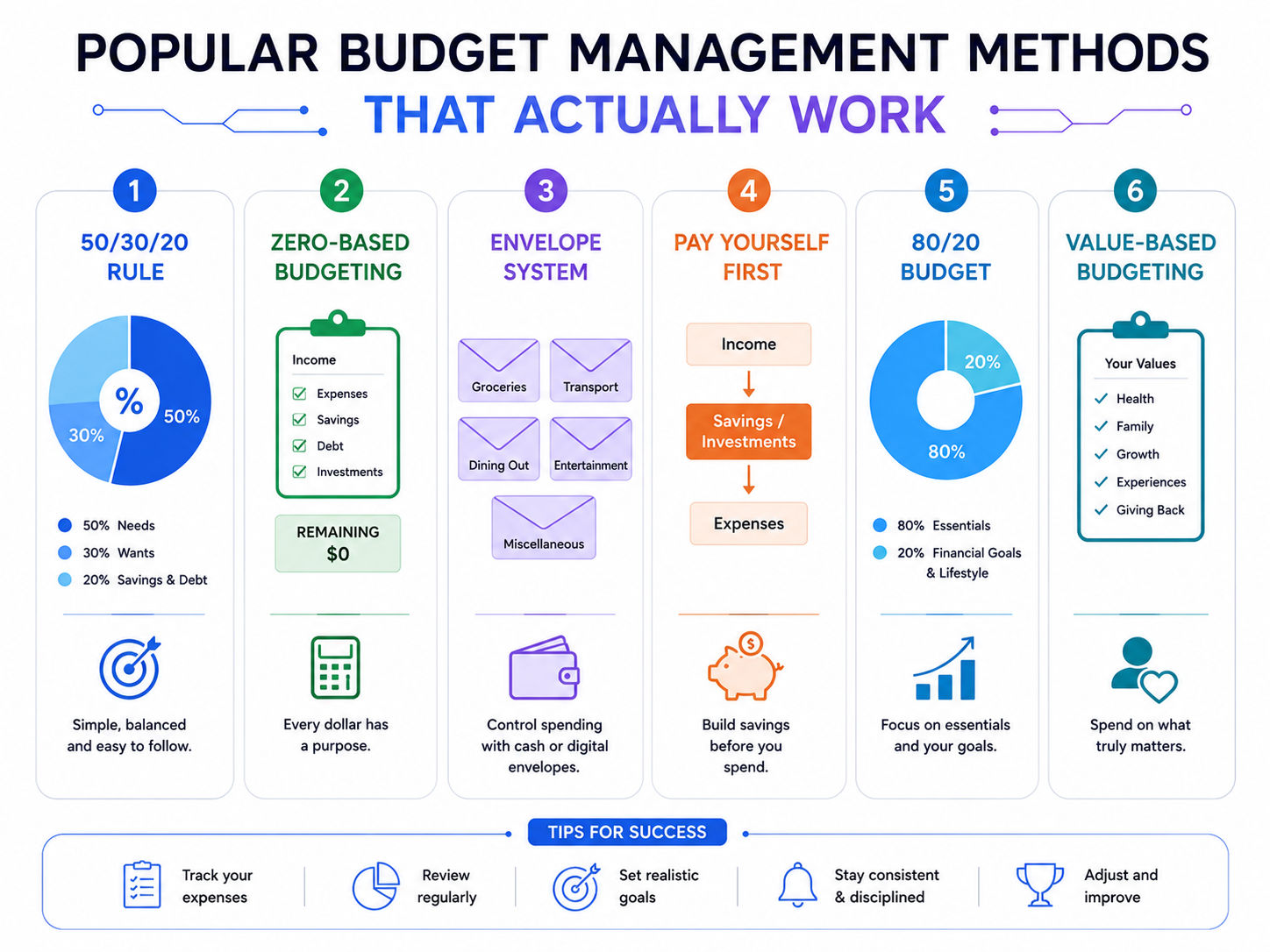
One of the most popular budgeting approaches is the 50/30/20 Rule.
Income is divided into:
Category |
Percentage |
| Needs | 50% |
| Wants | 30% |
| Savings and Debt Repayment | 20% |
Zero-Based Budgeting assigns every rupee or dollar for a purpose. Zero-Based Budgeting creates accountability and reduces wasteful spending.
Income minus expenses should equal to zero. This does not mean spending everything.
Instead, every amount gets allocated to:
Activity-Based Budgeting is commonly used in businesses but can also work for personal finance. Here, instead of budgeting by category, spending is linked to activities and outcomes.
Example:
Activity-Based Budgeting encourages value-driven spending.
This traditional method divides cash into separate spending categories.
Examples:
Once the envelope is empty, spending stops. It works particularly well for people trying to reduce impulse purchases.
The best approach often combines multiple techniques. Many people start with the 50/30/20 Rule and later move toward Zero-Based Budgeting for more control.
Situation |
Recommended Method |
| Beginners | The 50/30/20 Rule |
| Debt repayment | Zero-Based Budgeting |
| Business budgeting | Activity-Based Budgeting |
| Overspending habits | Envelope Method |
Creating a budget is easy. Following it for years is the real challenge.
A survey found that while many people create budgets, sticking to them consistently remains difficult due to unrealistic expectations and overspending habits.
One of the most overlooked habits is to Perform Regular Audits. Performing Regular Audits every month helps us identify wasteful spending.
Small expenses often create large leaks over time.
Review:
When in Change of financial situations, like increase in salary, unexpected expenses usually tend to appear. Inflation also affects our spending. That is why you must Stay Agile.
Instead of following the same budget forever, we must adjust it based on changing circumstances. People who Stay Agile adapt faster during financial challenges.
Emergency savings prevent financial setbacks from turning into financial disasters.
Experts generally recommend:
Budgeting apps can simplify Effective tracking.
Helpful features include:
Successful budget management is not about restricting life. It is about directing money toward what matters most.
Task |
Frequency |
| Track Income and Expenses | Weekly |
| Review cash flow | Weekly |
| Perform Regular Audits | Monthly |
| Update financial plan | Quarterly |
| Review financial goals | Quarterly |
| Stay Agile and adjust budget | As needed |
Budget management is one of the most practical financial skills anyone can learn. It helps you understand spending habits, improve cash flow, reduce stress, and move steadily toward your financial goals.
The process does not need to be complicated. Start by setting realistic targets, tracking spending, and reviewing your finances regularly. Whether you use the 50/30/20 Rule, Zero-Based Budgeting, or Activity-Based Budgeting, consistency matters more than the method itself.
The most effective budgets are not the strictest ones. They are the ones that adapt to real life. When you Set Clear Objectives, Track Income and Expenses, Perform Regular Audits, and Stay Agile, your budget becomes a tool for growth instead of a source of frustration.
Want personalized guidance on Budget management? Speak with an expert for a free 1:1 counselling session today.
Budget management is the process of planning how money will be earned, spent, saved, and invested. It helps people monitor income and expenses while ensuring they have enough money for important needs and future financial goals. A well-managed budget improves cash flow, reduces unnecessary spending, and creates better financial stability over time.
Budget management helps beginners understand where their money goes each month. Without a budget, it becomes difficult to control spending or save consistently. It also creates awareness around financial habits and supports better decision-making when working toward long-term financial goals.
Start by listing all income sources and expenses. Then prioritize essential spending before allocating money toward savings and lifestyle expenses. Even small savings matter. Effective tracking and monitoring income and expenses can help identify spending areas that can be reduced over time.
The 50/30/20 Rule is often considered the easiest method. It divides income into needs, wants, and savings categories. Its simplicity makes it easier to follow while still supporting a balanced financial plan and long-term money management.
Most financial experts recommend reviewing budgets weekly and conducting deeper reviews monthly. Regular reviews improve Effective tracking, help Perform Regular Audits, and ensure spending remains aligned with financial goals.
Budgeting focuses on daily and monthly spending decisions. Financial planning focuses on long-term goals such as retirement, investing, education, and wealth creation. Both work together. A successful financial plan usually starts with strong budget management habits.
Yes. Budget management helps identify unnecessary expenses and spending leaks that affect cash flow. By monitoring income and expenses consistently, individuals can create positive cash flow and improve overall financial health.
Zero-Based Budgeting assigns every unit of income a specific purpose. Nothing remains unallocated. It is particularly useful for people trying to eliminate debt, improve spending discipline, or gain tighter control over finances.
Activity-Based Budgeting links spending directly to activities and outcomes rather than broad expense categories. Businesses commonly use it, but individuals can also apply it when evaluating whether expenses contribute to specific financial goals.
Common mistakes include setting unrealistic limits, failing to Track Income and Expenses, forgetting irregular expenses, and not updating budgets regularly. Another major issue is failing to Stay Agile when financial circumstances change.
Focus on realistic goals instead of perfection. Use Effective tracking tools, review spending regularly, and adjust the budget when needed. People who Set Clear Objectives and Perform Regular Audits are more likely to maintain successful budget management habits over time.
1283 articles published
We are an online education platform providing industry-relevant programs for professionals, designed and delivered in collaboration with world-class faculty and businesses. Merging the latest technolo...
Get Free Consultation
By submitting, I accept the T&C and
Privacy Policy
Top Resources
Certification
3 Months
Certification
6 Months
O.P. Jindal Global University
Masters in International Accounting and Finance (Accredited by ACCA, UK)Master's Degree
12 Months