AI in Film: How It's Changing Every Stage of the Moviemaking Process
By upGrad
Updated on Jun 01, 2026 | 5 min read | 1.98K+ views
Share:

All courses
Certifications
More
By upGrad
Updated on Jun 01, 2026 | 5 min read | 1.98K+ views
Share:
Table of Contents
AI in film is transforming an industry that has long embraced new technology. From sound and digital cameras to streaming, innovation has always shaped filmmaking and now AI is influencing every stage. By analyzing data, recognizing patterns, and generating content, AI helps filmmakers work faster, enhance creativity, and make smarter decisions across production and storytelling.
This blog covers how AI in filmmaking works across every major stage of production, what it's doing well, where it falls short, and what that means for people who want to build a career in this space. Whether you're a film student, a working professional, or just deeply curious, you'll leave here with a clear picture.
Explore upGrad's Artificial Intelligence and Machine Learning programs to build practical skills in AI, generative AI, machine learning, computer vision, and emerging technologies that are increasingly shaping modern film production and creative industries.
Popular AI Programs
Most people assume AI in film production is only about visual effects. The technology has spread across almost every department, and the way it's being used varies a lot depending on the stage.
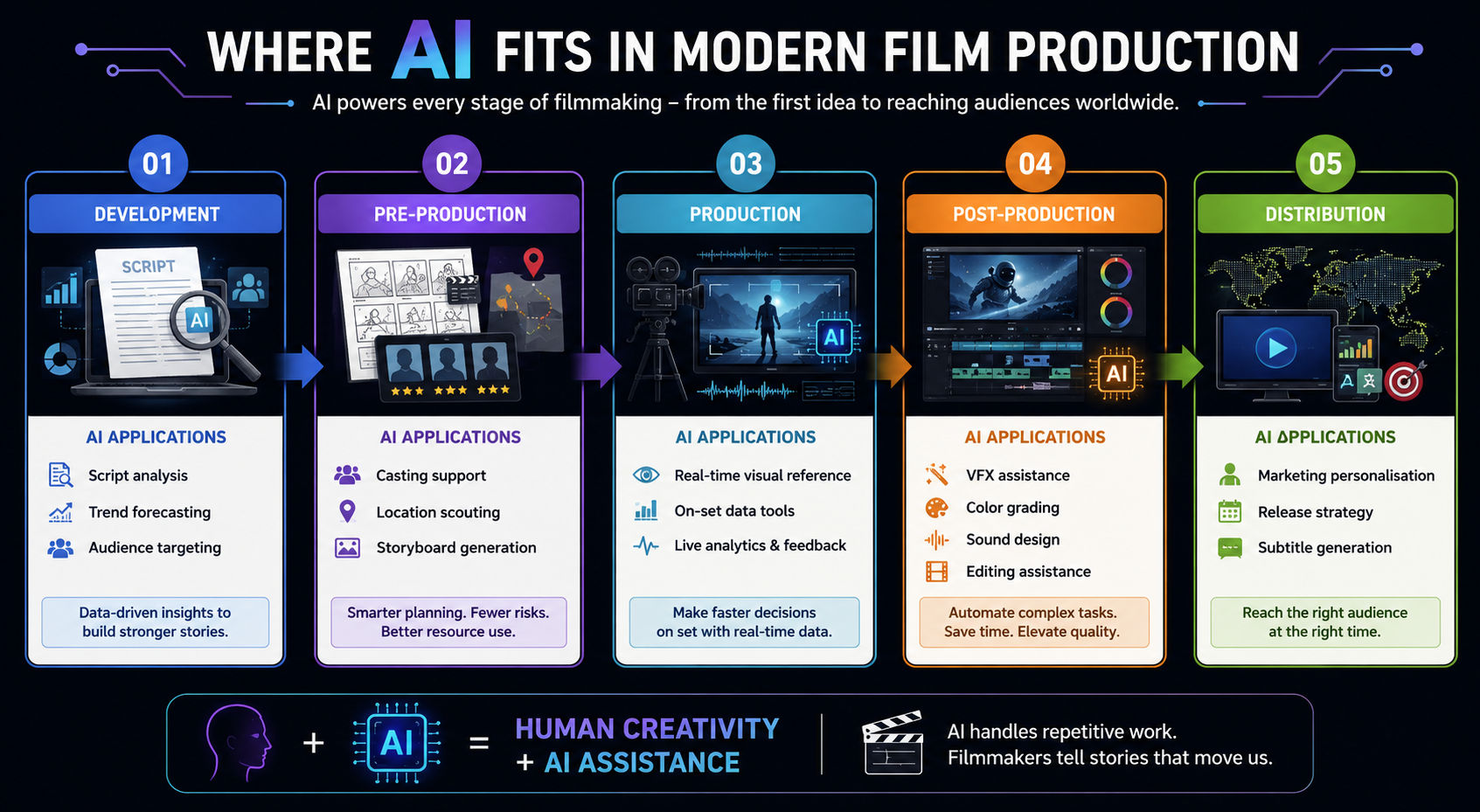
That's the part many people misunderstand. AI can process information quickly, but creative calls still sit with humans. It handles the repetitive, data-heavy, or time-intensive tasks that used to eat up hours of a team's time. Instead of spending hours on repetitive tasks, creative teams can spend more time refining scenes, performances, and narrative choices.
Not everyone is sold on it. Some studios are experimenting aggressively, while others are moving cautiously because the legal and labour questions aren't fully settled.
Must read: Types of AI: From Narrow to Super Intelligence with Examples
Free Courses
Five years ago, very few writers discussed AI during script development. Now it's showing up in writers' rooms, production meetings, and script evaluations. Tools like Cinelytic, ScriptBook, and various LLM-based platforms now help producers analyse scripts before they commit serious money to them.
What these tools actually do
A producer might receive a report showing that a key character disappears for too long or that the pacing slows noticeably near the end of the story. Some writers ignore those suggestions completely. Others use them as a second opinion. It varies from project to project.
Some writers use AI directly in the drafting process. They'll feed a premise into a language model, get rough scene ideas, then rewrite extensively. For many writers, it's less about getting answers and more about generating possibilities when they're stuck.
Writers have raised another concern. If studios start greenlighting projects based heavily on AI predictions, it could push the industry toward safer, more formulaic stories. That's a legitimate critique. The tools are trained on what has worked before, which doesn't always account for what audiences actually want next.
Also read: Applications of Artificial Intelligence and Its Impact
AI Courses to upskill
Explore Artificial Intelligence Courses for Career Progression
Ask someone where they've noticed AI in movies, and visual effects are usually the first answer. The VFX industry has been using machine learning for years, but the pace of change has accelerated sharply.
De-aging actors with AI is becoming faster and more affordable than traditional CGI. In India, movie 'Bharat' used digital techniques to present a younger Salman Khan, while 'Fan' combined VFX and AI-assisted methods to create a younger Shah Rukh Khan. Films like 'Zero' and 2.0 also relied on advanced digital tools to alter appearances and age. The software handles more of the repetitive processing now, but artists still spend hours checking shots and fixing details that machines miss.
Creating fully realistic digital humans is far more challenging. Indian films such as 'Ra.One' and 'Kochadaiiyaan' experimented with digital characters, but achieving lifelike faces, especially in close-ups, remains difficult. Studios are getting better results each year, yet most teams will tell you the technology still needs experienced artists behind it.
Rotoscoping, which involves tracing around subjects frame by frame, used to be one of the most labour-intensive tasks in post-production. Several studios now use AI-assisted rotoscoping tools that can reduce work that once took days into something that can be reviewed within a single shift.
Background work looks very different today than it did even a few years ago. Tools trained on vast image datasets can generate photorealistic landscapes, urban environments, or space scenes that feed directly into a compositor's workflow.
Traditional VFX Task |
Time with Manual Process |
Time with AI Assistance |
| Rotoscoping (2-min scene) | 3-5 days | 4-8 hours |
| Background matte painting | 1-2 weeks | 2-3 days |
| De-aging a character | Months | Weeks |
| Crowd simulation | Days | Hours |
The exact numbers vary between projects, but most VFX teams agree on one thing: these tasks are getting faster.
Must read: What is Generative AI? Understanding Key Applications and Its Role in the Future of Work
Most conversations about AI focus on visual effects, yet some of the biggest savings happen behind the scenes. It's less cinematic than VFX, but it's where AI is quietly saving productions millions of dollars.
Casting teams are starting to use AI systems that can organise audition footage and highlight performances matching specific requirements.. They don't make casting decisions, but they can flag which auditions match a director's stated requirements and surface performers who might have been overlooked.
When hundreds of auditions land on a casting desk, anything that helps narrow the shortlist becomes valuable. That's usually where AI fits.
Few parts of filmmaking create more headaches than scheduling. You've got actor availability, location permits, weather windows, equipment logistics, and union rules all competing at once. A scheduling platform can test hundreds of production scenarios and quickly identify options that reduce delays or unnecessary expenses.
A small scheduling mistake can create a surprisingly expensive chain reaction on a film set. In India, large-scale productions like Baahubali and RRR relied heavily on detailed pre-production planning and digital scheduling tools to manage complex shoots across multiple locations and timelines.
Even in Bollywood, films like Brahmāstra used advanced planning workflows to track VFX-heavy schedules and avoid delays. While not always publicly labeled as AI, studios in India are increasingly adopting data-driven planning systems similar to Hollywood to spot scheduling conflicts early and keep budgets under control.
Do read: Top 29 Image Processing Projects in 2026 For All Levels + Source Code
Here are the benefits and the limitations:
Benefits of AI in Film Production |
Limitations and Challenges of AI in Film Production |
| Faster Production Cycles | Creative Authenticity Concerns |
| Tasks that once consumed entire workdays, such as organising footage or breaking down scripts, can now be completed much faster, leaving more room for creative discussions. | AI can generate content but lacks human taste, emotional understanding, and cultural nuance. Overreliance may result in formulaic storytelling. |
| Cost Savings | Copyright and Ownership Issues |
| Reduces production costs through workflow automation, better resource allocation, faster editing, and optimized shooting schedules. | Questions remain around training data rights, AI-generated content ownership, and intellectual property protection. Legal standards are still evolving. |
| Better Data Insights | Bias in AI Models |
| Analyzes audience behavior, genre preferences, demographics, viewing patterns, and campaign performance to support smarter business decisions. | AI reflects biases present in its training data. This can influence casting recommendations, audience predictions, and content evaluation unfairly. |
| Improved Accessibility | Ethical Concerns Around Consent |
| Enables automated captions, translations, and voice dubbing, helping films reach global audiences more efficiently. | Using an actor's likeness, voice, or performance data without proper consent raises serious ethical and legal concerns. |
| Enhanced Post-Production Efficiency | Quality Consistency Issues |
| Accelerates editing, audio cleanup, visual effects generation, and scene tagging, reducing manual effort. | AI-generated VFX and content may look convincing in demos but often require extensive human review and corrections in real productions. |
| Data-Driven Decision Making | Job Displacement Concerns |
| Helps studios make informed choices about scripts, casting, marketing, and distribution based on large-scale data analysis. | Some roles may face automation pressure, particularly in editing and content creation, though new AI-focused roles are also emerging. |
| Support for Emerging Technologies | Dependence on Human Oversight |
| Powers innovations such as text-to-video generation, AI-assisted storyboarding, digital actors, automated dubbing, and real-time VFX. | AI outputs still require creative judgment, technical expertise, and ethical supervision to maintain quality and accountability. |
Also read: 5 Breakthrough Applications of Machine Learning
A growing number of job listings now expect candidates to understand both production processes and AI-assisted workflows. Studios don't just want AI engineers. They want people who understand production workflows and can apply these tools effectively.
Roles that are growing
Skills that matter:
Must read: 5 Significant Benefits of Artificial Intelligence [Deep Analysis]
The future probably sits somewhere in the middle. Human creativity remains essential, but AI is becoming part of the workflow.
Some of the tasks that needed entire departments a few years ago can now be completed by much smaller teams using AI-assisted tools. At the same time, audiences continue to value originality, emotional storytelling, and authentic creative voices.
Several developments are gaining momentum:
Several studios are already experimenting with these technologies on real projects rather than keeping them in research labs.
Also read: Job Opportunities in AI: Salaries, Skills & Careers in 2026
Professionals entering the industry should develop:
Filmmakers who understand storytelling and know how to work with new tools will likely have more options available to them.
Also read: Top 20 Challenges of Artificial Intelligence: Key Issues and Solutions for 2026
People connect with films because they recognise pieces of themselves in the characters and stories. AI can support production, but it doesn't possess lived experience.
The reason a quiet scene can stay with an audience for years often comes down to choices that aren't easy to measure with data. That's difficult to automate.
The future of AI in film looks less like replacement and more like collaboration between human creativity and machine efficiency.
AI in film has started influencing almost every stage of filmmaking, from early planning meetings to audience targeting after release. It helps teams save time, reduce repetitive work, and gain insights from large amounts of data. At the same time, creative judgment, storytelling skill, and ethical responsibility remain firmly in human hands.
The people likely to benefit most are those who understand both the strengths and limitations of these tools. They'll understand where technology adds value and where human creativity still leads the way. That balance is shaping the next chapter of the film industry.
Ready to start your journey? Book a free consultation with upGrad today to find the best path for your career.
The most widely used AI tools vary by department. Post-production teams often use Runway, Adobe Firefly, and Topaz Labs, while script analysts use platforms like ScriptBook and Cinelytic. Studios also rely on custom machine learning systems for audience forecasting, scheduling, and visual effects workflows.
AI prediction platforms can identify patterns from factors such as genre, cast popularity, release dates, and historical performance. However, film success is influenced by unpredictable variables including audience sentiment, competition, reviews, and cultural trends, making perfect prediction impossible.
Technically, AI can generate scripts, images, voices, music, and video clips. However, producing a commercially successful film still requires human oversight. Story structure, emotional depth, performance direction, and final creative judgment remain areas where human expertise plays a central role.
AI is automating repetitive tasks such as object tracking, rotoscoping, footage tagging, and background generation. This reduces manual workload but doesn't eliminate the need for artists. Instead, many VFX professionals are adapting by learning AI-assisted workflows and supervising machine-generated outputs.
Many film schools and media programs have started introducing AI-related modules. Students are learning how AI tools fit into editing, visual effects, screenwriting, and production planning. The focus is increasingly shifting toward combining creative skills with technical literacy.
Independent creators often lack large production teams and resources. AI tools can help with storyboarding, editing, voiceovers, subtitles, concept art, and marketing assets. This allows smaller teams to complete projects faster while keeping production costs under control.
Studios use AI to analyze viewing behavior, audience demographics, and engagement patterns. These insights help marketers create targeted campaigns, improve trailer performance, choose release windows, and recommend content to specific viewer segments across streaming platforms.
Yes. Modern AI systems can translate dialogue, generate voiceovers, and synchronize lip movements more accurately than earlier technologies. While human review is still necessary for cultural accuracy and emotional tone, AI is making global content distribution faster and more affordable.
Several legal questions remain unresolved, including copyright ownership, training data usage, digital likeness rights, and performer consent. Governments, studios, unions, and technology companies are still working to establish regulations that balance innovation with creator protection.
Traditional software follows direct user instructions, while AI systems can analyze data, generate content, and make recommendations based on learned patterns. Instead of simply executing commands, AI in film making assists decision-making and automates tasks that previously required significant manual effort.
AI in film production is expected to become more deeply integrated into pre-production, virtual production, visual effects, localization, and content personalization. The industry is moving toward collaborative workflows where AI handles efficiency-focused tasks while filmmakers focus on storytelling and creative direction.
972 articles published
We are an online education platform providing industry-relevant programs for professionals, designed and delivered in collaboration with world-class faculty and businesses. Merging the latest technolo...
Speak with AI & ML expert
By submitting, I accept the T&C and
Privacy Policy
Top Resources
Master's Degree
18 Months
Executive Diploma
12 Months
IIIT Bangalore
Executive Programme in Generative AI & Agentic AI for LeadersIndia’s #1 Tech University
Dual Certification
5 Months