AI in Sports: How Technology Is Changing the Game beyond the field
By upGrad
Updated on Jun 01, 2026 | 6 min read | 1.88K+ views
Share:

All courses
Certifications
More
By upGrad
Updated on Jun 01, 2026 | 6 min read | 1.88K+ views
Share:
Table of Contents
AI in Sports is remodelling the way the sports industry works. From changing the way the games are analysed to changing how an athlete can maximize his or her performance, from identifying the patterns of the opponents to improve strategic planning to understanding and preventing injury in sports, from better fan experience to better crowd management. AI in sports can deliver a more powerful and promising tomorrow.
This blog explains the use of AI in sports. You’ll learn how AI can help an athlete to improve performance, how sports analytics work, where AI fits into sports, and what challenges still exist. If you’re curious about sports technology, coaching, or data-driven decision making, this blog will paint you a clear picture.
Explore upGrad’s MBA, Management, and Agentic AI Courses to build strategic thinking, problem-solving, and modern AI-driven skills that help you understand modern trends like AI in sports, sports analytics, and data-backed performance management.
Popular AI Programs
You all must have seen the ad of Virat Kohli using Oakley Meta glasses during practice to review and understand his ball delivery in real time. And must have wondered how AI in sports actually works?
Previously, sports used to rely on instinct, experience, and raw talent. But today, coaches, athletes, broadcasters, and even fans depend on algorithms and predictions. AI has transitioned from just a tool to an invisible specialist in sports.
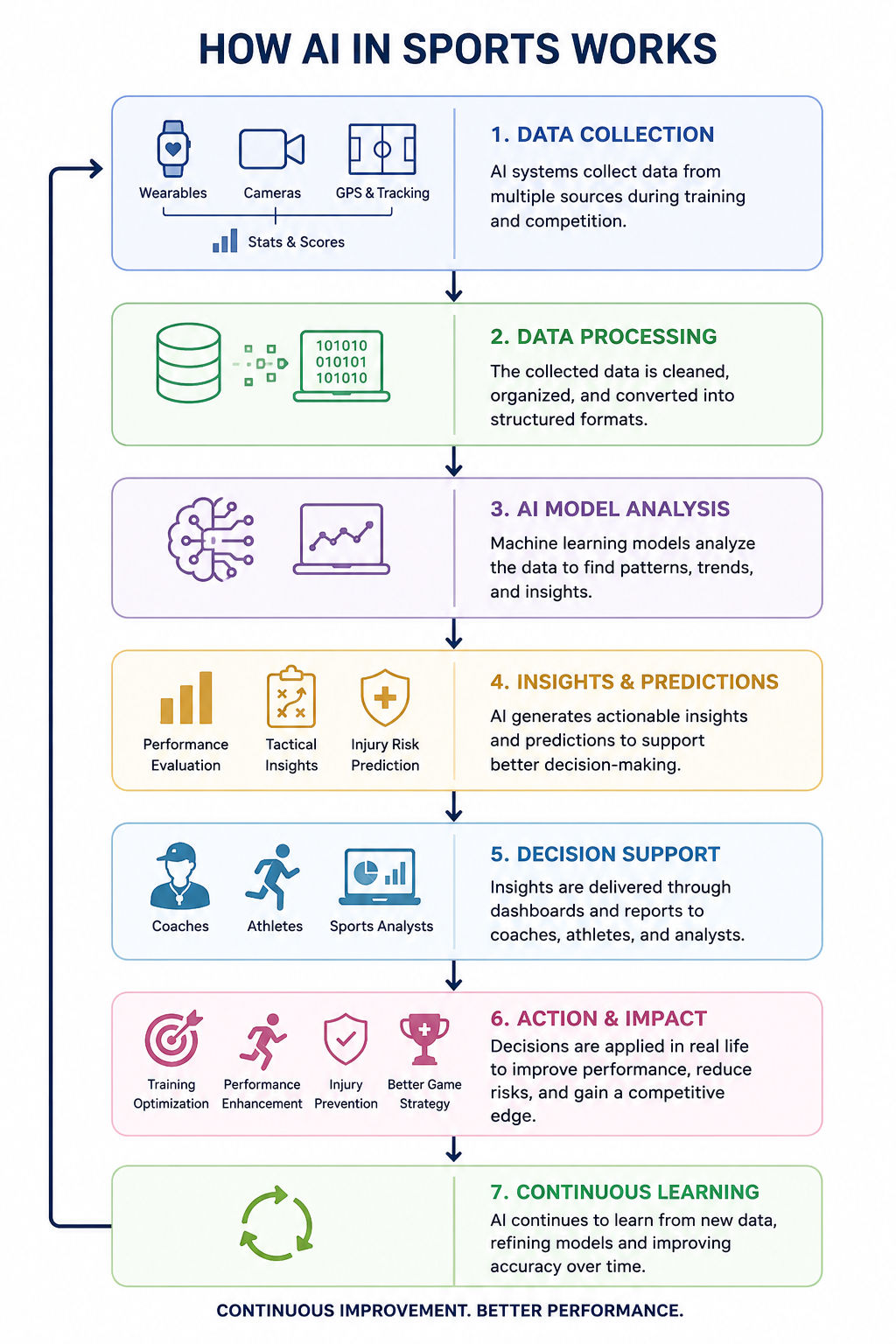
Here is how AI in sports is used:
AI can study an athlete’s past performance, fitness data, match statistics, and training patterns to predict who is likely to improve in the future and how to customise an athlete’s training and preparation plans based on their strengths, weaknesses, and body condition.
This helps teams select talented players early, make smarter selection decisions, and build stronger teams.
AI can watch and study sports videos much faster and more deeper than humans. It uses technologies like computer vision and deep learning to track players, ball movement, speed, positioning, and game actions in detail and analyse this data to find patterns and trends. This helps teams make better decisions during matches and improve their strategies in real time.
AI can also track how players move on the field, how fast they react, and how they perform in different scenarios. This gives coaches a clearer understanding of player performance and overall game flow, which allows them to make better game strategies.
Selectors can use AI to scan thousands of player profiles, filter by specific attributes, and shortlist candidates in a fraction of the time it once took. This also eliminates personal biases towards players and improves the overall team performance.
Tools like Hawk-Eye are helping referees and officials make fairer and more accurate decisions in sports, again eliminating the chances of personal biases.
For example,
AI can predict injuries before they happen. Injuries can cost teams a lot of money because injured players cannot play, ticket sales may drop, and team performance can suffer.
To reduce these issues, teams use AI systems to monitor players’ health and fitness. AI can predict which athletes may have a higher chance of getting injured. Coaches and medical teams can then take early preventive measures, like including more rest, changing their training plan, or improving recovery plans.
For example,
AI is helping sports equipment become more intelligent, accurate, and customised for each athlete, helping them train safer, smarter, and better. Companies like Adidas and Wilson Sporting Goods are using AI technology and sensors to create advanced sports gear that can improve player performance.
For example,
Now coming to the overall fan experience and the other side of this Industry:
AI is helping to make sports events easier, safer, and more enjoyable for fans both inside stadiums and online. AI facial recognition can help fans enter stadiums faster without standing in long ticket-checking lines.
Streaming platforms can use AI to recommend highlights, match clips, and content based on what their fans like to watch. Smart parking systems can use cameras and AI to guide fans to available parking spaces more efficiently. AI can also help manage crowd movement inside stadiums to reduce congestion and improve safety.
AI is changing sports journalism by helping reporters create faster and more detailed match coverage. Using language and data analysis tools, AI can understand fan reactions and can also predict possible match outcomes and player performance trends based on past data.
This technology allows sports news platforms to cover more matches, including smaller local games that may not normally receive much media attention.
In short, here is a list of the AI technologies used:
Technology |
How It Helps Sports |
| Machine Learning | Predicts outcomes and player performance |
| Computer Vision | Tracks player movement through video |
| Wearable Sensors | Measures heart rate, fatigue, and speed |
| Predictive Analytics | Identifies injury risks and match trends |
| Natural Language Processing | Analyzes interviews, commentary, and fan sentiment |
Also Read: From Sixes to Search: Google Brings AI Power to IPL 2026
Free Courses
For a coach, the biggest shift is speed. Before AI, reviewing match footage took hours. Now, a system can flag tactical patterns, poor positioning, and opponent tendencies in minutes. That's the time a coach can spend actually coaching.
For Athletes, the data they now access was once reserved for top-tier professional setups. A club cricketer can track bowling load. A junior sprinter can monitor recovery. The gap between elite and grassroots training is narrowing fast.
Here's what that looks like in practice:
What's changed isn't just the tools, it’s the decision-making culture. Coaches who once relied purely on instinct now combine gut feel with data. That's a smarter approach.
But if there is one thing AI can't do, it is to read a dressing room. It doesn't know if a player is carrying personal stress or playing through a confidence dip. That's still the coach's job. AI handles the numbers. Humans handle the people.
Must Read: Big Data in Sports: How Data-Driven Decisions Are Changing the Game
AI Courses to upskill
Explore Artificial Intelligence Courses for Career Progression
Keeping all this in mind, there are some real problems with AI in sports that teams, leagues, and governing bodies are still figuring out.
Here's a quick breakdown of the main challenges:
Challenge |
Why It Matters |
| Data Privacy | Sensitive athlete data needs clear ownership and protection |
| High Costs | Smaller teams can't access the same tools as elite clubs |
| Algorithmic Bias | Biased training data leads to unfair evaluations |
| Over-reliance on Analytics | Human judgment gets sidelined when it shouldn't be |
| Regulatory Gaps | Governing bodies are still catching up to the technology |
Sports betting adds another layer. AI helps betting operators set better odds and detect suspicious patterns. But it also helps sophisticated bettors exploit market gaps faster than regulators can respond. None of this means AI is wrong for sports. It means sports organisations need to be deliberate about how they adopt it.
Also Read: AI vs. Human Intelligence: Key Differences & Job Impact in 2025
Fans don't just watch sports anymore. They interact with it, analyze it, and consume it across dozens of platforms simultaneously. AI is a big reason why that's possible.
The sports fan experience has changed dramatically. A fan who watched a match on television twenty years ago and a fan streaming a game today with live statistics, instant replays, personalized content, and AI-generated insights are experiencing sports in completely different ways. AI is helping make sports more interactive, accessible, and engaging than ever before.
Do read: Types of AI: From Narrow to Super Intelligence with Examples
Data can tell you a lot, but it cannot understand the human emotion.
That's the tension at the center of AI in sports. The organizations getting it right aren't the ones with the most technology. They're the ones who know when to use it and when to step back.
A coach might have biomechanical data showing a player's output has dropped by 12% over three weeks. The data suggests rest. But the coach knows that player is three matches away from a career milestone and mentally sharper than ever. Who's right? Both. The answer isn't in the algorithm. It's in the conversation between the two.
AI should inform decisions but not make them.
That distinction matters more as the technology gets better. The temptation to defer entirely to a system that processes thousands of data points per second is real. But leadership, team chemistry, pressure handling, and competitive instinct don't show up in dashboards. They show up in moments.
The sports organizations that'll get the most from AI are the ones that treat it as a specialist, not a decision-maker. You bring in a specialist for their expertise. You don't hand them the keys.
Here's what that balance looks like in practice:
The technology is getting better every year. The fundamentals of sport aren't changing. Winning still comes down to preparation, adaptability, and execution under pressure.
Also read: How to Learn Artificial Intelligence: A Step-by-Step Roadmap
AI in sports isn't a future concept. It's already inside training sessions, selection rooms, broadcast studios, and stadiums.
The teams using it well aren't replacing judgment with data. They're using data to make better judgments. That's the shift worth paying attention to. Whether you're a coach, an athlete, a journalist, or a fan, AI is changing how sports works and how you experience it.
Ready to start your journey? Book a free consultation with upGrad today to find the best path for your career.
Yes. Semi-Automated Offside Technology (SAOT) is now used in major football competitions including Euro 2024 and the FIFA Club World Cup 2025. It tracks up to 10,000 data points per player and has cut average offside review time from 70 seconds to roughly 23 seconds, making decisions significantly faster and more accurate.
Access is improving but still uneven. Elite clubs invest heavily in custom AI infrastructure. Smaller teams increasingly use affordable wearables and basic analytics apps, and as costs drop, even local academies are adopting simplified AI motion analysis. The gap is narrowing, but it hasn't closed yet.
Positively. A 2025 Capgemini report found that 59% of sports fans trust AI-generated content, and 54% have shifted from traditional search to AI tools for sports information. One in four fans said they'd pay roughly 8% more for AI-enhanced viewing experiences that include real-time stats and predictive insights.
AI works across both. In tennis, smart rackets track swing speed and shot type and push feedback to a mobile app. In athletics, wearables monitor stride mechanics, heart rate zones, and recovery rates. Individual athletes at professional and semi-professional levels now use the same data-driven tools that were once exclusive to large team setups.
Sports analytics uses structured data, statistics, and AI models to find patterns that human observation misses. Unlike watching footage manually, sports analytics can process thousands of data points simultaneously, track player positioning across an entire season, and flag trends that only become visible at scale. It turns intuition into something measurable.
AI scans large volumes of player data and filters candidates by specific performance attributes in a fraction of the time manual scouting requires. It removes subjective bias from early shortlisting. That said, character, work ethic, and pressure handling still need human assessment. AI handles the first filter. Scouts handle the final judgment.
AI powers real-time graphics, win probability overlays, automatic highlight generation, and personalized content recommendations on streaming platforms. At CES 2025, AWS described using AI metadata from plays and players to give both commentators and fans richer, real-time game context. Formula 1 has used AI via Perplexity to explain technical moments to newer fans mid-race.
Yes. When the X Games partnered with Google Cloud for AI judging in snowboarding in January 2025, it marked the first time AI held an official judging role in a major event. Critics raised concerns about transparency, accountability, and whether subjective elements of sport can be fairly scored by an algorithm. The debate around AI in officiating is still very much open.
It can. Constant performance monitoring creates pressure to hit data benchmarks, which some athletes find dehumanizing. When every metric is tracked and visible to coaches and management, it can shift the focus from development to output. Sports psychologists and coaches increasingly discuss how to use performance data without turning athletes into numbers.
You don't need to be a programmer. You need comfort with data visualization tools, the ability to interpret algorithmic outputs, and an understanding of sports strategy. Courses in data analytics, machine learning, or sports management build the technical foundation. An MBA or agentic AI program adds the strategic layer needed for leadership roles in this space.
The direction is toward greater personalization and real-time application. FIFA has already announced that every player at the 2026 World Cup will be digitally scanned to create AI avatars for tracking precision. Expect AI to move deeper into coaching support, officiating, and fan interactivity, while questions around data ethics and governance will push organizations to build clearer standards.
1141 articles published
We are an online education platform providing industry-relevant programs for professionals, designed and delivered in collaboration with world-class faculty and businesses. Merging the latest technolo...
Speak with AI & ML expert
By submitting, I accept the T&C and
Privacy Policy
Top Resources
Master's Degree
18 Months
Executive Diploma
12 Months
IIIT Bangalore
Executive Programme in Generative AI & Agentic AI for LeadersIndia’s #1 Tech University
Dual Certification
5 Months