Top 10 Agentic AI Project ideas
By Vikram Singh
Updated on Aug 14, 2026 | 3 min read | 26.55K+ views
Share:

All courses
Certifications
More
By Vikram Singh
Updated on Aug 14, 2026 | 3 min read | 26.55K+ views
Share:
Table of Contents
Agentic AI projects ideas focus on building intelligent systems that can reason, plan, use tools, and complete complex tasks with minimal human input. These systems go beyond basic chatbots by working autonomously across multiple steps, making decisions along the way.
Popular examples of agentic AI projects include
These agentic AI project ideas help developers understand how autonomous AI agents can plan, reason, and execute tasks using LLMs and frameworks like LangGraph and CrewAI.
As businesses and developers adopt this technology, the demand for skilled professionals is rising fast.
Want to build and deploy your own agentic AI solutions? Enroll in our Agentic AI courses and start your journey today.
Agentic AI Courses to upskill
Explore Agentic AI Courses for Career Progression
IIIT Bangalore
Executive Diploma in Machine Learning and AI360° Career Support
Agentic AI projects focus on building smart systems that can think, plan, and act on their own to complete tasks. Below are some of the best AI agent project ideas that show how autonomous agents solve real-world problems with minimal human input.
Ready to turn ideas into real-world Agentic AI projects? Our expert-led programs give you hands-on skills to design and build autonomous AI systems used in real industries.
Enroll now to future-proof your career:
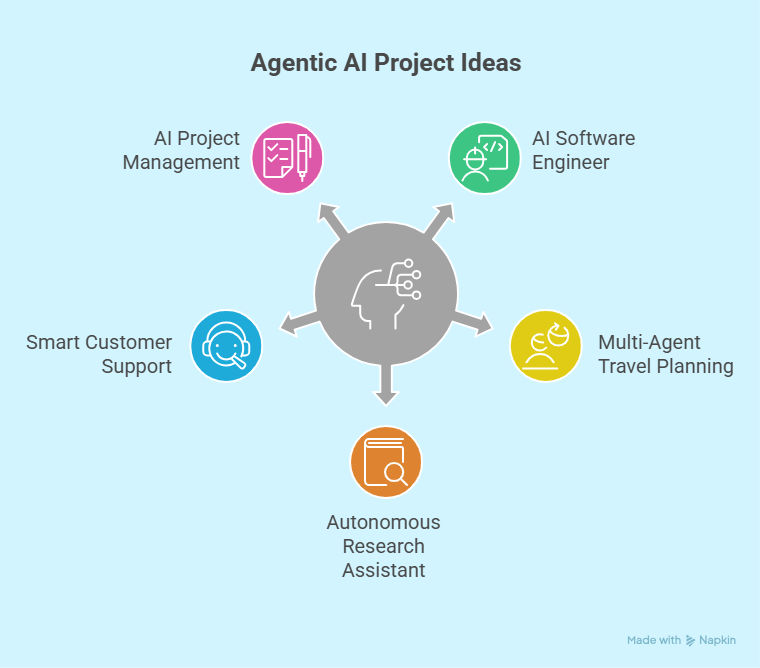
This agent works like a virtual software engineer that can write, review, and improve code on its own. It helps developers speed up development while maintaining code quality.
Also Read: Top Agentic AI Books
This AI agent project plans complete trips by coordinating multiple agents for bookings and scheduling. It creates optimized travel plans based on user preferences and budget.
Related Article: Top Agentic AI Tools
This agent helps users collect, analyze, and summarize information from multiple sources. It saves time by delivering accurate and structured research outputs.
Dive Deeper: Knowledge-Based Agents in AI
This agent handles customer questions and issues without constant human involvement. It improves response time while maintaining consistent support quality.
Explore More: Agentic AI Frameworks to Build Intelligent AI Agents
This agent tracks tasks, deadlines, and team progress in real time. It helps teams stay organized and meet project goals efficiently.
Must Read: How Is Agentic AI Different from Traditional Virtual Assistants?
This AI agent project supports users in managing budgets and financial goals. It provides smart insights based on spending patterns and income.
This agent automates resume screening and candidate shortlisting. It helps HR teams hire faster and more efficiently.
This agent combines retrieval and reasoning to deliver meaningful insights from large datasets. It improves decision-making by providing accurate data summaries.
Also Read: Top Computer Science Project Ideas for Beginners & Final-Year Students (2026)
This agent plans, executes, and optimizes marketing campaigns automatically. It adapts strategies based on performance data and trends.
This agent monitors systems and resolves issues before they become critical. It ensures system stability and reduces downtime.
In the case of agentic AI training, learners are required to develop autonomous systems that are able to reason and execute multiple-step activities with minimal supervision. Such projects are not limited to developing chatbots but also include training on real-world agent orchestration and tool integration.
Some of the projects that learners may work on include:
Agentic AI projects differ from normal AI projects because they are designed to think, plan, and act autonomously, rather than just respond to inputs.
1. Level of Autonomy
Normal AI systems are reactive and need constant user input, while agentic AI systems can make decisions and take actions independently.
2. Goal-Oriented Behavior
Normal AI focuses on single tasks like prediction or classification. Agentic AI focuses on achieving multi-step goals by breaking them into smaller actions.
3. Multi-Step Reasoning
Agentic AI can plan and execute multiple steps using memory and logic, whereas normal AI usually handles one-step outputs.
4. Tool Usage
Normal AI has limited integration with external tools, while agentic AI can use APIs, databases, and search tools to complete tasks.
5. Memory and Workflow Execution
Agentic AI maintains context across steps and follows a full workflow (plan → act → refine → complete), while normal AI typically generates a single response and stops.
Also Read: Agentic AI Architecture: Components, Workflow, and Design
Agentic AI projects are highly valuable for your portfolio because they demonstrate your ability to build autonomous, real-world AI systems that go beyond basic models or chatbots.
Also Read: Top Agentic AI Tools in 2026 for Automated Workflows
When you present agentic AI projects in your portfolio, keep things simple, clear, and practical. Don’t try to sound too technical everywhere, just explain what you did and why it matters.
Here’s a good way to structure it:
Yes, most modern Agentic AI training programs are designed to go beyond theory and include real-world, hands-on projects where learners build autonomous systems that can plan, reason, and execute tasks. Instead of just learning concepts, you work on practical applications like AI research assistants, RAG-based systems, workflow automation agents, and multi-agent collaboration setups.
These projects help you understand how agentic systems behave in real environments, how they break down goals, use tools, interact with APIs, and improve outcomes through feedback loops. You also gain experience with frameworks like LangChain, LangGraph, and other agent orchestration tools used in production-level AI systems.
Such hands-on learning is essential because it bridges the gap between understanding agentic AI and actually building deployable solutions that can be used in industries like automation, analytics, customer support, and software engineering.
Agentic AI projects represent the next stage of artificial intelligence, where systems can plan, reason, and act independently to solve complex problems. From software development and research to finance and operations, these AI agent projects are already transforming how work gets done across industries.
Learning how to build and manage such autonomous systems can open strong career opportunities in AI and data-driven roles. As demand for skilled professionals continues to grow, now is the right time to upskill and stay ahead of the curve.
Schedule a free counseling session with upGrad experts today and get personalized guidance to start your Agentic AI journey.
Agentic AI projects focus on building autonomous systems that can think, plan, and act independently. These systems use large language models to handle multi-step tasks with minimal human input. They are designed to achieve goals rather than just respond to commands.
Traditional AI systems mostly react to user inputs and follow predefined rules. In contrast, agentic AI projects can make decisions, plan actions, and adjust their behavior based on feedback. This makes them more suitable for complex and dynamic tasks.
Popular examples include AI software assistants like Coder Buddy, multi-agent travel planners, and RAG-based data analysis agents. These AI agent project examples show how autonomous agents solve real-world problems efficiently. They are widely used across industries.
Yes, agentic AI is already used in customer support, IT operations, analytics, and software development. Many companies use these systems to automate workflows and improve productivity. Their adoption is growing rapidly.
LLMs help agentic AI systems understand context, reason through problems, and generate actions. They act as the core decision-making engine for the agent. This enables planning, execution, and learning from outcomes.
Frameworks such as LangGraph, CrewAI, and AutoGen are widely used in agentic AI projects. These tools help manage agent workflows, memory, and multi-agent coordination. They simplify the development of autonomous systems.
Beginners can start by learning basic programming and understanding how LLMs work. Simple AI agent project ideas like research assistants or task planners are ideal starting points. Hands-on practice helps build confidence quickly.
Basic coding knowledge is enough to begin working on agentic AI projects. As projects grow in complexity, skills in Python, APIs, and AI frameworks become important. Continuous learning helps handle advanced use cases.
Industries such as IT, finance, healthcare, marketing, and e-commerce benefit greatly. Agentic AI projects help automate decisions, analyze data, and reduce manual effort. This leads to better efficiency and scalability.
Agentic AI is designed to support humans rather than fully replace them. These systems handle repetitive and complex tasks while humans focus on strategic decisions. This creates better collaboration between humans and AI.
Multi-agent systems involve multiple AI agents working together on different tasks. Each agent has a specific role and coordinates with others. This approach improves efficiency in complex workflows.
Yes; today, there are several courses available that make use of no-code tools like LangFlow and Flowise in teaching AGI. These tools are in line with upGrad’s project-based approach in that they make use of visual workflows and prompts in creating advanced autonomous systems and specialized chatbots without the need for programming skills in traditional software applications.
Many structured learning paths incorporate hands-on projects where learners design, test, and optimize autonomous agents for practical use cases such as workflow automation, RAG systems, and multi-agent coordination, helping bridge the gap between theory and real-world implementation.
Companies hiring AI professionals skilled in agentic systems include leading tech firms like Google, Microsoft, and Amazon, along with AI-focused startups and consulting firms. Industries such as healthcare, finance, and robotics actively seek experts to build autonomous, decision-making AI systems.
Yes, many beginner-friendly Generative AI and agentic AI courses now teach autonomous agent development without requiring advanced coding skills. These programs focus on no-code or low-code AI tools, prompt engineering, workflow automation, and AI agent orchestration, making them accessible to non-technical learners and business professionals.
150 articles published
Vikram Singh is a seasoned content strategist with over 5 years of experience in simplifying complex technical subjects. Holding a postgraduate degree in Applied Mathematics, he specializes in creatin...
Speak with AI & ML expert
By submitting, I accept the T&C and
Privacy Policy