Autonomous AI Agent: How Intelligent Systems Make Decisions Without Constant Human Input
By Sriram
Updated on Oct 21, 2026 | 8 min read | 7.39K+ views
Share:

All courses
Certifications
More
By Sriram
Updated on Oct 21, 2026 | 8 min read | 7.39K+ views
Share:
Table of Contents
An autonomous AI agent is an intelligent system that uses a large language model (LLM) to understand objectives, interpret information, and make decisions with minimal human guidance. Instead of following fixed instructions, it can adapt its actions based on the situation and desired outcome.
These agents can break complex goals into smaller tasks, create action plans, use external tools, and execute workflows independently. By continuously analyzing results and adjusting their approach, they can complete multi-step tasks more efficiently and with less human involvement.
In this guide, you'll learn what is autonomous agent in AI, how these systems work, their key components, real-world applications, advantages, limitations, and what the future holds for autonomous intelligence.
Want to build systems that break down goals and complete tasks with little human input? Take your first step with upGrad’s Generative AI and Agentic AI programs Online and learn through practical projects.
Agentic AI Courses to upskill
Explore Agentic AI Courses for Career Progression
IIIT Bangalore
EPGP in Applied AI and Agentic AIIIIT Bangalore
Executive Diploma in Machine Learning and AI360° Career Support
The simplest answer to what is autonomous agent in AI is that it is an AI system that can make decisions and take actions independently to achieve specific goals.
Traditional software follows a set of instructions. Autonomous agents are different. They constantly analyze data, consider possible actions and choose the most appropriate action according to their goals.
Imagine a navigation app. A traditional system might just show a route. An autonomous agent can monitor traffic conditions, detect accidents, reroute the journey, estimate delays and continuously optimize travel time without requiring manual adjustments.
An autonomous AI agent typically performs four key functions:
Function |
Purpose |
| Perception | Collects information from the environment |
| Reasoning | Analyzes data and evaluates options |
| Decision Making | Chooses the best action |
| Execution | Performs actions and monitors outcomes |
The level of autonomy can vary significantly.
Some agents perform narrowly defined tasks, while others manage complex workflows involving multiple systems and decision points.
For example:
The defining characteristic remains the same. The system actively works toward a goal rather than waiting for every instruction.
Must read: AI Agent vs AI Assistant: What’s the Real Difference?
Learning how an autonomous AI agent works helps explain why these systems have become so valuable across industries.
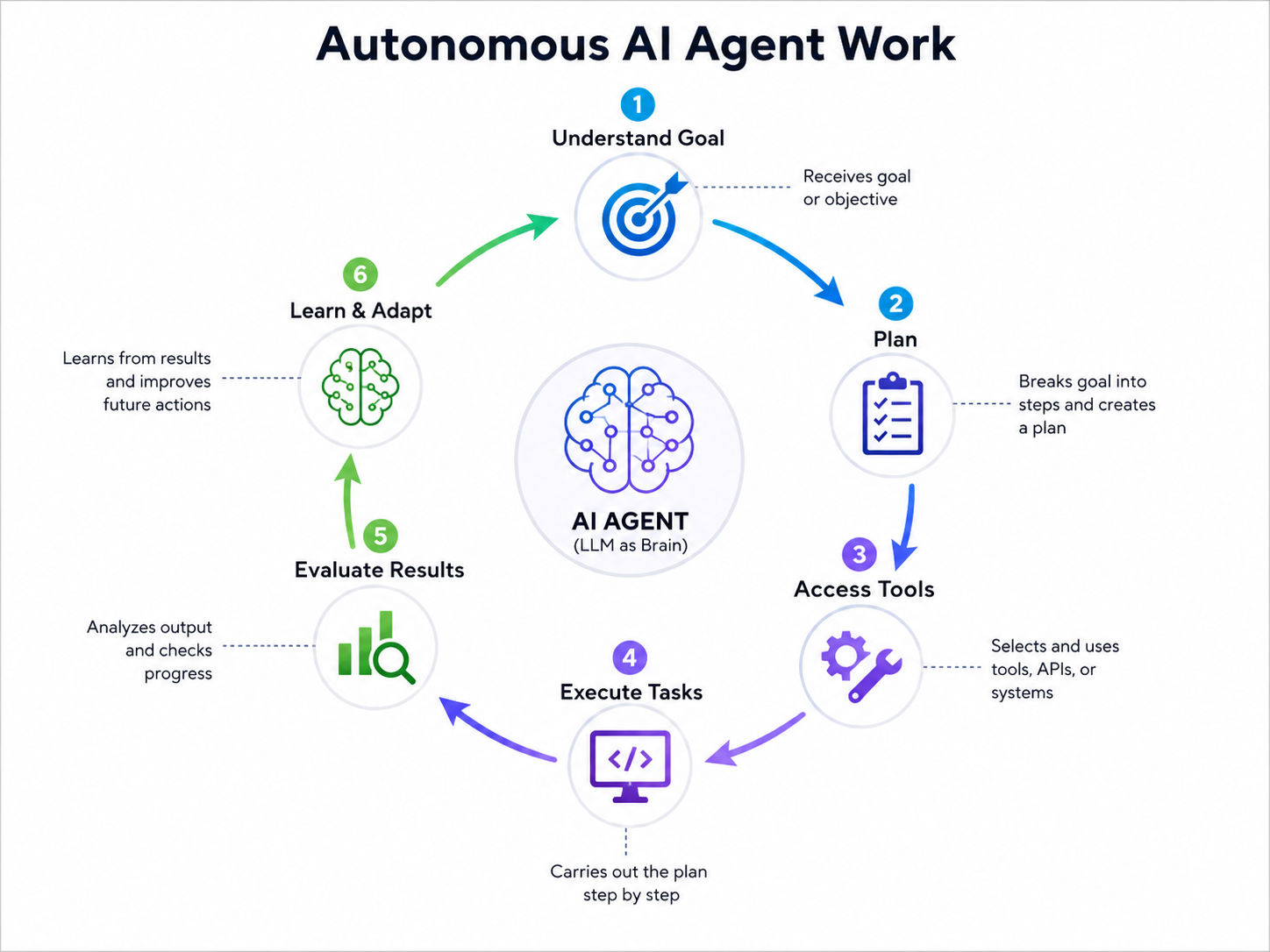
Most autonomous agents operate with a continuous decision cycle.
The agent first gathers information from various sources.
Depending on the application, this information may come from:
For example, an AI-powered logistics agent may monitor:
The quality of decisions largely depends on the quality of incoming information.
After collecting information, the agent evaluates the current situation.
Machine learning models, large language models, rule engines, and reasoning frameworks help the system interpret data and identify meaningful patterns.
At this stage, the agent answers questions such as:
The agent then creates a plan.
Instead of reacting immediately, advanced systems evaluate multiple options before selecting an action.
For example, an AI project management assistant might decide whether to:
The chosen action should maximize the likelihood of achieving the desired goal.
Once a plan is selected, the agent performs the required actions
Execution may involve:
One reason autonomous agents are powerful is their ability to learn from outcomes.
Feedback mechanisms help them determine whether decisions produced successful results.
Over time, the agent can improve performance, reduce errors, and adapt to changing conditions.
This continuous feedback loop creates systems that become more effective through experience.
Do read: Agentic AI Certification
Several technologies work together to make autonomous behavior possible.
While architectures differ, most agents include similar foundational components.
Component |
Role |
| Memory | Stores information and past interactions |
| Planning Engine | Creates action strategies |
| Reasoning System | Evaluates options and decisions |
| Learning Module | Improves performance over time |
| Tool Integration | Connects with external systems |
| Goal Manager | Tracks objectives and priorities |
Memory allows the agent to retain context.
Without memory, the system would treat every interaction as completely new.
Modern agents often use:
This enables more informed decision-making.
Planning separates autonomous agents from simple chatbots.
The system can break larger goals into smaller tasks and determine the best sequence of actions.
For example, an AI recruitment agent may:
Each step contributes toward a broader objective.
Autonomous agents become significantly more useful when connected to external tools.
Examples include:
This allows agents to move beyond recommendations and perform real-world actions.
Environments constantly change.
Agents that can learn from feedback become more resilient and effective over time.
This capability is particularly valuable in dynamic fields such as finance, logistics, and cybersecurity.
Must read: Agentic Workflows: A Guide to AI-Powered Autonomous Execution
Autonomous AI agents are already transforming multiple industries.
Their ability to handle decision-making and execution makes them suitable for a wide range of use cases.
AI agents can manage customer interactions around the clock.
They can:
This reduces response times and improves customer experience.
Development teams increasingly use autonomous coding agents.
These systems can:
Developers remain responsible for oversight, but routine tasks become significantly faster.
Security operations centers generate huge volumes of alerts.
Autonomous agents help by:
Monitoring networks
This improves response speed during security incidents.
Healthcare organizations use autonomous systems for:
Human professionals still make critical decisions, but AI reduces administrative workload.
Supply chains involve constant decision-making.
Autonomous agents can optimize:
Small improvements in these areas often create substantial operational savings.
Also read: What is Supply Chain Management: Components, Process & Benefits
Autonomous AI agents can greatly enhance productivity and decision-making, but they also present new operational and governance issues. Organizations that understand the benefits and limitations are better able to deploy these systems effectively.
It helps organisations automate complex workflows, while minimizing the need for constant human supervision. They can analyze information, make decisions and take action, which can increase efficiency, scalability and overall performance of operations.
One of the major benefits of autonomous AI agents is that they can work around the clock without breaks or supervision. They’re good at repetitive tasks, working on massive amounts of data, and can do workflows much faster than manual processes.
For example, a customer support agent can answer thousands of routine questions at once, reducing wait times and freeing up human teams to handle complicated issues.
As operations expand, additional staff and resources are often required to handle increasing workloads. Autonomous agents allow organizations to scale more effectively by automating mundane activities across departments.
Whether it’s processing invoices, monitoring IT systems or managing customer interactions, agents can help to meet growing demand without a corresponding increase in operational costs.
Many industries depend on quick responses to changing conditions. Autonomous agents analyze data in real time and act immediately when predefined objectives or thresholds are met.
This capability is particularly valuable in areas such as:
Unlike humans, autonomous agents do not experience fatigue or fluctuations in performance. They apply the same logic and decision-making framework across every task, helping organizations maintain consistent outcomes and standardized processes.
Despite their advantages, autonomous systems are not perfect. Several challenges must be addressed before deploying them at scale.
AI agents can occasionally make incorrect decisions due to incomplete information, poor data quality, or flawed reasoning. In highly automated environments, even small errors can affect multiple downstream processes.
Organizations should implement validation mechanisms and human review processes for critical decisions.
Although modern AI models are becoming more capable, they may still struggle with nuanced situations, changing business priorities, or uncommon scenarios.
For instance, an autonomous customer service agent might technically answer a query correctly but fail to recognize customer frustration or unique circumstances that require human judgment.
Autonomous AI agents often interact with sensitive business systems, customer records, and proprietary data. If access controls are weak, these systems can create security vulnerabilities.
Key security considerations include:
| Security Area | Why It Matters |
| Access Control | Prevents unauthorized actions |
| Data Protection | Safeguards sensitive information |
| Audit Trails | Tracks agent activities |
| Threat Monitoring | Detects misuse or compromise |
As agents gain greater autonomy, organizations must establish clear governance frameworks to ensure responsible operation.
Important governance areas include:
The best AI applications don’t rely on pure automation or human action. Instead, they combine the speed and scalability of autonomous AI agents with human expertise for oversight, exception handling and strategic decision-making.
This balanced approach enables organizations to achieve the benefits of autonomy while minimizing operational, security and compliance risks.
Explore: Top 10 Agentic AI Project ideas
The next generation of AI systems will likely
(1) move beyond single-purpose agents and
(2) toward collaborative ecosystems of specialized agents.
Rather than one AI doing all the work, organizations might use networks of agents that work collectively.
For instance:
Large language models are still making progress in reasoning, planning, memory and tool use abilities. As these technologies become more mature autonomous agents will become more capable of handling sophisticated workflows across industries.
But more autonomy will also bring a need for more governance, transparency, accountability and human oversight.
The future probably won’t be one of autonomous systems replacing humans. More realistic is human-AI collaboration, where agents handle routine operations and humans concentrate on strategy, creativity and complex judgment.
Must read: Latest AI News and Updates - Stay Ahead in the AI Revolution
Conclusion
Autonomous AI Agents take automation a step further by analyzing information, making decisions and taking action on their own, to achieve specific goals. With the advancement of AI technology, these systems are becoming increasingly relevant in industries.
Knowing what an AI autonomous agent is equips professionals and students for a future where intelligent agents will assist business operations, software development, customer service, and other complex workflows. They still have their own challenges, but their power to boost efficiency and decision-making is only increasing.
Want personalized guidance on AI and upskilling? Speak with an expert for a free 1:1 counselling session today.
Yes, some autonomous AI agents can operate without internet access if they are deployed locally and have access to the required models, data, and tools. However, agents that rely on real-time information, cloud services, or external APIs usually need internet connectivity to perform tasks effectively and keep their outputs current.
AI copilots primarily assist users by providing suggestions, recommendations, or generated content while keeping humans in control of decisions. Autonomous AI agents go further by planning tasks, making decisions, and executing actions independently. The key difference lies in the level of autonomy and responsibility assigned to the system.
In most cases, autonomous AI agents do not replace employees entirely. Instead, they automate repetitive and time-consuming activities, allowing people to focus on strategy, problem-solving, and customer interactions. Organizations often use agents to improve productivity rather than eliminate human involvement altogether.
Developers frequently use Python because of its extensive AI and machine learning ecosystem. Other languages such as JavaScript, Java, and C# are also used depending on the application. Framework selection often depends on scalability requirements, deployment environments, and integration needs.
Yes. Small businesses can use autonomous agents for customer support, appointment scheduling, lead qualification, content management, and administrative tasks. Many cloud-based solutions now make AI agents accessible without requiring large development teams or significant infrastructure investments.
Most agents rely on reasoning models, predefined constraints, and historical information to respond to unfamiliar scenarios. However, they may still struggle with highly unusual situations. For this reason, organizations often implement escalation mechanisms that transfer complex cases to human operators when needed.
Industries with large amounts of data and repetitive workflows are leading adoption. These include software development, customer service, cybersecurity, financial services, healthcare administration, logistics, and e-commerce. The ability to automate decision-making processes makes autonomous agents particularly valuable in these sectors.
Memory allows agents to retain context from previous interactions and tasks. This helps them make more informed decisions, avoid repeating actions, and maintain continuity across workflows. Advanced systems often combine short-term memory for active tasks with long-term memory for historical knowledge.
Developers should understand machine learning fundamentals, large language models, API integrations, prompt engineering, vector databases, and agent orchestration frameworks. Knowledge of software architecture and cloud deployment also becomes increasingly important when building production-ready agent systems.
They can be, but organizations must implement strong governance and compliance controls. Industries such as healthcare, banking, and insurance often require audit trails, human review processes, data protection measures, and transparent decision-making practices before deploying autonomous systems at scale.
The focus is shifting from single-purpose agents to multi-agent systems that collaborate to complete complex tasks. Future agents will likely have better reasoning, stronger memory capabilities, improved tool usage, and deeper integration with enterprise software, enabling them to handle more sophisticated workflows while working alongside human teams.
720 articles published
Sriram K is a Senior SEO Executive with a B.Tech in Information Technology from Dr. M.G.R. Educational and Research Institute, Chennai. With over a decade of experience in digital marketing, he specia...
Speak with AI & ML expert
By submitting, I accept the T&C and
Privacy Policy