Agentic AI Learning Path: A Complete Guide for Developers and AI Professionals
By Sriram
Updated on Oct 21, 2026 | 6 min read | 5.89K+ views
Share:

All courses
Certifications
More
By Sriram
Updated on Oct 21, 2026 | 6 min read | 5.89K+ views
Share:
Table of Contents
To truly master Agentic AI, you need to do more than feed simple prompts to large language models. It consists of learning how to build intelligent systems that can reason, plan tasks, use external tools, and complete multi-step workflows with little human intervention.
To start a practical learning journey, begin with Python programming, machine learning fundamentals, and LLM concepts. From there, students can explore retrieval systems, agent frameworks such as LangGraph and CrewAI, and hands-on projects that simulate real-world business and automation scenarios. This incremental approach helps cultivate the abilities necessary to build effective AI agents.
This guide explains the complete agentic AI learning path, including foundational concepts, technical skills, tools, frameworks, and project ideas.
Building AI that can reason, plan and use tools takes more than self-study. Get structured guidance with upGrad’s Generative AI Courses Online and learn through practical, real-world projects.
Agentic AI Courses to upskill
Explore Agentic AI Courses for Career Progression
IIIT Bangalore
EPGP in Applied AI and Agentic AIIIIT Bangalore
Executive Diploma in Machine Learning and AI360° Career Support
Before you embark on an agentic AI learning path, it is important to understand what makes an AI system agentic.
Generally, traditional AI models take a prompt and output something. An agentic AI system takes it a step further. Yes it can:
Imagine the difference between a chatbot and a travel planning agent.
A chatbot can answer questions about flights. An AI agent can hunt down flight options, check prices, generate an itinerary, make reservations via integrated systems, and alert users about schedule changes.
This move away from response generation towards autonomous action is why agentic AI has become a key area of focus across industries.
Key Characteristics of Agentic AI :
Capability |
Traditional AI |
Agentic AI |
| Responds to prompts | Yes | Yes |
| Multi-step reasoning | Limited | Advanced |
| Tool usage | Rare | Core feature |
| Planning | Minimal | Extensive |
| Autonomous execution | No | Yes |
| Memory retention | Limited | Often included |
Organizations are increasingly investing in AI agents because they can automate complex workflows rather than isolated tasks.
As a result, professionals who understand agent architectures, orchestration frameworks, and decision-making systems are becoming highly valuable.
Must read : Agentic AI Design Patterns: Building Smarter AI Systems
A common mistake that learners make is to jump straight into agent frameworks. Solid foundations are essential to successful AI agent development in practice.
A well-designed learning path for agentic AI begins with core technical competencies.
Python is still the language of choice for AI development.
You need to feel okay with:
Practical Python skills are essential because agents often interact with multiple external services.
You don’t need to be a machine learning researcher, but you should know:
These concepts help explain how modern AI systems retrieve and process information.
Since most AI agents rely on LLMs as their reasoning engine, learners should be aware of:
For example, agents can hallucinate, misinterpret goals, or make bad decisions with incomplete information.
In the real world agents rarely act alone.
They often refer to:
Learning how APIs work means agents can interact effectively with external tools.
Memory is often necessary for agentic systems.
This might be:
Developers need to know:
The skills are the technical foundation for any serious agentic AI roadmap.
A structured learning approach helps you build agentic AI skills progressively. The stages below cover LLMs, retrieval systems, agent frameworks, and deployment, providing a practical path toward developing autonomous AI applications.
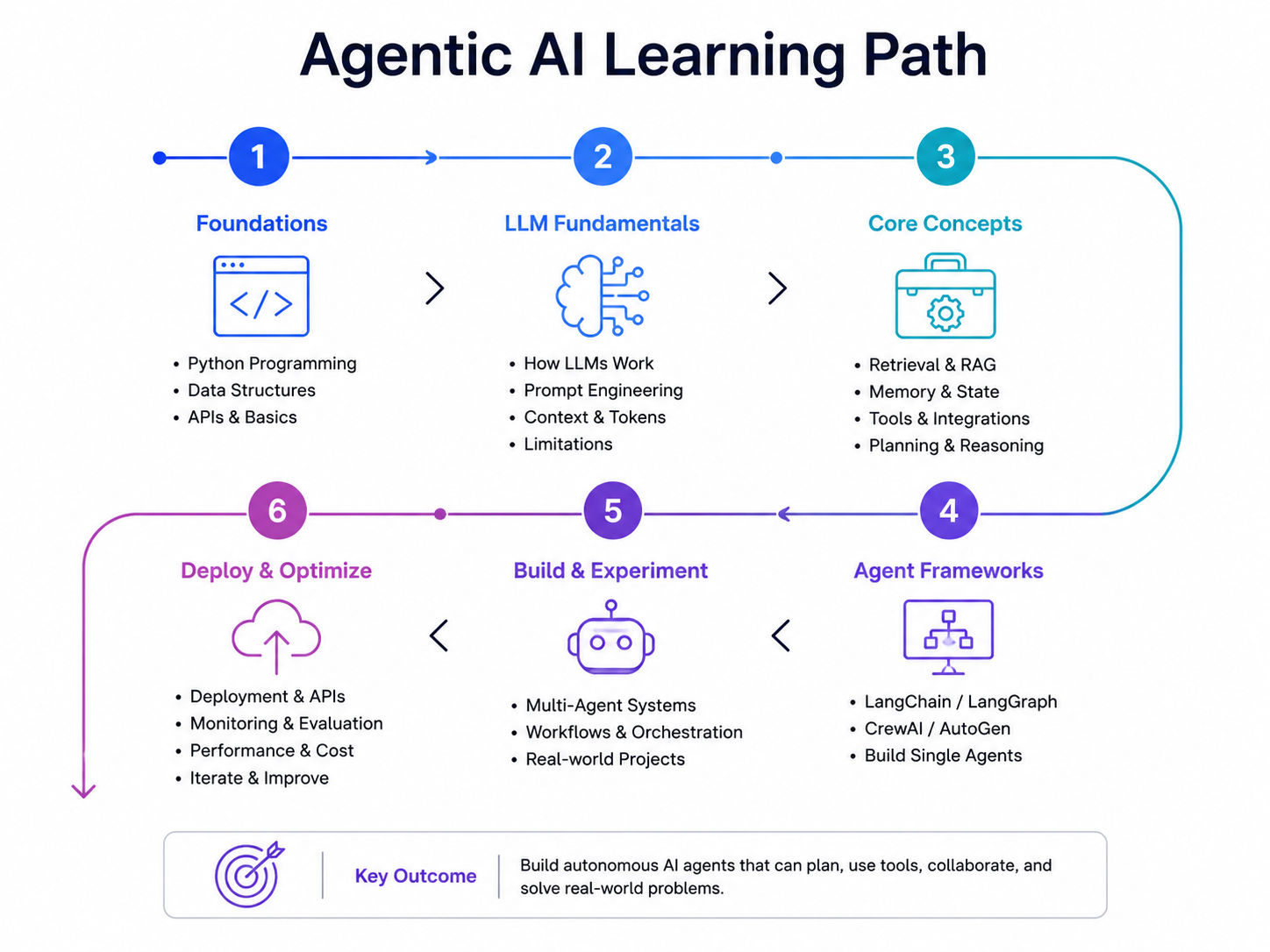
The following progression works well for most developers and AI professionals.
Start by building simple AI applications.
Projects might include:
Focus on understanding prompt design and model behavior.
RAG serves as the backbone for many modern agents.
Key topics include:
Without retrieval systems, agents often struggle with accuracy and current information.
This stage introduces core agent concepts:
You'll begin understanding how agents make decisions instead of simply generating text.
Several frameworks simplify agent development.
Popular options include:
Framework |
Primary Use |
| LangChain | Agent workflows |
| LangGraph | Stateful agent systems |
| CrewAI | Multi-agent collaboration |
| AutoGen | Conversational agents |
| Semantic Kernel | Enterprise AI applications |
Each framework approaches orchestration differently.
For example, LangGraph provides greater control over state transitions, while CrewAI focuses heavily on multi-agent teamwork.
Single agents work well for many tasks.
However, larger workflows often require multiple specialized agents.
Examples include:
This mirrors how human teams divide responsibilities.
Production environments introduce new challenges.
Developers must consider:
An impressive prototype may fail in production if these factors are ignored.
This practical stage separates experimentation from real-world implementation.
Yes. A well-rounded agentic AI learning path should cover responsible AI practices, including agent monitoring, decision traceability, evaluation frameworks, and governance principles. These skills help learners build AI agents that are transparent, reliable, and aligned with organizational and regulatory requirements.
Yes. A comprehensive agentic AI learning path should include responsible AI principles alongside technical skills. Learners should understand bias detection, data privacy, AI governance, safety guardrails, explainability, and human oversight while building autonomous agents. These concepts help ensure AI systems are transparent, reliable, and ready for enterprise deployment, making them an essential part of modern Agentic AI programs such as those offered by upGrad.
Are ethics and responsible AI part of AI training? Yes, most modern AI training programs include ethics and responsible AI as core topics. Learners are introduced to concepts such as AI bias, fairness, data privacy, transparency, explainability, governance, and human oversight. Understanding these principles helps professionals build AI systems that are compliant, trustworthy, and suitable for real-world business and enterprise applications.
The modern agent ecosystem evolves quickly, but certain tools consistently appear across projects.
A balanced agentic AI learning path should include exposure to the following technologies.
LLM Providers
Learning multiple ecosystems improves flexibility.
A strong agentic AI skill set requires familiarity with the tools that power modern AI agents. These technologies help developers build, deploy, monitor, and scale autonomous systems.
Category |
Popular Tools |
| Agent Development Frameworks | LangChain, LangGraph, CrewAI, AutoGen, Semantic Kernel |
| Vector Databases | Pinecone, Weaviate, Chroma, Milvus |
| Cloud Platforms | AWS, Microsoft Azure, Google Cloud Platform (GCP) |
| Observability & Monitoring Tools | LangSmith, Arize AI, Weights & Biases |
Why these tools matter:
Monitoring becomes increasingly important as agents gain autonomy.
Without proper observability, debugging complex agent behavior can become extremely difficult.
Many professionals choose an agentic ai course to gain structured exposure to these technologies while working on guided projects.
How long do agentic/Gen AI courses typically take to complete? The time required to complete a Generative AI or Agentic AI course depends on its depth and learning format. Short certification programmes generally take 3 to 6 months, while executive and advanced programmes typically span 6 to 12 months, covering LLMs, prompt engineering, RAG, AI agents, multi-agent workflows, evaluation, and deployment through hands-on projects. A structured programme with consistent weekly practice helps learners progress from AI fundamentals to production-ready applications.
Choosing the right Agentic AI course depends on your current experience. Beginners should start with Python fundamentals, prompt engineering, LLM basics, and Retrieval-Augmented Generation (RAG) before progressing to AI agents. Advanced learners can focus on multi-agent systems, orchestration frameworks like LangGraph and CrewAI, AI evaluation, deployment, and production-ready workflows.
If you're looking for structured, hands-on learning, upGrad's Agentic AI programmes are designed with different experience levels in mind, helping learners progress from foundational concepts to enterprise-grade AI agent development through practical projects and industry-relevant curriculum.
Also read: Top 10 Agentic AI Frameworks to Build Intelligent AI Agents in 2026
The quickest route to agentic AI mastery is implementation. Theory is useful, but projects expose real-world issues.
Here are some great project ideas by skill level.
1. Beginner Projects
2.Intermediate Projects
3.Advanced Projects
Consider a customer support scenario.A simple chatbot answers FAQs.
An advanced agent can:
Building projects like these develops skills that employers increasingly seek.
Do Read: Top 10 Agentic AI Project ideas
Learning agentic AI involves more than understanding frameworks and models. As projects become more complex, developers often encounter challenges related to reliability, cost, decision-making, and system performance in real-world environments.
A lot of marketing material says agents can solve any problem by themselves.
In reality, what good systems still need:
Decision quality may decline as the number of connected tools increases.
Poor orchestration of tools can lead to performance issues.
Large scale agent execution can get expensive.
Cost is added with every reasoning step, with an API call, retrieval, and model invocation.
Sometimes agents:
Knowing these limitations makes you a better practitioner.
An ambitious agentic ai roadmap involves developing skills in designing safeguards and monitoring systems and evaluation frameworks, in addition to development skills.
To know more: A Complete Guide on Agent Systems
Conclusion
The best learning pathway for agentic AI is one that combines strong technical foundations with hands-on experimentation. Begin with Python, fundamentals of ML, APIs and concepts of LLM. Then move into retrieval systems, agent architectures, orchestration frameworks, and deployment practices.
As organizations increasingly adopt autonomous AI systems, the demand for professionals who can build, manage and evaluate AI agents is growing. Whether you are a developer, a data scientist or an AI enthusiast, following a structured learning journey combined with practical projects will help you build expertise that will remain relevant as the technology evolves.
Want personalized guidance on AI and upskilling? Speak with an expert for a free 1:1 counselling session today.
The timeline depends on your background. If you already know Python and basic machine learning, you can start building simple AI agents within a few weeks. Reaching a level where you can design, deploy, and monitor production-ready agent systems often takes several months of consistent practice. Building projects and experimenting with frameworks usually speeds up learning more than watching tutorials alone.
Not necessarily. You do not need to train deep learning models from scratch to build AI agents. However, understanding concepts like embeddings, vector search, prompting, and model limitations will help you make better design decisions. A basic understanding of machine learning creates a stronger foundation for long-term growth.
Python remains the most widely used language for agentic AI projects. Most popular frameworks, libraries, and AI tools offer strong Python support. While other languages can be used, learning Python gives you access to the largest ecosystem of AI development resources, examples, and community support.
Yes. Even though modern agents automate many tasks, prompt design still affects performance. Clear instructions help agents select tools correctly, follow workflows, and avoid unnecessary actions. Poor prompts can lead to inaccurate outputs, inefficient reasoning steps, or unexpected behavior during execution.
A chatbot mainly responds to user queries. An AI agent can take actions beyond conversation. For example, it may search databases, use external tools, analyze documents, schedule tasks, or complete workflows. The key difference lies in autonomous decision-making and task execution rather than simple response generation.
Many beginners start with LangChain because it introduces key concepts such as prompts, chains, tools, and memory. After understanding these fundamentals, frameworks like LangGraph, CrewAI, and AutoGen become easier to learn. The best choice depends on whether you want to build single-agent systems or collaborative multi-agent applications.
Yes. Many developers use open-source language models for experimentation and learning. Local models can help you understand agent architectures without incurring API costs. However, performance, reasoning ability, and context handling may vary depending on the model and available hardware resources.
Common challenges include tool failures, hallucinated outputs, workflow loops, memory management issues, and rising inference costs. Many developers discover that creating a reliable agent is harder than creating a working prototype. Testing, monitoring, and evaluation often require as much attention as development itself.
Not always. Multi-agent systems can improve task specialization and scalability, but they also introduce additional complexity. Communication overhead, coordination issues, and debugging challenges increase as more agents interact. For many business use cases, a well-designed single agent may perform just as effectively.
Organizations in customer support, finance, healthcare, software development, logistics, education, and enterprise operations are exploring agent-based systems. Companies often use agents to automate repetitive workflows, improve research processes, assist employees, and reduce manual coordination across multiple business functions.
Focus on measurable outcomes rather than impressive demonstrations. Track task completion rates, accuracy, tool usage success, response quality, latency, and operational costs. Real-world testing with realistic user scenarios often reveals weaknesses that controlled demonstrations fail to identify. Continuous evaluation helps improve reliability over time.
Yes. Some beginner-friendly AI courses introduce no-code and low-code tools to help learners understand agent workflows and automation concepts. However, upGrad’s advanced Agentic AI programs also teach Python-based development, enabling learners to build, customize, and deploy production-ready autonomous agents for real-world applications.
upGrad offers industry-recognized Agentic AI certifications through programs such as the Executive Post Graduate Certificate in Generative AI & Agentic AI from IIT Kharagpur. These programs combine hands-on projects, agent development, deployment workflows, and academic credentials valued by employers.
Yes. Many Generative AI and Agentic AI programs are designed for beginners and start with AI fundamentals before progressing to prompt engineering, LLMs, automation, and agent workflows. upGrad’s structured learning paths, mentorship, and hands-on projects help learners build practical skills step by step.
Courses that combine hands-on projects with agent development frameworks are best for learning real-world Agentic AI applications. upGrad’s Agentic AI programs focus on building AI agents, multi-agent workflows, RAG systems, automation solutions, and deployment-ready projects that mirror enterprise use cases.
Yes. Leading Agentic AI programs teach learners to build autonomous AI agents using frameworks like LangChain through hands-on projects involving tool calling, multi-step workflows, memory, reasoning, API integrations, and agentic RAG systems. upGrad's Agentic AI curriculum similarly focuses on developing real-world autonomous workflows and AI agent applications.
After completing a Gen AI or Agentic AI course, you can build RAG-powered assistants, autonomous AI agents, multi-agent workflows, enterprise knowledge systems, workflow automation tools, and AI applications integrated with APIs, databases, and external tools. upGrad's Agentic AI programs emphasize deployable, real-world projects and production-ready AI systems.
The best program combines Generative AI fundamentals with hands-on Agentic AI development. upGrad's Executive Post Graduate Certificate in Generative AI & Agentic AI with IIT Kharagpur covers LLMs, RAG, AI agents, production deployment, and industry projects, making it ideal for professionals transitioning into AI careers.
Look for certifications that combine Generative AI, Agentic AI, RAG, AI agents, tool integration, and hands-on projects. Programmes from upGrad in collaboration with institutions like IIT Kharagpur and IIIT Bangalore help learners build production-ready AI systems while earning industry-recognized credentials.
Courses that emphasize real-world agentic AI applications should go beyond theory by covering AI agents, Retrieval-Augmented Generation (RAG), tool calling, autonomous workflows, deployment, and enterprise projects. upGrad's Agentic AI programmes follow this approach, enabling learners to build production-ready AI systems through hands-on projects, capstone experiences, and industry-relevant use cases.
A well-designed Agentic AI course should include real-world projects that progressively build practical skills. Instead of focusing only on coding exercises, learners typically develop AI chatbots, RAG-powered assistants, customer support agents, workflow automation systems, and multi-agent applications using frameworks like LangChain, LangGraph, or CrewAI. Working on these deployment-oriented projects helps bridge the gap between theory and enterprise AI implementation.
Yes, advanced Agentic AI programs like those from upGrad can teach cloud deployment, including how to deploy AI agents, connect them with cloud services, and manage agent-based workflows in cloud environments. The exact platforms and deployment tools depend on the program curriculum.
710 articles published
Sriram K is a Senior SEO Executive with a B.Tech in Information Technology from Dr. M.G.R. Educational and Research Institute, Chennai. With over a decade of experience in digital marketing, he specia...
Speak with AI & ML expert
By submitting, I accept the T&C and
Privacy Policy
Open Source LLMs: A Complete Guide for Developers and AI Professionals
03 Jun 2026 | 11 min read