Open Source LLMs: A Complete Guide for Developers and AI Professionals
Updated on Jun 03, 2026 | 11 min read | 4.64K+ views
Share:

All courses
Certifications
More
Updated on Jun 03, 2026 | 11 min read | 4.64K+ views
Share:
Table of Contents
An open-source Large Language Model (LLM) is an AI model whose code, architecture, and trained weights are made publicly available. This allows developers, researchers, and organizations to access the model, understand how it works, and adapt it for different applications.
Unlike proprietary AI systems that rely on external APIs, open-source LLMs can often be downloaded and deployed on local servers or private infrastructure. This gives users greater control over customization, data privacy, security, and overall deployment costs.
This blog explores open source LLMs, how they work, their key benefits, challenges, and popular models. It also highlights practical use cases and important factors to consider before deployment.
Explore practical AI and ML skills with upGrad’s Artificial Intelligence Courses. Learn machine learning, AI models and emerging technologies while working on real-world projects.
Popular AI Programs
Open source LLMs are large language models whose weights, codebase, or training frameworks are publicly available for developers to access, modify, and deploy.
Unlike closed-source AI systems, open-source alternatives provide greater transparency and flexibility. Organizations can inspect how the model operates, customize it for specific tasks, and host it on their own infrastructure.
These models learn patterns from massive datasets that include books, websites, articles, code repositories, and other publicly available text. During training, they develop the ability to understand context, generate text, summarize information, answer questions, write code, and perform many language-related tasks.
Some of the most widely used open source LLMs include:
| Model | Organization | Primary Strength |
| Llama | Meta | General-purpose AI tasks |
| Mistral | Mistral AI | Efficiency and performance |
| Falcon | Technology Innovation Institute | Research and enterprise use |
| Gemma | Lightweight deployment | |
| Qwen | Alibaba Cloud | Multilingual capabilities |
Not all models are "fully open" in the strictest sense. Some release model weights while keeping training datasets private. Others impose commercial licensing restrictions. Developers should always review licensing terms before deployment.
The popularity of open source AI models continues to grow because organizations increasingly want ownership of their AI infrastructure rather than depending entirely on external providers.
Must read : Large Language Models: What They Are, Examples, and Open-Source Disadvantages
Free Courses
At their core, open source LLMs use transformer architectures. These architectures allow models to analyze relationships between words and predict the most likely sequence of text.
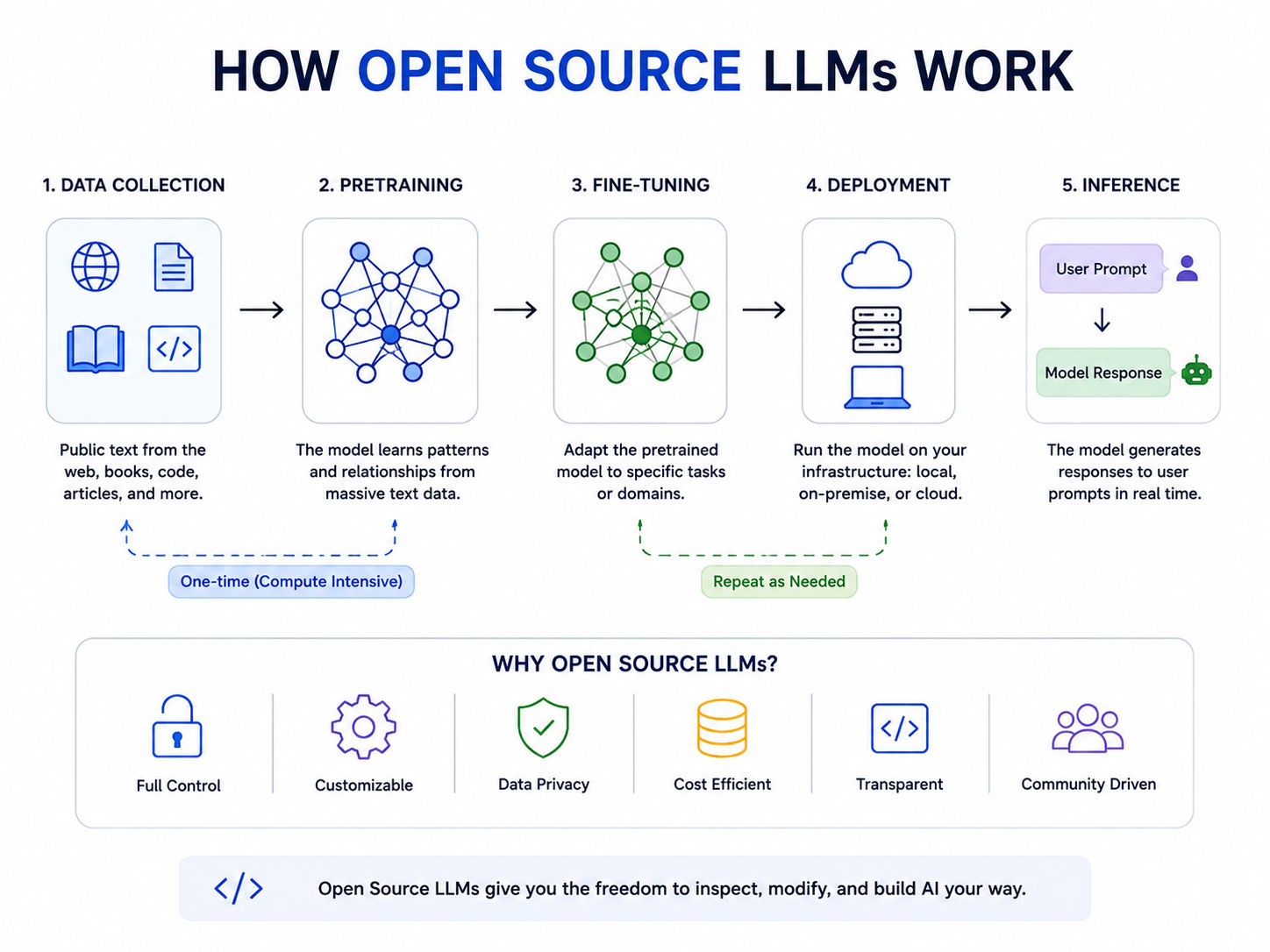
The process generally involves three stages:
Pre-Training
The model learns from enormous datasets containing billions or even trillions of tokens.
During this phase, it predicts missing words and discovers patterns in language, reasoning, coding, and knowledge representation.
For example, after reading millions of programming examples, a model begins recognizing coding structures and syntax patterns without being explicitly programmed.
Fine-Tuning
Organizations often adapt a pre-trained model for specific tasks.
A healthcare company may fine-tune a model on medical literature. A financial institution may train it further using financial documents and reports.
This process improves domain-specific performance without requiring full model retraining.
Inference
Inference occurs when users interact with the model.
The model processes prompts, predicts probable responses, and generates outputs in real time.
Modern open source LLMs support tasks such as:
One practical advantage is deployment flexibility. Teams can run many models locally, in private clouds, or on-premise infrastructure. This becomes especially valuable when handling sensitive or regulated data.
As large language models become more capable, organizations increasingly combine them with retrieval systems, vector databases, and external tools to improve accuracy and reduce hallucinations.
Read more : What are the Different Types of LLM Models?
AI Courses to upskill
Explore Artificial Intelligence Courses for Career Progression
Open source LLMs provide major benefits such as flexibility, transparency, and greater control over AI deployments. These benefits have led to adoption of these technologies by businesses, researchers and developers in many applications. However, organizations need to understand challenges such as infrastructure requirements, maintenance responsibilities, and licensing consideration before implementation.
1.Main Benefits
More control :
Organizations retain ownership of deployment environments, security controls, and model customization.
In many industries with tough compliance requirements this level of control is often important.
Cost Efficiency :
Many open source LLMs eliminate recurring API costs.
While infrastructure expenses still exist, large-scale deployments can become significantly more cost-effective over time.
Customization :
Developers can fine-tune models for specialized domains.
Examples include:
Transparency :
Access to model weights and code enables deeper understanding of system behavior.
Researchers can analyze biases, benchmark performance, and improve architectures more effectively.
2.Common Issues
Hardware Requirements:
High-end models require strong GPUs and a lot of memory resources.
Even inference can be expensive for very large models.
Responsibility for Maintenance
Organizations are responsible for:
Not every open-source release does just as well.
Some models are great at reasoning, some at coding, some for multilingual tasks, some for efficiency.
Compliance and Data Risks
The training data sources may not always be completely transparent.
Companies should do their homework before selecting a model for commercial use.
Often, the right choice is a balance between flexibility and operational complexity. Open source solutions offer freedom but require technical knowledge.
Also read: How to Learn Artificial Intelligence: A Step-by-Step Roadmap
Several open source LLMs have become industry leaders. Each model has its own benefits based on use cases and deployment needs.
Llama
Llama from Meta is still one of the most influential model families.
Typical uses include:
It has a huge community support which makes it easier for developers to implement.
Mistral 7.2.0
Mistral is very efficiency-oriented.
But it typically delivers impressive performance on reasoning and language tasks, even with fewer parameters than some rivals.
Organizations often use it to:
Falcon:
Falcon’s strong benchmarks and open access made it popular.
Many research teams use Falcon to conduct experiments and build custom AI.
Gemma
Google designed Gemma to provide lightweight and deployable models.
It works well for teams with limited computational resources.
Qwen
Qwen has become particularly attractive for multilingual applications.
Businesses serving international audiences often use it for:
Choosing the Right Model
When evaluating models, consider:
| Factor | Why It Matters |
| Model Size | Impacts hardware requirements |
| Accuracy | Affects output quality |
| Licensing | Determines commercial usage rights |
| Community Support | Improves troubleshooting and learning |
| Fine-Tuning Options | Enables customization |
| Deployment Method | Influences infrastructure needs |
A startup building a customer service chatbot may prioritize efficiency. A research lab might focus on reasoning performance. There is rarely a single best model for every scenario.
Do read: Types of AI: From Narrow to Super Intelligence with Examples
Open source LLMs are moving fast. Hardware requirements are becoming more manageable. Model performance keeps improving.
The future is being shaped by a number of trends:
Today, many organisations see open-source AI as a strategic asset, not just experimental technology. Long-term value is created through the ability to customise models, protect sensitive data, and reduce vendor dependency.
At the same time, the competition between commercial and open source ecosystems continues to further accelerate innovation. Open-source systems available today are already on par with proprietary ones for many practical tasks.
For developers, students, and AI professionals, understanding open source LLMs is becoming an essential skill. Whether you're building chatbots, intelligent search systems, coding assistants, or enterprise AI applications, open-source models offer a powerful foundation for creating flexible and scalable solutions.
Open source Large Language Models (LLMs) have revolutionised AI development by giving organizations more control, flexibility, and transparency. They allow developers to customize models, manage deployments, and reduce reliance on proprietary platforms.
As large language models continue to evolve, open source AI models will play an increasingly important role in enterprise applications, research and innovation. Selecting the appropriate model involves balancing performance, infrastructure requirements, and licensing considerations to develop effective and reliable AI solutions.
Want personalized guidance on AI and upskilling? Speak with an expert for a free 1:1 counselling session today.
Yes, many open source LLMs can run on personal computers, especially smaller models with 7B to 13B parameters. However, performance depends on your hardware. A system with a modern GPU and sufficient RAM can handle inference more efficiently. Lightweight models are often suitable for local experimentation, development, and learning purposes.
Developers typically fine-tune an open source LLM using domain-specific datasets that align with their use case. For example, a customer support chatbot may be trained on support tickets and FAQs. Modern techniques such as LoRA and QLoRA reduce computational costs, making fine-tuning more accessible even for smaller teams.
Many enterprises use open source LLMs for internal knowledge management, document analysis, coding assistance, and customer service automation. Their suitability depends on factors such as security requirements, infrastructure capabilities, and compliance obligations. Organizations often prefer them when data privacy and deployment control are top priorities.
Source code contains the instructions that define how a model operates, while model weights represent the knowledge learned during training. Without weights, a model cannot perform meaningful tasks. Many projects release both components, while some provide only the weights under specific licensing conditions.
Storage requirements vary significantly based on model size. Smaller models may require only a few gigabytes, while larger models can exceed hundreds of gigabytes. Quantization techniques can reduce storage needs and make deployment more practical for organizations with limited hardware resources.
Industries that manage large volumes of text-based information often benefit the most. This includes healthcare, finance, legal services, education, software development, and customer support. Organizations can customize models to process industry-specific terminology and workflows more effectively than generic AI systems.
Yes, many modern open source LLMs support multiple languages. Models such as Qwen and several Llama variants perform well across different languages and regions. This capability makes them useful for global businesses that need multilingual chatbots, translation systems, or content generation tools.
Open source LLMs offer greater transparency, customization, and deployment flexibility. Proprietary models often provide managed infrastructure and simpler implementation. The best choice depends on your goals. Organizations seeking control and customization may prefer open-source solutions, while those prioritizing convenience may choose hosted services.
Although many models are available at no licensing cost, organizations still incur expenses related to hardware, cloud infrastructure, monitoring, maintenance, and engineering resources. Large-scale deployments may require significant investment in GPUs and operational support to maintain performance and reliability.
yes, developers frequently integrate open source LLMs with CRM platforms, enterprise databases, internal documentation systems, and workflow tools. APIs, vector databases, and retrieval-augmented generation frameworks help connect models with existing business applications and improve response accuracy using company-specific information.
Before selecting a model, evaluate performance benchmarks, licensing terms, hardware requirements, community support, and fine-tuning capabilities. You should also consider your deployment environment, security needs, and long-term maintenance plans. A model that performs well in benchmarks may not always be the best fit for your specific use case.
Speak with AI & ML expert
By submitting, I accept the T&C and
Privacy Policy
Top Resources
Master's Degree
18 Months
Executive Diploma
12 Months
IIIT Bangalore
Executive Programme in Generative AI & Agentic AI for LeadersIndia’s #1 Tech University
Dual Certification
5 Months