Data Mesh Architecture: A Complete Guide for Beginners and Professionals
By Rahul Singh
Updated on Jun 11, 2026 | 10 min read | 3.14K+ views
Share:

All courses
Certifications
More
By Rahul Singh
Updated on Jun 11, 2026 | 10 min read | 3.14K+ views
Share:
Table of Contents
Data mesh architecture is a decentralized approach to managing data where individual business domains own and maintain their own data instead of relying on a central data team. It was introduced by Zhamak Dehghani in 2019 to address scalability challenges in traditional data architectures.
By treating data as a product, each domain becomes responsible for data quality, accessibility, and governance. This approach helps organizations scale data operations more efficiently and reduce bottlenecks.
In this blog, you will get a full breakdown of data mesh architecture: what it is, why it was built, its four core principles, and how it compares to older approaches.
Transform your career with upGrad’s Data Science Course. Learn from industry experts, work on hands-on projects, and gain the skills top employer’s demand.
Popular Data Science Programs
Think of it like this. In a traditional setup, every team sends its data to one central team that cleans, transforms, and serves it. That central team becomes a bottleneck. In a data mesh, each domain handles its own data end to end.
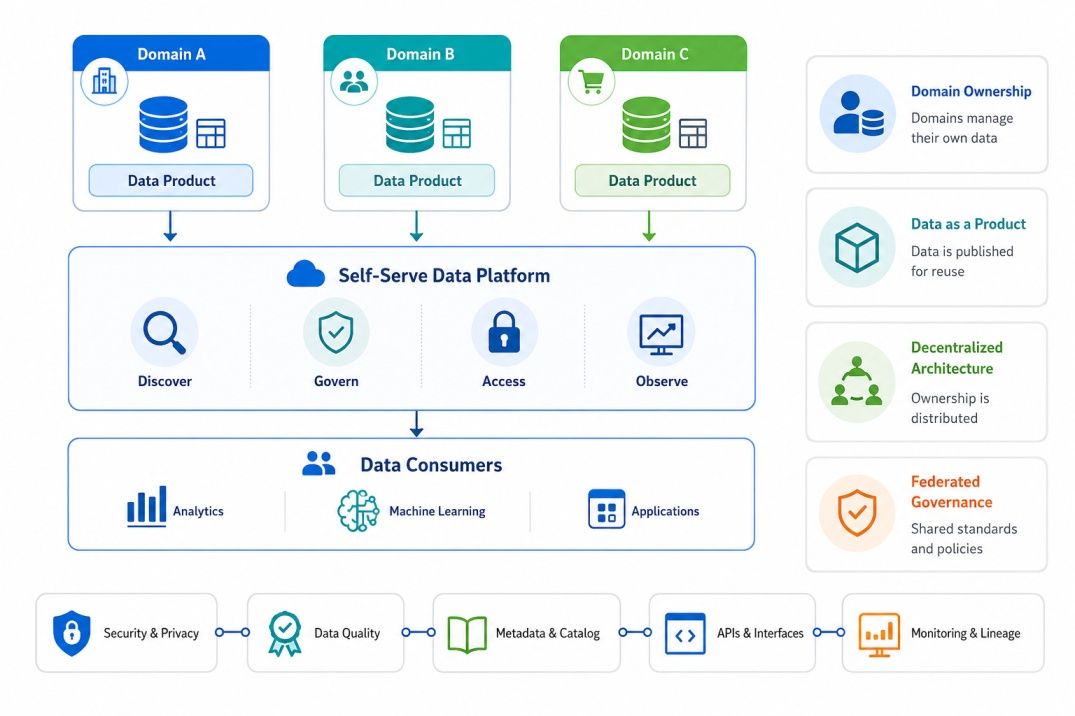
Before data mesh, most organizations followed a centralized model:
This model works at small scale. But as organizations grow, the central team cannot keep up. Pipelines break, data goes stale, and teams lose trust in the data they receive.
Data mesh architecture solves this by distributing both data ownership and data processing responsibilities to the teams that understand the data best.
Term |
What It Means |
| Domain | A specific area of the business (e.g., sales, marketing, logistics) |
| Data Product | A well-defined dataset maintained and served by a domain team |
| Data Owner | The domain team responsible for their data product |
| Self-Serve Platform | Infrastructure that any team can use to build and share data products |
| Federated Governance | Shared rules that all domains follow while maintaining autonomy |
Also Read: Data Warehouse Architecture: Discover Layers That Enhance Your Data!
Free Courses
Data mesh architecture is built on four principles. These are not optional guidelines. They are the foundation of the entire approach. Miss one, and the architecture breaks down.
Each business domain owns its data end to end. This includes ingestion, transformation, quality, and access. The team that creates the data is also responsible for maintaining it.
For example, a logistics team owns all shipment and delivery data. They do not hand it off to a central data team. They maintain pipelines, monitor quality, and publish the data for others to consume.
This shifts accountability. When something breaks, there is no ambiguity about who fixes it.
Each domain treats its data as a product, not a byproduct. This means applying product thinking to data:
This principle raises the quality bar significantly. Teams stop publishing raw dumps and start publishing well-documented, reliable datasets.
Also Read: A Comprehensive Guide to Understanding the Different Types of Data in 2026
For domain teams to own their data, they need the right tools. A centralized platform team builds and maintains the self-serve infrastructure that all domains use.
This platform typically includes:
The goal is to reduce friction. A domain team should be able to build, test, and publish a data product without needing deep data engineering expertise.
Governance in data mesh is not centralized or chaotic. It is federated. A governance group made up of domain representatives and platform owners sets global standards:
Each domain follows these standards but retains autonomy over how they implement them. This keeps the system coherent without creating a new central bottleneck.
Also Read: What is AWS Data Pipeline? How its Works? and it’s Components
Data Science Courses to upskill
Explore Data Science Courses for Career Progression
IIIT Bangalore
Executive Post Graduate Certificate in Data Science & AIPlacement Assistance
Many people confuse data mesh architecture with data lakes or data warehouses. They are different things. Understanding the difference helps you see why data mesh matters.
Aspect |
Data Warehouse |
Data Lake |
Data Mesh |
| Structure | Structured, schema-on-write | Unstructured, schema-on-read | Distributed, domain-owned |
| Ownership | Central team | Central team | Domain teams |
| Scalability | Limited by central team | Limited by central team | Scales with domain growth |
| Data Quality | High (but slow) | Varies widely | High (enforced per domain) |
| Governance | Centralized | Often weak | Federated |
| Best For | Reporting, BI | Raw storage, ML | Large, multi-domain orgs |
Data mesh is not the right choice for every organization. Avoid it when:
For smaller organizations, a well-run data warehouse or lake with a strong central team often outperforms a data mesh. The overhead of domain ownership requires maturity to pay off.
Also Read: Data Lake vs Data Warehouse: Difference Between Data Lake & Data Warehouse
Implementing data mesh architecture is not a one-day project. It is an organizational and technical transformation. Here is a practical path to get started.
Start by mapping your organization's major business domains. These are typically aligned to departments or business functions: sales, finance, product, customer support, logistics.
Each domain should produce at least one meaningful dataset that others in the organization would want to use.
For each domain, identify who will be responsible for the data. This is usually a senior engineer or data lead within that team. They become the data product owner.
This is often the hardest step because it requires changing how teams think about their work. Engineers who previously focused only on application code now share responsibility for the data their systems produce.
Also Read: Career in Data Science: Jobs, Salary, and Skills Required
Your domains need tooling to build and serve data products. You have two options:
Most organizations use a combination of cloud services and open-source tooling.
Work with representatives from each domain to agree on shared standards. Focus on:
Keep the rules lightweight at first. Add complexity as you learn.
Do not roll out data mesh across the entire organization at once. Pick one domain, build one data product, and validate the approach. Use the pilot to expose gaps in your platform, governance model, and team skills.
Also Read: Apache Kafka Architecture: Comprehensive Guide For Beginners [2026]
Expand once the pilot shows clear results.
Challenge |
How to Address It |
| Teams resist ownership | Start with willing, motivated teams |
| Platform takes too long | Use existing cloud tools first, build custom later |
| Governance becomes bureaucratic | Keep rules minimal and enforceable |
| Data quality varies across domains | Define quality SLAs early |
| Discoverability is poor | Invest in a good data catalogue from day one |
Data mesh architecture is not just theory. Several large organizations have adopted it and shared their experiences publicly.
Netflix uses a domain-driven approach to data. Different product teams own their own event streams and analytical datasets. This lets them iterate quickly without depending on a central team for every data need.
Intuit moved toward a data mesh model to handle the scale of its financial data across products like TurboTax and QuickBooks. Domain teams now own their pipelines and surface data through shared catalogues.
The European e-commerce platform Zalando was one of the early adopters of data mesh concepts. They restructured their data organization around domains and invested heavily in a self-serve data platform that lets hundreds of engineers work independently.
These examples share a pattern: large organizations with multiple product lines, where central data teams had become a bottleneck. Data mesh architecture gave them a way to scale without sacrificing quality or governance.
Also Read: Data Literacy in Data Science: Everything You Need to Know
Below are some pros and cons of data mesh architecture:
Also Read: Data Science Life Cycle: Phases, Tools and Best Practices
Data mesh architecture helps organizations scale data operations by distributing ownership to the teams that understand the data best. By combining domain ownership, data-as-a-product thinking, self-service platforms, and shared governance, it reduces bottlenecks and improves data accessibility across the organization.
If you're looking to build expertise in modern data systems and analytics, explore upGrad’s Data Science Courses. You'll learn data engineering concepts, cloud technologies, and scalable data architectures that are shaping today's data-driven organizations.
Want personalized guidance in Data Science and upskilling? Speak with an expert for a free 1:1 counselling session today.
The main goal of data mesh architecture is to decentralize data ownership. Instead of a single team managing all data, each business domain owns and maintains its own data products, which reduces bottlenecks and improves data quality and availability across the organization.
Data mesh architecture was introduced by Zhamak Dehghani in 2019 while she was at ThoughtWorks. She outlined the concept in a widely read article that proposed moving away from centralized data teams and toward domain-driven data ownership.
No, they are different. A data lake is a centralized repository for storing raw data, usually managed by one team. Data mesh is an architectural approach where multiple domain teams own and serve their own data, with no central team acting as the gatekeeper.
You need a combination of data engineering skills (building pipelines, working with SQL and streaming tools), cloud platform knowledge, and familiarity with data governance concepts. Understanding distributed systems and product thinking also helps, since domain teams treat data as a product.
Data mesh uses federated computational governance. A cross-domain group sets shared standards for security, formatting, naming, and compliance. Each domain then applies these standards independently. This keeps the system consistent without centralizing control in one team.
Usually not. Data mesh works best in large organizations with multiple business domains and significant data engineering capacity. Small companies often get better results from a well-managed data warehouse or a centralized data team, since the overhead of domain ownership is too high at small scale.
Popular tools include dbt for data transformation, Apache Kafka for streaming, Databricks for compute and storage, and cloud-native services like Google Cloud Dataplex, AWS Glue, and Azure Purview. A good data catalogue tool such as DataHub or Amundsen is also important for discoverability.
There is no fixed timeline, but most organizations treat it as a multi-year transformation. A pilot with one domain can take three to six months. Rolling it out across the organization typically takes one to three years, depending on team size, existing infrastructure, and organizational culture.
A data product is a well-maintained, documented dataset that a domain team publishes for others to use. It has a stable location, clear schema, quality guarantees, and access controls. The concept borrows from software product thinking and applies it to datasets.
Microservices architecture applies decentralization to software services, while data mesh applies decentralization to data. They share similar principles, including domain ownership and independent deployment, but operate at different layers. Many organizations that use microservices find it natural to also adopt data mesh for their data layer.
The biggest challenge is cultural and organizational, not technical. Getting engineering teams to take ownership of data, training domain teams to think in terms of data products, and building trust in federated governance all require significant change management. The technology is available; getting teams to use it correctly is the harder part.
98 articles published
Rahul Singh is an Associate Content Writer at upGrad, with a strong interest in Data Science, Machine Learning, and Artificial Intelligence. He combines technical development skills with data-driven s...
Speak with Data Science Expert
By submitting, I accept the T&C and
Privacy Policy
Start Your Career in Data Science Today
Top Resources
Executive Diploma
12 Months
Master's Degree
18 Months
Bootcamp
6 Months