Data Literacy in Data Science: Everything You Need to Know
By Rahul Singh
Updated on Jun 01, 2026 | 10 min read | 4.26K+ views
Share:

All courses
Certifications
More
By Rahul Singh
Updated on Jun 01, 2026 | 10 min read | 4.26K+ views
Share:
Table of Contents
Data literacy in data science refers to the ability to understand, interpret, analyze, and communicate data effectively. It helps individuals make sense of data sources, evaluate the reliability of information, and draw meaningful conclusions from datasets.
While data scientists build models and generate insights, data literacy enables teams to understand the results, identify potential limitations, and translate data-driven findings into informed business decisions. It serves as a critical bridge between technical analysis and real-world action.
This blog covers everything from the basic data literacy meaning to how it fits into data science careers, what skills it actually includes, how to measure your current level, and practical ways to build it.
Transform your career with upGrad’s Data Science Course. Learn from industry experts, work on hands-on projects, and gain the skills top employer’s demand.
Popular Data Science Programs
At its core, data literacy is the ability to read, understand, question, and communicate with data. Think of it like reading comprehension, but for numbers, charts, and datasets instead of text.
A person with strong data literacy can look at a bar chart and tell you what it means, what it does not tell you, and whether the conclusions being drawn from it are actually valid. They do not need to be a data scientist or a statistician. They just need to know how to think critically about data.
The data literacy meaning boils down to three things:
This is different from being a data expert. A data scientist builds models and writes complex code. A data-literate person knows how to interpret those outputs and make decisions based on them. Both roles matter. And they work best when everyone around the table understands the basics.
Also Read: What Is Data Science? Courses, Basics, Frameworks & Careers
In 2026, 60% of enterprise leaders reported a data skills gap, despite 88% saying data literacy is now essential for everyday work, showing that demand for data skills is growing faster than workforce readiness. Yet businesses are generating more data than ever. The gap between data availability and the ability to use it well is costing companies real money in poor decisions, missed opportunities, and wasted analytics budgets.
For individuals, low data literacy means being dependent on others to interpret numbers for you. That limits your contribution in meetings, slows down decisions, and holds back career growth.
Without Data Literacy |
With Data Literacy |
| Accepts reports at face value | Questions the methodology behind results |
| Cannot spot errors in a chart | Identifies misleading visualizations |
| Avoids data-heavy discussions | Contributes confidently in analytics reviews |
| Makes gut-based decisions | Backs decisions with evidence |
Free Courses
Data literacy is not a single skill. It is a bundle of abilities that work together. Here is what it actually includes.
Before you can analyze anything, you need to know what kind of data you are looking at. There are two broad categories:
Within these, data can be structured (organized in rows and columns, like a spreadsheet) or unstructured (like text messages or videos). Knowing the difference helps you choose the right tools and ask the right questions.
Also Read: Career in Data Science: Jobs, Salary, and Skills Required
Charts and graphs are the most common way data gets communicated in workplaces. A data-literate person knows how to:
This is not about being a design expert. It is about not being fooled by visuals that are technically accurate but misleading.
You do not need to run regressions to be data literate. But you do need a basic grasp of concepts like:
This might be the most underrated part of what is data literacy. The best data professionals are not just analysts; they are curious skeptics. They ask:
Good questions lead to better insights. Bad questions lead to confident wrong conclusions.
Also Read: Understand the Key Difference Between Covariance and Correlation!
Data Science Courses to upskill
Explore Data Science Courses for Career Progression
IIIT Bangalore
Executive Post Graduate Certificate in Data Science & AIPlacement Assistance
Data science is a technical field involving programming, machine learning, statistics, and large-scale data processing. Data literacy is the foundation it rests on.
It seems obvious that a data scientist would be data literate. But in practice, technical skills and interpretive skills are not always paired. A data scientist can build a very accurate model and still draw the wrong business conclusion from it if they lack context or communication ability.
Strong data literacy helps data scientists:
Also Read: Measure of Central Tendency: Mean, Median, and Mode
Here is what a lot of organizations get wrong: they assume data literacy is only for the data team. It is not.
Marketing managers, HR professionals, product managers, and finance teams all work with data regularly. When those teams cannot critically evaluate what the analytics team is telling them, one of two things happens:
Neither is good. Data literacy creates a shared language across departments. It makes the entire organization smarter.
Think of data literacy as a spectrum, not a binary skill.
Level |
Who It Fits |
What They Can Do |
| Foundational | Students, general employees | Read basic charts, understand common metrics |
| Intermediate | Analysts, managers | Interpret complex reports, question methodology |
| Advanced | Data professionals, strategists | Build data arguments, design experiments |
| Expert | Data scientists, researchers | Model data, run statistical tests, build pipelines |
Most people need to reach at least the intermediate level to be effective in modern workplaces.
Also Read: 9 Types of Data Scientists | Which One Should You Become?
Building data literacy does not require a computer science degree. It requires consistent exposure and deliberate practice.
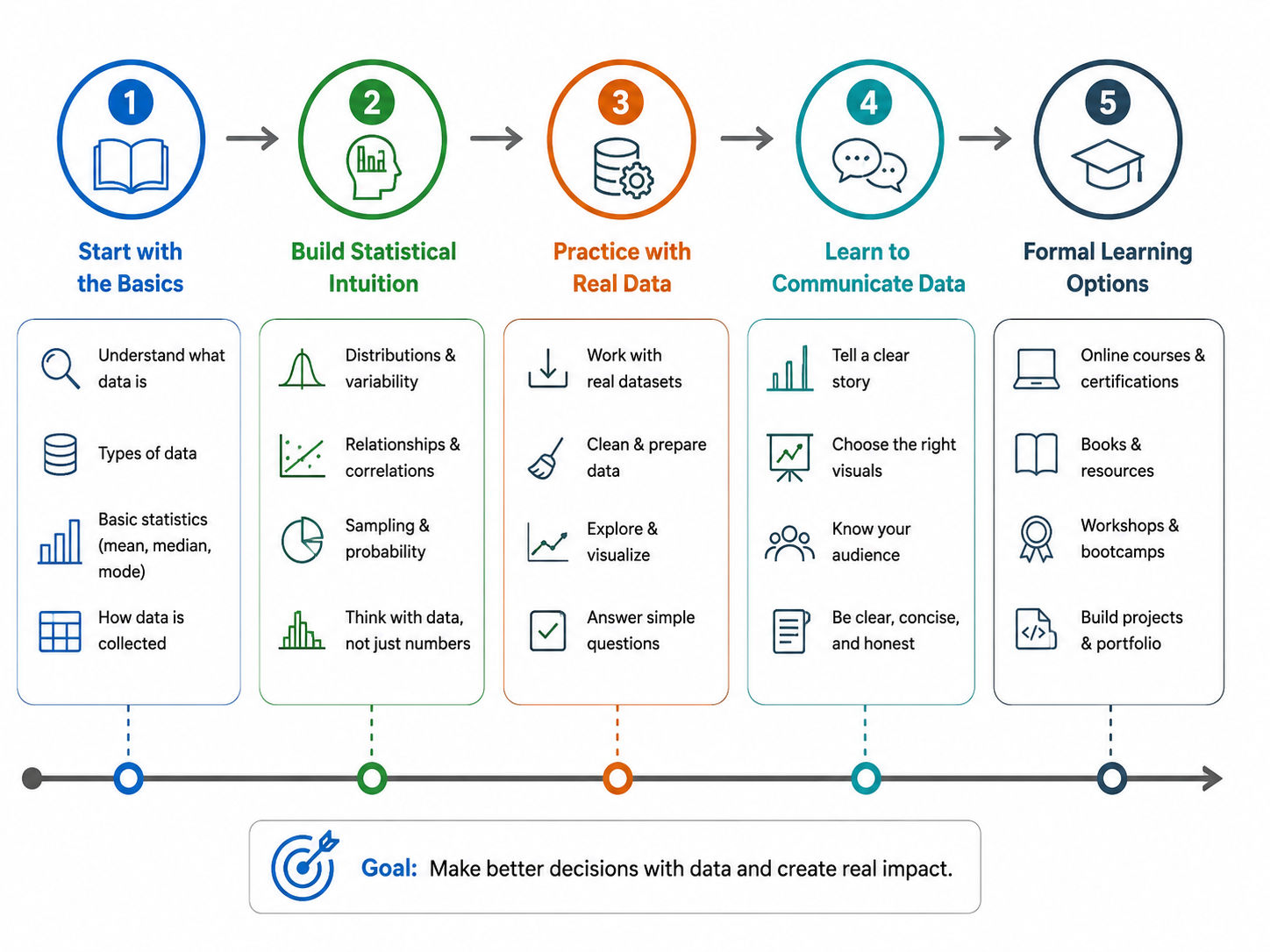
If you are new to this, begin here:
You do not need to become a statistician. But exposure to basic concepts goes a long way.
Theory only gets you so far. The best way to build data literacy is to work with actual data.
Reading data is one side of the coin. Communicating it clearly is the other.
For those looking to go deeper, structured learning accelerates the process significantly. Courses in data analytics, business intelligence, or data science foundations cover data literacy as a core component. Programs like those offered by upGrad pair hands-on projects with mentorship from industry professionals, which helps bridge the gap between knowing concepts and applying them in real work situations.
Also Read: Data Visualisation: The What, The Why, and The How!
Even people who consider themselves data-savvy fall into these traps.
Ice cream sales go up in summer. So do drowning rates. That does not mean ice cream causes drowning. Both are linked to a third variable: hot weather. This is called a confounding variable, and it is everywhere in data.
Before concluding that X caused Y, ask: what else could explain this?
Averages hide variation. If five employees earn 20,000 rupees per month and one earns 10 lakh rupees per month, the average salary looks decent. But that average is being pulled hard by one outlier.
Always look at the distribution, not just the central tendency.
A study with 30 participants and a study with 30,000 participants are not equally reliable. Small samples produce noisy results. Before trusting a statistic, ask how many data points it is based on.
A number like 73.4% looks precise. But if the methodology was flawed, it is precisely wrong. Precision and accuracy are different things. Always investigate how a number was calculated, not just what it says.
Data literacy is not a skill reserved for data scientists or analysts. It is a foundational capability for anyone who works in a world driven by information, which is essentially everyone today.
Whether you are just starting out or looking to level up your analytics career, investing in data literacy is one of the highest-return moves you can make right now.
Want personalized guidance on Data Science and upskilling? Speak with an expert for a free 1:1 counselling session today.
Data literacy is the ability to read, interpret, and communicate with data. Data science is a technical discipline involving programming, machine learning, and statistical modeling. Data science requires data literacy as a base, but data literacy itself does not require coding or technical expertise.
No. Data literacy is relevant for anyone who reads reports, makes business decisions, or interprets research. Managers, marketers, HR professionals, and even journalists benefit from being data literate, not just data teams.
With consistent effort, most people can reach a functional level of data literacy in three to six months. Foundational skills like reading charts, understanding averages, and spotting misleading visuals can be picked up in just a few weeks with regular practice.
Yes. Platforms like Google's Data Analytics course, and upGrad offer free or low-cost resources. Public datasets on Kaggle and government data portals also provide hands-on practice material without any cost.
Start with Google Sheets or Microsoft Excel for handling basic data. Then explore visualization tools like Tableau Public or Google Looker Studio. As you grow, tools like Python (with pandas and matplotlib) or Power BI become useful additions.
If you can read a chart accurately, understand basic statistics like mean and percentage, and ask critical questions about where data came from, you are at a foundational level. Intermediate data literacy means you can evaluate methodology, spot potential biases, and draw conclusions independently. Advanced means you can design data experiments and communicate complex insights to non-technical audiences.
In a business context, data literacy meaning refers to the ability of employees to access, understand, and use data to make better decisions at work. It includes reading dashboards, interpreting KPIs, and questioning whether reported metrics reflect the actual business situation.
Organizations are investing in data literacy training because poor data understanding leads to costly mistakes: wrong strategic calls, misread customer signals, and wasted analytics spending. A data-literate workforce makes faster, more confident, and more accurate decisions at every level.
Not exactly. Data literacy involves logical thinking and pattern recognition more than advanced mathematics. You need to understand basic concepts like percentages, averages, and ratios, but you do not need to be strong in algebra or calculus to become data literate.
In a data science career, data literacy helps you frame business problems correctly before modeling, communicate your findings clearly to non-technical stakeholders, and catch data quality or logic errors early. It bridges the gap between technical output and real-world decision-making.
The most effective habits include regularly reading data-driven publications, questioning the methodology behind statistics you encounter in daily life, practicing with real datasets on platforms like Kaggle, and making a habit of turning any chart you see into a plain-language sentence. Consistent exposure beats intensive cramming every time.
96 articles published
Rahul Singh is an Associate Content Writer at upGrad, with a strong interest in Data Science, Machine Learning, and Artificial Intelligence. He combines technical development skills with data-driven s...
Speak with Data Science Expert
By submitting, I accept the T&C and
Privacy Policy
Start Your Career in Data Science Today
Top Resources
Executive Diploma
12 Months
Master's Degree
18 Months
Bootcamp
6 Months