Data Science Research Papers: A Complete Guide for Students and Professionals
By Sriram
Updated on Jun 23, 2026 | 7 min read | 7.23K+ views
Share:

All courses
Certifications
More
By Sriram
Updated on Jun 23, 2026 | 7 min read | 7.23K+ views
Share:
Table of Contents
Data science research papers play a vital role in connecting academic research with practical applications. They provide valuable insights that help organizations analyze data, develop machine learning models, improve decision-making, and solve complex business challenges. By transforming theoretical concepts into actionable solutions, data science research papers continue to drive innovation across industries and support advancements in artificial intelligence, analytics, and data-driven technologies.
This blog explores the importance of data science research papers, their key components, popular research areas, and practical steps for creating a high-quality publication.
Advance your data science career with upGrad's expert-led programs. Learn Data Science course through hands-on projects and industry-focused training.
Popular upGrad Programs
Data science research papers are scholarly documents that present original findings, experiments, methodologies, or theoretica contributions related to data science.
These papers are commonly published in academic journals, conference proceedings, and research repositories.
They help researchers communicate insights, validate new techniques, and contribute to the broader scientific community.
A typical research paper may focus on:
The primary objective is to provide evidence-based findings that can be replicated, evaluated, and expanded upon by other researchers.
Must Read : Learn Data Science – An Ultimate Guide to become Data Scientist
Free Courses
It can be classified according to its goals, methods and contributions to the field. Knowing these categories helps researchers to choose the best approach for their work.
These papers deal with testing hypotheses by experiments and data analysis. Researchers use datasets to evaluate algorithms, models or techniques and compare results with existing methods.
Theoretical studies introduce new frameworks, mathematical models or concepts that contribute to the progress of data science. These papers often provide the foundation for future practical use.
Applied research focuses on solving real-world problems using data science techniques. Common areas include healthcare analytics, financial forecasting, customer behavior analysis, and supply chain optimization.
Review papers survey and synthesize existing research on a particular topic. They help researchers to understand current trends, to identify gaps in knowledge and to find opportunities for future studies.
Case studies examine the application of data science techniques within a particular organization, industry, or project. These papers offer practical insights and lessons learnt from real implementations.
Each type of paper contributes differently to the field, whether through innovation, validation, practical application, or knowledge synthesis.
Do read : Learn Data Science – An Ultimate Guide to become Data Scientist
Recommended Courses to upskill
Explore Our Popular Courses for Career Progression
IIIT Bangalore
Executive Diploma in Machine Learning and AI360° Career Support
O.P.Jindal Global University
MBA from O.P.Jindal Global UniversityLive Case Studies and Projects
As technology advances, the field of data science is growing and researchers are exploring a wide range of topics. There are some topics that are always of great interest, because they affect businesses, industries and society.
AI and machine learning is the field of creating systems that learn from data and make intelligent decisions. The hot areas are deep learning, reinforcement learning, and generative AI.
NLP research aims to enhance the capacity of computers to understand and generate human language. The research is usually about chatbots, sentiment analysis, machine translation and large language models.
Researchers investigate methods for processing and analyzing massive datasets efficiently. Topics include distributed computing, cloud analytics, and real-time data processing.
Computer vision enables machines to interpret visual information. Research papers frequently address image recognition, object detection, facial recognition, and medical imaging applications.
As AI adoption grows, researchers are focusing on making machine learning models more transparent and understandable. Explainable AI helps organizations build trust in automated decision-making systems.
With increasing concerns about data security, many studies examine privacy-preserving techniques, ethical AI development, bias detection, and responsible data governance.
These topics continue to shape the future direction of data science research and innovation.
Also read : Role of Data Science in Healthcare: Applications & Future Impact
The findings from data science research papers often extend far beyond academia. Organizations across industries use research-backed techniques to improve decision-making, efficiency, and customer experiences.
The table shows how Data Science Research Is Applied in Different Industries :
Industry |
Applications of Data Science Research |
Benefits |
| Healthcare | Disease prediction, medical image analysis, personalized treatment recommendations, patient risk assessment | Improves clinical outcomes and operational efficiency |
| Finance | Fraud detection, credit risk assessment, algorithmic trading, investment forecasting | Reduces risks and improves profitability |
| Retail and E-Commerce | Customer behavior analysis, price optimization, product recommendations, demand forecasting | Enhances customer satisfaction and drives revenue growth |
| Manufacturing | Predictive maintenance, quality control, process optimization | Reduces downtime and operational costs |
| Transportation and Logistics | Route optimization, delivery planning, supply chain management | Improves efficiency and service quality while lowering expenses |
| Education | Personalized learning, student performance prediction, curriculum improvement | Supports adaptive learning and better educational outcomes |
Many students frequently ask, How to write a research paper in data science effectively.
The process becomes easier when broken into clear stages.
Start by identifying a meaningful problem.
Good research questions are:
Examples include:
Study previously published work related to your topic.
This helps you:
Academic databases such as Google Scholar, IEEE, Springer, and ACM Digital Library are excellent starting points.
High-quality data is essential for meaningful results.
Tasks typically include:
Apply suitable analytical techniques.
Common methods include:
Evaluate performance using appropriate metrics.
Numbers alone are not enough.
Researchers must explain:
Organize your findings logically.
Before submission:
A strong paper combines technical accuracy with clear communication.
Also Read : AI in Data Science: What It Is, How It Works, and Why It Matters Today
Not all research papers create a meaningful impact. The most influential studies share several characteristics.
What Makes a Strong Research Paper?
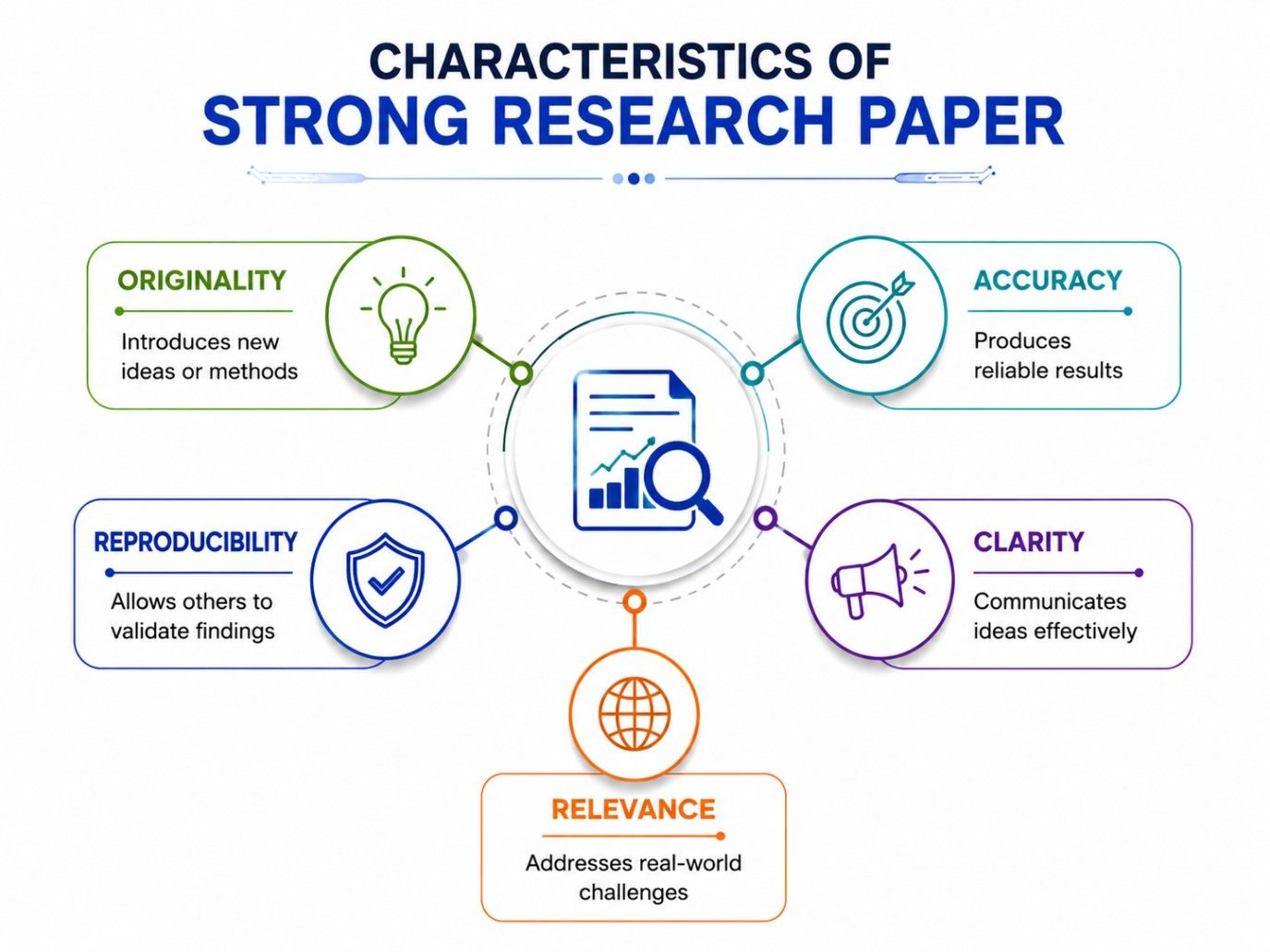
Researchers should focus on solving meaningful problems rather than simply applying algorithms to datasets.
Read : Real Data Science Case Studies That Drive Results!
Writing data science research papers involves more than technical knowledge. Researchers often face challenges related to data quality, methodology selection, and effectively communicating complex findings to diverse audiences.
Navigating these obstacles is an essential part of the research process and helps improve the overall quality and impact of a study
Some common obstacles include:
Limited Data Availability
Many research projects struggle due to insufficient or low-quality datasets.
Complex Methodologies
Advanced machine learning and AI techniques often require significant technical expertise.
Research Gap Identification
Finding an unexplored area can be difficult in rapidly evolving fields.
Model Interpretability
High-performing models are not always easy to explain.
This challenge is becoming increasingly important in industries where transparency matters.
The future of data science research continues to evolve rapidly.Several areas are attracting significant academic and industry attention.
Trending Research Topics :
Researchers who focus on these emerging fields are likely to contribute to some of the most impactful innovations of the coming decade.
Also Read: Data Science in Finance: Career, Tools, and Trends
Data science research papers drive innovation in artificial intelligence, machine learning, and analytics by helping researchers share findings, validate methods, and solve real-world challenges using data-driven approaches.
Whether you're writing your first research paper on data science or improving your research skills, understanding the research process is essential. Strong research papers contribute valuable knowledge to academia and industry while supporting future technological advancements and innovation.
Want personalized guidance on data science and upskilling? Speak with an expert for a free 1:1 counselling session today.
You can access many data science research papers through platforms like Google Scholar, arXiv, ResearchGate, and university repositories. These sources often provide free access to preprints and published studies. When searching, use specific keywords related to your topic to find the most relevant and recent research instead of relying on broad searches.
Start by identifying a real-world problem that interests you. Look for gaps in existing research, emerging technologies, or industry challenges. Topics related to generative AI, explainable AI, healthcare analytics, and predictive modeling continue to attract attention because they offer practical applications and research opportunities.
The ideal length depends on the journal, conference, or academic institution. Most data science research papers range between 4,000 and 8,000 words. Instead of focusing on word count, prioritize presenting a clear problem statement, strong methodology, meaningful results, and concise analysis that supports your conclusions.
Focus on solving a unique problem or offering a fresh perspective on an existing challenge. Use high-quality datasets, explain your methodology clearly, and provide actionable insights. Papers that address practical business or societal problems often attract more attention than studies that focus solely on technical implementation.
Yes. Many organizations use findings from data science research papers to improve decision-making, optimize operations, and develop new products. Professionals often refer to research studies to understand emerging techniques, compare methodologies, and evaluate technologies before implementing them in real-world projects.
Researchers typically use Python, R, Jupyter Notebook, TensorFlow, PyTorch, and SQL for analysis and experimentation. For writing and citations, tools such as LaTeX, Overleaf, Zotero, and Mendeley are widely used. The right combination depends on your research goals and technical requirements.
Dataset selection directly affects the quality and credibility of your research. Poor-quality or biased datasets can lead to inaccurate conclusions. You should choose datasets that are relevant, representative, and reliable. Proper data cleaning and preprocessing are equally important for producing trustworthy results.
Yes. Many students and early-career professionals successfully publish research papers each year. The key is choosing a manageable topic, conducting thorough research, and following academic standards. Collaborating with professors, mentors, or experienced researchers can also improve the quality of your work and increase publication chances.
Current research trends include generative AI, explainable machine learning, federated learning, AI ethics, natural language processing, and automated machine learning. These areas continue to evolve rapidly, creating opportunities for researchers to explore new applications and contribute valuable insights through data science research papers.
Reviewers assess originality, methodology, data quality, clarity of presentation, and the significance of findings. They also examine whether results are reproducible and whether conclusions are supported by evidence. A well-structured paper with transparent methods and strong analysis typically performs better during peer review.
You can follow academic journals, subscribe to research newsletters, and set up Google Scholar alerts for specific topics. Platforms like arXiv regularly publish new studies before formal journal publication. Reading a few research papers each week helps you stay informed about emerging trends, tools, and industry developments.
730 articles published
Sriram K is a Senior SEO Executive with a B.Tech in Information Technology from Dr. M.G.R. Educational and Research Institute, Chennai. With over a decade of experience in digital marketing, he specia...
Get Free Consultation
By submitting, I accept the T&C and
Privacy Policy
Top Resources
Certification
3 Months
Certification
6 Months
O.P. Jindal Global University
Masters in International Accounting and Finance (Accredited by ACCA, UK)Master's Degree
12 Months