Probability for Data Science: A Complete Guide from Basics to Advanced
By Rahul Singh
Updated on Jun 15, 2026 | 10 min read | 4.22K+ views
Share:

All courses
Certifications
More
By Rahul Singh
Updated on Jun 15, 2026 | 10 min read | 4.22K+ views
Share:
Table of Contents
Probability for data science is the mathematical framework used to measure uncertainty, analyze patterns, and make predictions from data. It helps data scientists understand how likely an event is to occur and provides the foundation for statistical analysis, machine learning models, and data-driven decision-making.
From predicting customer behavior and detecting fraud to evaluating model performance, probability plays a critical role in modern analytics. By quantifying uncertainty and modeling random events, it enables data scientists to draw meaningful insights from data and build more accurate predictive systems.
This blog covers everything you need to know about probability for data science, from the very basics to the advanced concepts that show up in real machine learning pipelines.
Popular Data Science Programs
Data science is about making decisions under uncertainty. You rarely have complete information. Your data is a sample, not the full picture. Your model is an approximation, not the truth. Probability gives you the tools to reason clearly when things are not certain.
Every time a machine learning model outputs a prediction, it is really outputting a probability. A binary classifier does not just say "spam" or "not spam." It says "there is a 92% chance this is spam." That number is rooted in probability theory.
Here is why probability for data science matters so much:
If you skip probability, you can still write code. But you will struggle to understand why your model behaves a certain way, or how to fix it when it fails.
There are two major ways to think about probability, and data scientists use both.
Both views matter. Frequentist thinking drives classical statistics and many hypothesis tests. Bayesian thinking drives modern probabilistic models and is central to techniques like Bayesian optimization and Markov Chain Monte Carlo (MCMC).
Free Courses
Before you can apply probability to machine learning, you need to understand the fundamental building blocks. These probability concepts for data science come up everywhere, from EDA to model evaluation.
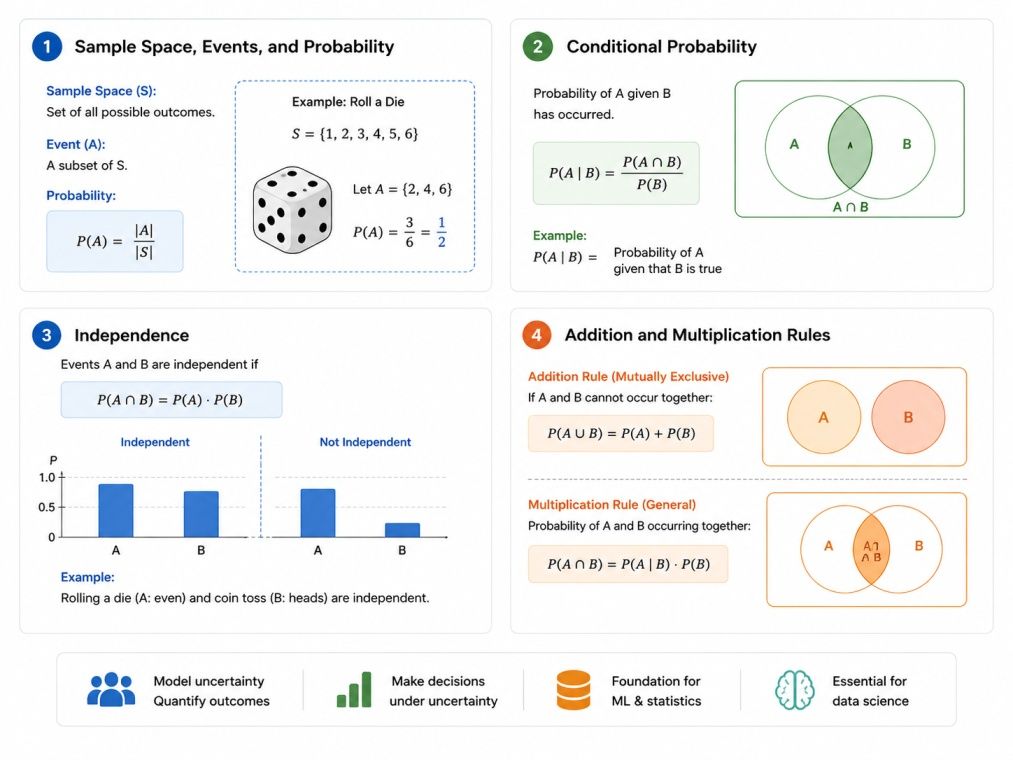
This simple formula is the starting point. Real data science problems layer much more complexity on top of it.
Conditional probability answers the question: what is the probability of A, given that B has already happened?
P(A | B) = P(A and B) / P(B)
This is one of the most important probability concepts for data science. It is used in:
Also Read: 30 Data Science Project Ideas
Two events are independent if knowing one tells you nothing about the other. Mathematically:
P(A and B) = P(A) * P(B)
The Naive Bayes classifier is built entirely on the assumption that features are independent given the class label. That assumption is almost never perfectly true in real data, but the algorithm works surprisingly well anyway.
Rule |
Formula |
Use Case |
| Addition (Mutually Exclusive) | P(A or B) = P(A) + P(B) | Either event happens, not both |
| Addition (General) | P(A or B) = P(A) + P(B) - P(A and B) | Events can overlap |
| Multiplication (Independent) | P(A and B) = P(A) * P(B) | Events do not influence each other |
| Multiplication (Dependent) | P(A and B) = P(A) * P(B given A) | Events are related |
These rules look simple, but they are used constantly in building probabilistic models and writing likelihood functions.
Also Read: Learn with Data Science Projects GitHub 2026: Beginner to Pro
Data Science Courses to upskill
Explore Data Science Courses for Career Progression
IIIT Bangalore
Executive Post Graduate Certificate in Data Science & AIPlacement Assistance
A probability distribution tells you how likely each possible value of a random variable is. Understanding distributions is central to probability for data science because real data always follows some distribution, and choosing the right one matters enormously.
Distribution |
Typical Use Case in DS |
| Normal | Error terms in regression, feature scaling |
| Binomial | Click prediction, pass/fail classification |
| Poisson | Count data, anomaly detection |
| Beta | Prior distributions in Bayesian A/B tests |
| Exponential | Time-to-event models, churn prediction |
Knowing which distribution to use is not just academic. It directly affects model accuracy and the validity of your conclusions.
Also Read: Complete Guide to Types of Probability Distributions: Examples Explained
Bayes' theorem is arguably the single most important result in probability for data science. Here it is:
P(A | B) = [ P(B | A) * P(A) ] / P(B)
In plain English:
Suppose a patient tests positive for a rare disease. The test is 99% accurate. But the disease affects only 1 in 1000 people. What is the actual probability the patient has the disease?
Without Bayes, most people say "99%." The correct answer is around 9%. The rarity of the disease (the prior) has a massive effect on the final probability. This is why Bayes matters in real decisions.
The Naive Bayes classifier is a direct application of this theorem. For each class, it computes:
P(class | features) proportional to P(features | class) * P(class)
Bayesian thinking also underpins:
Mastering Bayes is not optional for serious data science work. It shows up in model selection, uncertainty quantification, and causal reasoning.
Also Read: What is Bayesian Thinking ? Introduction and Theorem
These three probability concepts for data science define how multiple random variables relate to each other. They are the backbone of multivariate analysis and probabilistic graphical models.
Joint probability is the probability of two or more events happening together.
P(A and B) tells you how often both events co-occur.
In data science, a joint probability table for two categorical features shows you exactly how those features interact. This is the starting point for understanding feature dependencies.
Marginal probability is the probability of a single event, ignoring all other variables.
You get it by summing (or integrating) the joint distribution over all values of the other variable. It "marginalizes out" the other variables.
In machine learning, when you compute the prior probability of a class label in a training set, you are computing a marginal probability.
Also Read: Career in Data Science: Jobs, Salary, and Skills Required
You saw this earlier, but it comes up constantly. In classification:
P(spam | contains word "offer") = ?
This is a conditional probability. Your spam filter is computing it for every word in every email, every time it runs.
Type |
Definition |
Example |
| Joint | P(A and B) | User clicks AND converts |
| Marginal | P(A) | User clicks, regardless of conversion |
| Conditional | P(A given B) | User converts, given that they clicked |
Understanding these three types helps you read research papers, implement algorithms correctly, and debug models that are producing unexpected outputs.
Subscribe to upGrad's Newsletter
Join thousands of learners who receive useful tips
Once you have the basics down, there are several advanced probability concepts for data science that become essential as you work on more complex problems.
MLE is the method of finding the model parameters that make the observed data most probable. You choose parameters theta to maximize:
L(theta) = P(data | theta)
Logistic regression and linear regression are both optimized using maximum likelihood. When you minimize cross-entropy loss in a neural network, you are effectively performing MLE.
As sample size increases, the sample mean converges to the true population mean. This is why more training data generally leads to better models. It also explains why A/B tests need sufficient sample sizes to be reliable.
No matter what distribution your data comes from, the distribution of sample means will approximate a normal distribution as sample size grows. This is why so many statistical tests assume normality. It is also why confidence intervals work the way they do.
Entropy measures uncertainty in a probability distribution. A distribution where all outcomes are equally likely has maximum entropy.
In data science, entropy is used in:
KL Divergence measures how different one probability distribution is from another. It appears in variational autoencoders (VAEs), where you minimize the divergence between a learned distribution and a target one.
Monte Carlo methods use random sampling to estimate quantities that are hard to compute analytically. In data science, they are used for:
The expected value (E[X]) is the long-run average of a random variable. The variance (Var[X]) measures how spread out the values are. These two summary statistics show up in loss functions, regularization terms, and model diagnostics constantly.
Also Read: Decision Tree Regression Functionality, Terms, Implementation [With Example]
Theory is useful, but application is what counts. Here is a direct mapping between key probability concepts for data science and the algorithms that use them.
Algorithm |
Key Probability Concepts Used |
| Logistic Regression | Conditional probability, MLE, sigmoid function |
| Naive Bayes | Bayes' theorem, conditional independence |
| Decision Trees | Entropy, information gain |
| K-Means Clustering | Expectation-Maximization (probabilistic version) |
| Neural Networks | MLE, cross-entropy, Monte Carlo dropout |
| Hidden Markov Models | Joint probability, conditional probability, Bayes |
| Variational Autoencoders | KL divergence, latent distributions |
| Gaussian Processes | Multivariate normal distribution, Bayesian inference |
When you understand probability, you do not just use these algorithms. You understand what they are doing, when they will fail, and how to improve them.
Learning probability is not a one-time event. It is a skill you build over time, ideally with a mix of theory and practice.
Recommended tools for practice:
Probability for data science is not just background theory. It is the language that machine learning speaks. Every prediction, every loss function, every model evaluation metric has probability at its core.
You started this guide not knowing how all these pieces fit together. Now you have a clear map: from basic events and conditional probability, through key distributions and Bayes' theorem, to advanced concepts like MLE, entropy, and Monte Carlo methods.
The next step is practice. Pick one concept from this guide, implement it in Python, and apply it to a dataset. Then move to the next. That is how probability goes from something you read about to something you actually use.
Want personalized guidance in Data Science and upskilling? Speak with an expert for a free 1:1 counselling session today.
Probability in data science is the mathematical framework for quantifying uncertainty. It matters because data science deals with incomplete information. Every prediction a model makes is fundamentally a probability estimate, and understanding this helps you build better models and interpret their outputs correctly.
Basic probability does not require calculus. However, as you move toward continuous distributions, likelihood functions, and Bayesian inference, some knowledge of integration and differentiation becomes helpful. You can start with discrete probability and build up gradually without being blocked by calculus early on.
Probability moves from known rules to uncertain outcomes. Statistics moves from observed data back to underlying rules. In practice, data scientists use both: probability to build models and describe uncertainty, and statistics to draw conclusions from data and validate those models.
The normal (Gaussian) distribution is the most widely used. Many algorithms assume normality in their error terms, and many real-world datasets approximate it. The Bernoulli and Binomial distributions are also extremely common in classification settings, and the Poisson distribution appears frequently in count-based problems.
Bayes' theorem is used in Naive Bayes classifiers for text classification, in Bayesian optimization for hyperparameter tuning, in probabilistic graphical models for structured prediction, and in A/B testing to update beliefs about conversion rates. It is also foundational to the entire field of Bayesian machine learning.
Entropy measures uncertainty or disorder in a probability distribution. In decision trees, entropy is used to decide which feature to split on (information gain). In neural networks, cross-entropy loss measures how different the predicted probability distribution is from the true labels. Lower entropy in a trained model's outputs generally means more confident predictions.
Recommendation systems often estimate the probability that a user will like or purchase item B given that they already liked item A. This is a direct application of conditional probability. Collaborative filtering, for example, uses co-occurrence patterns to estimate these conditional probabilities across large user-item matrices.
Maximum Likelihood Estimation (MLE) is a method for finding model parameters that make the observed training data most probable. Logistic regression, linear regression, and neural networks are all trained using variants of MLE. When you minimize cross-entropy or mean squared error, you are implicitly performing maximum likelihood estimation under specific distributional assumptions.
The Central Limit Theorem states that the distribution of sample means approaches a normal distribution as sample size grows, regardless of the original data distribution. This is why confidence intervals, z-tests, and t-tests work reliably. It also explains why larger datasets tend to produce more stable and reliable estimates in machine learning.
Start by understanding the nature of your variable. Continuous, symmetric data often fits a normal distribution. Count data with rare events fits Poisson. Binary outcomes fit Bernoulli or Binomial. You can also use tools like Q-Q plots, histograms, and goodness-of-fit tests (like the Kolmogorov-Smirnov test) to compare your data against candidate distributions and pick the best fit.
The core theory is the same, but the emphasis differs. Data science focuses on applying probability concepts directly to algorithms, model building, and prediction tasks. It gives more weight to Bayesian methods, probabilistic graphical models, and information theory than a traditional introductory statistics course would. The practical focus on implementation in Python is also much stronger in data science curriculum.
98 articles published
Rahul Singh is an Associate Content Writer at upGrad, with a strong interest in Data Science, Machine Learning, and Artificial Intelligence. He combines technical development skills with data-driven s...
Speak with Data Science Expert
By submitting, I accept the T&C and
Privacy Policy
Start Your Career in Data Science Today
Top Resources
Executive Diploma
12 Months
Master's Degree
18 Months
Bootcamp
6 Months