Artificial Intelligence Optimization: A Complete Guide from Basics to Advanced
By Rahul Singh
Updated on Jun 16, 2026 | 10 min read | 4.25K+ views
Share:

All courses
Certifications
More
By Rahul Singh
Updated on Jun 16, 2026 | 10 min read | 4.25K+ views
Share:
Table of Contents
Artificial intelligence optimization is how machines get better at solving problems. At its core, it means using algorithms and data to help AI systems find the best possible solution out of thousands of options, faster and more accurately than any human ever could. Every time you see a recommendation on Netflix or a route suggestion on Google Maps, that is AI optimization working behind the scenes.
In this blog, you will learn what artificial intelligence optimization actually means, how it works, the different types, real-world applications, and what it takes to build or improve an optimized AI system. Whether you are just getting started or looking to deepen your understanding, this guide covers everything you need in one place.
Popular AI Programs
Artificial intelligence optimization is the process of improving how an AI model performs by adjusting its parameters, training data, or decision-making process to get better results.
Think of it like this. Imagine you are trying to find the fastest route from Delhi to Mumbai. There are hundreds of possible routes. An optimized AI does not check all of them one by one. It uses smart algorithms to quickly narrow down the best option based on distance, traffic, and fuel cost.
That same logic applies to almost every AI system, whether it is predicting disease in medical imaging, filtering spam emails, or optimizing supply chains for a large retail company.
Without optimization, AI models would be slow, inaccurate, and expensive to run. Here is what good artificial intelligence optimization delivers:
No matter how good your data or your model architecture is, poor optimization will limit your results. It is the difference between an AI system that barely works and one that consistently outperforms human benchmarks.
Also Read: Top 7 Generative AI Models in 2026
Free Courses
There is no single way to optimize an AI system. Different problems call for different approaches. Understanding the types helps you pick the right tool for the job.
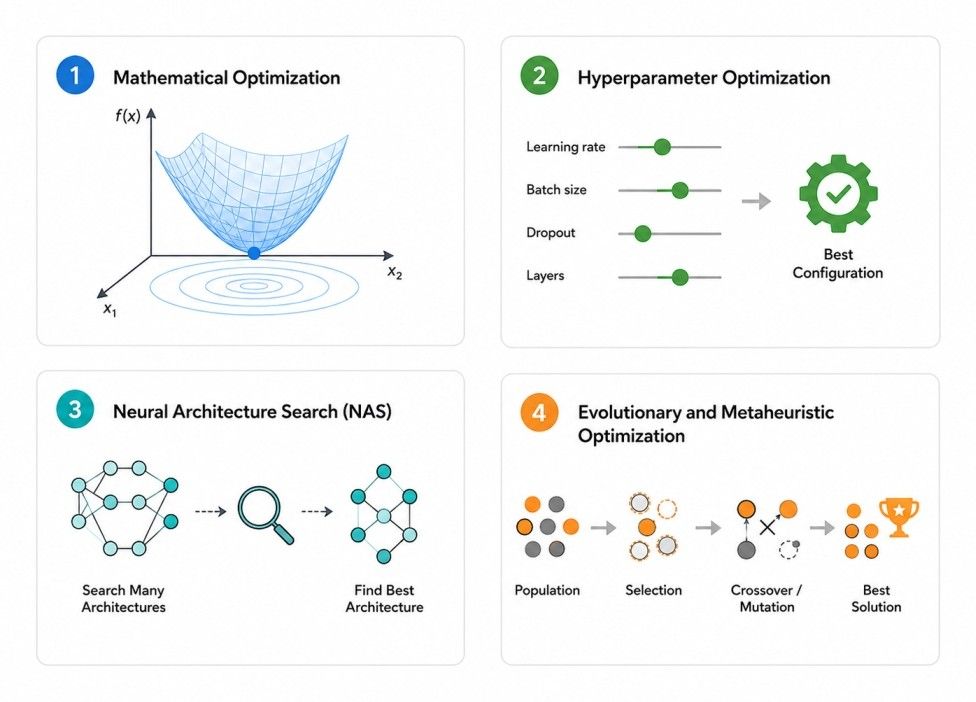
This is the foundation of most AI optimization. It involves finding the minimum or maximum value of a function. In machine learning, this usually means minimizing a loss function, which measures how wrong the model's predictions are.
Common techniques include:
A model has settings that are not learned during training, like learning rate, number of layers, or batch size. These are called hyperparameters, and tuning them correctly can significantly change how a model performs.
Method |
How It Works |
Best For |
| Grid Search | Tests every combination | Small parameter spaces |
| Random Search | Tries random combinations | Faster exploration |
| Bayesian Optimization | Uses past results to guide the next test | Efficient and accurate |
Also Read: Random Forest Hyperparameter Tuning in Python: Complete Guide
Instead of manually designing a neural network, NAS automates the process. The AI searches for the best possible network design for a given task. This is how some of the most powerful models today were built, including those used in image recognition and natural language processing.
These methods take inspiration from nature. Genetic algorithms, for example, work like natural selection. Multiple solutions compete, the best ones survive, and new solutions are generated from them. This works well when the problem is complex and the search space is very large.
AI Courses to upskill
Explore Artificial Intelligence Courses for Career Progression
Let us walk through a simple, practical example to understand the full cycle.
Suppose you are training an AI model to detect fraudulent bank transactions.
Step 1: Define the goal You want to maximize detection accuracy while minimizing false alerts. This becomes your objective function.
Step 2: Feed in data The model looks at thousands of past transactions, both fraudulent and legitimate.
Step 3: Make predictions and measure error The model predicts which transactions are fraud. The loss function measures how many it got wrong.
Step 4: Optimize The optimizer (say, Adam or SGD) adjusts the model's internal weights to reduce the error. This repeats across many training rounds.
Step 5: Tune hyperparameters Once the model is trained, you test different settings to improve performance further.
Step 6: Evaluate The model is tested on new, unseen data to check if it actually works in the real world.
This entire cycle is artificial intelligence optimization in action. Every real-world AI product goes through some version of this loop.
Also Read: A Complete Guide to AI Architecture
Artificial intelligence optimization is not just a technical concept. It powers some of the most important systems we use every day.
AI optimization helps doctors by analyzing X-rays, MRIs, and patient data to detect conditions early. Optimized models can catch early-stage cancer with accuracy that rivals experienced specialists. In drug discovery, AI narrows down millions of potential compounds to a shortlist worth testing in labs.
Banks use optimized AI to detect fraud in real time, approve loans faster, and predict market movements. A well-optimized model can process thousands of transactions per second and flag anomalies instantly.
Also Read: Artificial Intelligence Tools: Platforms, Frameworks, & Uses
Every time Amazon or Flipkart recommends a product to you, an optimized recommendation engine is running in the background. These systems analyze your browsing history, purchase patterns, and user behavior to suggest what you are most likely to buy next.
AI optimization is used in factory floors to reduce waste, improve quality control, and predict when machines will break down before they actually do. This is called predictive maintenance and it saves companies millions every year.
Companies like FedEx and DHL use AI optimization to plan delivery routes, manage inventory levels, and forecast demand. A route optimized by AI can reduce fuel costs and delivery time at the same time.
Industry |
What AI Optimization Does |
Impact |
| Healthcare | Disease detection, drug discovery | Faster diagnosis, better outcomes |
| Finance | Fraud detection, credit scoring | Lower risk, faster decisions |
| Retail | Personalized recommendations | Higher sales, better user experience |
| Manufacturing | Predictive maintenance | Less downtime, lower costs |
| Logistics | Route and inventory optimization | Faster delivery, lower costs |
Even with powerful tools available, AI optimization is not without its difficulties.
Also Read: What is Overfitting and Underfitting in Machine Learning?
If you want to build a career or project around artificial intelligence optimization, here is a practical starting path:
For beginners:
For intermediate learners:
For advanced practitioners:
upGrad offers structured programs in AI and machine learning that cover these topics in depth, from foundational concepts to real-world deployment.
Artificial intelligence optimization is what makes AI systems actually useful. It is the engine that turns a basic model into something powerful enough to detect cancer, recommend movies, prevent fraud, and optimize delivery routes.
The topic runs deep, but the core idea is straightforward: help the AI find the best solution, faster and more accurately, with less waste. Whether you are learning this for the first time or trying to advance your skills, understanding optimization is non-negotiable if you want to work seriously with AI.
Start with the basics, practice consistently, and follow where the problems take you. That is how real AI expertise is built.
Want personalized guidance on AI and upskilling? Speak with an expert for a free 1:1 counselling session today.
Artificial intelligence optimization is the process of training an AI model to find the best possible answer to a problem. It involves adjusting the model's settings and learning process so it makes fewer errors and performs better over time.
AI refers to systems that can perform tasks that normally require human intelligence. Artificial intelligence optimization specifically focuses on improving how well those systems work, by tuning algorithms, data, and parameters to get the best possible output with the least error.
There is no one-size-fits-all answer, but Adam is one of the most widely used optimizers in deep learning because it adapts the learning rate automatically for each parameter. For simpler models or large datasets, SGD with momentum also performs very well.
Gradient descent works by calculating the direction in which the model's error increases the most, then moving in the opposite direction to reduce that error. This process repeats many times until the model reaches a point where the error is as low as possible.
Hyperparameter tuning is the process of finding the best configuration settings for an AI model that are not learned during training. These include settings like learning rate, batch size, and number of layers. Good tuning can significantly improve a model's accuracy.
A loss function measures how wrong the model's predictions are. The goal of artificial intelligence optimization is to minimize this loss. The optimizer adjusts the model's internal values in each training round based on what the loss function returns.
Overfitting happens when a model learns the training data too well and fails to generalize to new data. It is a common challenge in AI optimization. Techniques like regularization, dropout, and using more diverse training data help prevent it.
Yes, to a degree. AutoML (Automated Machine Learning) tools can automatically select models, tune hyperparameters, and even search for the best neural architecture. However, human expertise is still needed to define the problem, prepare the data, and evaluate results properly.
Healthcare, finance, retail, logistics, and manufacturing are among the top industries that benefit from AI optimization. These sectors use it for tasks like fraud detection, demand forecasting, route planning, product recommendations, and predictive maintenance.
The timeline depends on your starting point. Someone with a basic programming background can learn the core concepts of AI optimization in three to six months with focused study. Reaching an advanced level typically takes one to two years of hands-on practice and project work.
Some widely used tools include TensorFlow, PyTorch, Scikit-learn, Optuna, Keras, and Ray Tune. These frameworks provide built-in optimizers, hyperparameter search utilities, and tools to monitor model performance throughout the training process.
98 articles published
Rahul Singh is an Associate Content Writer at upGrad, with a strong interest in Data Science, Machine Learning, and Artificial Intelligence. He combines technical development skills with data-driven s...
Speak with AI & ML expert
By submitting, I accept the T&C and
Privacy Policy
Top Resources
Master's Degree
18 Months
Executive Diploma
12 Months
IIIT Bangalore
Executive Programme in Generative AI & Agentic AI for LeadersIndia’s #1 Tech University
Dual Certification
5 Months