Artificial Intelligence in Auditing: A Complete Guide
By Sriram
Updated on Jun 12, 2026 | 7 min read | 4.58K+ views
Share:

All courses
Certifications
More
By Sriram
Updated on Jun 12, 2026 | 7 min read | 4.58K+ views
Share:
Table of Contents
Artificial intelligence in auditing involves systematically evaluating AI systems, including their data, algorithms, governance, and deployment processes. It helps ensure fairness, security, transparency, and regulatory compliance. At the same time, AI enhances traditional auditing by automating data analysis, detecting anomalies, improving risk assessment, and increasing overall audit efficiency.
In this blog, you'll learn how AI is changing modern auditing practices, the technologies involved, key use cases, benefits, challenges, and the future role of auditors in an AI-driven environment. Whether you're a student, finance professional, auditor, or technology enthusiast, this article provides a practical understanding of the topic.
Discover upGrad's Artificial Intelligence and Machine Learning programs and learn how to build, deploy, and optimise intelligent systems using technologies that are driving innovation across Bussiness, healthcare, finance, and other sectors.
Popular AI Programs
Artificial intelligence in auditing uses technologies like machine learning and automation to analyze large datasets, detect unusual patterns, and identify risks. Instead of reviewing samples, AI can examine entire datasets, helping auditors improve accuracy, efficiency, and decision-making while focusing on strategic audit tasks.
The following table highlights how traditional auditing differs from AI-powered auditing:
| Aspect | Traditional Auditing | AI-Powered Auditing |
| Data Review | Sample-based | Full dataset analysis |
| Processing Speed | Manual and slower | Automated and faster |
| Fraud Detection | Rule-based reviews | Pattern and anomaly detection |
| Risk Assessment | Periodic | Continuous monitoring |
| Error Detection | Limited by sampling | Broader coverage |
| Reporting | Manual preparation | Automated insights |
Consider a multinational company processing millions of transactions annually. A human audit team may review only a fraction of those transactions. An AI system can evaluate all transactions, flag unusual activities, and present risk indicators for further investigation.
This shift explains why organizations increasingly view AI as an essential component of modern audit functions.
Do read : How to Learn Artificial Intelligence: A Step-by-Step Roadmap
Free Courses
The impact of artificial intelligence in auditing becomes clear when examining real-world applications. Organizations use AI across different audit stages, from planning and data collection to reporting and risk analysis.
AI systems can process structured data such as financial records and unstructured data such as emails, contracts, and policy documents. This capability allows auditors to obtain a more comprehensive view of organizational activities.
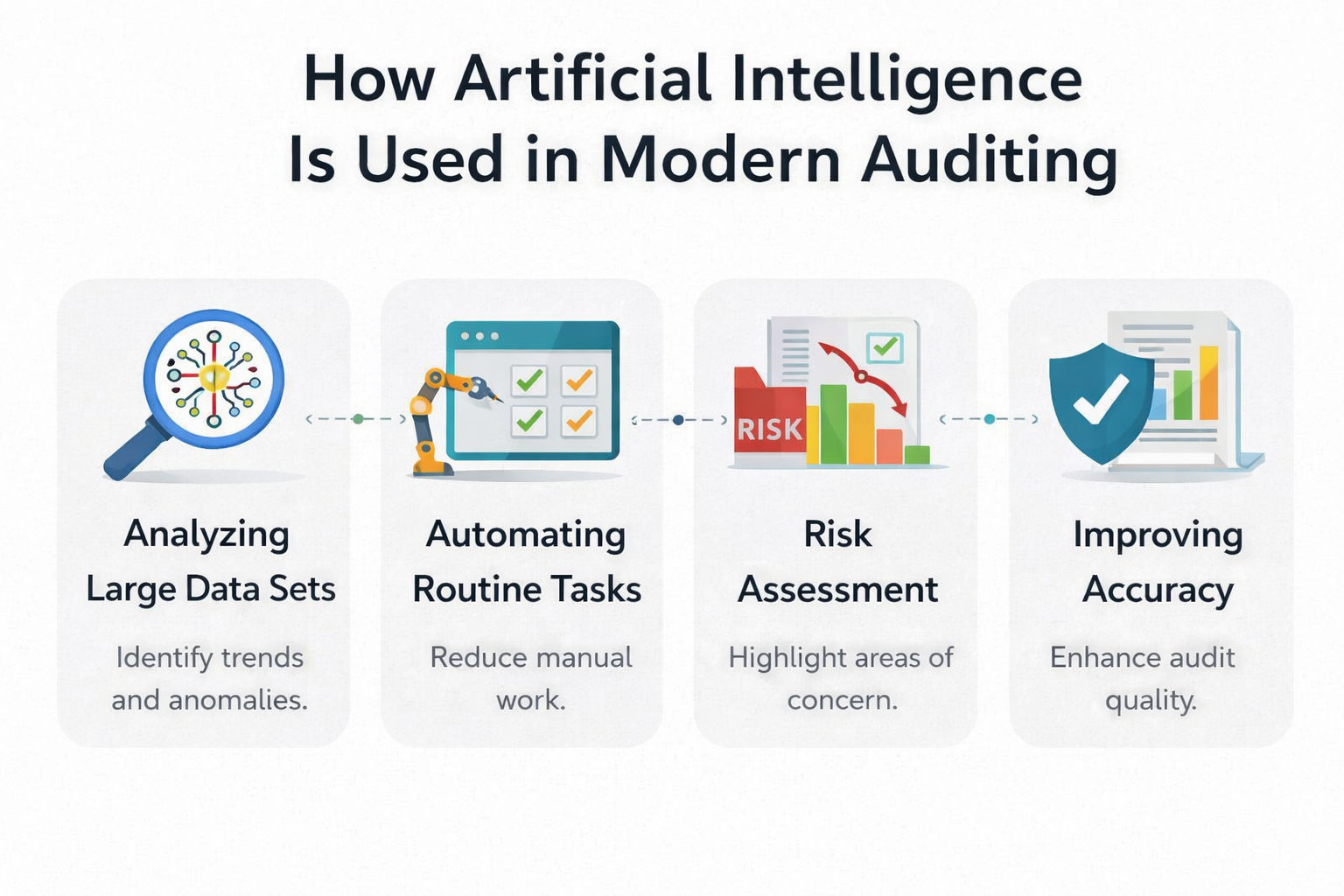
The following areas represent common AI applications in auditing:
Let's look at some practical examples.
Fraud schemes often hide subtle patterns within massive datasets. Machine learning models detect strange transactions, duplicate payments, unauthorised approvals or suspicious vendor relationships.
Using AI, for example, could identify an employee who consistently approves payments just under a pre-established approval threshold, which could be suspicious behaviour.
Organisations create thousands of contracts, invoices, and regulatory filings. NLP algorithms pull out relevant information, find inconsistencies, and check documents against compliance requirements. Auditors are provided with priority findings for review rather than manually reviewing hundreds of pages.
Traditional audits often occur quarterly or annually. AI enables continuous auditing by monitoring transactions in real time.
The following table illustrates the difference:
| Audit Approach | Monitoring Frequency |
| Traditional Audit | Periodic |
| Continuous Audit | Real-time |
| Risk Identification | After occurrence |
| AI Monitoring | Immediate detection |
AI systems assess past trends, transaction patterns and operational data to produce risk scores. For example, an unusual payment pattern, late deliveries and compliance breaches by a supplier may justify a higher risk rating and extra audit procedures.
Artificial intelligence in auditing is about more than efficiency. This enhances the quality of the audit, allowing the professionals to focus on the areas that have the highest potential risk and not spend hours on routine verification tasks.
Also Read: Best AI Tools for Business: Top Tools & Use Cases
AI Courses to upskill
Explore Artificial Intelligence Courses for Career Progression
Artificial Intelligence in internal audit helps organizations improve efficiency, strengthen risk management, and increase audit coverage. By automating repetitive tasks and analyzing large datasets, AI enables internal auditors to focus on higher-value activities such as risk assessment and decision-making.
The table below summarizes the key benefits:
Benefit |
How AI Helps |
| Faster Audit Execution | Automates data collection, testing, and reporting processes. |
| Improved Accuracy | Reduces manual errors and improves consistency in audit reviews. |
| Better Fraud Detection | Identifies unusual transactions and suspicious patterns quickly. |
| Enhanced Risk Management | Detects potential risks earlier through continuous analysis. |
| Continuous Monitoring | Tracks financial and operational activities in real time. |
| Reduced Manual Workload | Automates repetitive audit tasks and documentation. |
| Greater Audit Coverage | Analyzes entire datasets instead of limited samples. |
| Better Decision Support | Provides data-driven insights for informed audit decisions. |
Also read : Artificial Intelligence Tools: Platforms, Frameworks, & Uses
While AI improves audit efficiency and accuracy, organizations must address several implementation challenges.
The table below summarizes the most common limitations and their impact on auditing processes.
Challenge |
Description |
Impact on Auditing |
| Data Quality Issues | AI systems depend on accurate and complete data for training and analysis. | Poor-quality data can lead to incorrect findings, missed risks, and unreliable audit results. |
| Algorithm Bias | AI models may inherit biases from historical data or flawed training processes. | Biased outputs can affect risk assessments and decision-making accuracy. |
| Lack of Transparency | Many AI models operate as "black boxes" and provide limited visibility into how conclusions are reached. | Auditors may struggle to explain findings to regulators, management, and stakeholders. |
| Regulatory Uncertainty | AI regulations continue to evolve across industries and regions. | Organizations must continuously adapt compliance and governance practices. |
| Integration Complexity | AI tools often need to connect with existing financial and audit systems. | Implementation can require significant time, resources, and technical expertise. |
| Skills Gaps | Many audit teams lack advanced AI, analytics, and data science skills. | Organizations may need additional training or specialized talent. |
| Cybersecurity Risks | AI systems can become targets for cyberattacks, data breaches, or model manipulation. | Security vulnerabilities may compromise sensitive financial and audit information. |
Must Read: 28+ Top Generative AI Tools in 2025: Key Benefits and Uses
Artificial intelligence in auditing is transforming the audit processes through enabling continuous monitoring, faster data analysis, and proactive risk management. As organizations handle larger data sets and changing regulations, AI, automation and advanced analytics will play a larger role in improving audit efficiency and decision-making. AI won’t replace auditors, but it will help them become more accurate, insightful and strategically aware.
Several developments are expected to transform the auditing profession in the coming years:
| Emerging Trend | Expected Impact |
| Continuous Auditing | Enables real-time monitoring instead of periodic audits. |
| Predictive Risk Analysis | Identifies potential risks before they become significant issues. |
| AI-Assisted Compliance Management | Improves regulatory monitoring and compliance reporting. |
| Advanced Fraud Detection | Detects suspicious activities through pattern recognition and anomaly analysis. |
| Automated Audit Documentation | Reduces manual reporting efforts and improves consistency. |
| Enterprise System Integration | Connects audit tools with ERP, finance, and operational systems for deeper insights. |
One of the most promising developments is the predictive auditing. Old-fashioned audits tend to discover problems after they’ve happened. AI-enabled predictive models can analyze past and present data to predict potential risks before they affect the organization.
For instance, a manufacturer might rely on predictive analytics to detect suppliers that are exhibiting early indications of operational disruption, allowing management to intervene before supply chain issues arise.
As organizations seek continuous assurance, Artificial Intelligence in internal audit will become increasingly important. Internal audit teams are expected to move beyond periodic reviews and adopt real-time monitoring approaches.
The following capabilities are likely to become standard in modern internal audit functions:
These capabilities allow internal auditors to focus on risk evaluation and business improvement rather than spending significant time on manual testing and data collection.
As AI becomes a core part of audit operations, auditors will need a broader mix of technical and business skills.
The following competencies are expected to be highly valuable:
| Skill Area | Why It Matters |
| Data Analytics | Helps auditors interpret large datasets and identify trends. |
| AI Governance | Ensures responsible and compliant use of AI systems. |
| Risk Management | Supports proactive identification and mitigation of risks. |
| Cybersecurity | Protects sensitive audit and financial information. |
| Regulatory Compliance | Ensures adherence to evolving legal requirements. |
| Business Intelligence Tools | Enables data visualization and decision-making. |
Despite rapid technological advancements, AI cannot replace human judgment, ethical reasoning, and business understanding. Future auditors will spend less time collecting and processing data and more time interpreting insights, assessing risks, and advising stakeholders.
The most successful audit teams will combine AI-driven efficiency with human expertise. This partnership will help organizations improve audit quality, strengthen governance, and make better-informed business decisions in an increasingly data-driven world.
Also read: Top 20 Challenges of Artificial Intelligence: Key Issues and Solutions for 2026
Artificial intelligence in auditing is transforming how organizations manage risk, compliance, and financial oversight. By analyzing large datasets and detecting anomalies, AI improves efficiency, fraud detection, and decision-making. However, success depends on strong data quality, governance, and human oversight. As adoption grows, combining AI-driven insights with professional judgment will define the future of effective auditing.
Ready to start your journey? Book a free consultation with upGrad today to find the best path for your career.
Auditors do not rely solely on AI outputs. They validate findings by reviewing supporting evidence, checking data sources, and applying professional judgment. Many organizations also conduct model testing and performance reviews to ensure AI systems produce reliable results. Human oversight remains essential for interpreting complex situations and making final audit decisions
Yes. AI systems equipped with natural language processing can analyze unstructured data, including emails, contracts, invoices, and policy documents. This capability helps auditors identify inconsistencies, compliance issues, and unusual patterns that might be difficult to detect through manual document reviews.
Industries that generate large volumes of data often gain the most value from AI-assisted audits. These include banking, insurance, healthcare, manufacturing, retail, and telecommunications. AI helps these organizations monitor transactions, manage compliance requirements, and identify operational risks more efficiently.
AI can continuously monitor transactions and business activities against predefined regulatory requirements. It helps identify compliance gaps, track policy violations, and generate audit trails. This allows organizations to address potential issues before they escalate into regulatory or financial problems.
Modern auditors increasingly benefit from skills in data analytics, AI governance, cybersecurity, risk management, and business intelligence tools. Understanding how AI models generate insights enables auditors to evaluate results more effectively and communicate findings to stakeholders with greater confidence.
Yes. Small and medium-sized businesses can use AI-powered audit tools to automate repetitive tasks, improve reporting accuracy, and strengthen internal controls. Many cloud-based solutions now offer scalable options that allow smaller organizations to adopt AI without making large infrastructure investments.
AI analyzes large datasets to identify unusual transactions, spending patterns, duplicate payments, or abnormal account activities. Unlike traditional methods that rely on limited samples, AI can examine entire datasets and uncover hidden relationships that may indicate fraudulent behavior.
Yes. Continuous auditing is one of the most valuable applications of AI. Instead of waiting for quarterly or annual reviews, AI systems can monitor transactions in real time, flag exceptions immediately, and provide ongoing visibility into organizational risks and control effectiveness.
Successful implementation depends on several factors:
Organizations that focus on these areas typically achieve better audit outcomes and greater value from AI investments.
AI improves audit planning by analyzing historical records, operational data, and emerging trends. It helps auditors identify high-risk areas earlier and allocate resources more effectively. This risk-focused approach allows audit teams to spend more time investigating critical issues rather than reviewing low-risk activities.
As AI automates data-intensive tasks, auditors will spend less time gathering information and more time evaluating risks, interpreting insights, and advising business leaders. The future auditor will combine technical knowledge with critical thinking, regulatory expertise, and business understanding to deliver greater strategic value.
698 articles published
Sriram K is a Senior SEO Executive with a B.Tech in Information Technology from Dr. M.G.R. Educational and Research Institute, Chennai. With over a decade of experience in digital marketing, he specia...
Speak with AI & ML expert
By submitting, I accept the T&C and
Privacy Policy
Top Resources
Master's Degree
18 Months
Executive Diploma
12 Months
IIIT Bangalore
Executive Programme in Generative AI & Agentic AI for LeadersIndia’s #1 Tech University
Dual Certification
5 Months