Ontological Engineering in Artificial Intelligence: A Complete Guide
By Sriram
Updated on Jun 24, 2026 | 5 min read | 4.47K+ views
Share:

All courses
Certifications
More
By Sriram
Updated on Jun 24, 2026 | 5 min read | 4.47K+ views
Share:
Table of Contents
Ontological engineering is the practice of defining concepts, relationships, and rules within a specific domain to create structured knowledge models. These machine-readable ontologies help AI systems organize information, understand context, connect related data, and perform intelligent reasoning. By providing a clear framework for knowledge representation, ontological engineering enables more accurate, explainable, and efficient artificial intelligence applications.
In this blog, you will learn what ontological engineering in artificial intelligence is, how it works, its key components, applications, benefits, challenges, and future trends shaping modern AI systems.
Explore upGrad’s AI courses to gain practical skills in machine learning, knowledge engineering, and intelligent systems.
Popular AI Programs
Ontological engineering in artificial intelligence refers to the process of creating and managing ontologies that represent knowledge in a structured and machine-readable format.
An ontology defines:
In simple terms, an ontology acts as a knowledge map that helps AI systems understand how different pieces of information relate to one another.
Also Read: Applications of Artificial Intelligence and Its Impact
Free Courses
Modern AI systems deal with vast amounts of information from different sources.
Without structured knowledge representation, understanding relationships between data points becomes difficult.
Ontological engineering helps AI systems:
As organizations increasingly adopt AI technologies, ontologies play a critical role in ensuring consistency and accuracy in knowledge management.
Do read: Applications of Artificial Intelligence and Its Impact
AI Courses to upskill
Explore Artificial Intelligence Courses for Career Progression
Several core components work together to create effective ontologies.
Component |
Definition |
| Classes | Categories or concepts representing groups of entities within a domain. |
| Individuals | Specific instances belonging to a class. |
| Properties | Attributes that describe characteristics of entities. |
| Relationships | Connections between different concepts and entities. |
| Constraints | Rules that govern how concepts interact. |
| Axioms | Statements that define logical truths within the ontology. |
Together, these components create a structured framework that AI systems can interpret and utilize for reasoning tasks.
The process of ontological engineering in artificial intelligence involves multiple stages that help transform domain knowledge into a machine-understandable structure.
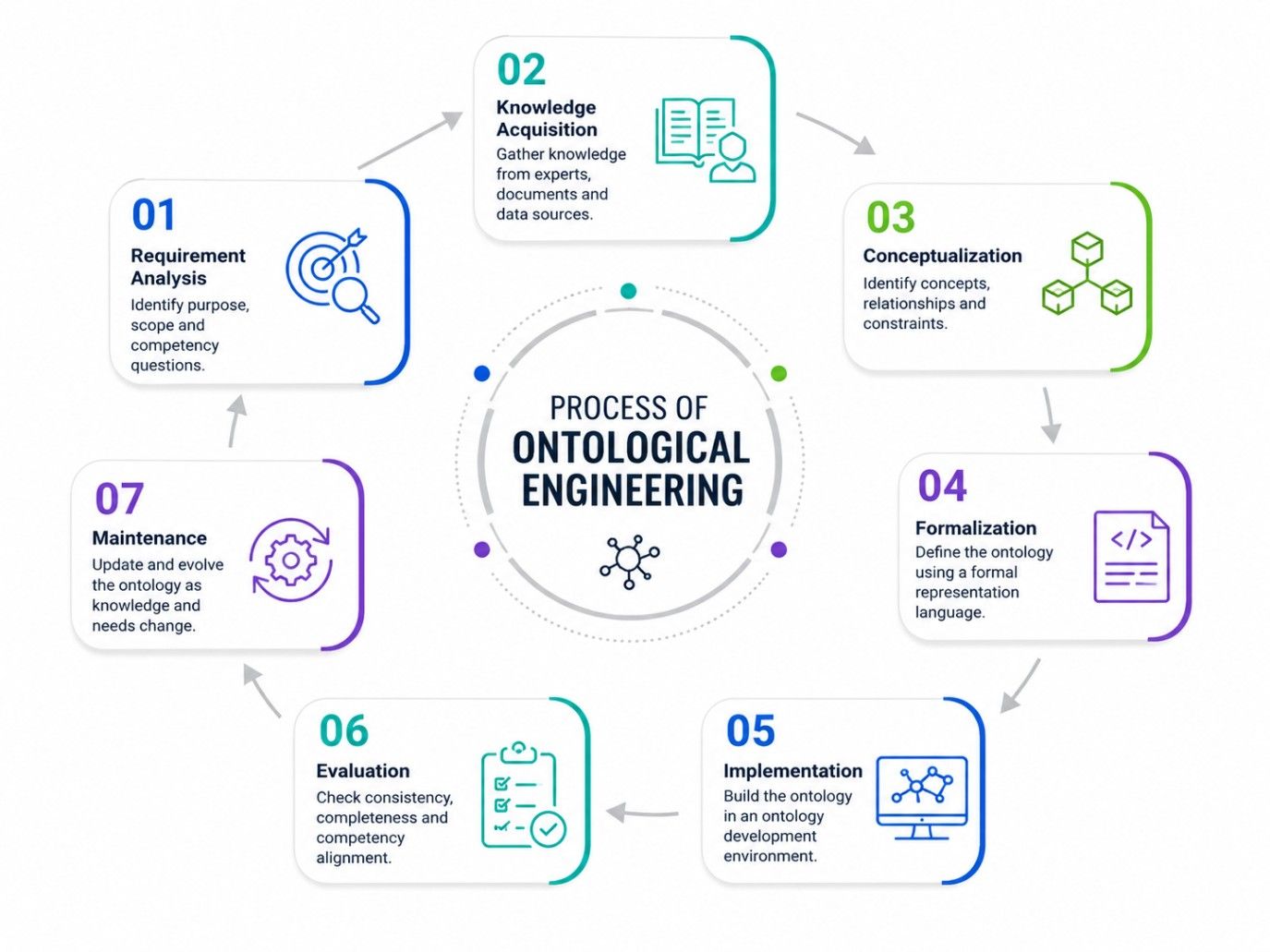
Different types of ontologies serve different purposes depending on the application.
Together, they help AI systems represent knowledge, understand relationships, and support intelligent reasoning across various domains.
Upper ontologies provide general concepts that can be applied across multiple domains and industries. They serve as a foundational framework for building more specialized ontologies.
Examples
Domain ontologies focus on a specific field or area of knowledge. They capture concepts, relationships, and terminology unique to a particular industry.
Examples
Task ontologies represent knowledge related to specific activities or functions. They help AI systems understand the processes involved in performing particular tasks.
Examples
Application ontologies are designed for specific software systems, business processes, or use cases. They combine domain and task knowledge to support particular applications.
Examples
These ontology types often work together to create comprehensive knowledge structures that support complex artificial intelligence systems.
Also read: How to Learn Artificial Intelligence: A Step-by-Step Roadmap
Ontological engineering supports AI applications across industries by enabling structured knowledge representation, intelligent reasoning, semantic understanding, and data integration.
Healthcare organizations use ontologies to organize medical knowledge and improve diagnostic accuracy.
Applications include:
Financial institutions leverage ontologies for:
Retail businesses utilize ontology-based systems to:
Educational platforms use ontologies for:
Security teams apply ontological models to:
Organisations increasingly invest in ontology development because it improves knowledge management, enhances AI performance, enables smarter decision-making, and supports seamless data integration across complex systems.
Key Benefits of Ontological Engineering and Their Impact on AI Systems :
Benefit |
Description |
| Improved Knowledge Representation | Ontologies organize information in a structured and meaningful manner, making knowledge easier for AI systems to understand and utilize. |
| Better AI Reasoning | Machines can draw logical conclusions and infer new knowledge based on predefined relationships and rules. |
| Enhanced Data Integration | Different systems and data sources can share, exchange, and interpret information consistently. |
| Improved Search Accuracy | Semantic understanding helps AI systems deliver more relevant and context-aware search results. |
| Increased Explainability | Ontology-based systems provide transparent reasoning processes, supporting explainable and trustworthy AI. |
| Stronger Decision-Making | Structured knowledge improves the quality and accuracy of both automated and human-assisted decisions. |
Do read: AI Course Fees and Career Opportunities in India for 2026
Despite its advantages, implementing ontological engineering presents several challenges.
Major Challenges of Ontological Engineering and Their Impact on AI Systems :
Challenge |
Description |
| Knowledge Acquisition Complexity | Gathering accurate domain knowledge requires collaboration with subject matter experts and extensive research. |
| Maintenance Requirements | Ontologies must be regularly updated to reflect changes in knowledge, terminology, and business requirements. |
| Scalability Issues | Large and complex ontologies can become difficult to manage, maintain, and optimize over time. |
| Integration Difficulties | Combining ontologies from different domains or systems may create inconsistencies and compatibility challenges. |
| Development Costs | Building high-quality ontologies requires significant time, expertise, and resources for design and validation. |
As AI continues to evolve, ontological engineering will become increasingly important for creating intelligent and explainable systems.
Emerging trends include:
The combination of machine learning and ontology-based knowledge representation is expected to drive the next generation of intelligent applications.
Must read: 5 Significant Benefits of Artificial Intelligence [Deep Analysis]
Ontological engineering in artificial intelligence helps machines organize, understand, and reason with knowledge through structured concepts, relationships, and rules. It enables more accurate decision-making, semantic understanding, and intelligent data processing.
As AI adoption grows, ontology-driven systems are enhancing applications across healthcare, finance, e-commerce, and cybersecurity, making AI solutions smarter, more reliable, and easier to explain.
Ready to start your journey with AI? Book a free consultation with upGrad today to find the best path for your career.
Yes, ontological engineering can improve generative AI by providing structured domain knowledge that complements machine learning models. While large language models learn patterns from data, ontologies define relationships and rules explicitly. This helps reduce ambiguity, improves contextual understanding, and supports more accurate responses in specialized fields such as healthcare, finance, and legal services.
An ontology defines the concepts, relationships, and rules within a domain, while a knowledge graph uses those definitions to connect real-world entities and data points. Think of an ontology as the blueprint and a knowledge graph as the implementation. Many AI applications use both together to enhance search, reasoning, and information retrieval.
Explainable AI requires systems to provide understandable reasons for their decisions. Ontologies help by defining clear relationships and logical rules that AI systems can follow. When a recommendation or prediction is made, organizations can trace the reasoning path through the ontology, making outcomes easier to interpret and validate.
Industries that manage large volumes of complex information gain the most value. Healthcare uses ontologies for medical knowledge management, finance applies them for compliance and risk analysis, and e-commerce leverages them for product recommendations. Research, cybersecurity, and education also rely on ontology-driven systems to improve decision-making and knowledge discovery.
Ontology engineering is the process of designing, developing, and maintaining structured knowledge models that define concepts, relationships, and rules within a domain. These ontologies allow AI systems to understand information in a meaningful way rather than treating data as isolated records. The approach is widely used in semantic web technologies, knowledge graphs, and intelligent decision-support systems.
Yes, small businesses can benefit from ontological engineering in artificial intelligence, especially when managing complex data from multiple sources. Even simple ontology models can improve search functionality, customer support automation, and data consistency. Businesses do not always need large-scale implementations to gain practical value from structured knowledge representation.
Context comes from understanding relationships rather than individual pieces of information. Ontologies define how concepts connect within a domain. For example, an AI healthcare application can understand that a doctor treats a patient at a hospital because those relationships are explicitly defined. This contextual awareness improves reasoning and decision-making capabilities.
No, ontology development is not replacing machine learning. Instead, the two approaches are increasingly being combined. Machine learning excels at identifying patterns from large datasets, while ontologies provide structured knowledge and reasoning capabilities. Together, they create more reliable and explainable AI systems than either approach alone.
The four commonly recognized types of AI are Reactive Machines, Limited Memory AI, Theory of Mind AI, and Self-Aware AI. Most modern AI applications fall into the Limited Memory category because they learn from historical data. Researchers use knowledge representation techniques, including ontologies, to help advanced AI systems move toward greater contextual understanding and reasoning.
Ontology is used in AI to organize knowledge, define relationships between concepts, and support logical reasoning. It enables systems to interpret information with greater context and consistency. Applications include semantic search, recommendation engines, virtual assistants, knowledge graphs, healthcare diagnostics, and enterprise data integration. Ontological engineering in artificial intelligence plays a key role in building these intelligent systems.
In Palantir's technology platform, an ontology refers to a digital representation of an organization's data, processes, and relationships. It creates a common framework that connects information from different systems and makes it easier for users and AI applications to analyze data. While the concept aligns with traditional ontologies, Palantir applies it to operational decision-making and enterprise data management at scale.
730 articles published
Sriram K is a Senior SEO Executive with a B.Tech in Information Technology from Dr. M.G.R. Educational and Research Institute, Chennai. With over a decade of experience in digital marketing, he specia...
Speak with AI & ML expert
By submitting, I accept the T&C and
Privacy Policy
Top Resources
Master's Degree
18 Months
Executive Diploma
12 Months
IIIT Bangalore
Executive Programme in Generative AI & Agentic AI for LeadersIndia’s #1 Tech University
Dual Certification
5 Months