Bidirectional Search in Artificial Intelligence: A Complete Guide
By Rahul Singh
Updated on Jun 22, 2026 | 9 min read | 4.24K+ views
Share:

All courses
Certifications
More
By Rahul Singh
Updated on Jun 22, 2026 | 9 min read | 4.24K+ views
Share:
Table of Contents
Bidirectional search is a graph traversal algorithm that finds the shortest path between two nodes by performing two simultaneous searches. One search begins from the initial state and moves forward, while the other starts from the goal state and moves backward. The algorithm stops when the two search frontiers meet at a common node, allowing the complete path to be constructed efficiently.
This guide covers everything you need to understand bidirectional search in artificial intelligence. You will learn what it is, why it matters, how the algorithm works step by step, see a concrete example, and understand where it fits in the real world.
Popular AI Programs
At its core, bidirectional search is a strategy for finding the shortest path between two nodes in a graph. Most traditional search algorithms, like Breadth-First Search (BFS) or Depth-First Search (DFS), work in one direction only. They expand nodes from the start until they reach the goal. Bidirectional search breaks that pattern by running two searches simultaneously.
The two searches are:
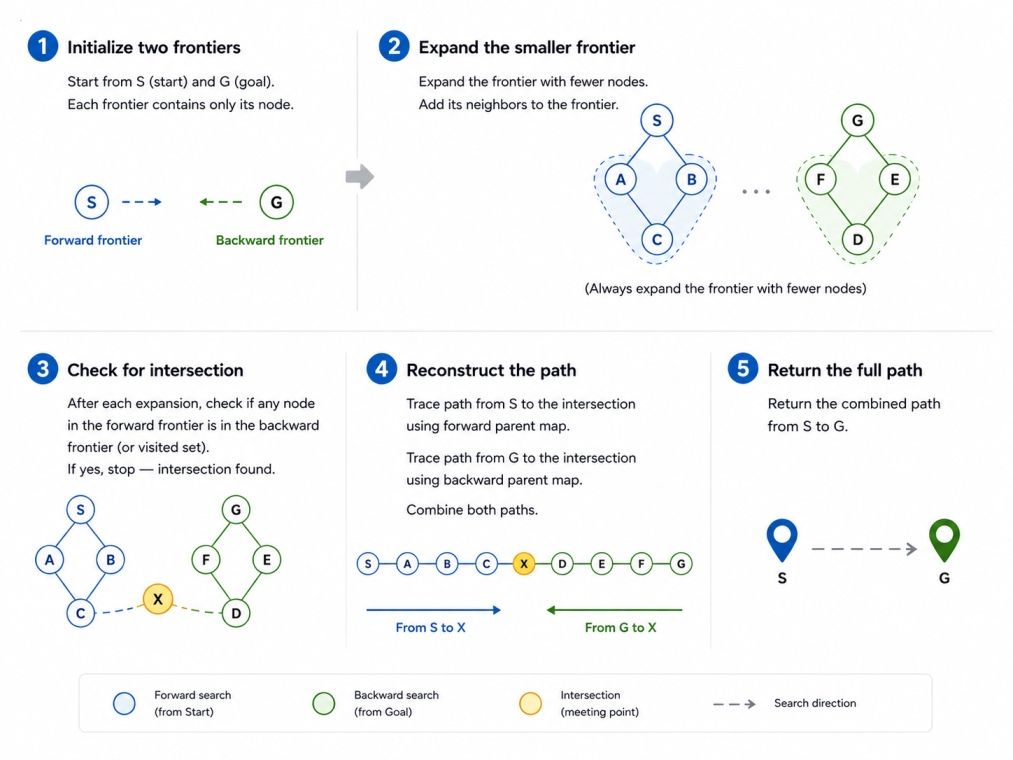
The bidirectional search in artificial intelligence stops when these two frontiers meet. The path is then reconstructed by combining the two partial paths.
Think about searching a map from Delhi to Mumbai. A standard BFS would explore every city reachable from Delhi, expanding outward in a huge circle. Bidirectional search instead expands a smaller circle from Delhi and another from Mumbai at the same time. When the two circles touch, you have your path.
The efficiency gain is significant. If a graph has branching factor b and the solution is at depth d, a standard BFS explores roughly b^d nodes. Bidirectional search reduces that to roughly 2 * b^(d/2). For large graphs, this difference is enormous.
Search Type |
Nodes Explored (approx.) |
Time Complexity |
| BFS (one direction) | b^d | O(b^d) |
| Bidirectional Search | 2 * b^(d/2) | O(b^(d/2)) |
| DFS (one direction) | b^d | O(b^d) |
Here b is the branching factor and d is the depth of the solution.
Bidirectional search works best when:
Also Read: Top 5 Machine Learning Models Explained For Beginners
Free Courses
The bidirectional search algorithm in artificial intelligence follows a clear step-by-step process. Understanding each step helps you implement it correctly and reason about its behavior.
BidirectionalSearch(start, goal):
   forward_queue  = [start]
   backward_queue = [goal]
   forward_visited  = {start: None}
   backward_visited = {goal: None}

   while forward_queue and backward_queue:
       if size(forward_queue) <= size(backward_queue):
            node = forward_queue.dequeue()
            for neighbor in neighbors(node):
                if neighbor not in forward_visited:
                    forward_visited[neighbor] = node
                   forward_queue.enqueue(neighbor)
                if neighbor in backward_visited:
                    return reconstruct_path(forward_visited, backward_visited, neighbor)
       else:
            node = backward_queue.dequeue()
            for neighbor in neighbors(node):
                if neighbor not in backward_visited:
                    backward_visited[neighbor] = node
                   backward_queue.enqueue(neighbor)
                if neighbor in forward_visited:
                    return reconstruct_path(forward_visited, backward_visited, neighbor)

   return None  // No path found
Also Read: Time and Space Complexity in Data Structures: A Detailed Guide
AI Courses to upskill
Explore Artificial Intelligence Courses for Career Progression
A concrete example makes everything clearer. Let us walk through the bidirectional search algorithm in artificial intelligence with an example using a simple undirected graph.
Suppose you have the following connections:
A -- B -- C -- D
| |
E -- F -- G -- H
Nodes: A, B, C, D, E, F, G, H
Start: A
Goal: H
Initial state:
Iteration 1 (expand forward):
Iteration 2 (expand backward):
Iteration 3 (expand forward):
Iteration 4 (expand backward):
Path reconstruction:
The algorithm found the shortest path in just 4 iterations, touching only 7 of 8 nodes. A standard BFS from A alone would have explored all nodes before confirming the shortest path to H.
Also Read: Types of Algorithms in Machine Learning: Uses and Examples
Metric |
BFS |
Bidirectional Search |
| Nodes explored | 8 | 7 |
| Iterations | 7+ | 4 |
| Path found | A-B-C-D-H | A-B-C-D-H |
| Path length | 4 | 4 |
The path is the same. The cost to find it is lower with bidirectional search in artificial intelligence.
Not all implementations of bidirectional search in artificial intelligence work the same way. The technique can be applied on top of different underlying search strategies.
The most common form. Both the forward and backward searches use Breadth-First Search. This guarantees the shortest path in unweighted graphs. It is also the most straightforward to implement.
Best for: Unweighted graphs, finding shortest hops between nodes
Also Read :Applications of Artificial Intelligence and Its Impact
Uses Dijkstra's algorithm in both directions, expanding nodes based on cost. This works for weighted graphs and still guarantees the optimal path.
Best for: Weighted graphs like road networks or logistics systems
Combines the bidirectional approach with A* heuristics. Both searches use a heuristic function to guide expansion toward the meeting point. This is trickier to implement correctly because the termination condition is more complex, but it can be significantly faster.
Best for: Large search spaces where a good heuristic is available
Variant |
Graph Type |
Optimal? |
Uses Heuristic? |
Complexity |
| Bidirectional BFS | Unweighted | Yes | No | O(b^(d/2)) |
| Bidirectional Dijkstra | Weighted | Yes | No | O(b^(d/2) log n) |
| Bidirectional A* | Weighted | Yes (with admissible heuristic) | Yes | Varies |
Each variant fits a different scenario. Choosing the right one depends on whether your graph is weighted, whether you have a useful heuristic, and how large the search space is.
Also Read: Advanced Graph Algorithms for Big Data Applications
The bidirectional search algorithm in artificial intelligence is not just a textbook concept. It powers real systems people use every day.
Apps like Google Maps and GPS systems use variants of bidirectional Dijkstra to find shortest routes. When you ask for directions from one city to another, searching from both ends simultaneously cuts down the number of nodes processed by a large factor. This matters when the road graph contains millions of intersections.
Finding the shortest connection between two people on a social platform is a classic bidirectional BFS problem. Instead of exploring all of one person's connections and their connections, you search from both people at once and meet in the middle.
Also Read: Top 10 Uses of Artificial Intelligence
AI systems solving puzzles like the 15-puzzle or navigating game maps use bidirectional search to find solutions faster. When both the start and end states are known, bidirectional search reduces the work considerably compared to exploring from one side alone.
In computer networks, finding the shortest path between two routers or nodes can benefit from bidirectional algorithms. The approach reduces the nodes that need to be evaluated, improving routing speed.
Robots navigating physical environments use bidirectional search when they know where they are and where they need to go. The reduced search space translates directly to faster movement decisions.
Like any algorithm, bidirectional search has clear strengths and some genuine limitations worth knowing.
Also Read: 23+ Top Applications of Generative AI Across Different Industries in 2026
Feature |
Standard BFS |
Bidirectional Search |
| Goal state required | No | Yes |
| Time complexity | O(b^d) | O(b^(d/2)) |
| Space complexity | O(b^d) | O(b^(d/2)) |
| Works on directed graphs | Yes | Needs reverse edges |
| Implementation difficulty | Low | Medium |
Bidirectional search in artificial intelligence is a smart, efficient approach to finding paths in large graphs. By running two searches at the same time and meeting in the middle, it cuts through the search space far more effectively than traditional one-directional methods.
If you are preparing for AI coursework, a technical interview, or building a system that needs efficient pathfinding, mastering bidirectional search gives you a practical tool with wide application. upGrad offers structured programs in Artificial Intelligence and Data Science that take you from these fundamentals all the way to advanced applied AI.
Want personalized guidance on AI and upskilling? Speak with an expert for a free 1:1 counselling session today.
Bidirectional search is a pathfinding technique that runs two searches at the same time. One starts from the beginning and one starts from the goal. When they meet, the full path is combined and returned. It is faster because each search only needs to cover half the distance.
The time complexity of bidirectional search using BFS is O(b^(d/2)), where b is the branching factor and d is the depth of the solution. This is significantly better than standard BFS, which has a time complexity of O(b^d), especially for large search spaces.
Not always. Bidirectional search requires that the goal state is known in advance and that you can traverse edges in reverse. For small graphs or problems where the goal is unknown, standard BFS may be more appropriate. Bidirectional search excels in large, well-defined graphs with known start and end points.
Standard A* runs in one direction from start to goal using a heuristic to guide expansion. Bidirectional A* runs two heuristic-guided searches simultaneously, one from start and one from goal. The bidirectional version can be faster, but it is harder to implement correctly because the termination condition is more complex.
Yes, but you need access to the reverse graph. In a directed graph, edges only go one way. For the backward search to work, it must follow edges in reverse. If you know or can build the reverse edge list for your directed graph, bidirectional search works fine.
When both searches use BFS on an unweighted graph, bidirectional search guarantees the shortest path. For weighted graphs, you need bidirectional Dijkstra to maintain the optimality guarantee. Bidirectional A* also guarantees the optimal path when an admissible heuristic is used.
Bidirectional search powers navigation apps like Google Maps, social network shortest-path queries, game AI pathfinding, network routing, and robotic path planning. Any domain that involves finding the fastest route between two known points in a large graph can benefit from this approach.
If no path exists between the start and goal nodes, the two frontiers will eventually exhaust all reachable nodes without finding an intersection. The algorithm returns no path found. This can happen in disconnected graphs where the two nodes belong to separate components.
For weighted graphs, bidirectional Dijkstra is used instead of bidirectional BFS. Each search expands nodes in order of their cumulative path cost, just like standard Dijkstra. The termination condition requires additional care to ensure the path found is truly optimal, not just the first intersection discovered.
The space complexity is O(b^(d/2)) because each frontier only needs to store half the nodes that a full one-directional search would. Both frontiers together use roughly the same memory as one fully expanded BFS frontier, making bidirectional search noticeably more memory-efficient for deep search problems.
Not quite. Two independent BFS searches would each run to completion without knowing about each other. Bidirectional search coordinates both searches, alternating between them and checking at every expansion whether the new node has already been visited by the other search. This coordination is what allows it to stop early and reconstruct a combined path.
98 articles published
Rahul Singh is an Associate Content Writer at upGrad, with a strong interest in Data Science, Machine Learning, and Artificial Intelligence. He combines technical development skills with data-driven s...
Speak with AI & ML expert
By submitting, I accept the T&C and
Privacy Policy
Top Resources
Master's Degree
18 Months
Executive Diploma
12 Months
IIIT Bangalore
Executive Programme in Generative AI & Agentic AI for LeadersIndia’s #1 Tech University
Dual Certification
5 Months