Planning in Artificial Intelligence: A Complete Beginner's Guide
By Sriram
Updated on Jun 30, 2026 | 6 min read | 2.29K+ views
Share:

All courses
Certifications
More
By Sriram
Updated on Jun 30, 2026 | 6 min read | 2.29K+ views
Share:
Table of Contents
Planning in Artificial Intelligence helps an AI system decide what actions to take to reach a specific goal. It does not just react to every situation. Instead, an AI planner looks at the state thinks about possible actions and predicts what will happen if it takes those actions. This helps AI systems solve problems, automate tasks, and take decisions even when things change. AI planning is, about choosing the actions, consider the actions that work best or possible actions. And allows AI systems to achieve their goals.
In this blog, you'll learn what planning in artificial intelligence is, why it matters, how the planning process works, and the major planning techniques used in modern AI systems.
Explore Artificial Intelligence Courses from upGrad and build in-demand skills employers seek with specialized AI and ML programs.
Popular AI Programs
Planning in Artificial Intelligence is about creating a list of steps that help an AI move from its current state to a desired goal state. Unlike systems that just follow rules, planning enables an AI to think ahead. It looks at options and chooses the best path before acting.
Think of using a GPS app, instead of giving you random directions it looks at where you are, where you want to go, and the traffic. Then it suggests a way to get there. AI planning works that way.
Planning in AI is used in areas. For example, it is used in robotics. It is used in self-driving cars. Planning helps these systems work safely and efficiently.
At the heart of planning lies three simple questions:
Every planning system answers these questions before executing any action.
Also Read: Artificial Intelligence Subjects: Everything You Need to Know Before Enrolling
A planning problem usually has key parts. These parts help a computer system make decisions in a structured way instead of relying on trial and error.
Component |
Description |
| Initial State | The current situation or environment of the AI agent. |
| Goal State | The final objective the system wants to achieve. |
| Actions | Possible operations the agent can perform. |
| Preconditions | Conditions that must be true before an action is executed. |
| Effects | Changes that occur after an action is completed. |
| Plan | An ordered sequence of actions leading to the goal. |
Also Read: How to Learn Artificial Intelligence: A Step-by-Step Roadmap
Free Courses
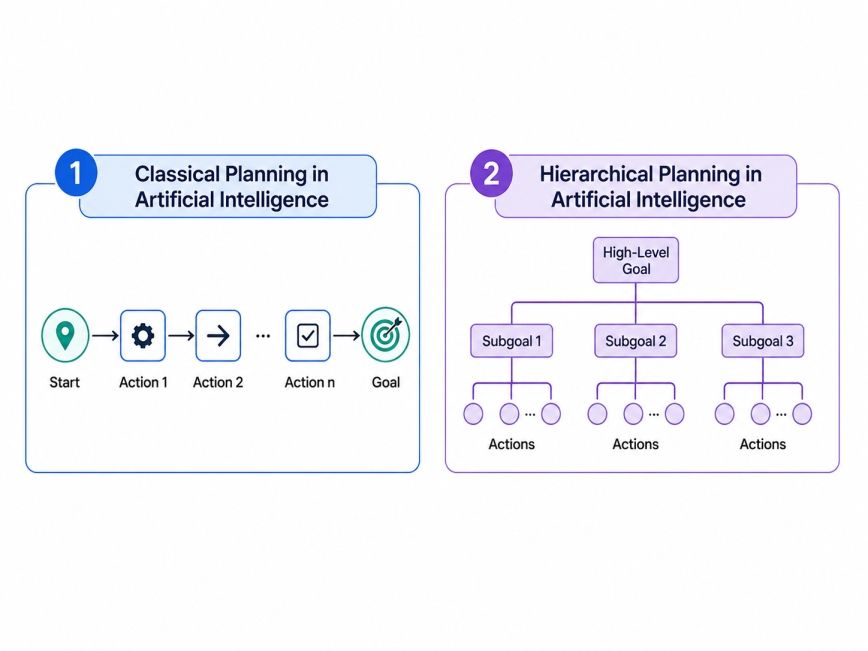
Not every problem with Artificial Intelligence can be figured out in the way. A robot that works inside a factory has needs when it comes to planning than a self-driving car that must navigate through busy roads. That is why Artificial Intelligence uses different planning techniques each one made for a specific kind of problem.
Some methods are really good when everything stays the same and you can tell what will happen when you do something. Artificial Intelligence uses these methods in environments where every action has a predictable outcome.
Classical planning in Artificial Intelligence is the basic way that AI plans things. It is based on the idea that we know everything about the situation and that the things we do will always have the result and that the system has all the information it needs before it decides.
This way of planning works well when we are dealing with problems that have clear rules and are very structured. AI comes up with a list of things to do that will help us achieve our goal if everything happens exactly like we thought it would be.
For example, imagine a robot moving boxes inside a warehouse. The robot knows:
Since nothing changes unexpectedly, the robot can calculate the shortest sequence of actions before it starts moving.
Characteristics of classical planning in artificial intelligence
Feature |
Description |
| Environment | Fully known |
| Action outcomes | Deterministic |
| Goal | Clearly defined |
| Planning style | Offline before execution |
| Best suited for | Robotics, logistics, puzzle solving |
As planning problems become more complex, solving everything at once becomes difficult. This is where hierarchical planning in artificial intelligence becomes useful. Instead of making one big plan, the AI breaks hard tasks into smaller tasks to make it easier to manage. AI solves each sub-task individually before putting them all together to make a complete plan.
AI follows the same strategy through hierarchical planning in artificial intelligence, making large planning problems easier to solve. This approach is especially useful in industries where tasks involve many interconnected decisions.
Consider planning an international vacation. By simplifying complex goals into smaller objectives, hierarchical planning in artificial intelligence improves scalability and reduces computational effort.
You usually don't think about every small detail at once. Instead, you break the process into stages:
Some common applications include:
Also Read: Comprehensive Artificial Intelligence Syllabus to Build a Rewarding Career
While classical planning in artificial intelligence and hierarchical planning in artificial intelligence is among the most widely studied methods, several other planning techniques are also important.
Each method deals with many real-world problems. Modern AI systems usually combine multiple planning strategies instead of using just one method.
Planning Type |
Best Used When |
Example |
| Conditional Planning | Outcomes are uncertain | Medical diagnosis systems |
| Probabilistic Planning | Actions have different success rates | Self-driving vehicles |
| Temporal Planning | Time constraints matter | Airline scheduling |
| Reactive Planning | Environment changes continuously | Robot obstacle avoidance |
| Multi-Agent Planning | Multiple AI agents cooperate | Drone fleet coordination |
AI Courses to upskill
Explore Artificial Intelligence Courses for Career Progression
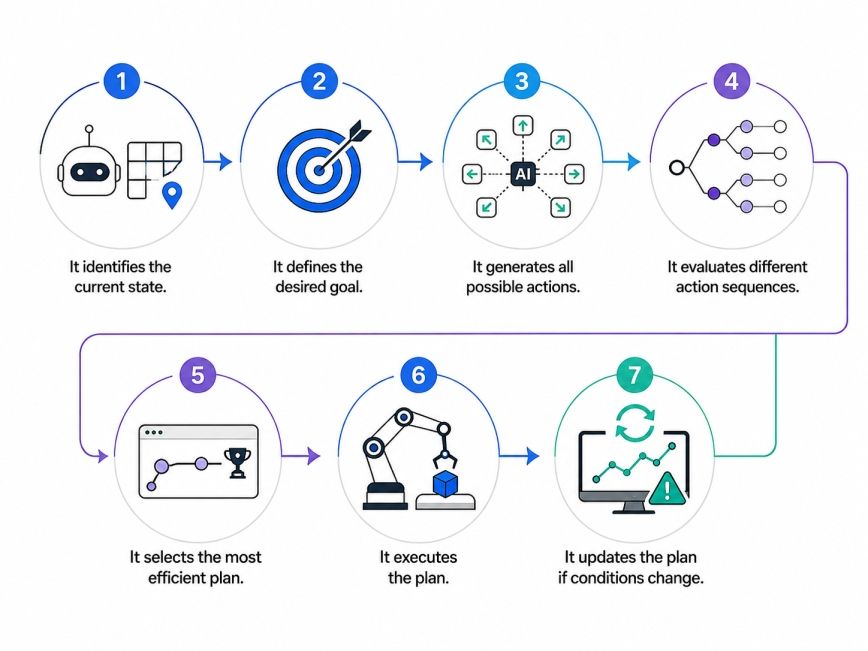
Now that you have looked at the planning methods, it is useful to see how a planning system creates a solution. Most planning systems have a basic process even though different algorithms use different strategies.
Planning is like solving a puzzle. The AI knows it's starting point and its ending point. The AIs job is to find the series of steps to take. It must avoid doing things. The AI needs to discover the sequence of moves.
The process begins by identifying the current state of the environment. This includes all the information the AI needs before making any decisions. The planner needs an accurate starting point to work properly and find good solutions for the planner to work with.
For example, a warehouse robot identifies:
The next step is to figure out what success means. A goal needs to be something we can measure and understand easily. The planner continuously compares its progress against this target while generating actions.
Examples include:
Artificial Intelligence now figures out everything it can do. For example, a robot that delivers things can do things like move forward, turn around, pick up a package or put it down where it is supposed to go.
These things the robot can do are like the pieces that make up the plan, for the delivery robot.
Each action has:
The planner explores multiple action sequences. Rather than selecting the first available path, it compares different alternatives. Search algorithms are commonly used during this stage to identify efficient solutions.
It evaluates factors such as:
Once several plans have been generated, the AI ranks them using predefined evaluation criteria. The chosen plan balances efficiency with the likelihood of achieving the desired outcome.
Some systems prioritize:
Planning does not end after execution begins. Many modern AI systems monitor the environment continuously. This ability to adapt is one reason planning remains a core capability in intelligent systems.
If conditions change, they may:
Take your AI project experience beyond coding with the IIM Kozhikode Strategic AI for Business Professionals - Leadership for an AI-First World program and learn how organizations leverage AI to drive business growth and innovation.
Planning is really useful for Artificial Intelligence. It lets machines do more than just make guesses. Artificial Intelligence can take action to get what it wants. We use planning in lots of places, like healthcare. When we move things around. It helps people and companies work better, save money, and make decisions on their own with Artificial Intelligence.
The effect of planning in AI is huge and can be seen in various industries. AI planners help systems make decisions that need a lot of human effort. In such cases, planning in AI helps machines think and act like humans.
Industry |
How AI Planning Is Used |
| Healthcare | Scheduling surgeries, treatment planning, hospital resource allocation |
| Logistics | Route optimization, fleet management, warehouse automation |
| Manufacturing | Production scheduling, robotic assembly, inventory planning |
| Finance | Workflow automation, fraud investigation processes, portfolio planning |
| Transportation | Autonomous navigation, traffic management, delivery optimization |
| Agriculture | Irrigation scheduling, crop monitoring, resource allocation |
| Space Exploration | Mission planning, rover navigation, satellite operations |
Planning has come a way, but it still has some big problems to solve. Because of these issues, modern planning systems often use planning and machine learning. They also use optimization techniques and real-time feedback. Planning systems do not just follow one plan they change as they get new information.
1. Dynamic environments
Real-world conditions rarely stay constant. Unexpected events such as road closures, equipment failures, or changing customer requests can make an existing plan ineffective.
2. Incomplete information
AI systems do not always have access to every detail. Missing or inaccurate data can lead to poor planning decisions.
3. Computational complexity
As the number of possible actions increases, the number of potential plans grows rapidly. This makes large planning problems computationally expensive.
4. Uncertainty
Many actions involve uncertain outcomes. Weather conditions, human behavior, or equipment reliability may affect whether a plan succeeds.
5. Resource constraints
AI planners often need to work within limits such as time, budget, battery life, computing power, or available personnel.
Planning is one of the foundational concepts that enables artificial intelligence to solve problems systematically. Instead of reacting to situations one step at a time, AI planners evaluate goals, analyze possible actions, and identify the most effective path forward.
As AI systems continue to evolve, planning will remain essential for building intelligent applications that can reason, adapt, and make informed decisions. Whether you're studying AI, preparing for interviews, or developing intelligent systems, understanding planning provides a strong foundation for exploring more advanced topics in artificial intelligence.
Want to explore more about management accounting? Book your free 1:1 personal consultation with our expert today.
Planning in artificial intelligence is the process of identifying a sequence of actions that helps an AI system achieve a specific goal. A common example is a warehouse robot that determines the shortest route to collect and deliver packages while avoiding obstacles and minimizing travel time.
Planning allows AI systems to make goal-oriented decisions instead of simply reacting to inputs. It improves efficiency, reduces unnecessary actions, optimizes resource usage, and enables intelligent automation across industries such as healthcare, logistics, manufacturing, and robotics.
Problem-solving focuses on finding a solution to a specific challenge, while planning determines the sequence of actions required to reach a desired outcome. In many AI systems, planning is considered a practical extension of problem-solving because it prepares the agent for execution.
Classical planning in artificial intelligence assumes that the environment is fully observable, actions are predictable, and the initial state is known. Under these assumptions, AI generates an action sequence before execution, making it suitable for structured and controlled environments.
Hierarchical planning in artificial intelligence divides a large problem into smaller subtasks that are easier to solve. After completing each subtask, the AI combines them into a complete solution. This approach is widely used for complex projects involving many interconnected decisions.
Several algorithms support planning in artificial intelligence, including A* Search, STRIPS, GraphPlan, Partial-Order Planning (POP), Hierarchical Task Network (HTN) Planning, and Fast Forward (FF) Planning. The choice depends on the complexity of the environment and the planning objective.
Planning is used in autonomous vehicles, warehouse automation, robotics, healthcare scheduling, airline operations, smart manufacturing, supply chain management, agriculture, finance, and space exploration. These systems rely on planning to make efficient decisions while adapting to operational constraints.
Some common challenges include uncertain environments, incomplete information, computational complexity, changing goals, and limited resources. Modern AI systems address these issues by combining planning with machine learning, optimization techniques, and real-time monitoring.
Machine learning and planning solve different problems. Machine learning helps AI recognize patterns and make predictions, while planning determines the sequence of actions required to achieve goals. Many advanced AI systems combine both techniques to improve decision-making and adaptability.
Yes. Understanding planning helps beginners learn how AI agents make decisions, organize tasks, and solve real-world problems. It also builds a strong foundation for studying robotics, search algorithms, reinforcement learning, and autonomous systems later in an AI learning journey.
After learning planning, you can explore search algorithms, knowledge representation, constraint satisfaction problems, reinforcement learning, probabilistic reasoning, natural language processing, and multi-agent systems. Together, these topics provide a deeper understanding of how intelligent systems reason and act.
730 articles published
Sriram K is a Senior SEO Executive with a B.Tech in Information Technology from Dr. M.G.R. Educational and Research Institute, Chennai. With over a decade of experience in digital marketing, he specia...
Speak with AI & ML expert
By submitting, I accept the T&C and
Privacy Policy
Top Resources
Master's Degree
18 Months
Executive Diploma
12 Months
IIIT Bangalore
Executive Programme in Generative AI & Agentic AI for LeadersIndia’s #1 Tech University
Dual Certification
5 Months