Probabilistic Reasoning in Artificial Intelligence: AI Handles Uncertainty
By Sriram
Updated on Sep 29, 2026 | 6 min read | 2.37K+ views
Share:

All courses
Certifications
More
By Sriram
Updated on Sep 29, 2026 | 6 min read | 2.37K+ views
Share:
Table of Contents
Probabilistic reasoning in Artificial Intelligence is how machines learn to deal with the messiness of the real world. Instead of forcing every situation into a rigid yes-or-no box, it assigns a likelihood of a numerical confidence score to different possible outcomes. So rather than declaring something definitively true or false, the system says, "there's a 78% chance this is the case."
This matters because real-world data is rarely clean or complete. Sensors misread; datasets have gaps, and context shifts. Probabilistic reasoning gives AI the flexibility to work through that noise and still arrive at reliable, well-calibrated decisions much like how humans weigh odds before making a judgment call under uncertainty.
In this guide, you'll learn what probabilistic reasoning in artificial intelligence is, why it matters, how it works, and where it is used.
Learn Artificial Intelligence Courses from upGrad today and master probabilistic reasoning and advance your AI career.
Popular AI Programs
Artificial intelligence works in situations where it does not have all the information. A doctor may diagnose a patient when they do not have all the test results. A self-driving car has to drive even when it is hard to see things on the road because of heavy rain. An online shopping platform cannot predict what every customer wants to buy.
Instead of just following rules, artificial intelligence uses probabilistic reasoning to figure out what might happen. Artificial intelligence uses math and probability to make decisions based on what it knows. AI looks at the evidence and makes a smart choice. This helps artificial intelligence make decisions when it is not totally sure what is going on. AI is very good and helps in many situations.
Also Read: Comprehensive Artificial Intelligence Syllabus to Build a Rewarding Career
Probabilistic models are different from rule-based systems because probabilistic models do not ignore uncertainty. Probabilistic reasoning takes uncertainty into account. So, what is probabilistic reasoning about?
It helps us figure out things like:
Free Courses
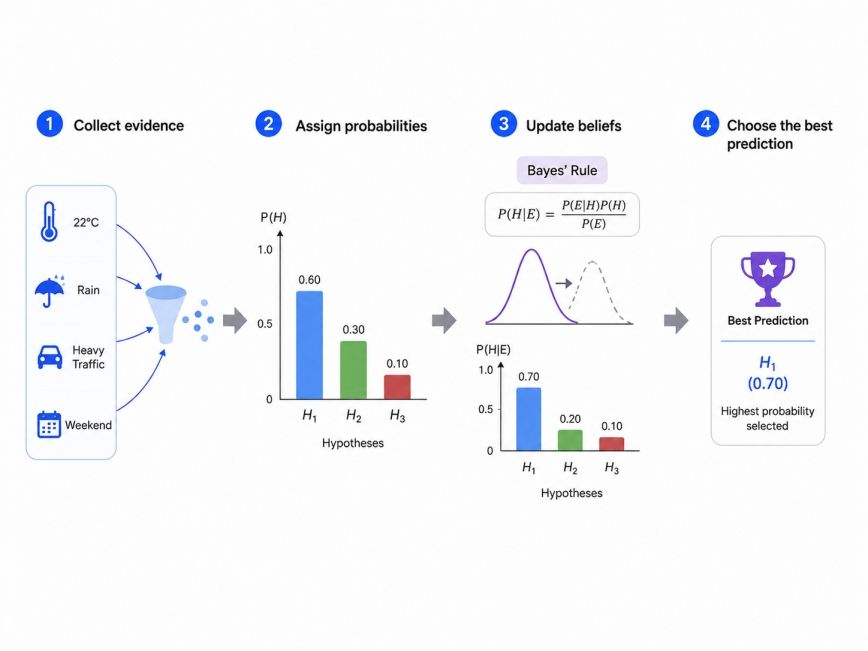
Instead of giving only "yes" or "no" answers, probabilistic models express confidence levels.
The process generally follows these steps:
Step |
What happens |
| Collect evidence | Gather available data |
| Assign probabilities | Estimate the likelihood of different outcomes |
| Update beliefs | Incorporate new information |
| Choose the best prediction | Select the most probable outcome |
Real-world environments constantly change. Ignoring uncertainty can lead to choices. Probabilistic reasoning helps AI make decisions even when data is not perfect or complete. This approach allows AI to work well with data, and more effective in real-life situations.
Some common sources of uncertainty include:
Probabilistic AI is different from deterministic systems because it keeps changing and continuously adjusting. It is always learning and getting better. Some defining features include:
AI Courses to upskill
Explore Artificial Intelligence Courses for Career Progression
To understand probabilistic reasoning in artificial intelligence, let's think about how we make decisions. Imagine you are about to leave. You're carrying an umbrella. You don't know for sure if it's going to rain. You look at the dark clouds, check the weather forecast on your phone, and think about the time of year. Based on all this you guess the chances of rain. Decide what to do.
Artificial intelligence works in a way. Instead of using your gut feeling, AI uses special math models and data to figure out how likely different things are to happen. As it gets information, it updates its guesses and gets better at predicting things. AI uses probability models and data to estimate the likelihood of outcomes. Artificial intelligence updates these estimates. Improves its predictions as new information becomes available.
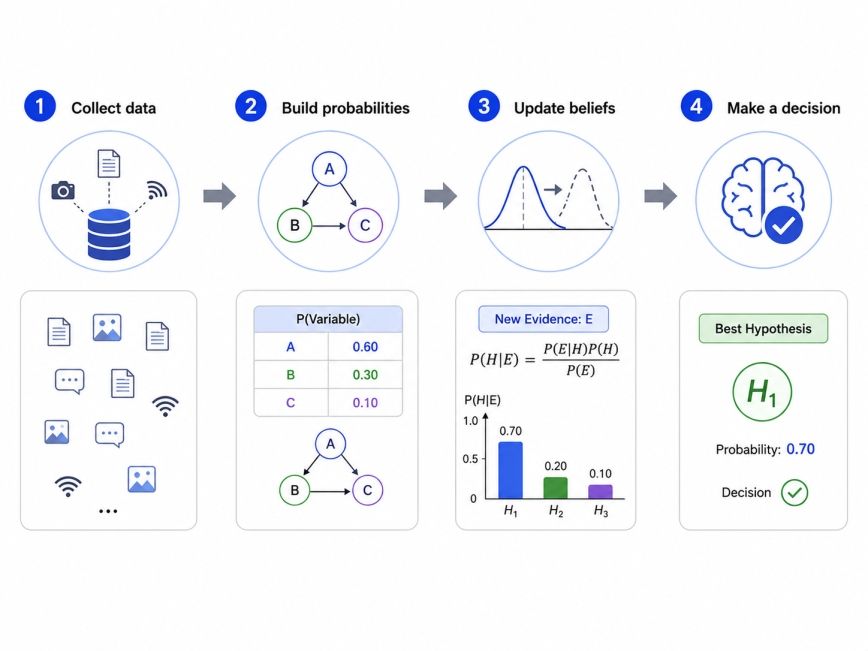
The process of learning all the time helps Artificial Intelligence stay flexible. It does not have to follow rules all the time. Artificial Intelligence can. Adapt because of this.
Most AI systems using probabilistic reasoning follow a structured process.
Stage |
What the AI Does |
Example |
| Collect data | Gathers information from sensors, databases, or user input | Customer purchase history |
| Build probabilities | Calculates how likely different outcomes are | Probability of buying a product |
| Update beliefs | Revises predictions when new evidence arrives | User adds items to cart |
| Make a decision | Selects the outcome with the highest probability | Recommend related products |
Understanding probabilistic reasoning is only the first step in applying it to real-world AI systems where careers are built. Explore Chief Technology Officer & AI Leadership Programme designed to help you develop the practical, industry-ready skills that today's AI roles demand.
Different AI problems need ways to figure out chances. Over time, researchers have come up with a lot of ways to help machines think when things are not certain.
Each AI model is good at things depending on the kind of information and the decisions that need to be made with Artificial Intelligence.
Bayesian Networks are like maps that show how different things are connected to each other. The network does not look at each thing by itself, instead it looks at how all the things in the Bayesian Networks interact with each other.
Each thing is linked to others based on how it affects them.
For example, in healthcare:
Common applications include:
Also Read: Bayesian Networks and How They Work: A Guide to Belief Networks in AI
Some events cannot be observed directly. Hidden Markov Models estimate these hidden states using observable data.
For example:
Speech recognition systems cannot directly observe the words a person intends to say. Instead, they analyze sound signals and estimate the most probable sequence of words.
They are commonly used in:
Related Article: Hidden Markov Model in Machine Learning: Key Components, Applications, and More
The Naïve Bayes algorithm is simple. It is a way that machines can learn from things. It thinks that features do not affect each other so it can do things quickly. This makes the Naïve Bayes algorithm very fast when it does calculations.
Although this assumption is not always realistic, the algorithm performs surprisingly well for many practical problems.
Popular applications include:
Also Read: Naive Bayes Explained: Function, Advantages & Disadvantages, Applications in 2026
Sometimes artificial intelligence must pick what it wants to do, just guess what will happen. Markov Decision Processes help the intelligence figure out which thing it can do that will give it the best result.
Examples include:
The AI evaluates:
It then selects the option with the highest long-term benefit.
Conditional Random Fields are useful when we need to make predictions that rely on information, from things.
For example, when we are working with language, figuring out what one word means often depends on the words that come before and after it because Conditional Random Fields help us understand how these words are connected.
CRFs help improve accuracy in tasks such as:
Model |
Primary Purpose |
Common Applications |
| Bayesian Networks | Represent relationships between variables | Healthcare, diagnostics, finance |
| Naïve Bayes | Fast classification | Spam filtering, sentiment analysis |
| Hidden Markov Models | Predict hidden states | Speech recognition, language processing |
| Markov Decision Processes | Decision-making | Robotics, autonomous systems |
| Conditional Random Fields | Sequence prediction | NLP, computer vision |
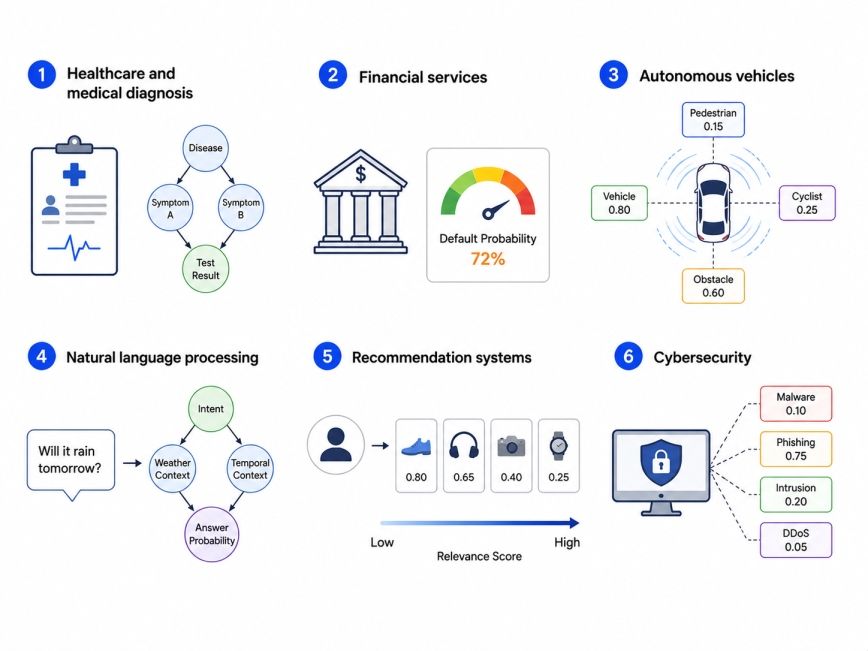
The value of reasoning in artificial intelligence is important when we look at what artificial intelligence can do in the real world. Artificial intelligence systems that we use today often work in situations where we do not have all the information, or the information is changing all the time. Probability allows these systems to make reliable decisions without needing perfect data.
Healthcare is one of the uses for a kind of artificial intelligence called probabilistic AI. Rather than replacing doctors, AI helps them make more informed clinical decisions.
Doctors usually make decisions about a patient by looking at the symptoms and history of the patient before testing results and what might put the patient at risk. Probabilistic AI helps doctors by calculating the probability of a disease and suggesting likely diagnoses.
Examples include:
Banks and financial institutions handle a number of transactions daily. They use a type of intelligence that looks for unusual patterns to spot possible fraud or financial risks. This AI system learns from transaction data to get better at predicting risks.
Banks and financial institutions rely on it to stay safe. The AI keeps learning from millions of transactions to improve its predictions. It helps banks and financial institutions to identify problems early.
Common applications include:
Self-driving cars operate in highly uncertain environments. Probabilistic reasoning helps AI make choices while driving. It lets AI think about risks, picking the safest action. This happens based on how the road is like right now. The AI uses reasoning to look at the road conditions. It then chooses the action to take.
A vehicle may encounter:
People often do not say what they mean. For example, when we say the word "bank" it could mean a place where we keep our money. It could mean the side of a river where we can sit.
Language models look at the situation. Use a kind of guesswork to figure out what the word "bank" is most likely to mean when we use it.
Applications include:
Streaming platforms and e-commerce websites rely heavily on probabilistic AI.
Instead of recommending products randomly, they estimate which items users are most likely to enjoy.
Recommendation engines analyze:
This improves customer satisfaction and engagement.
Modern cyberattacks are always changing. Probabilistic reasoning is helpful in cybersecurity systems. It helps to find activities.
This is done by checking how likely it is that a certain event is a threat. Cyberattacks are a concern. Probabilistic reasoning helps to evaluate the likelihood of a threat.
Applications include:
Also Read: Explore Top Free AI Courses with Certificate in 2026
Subscribe to upGrad's Newsletter
Join thousands of learners who receive useful tips
One of the things about probabilistic reasoning is that it can deal with uncertainty.
Probabilistic AI is good, for things where you must make decisions even when the information is not perfect or is changing and that is because probabilistic reasoning can work with uncertainty, which makes probabilistic AI useful for these kinds of applications.
Key advantages include:
Implementing models can be tough. Organizations must make sure that AI systems are trained on datasets so that Artificial Intelligence systems are fair and do not have bias.
Some common challenges include:
Organizations can maximize the effectiveness of probabilistic AI by following a few practical guidelines:
Probabilistic reasoning in artificial intelligence enables us to make informed decisions despite incomplete or uncertain information. Rather than relying on rigid rules, it evaluates available evidence, estimates the likelihood of different outcomes, and updates its predictions as new data becomes available.
As AI continues to evolve, understanding probabilistic reasoning in artificial intelligence will become increasingly valuable for students, developers, data scientists, and business professionals alike. Whether you're building machine learning models or simply exploring how AI works, learning this concept provides a strong foundation for understanding intelligent decision-making in the real world.
Want to explore more about management accounting? Book your free 1:1 personal consultation with our expert today.
Probabilistic reasoning in artificial intelligence is a method that enables AI systems to make decisions when information is incomplete or uncertain. Instead of treating every input as absolutely true or false, the system assigns probabilities to different outcomes and chooses the most likely one. This approach makes AI more reliable in real-world situations where uncertainty is common.
The probabilistic method in artificial intelligence refers to the use of mathematical probability to model uncertainty and improve decision-making. AI systems calculate the likelihood of different events based on available evidence and continuously update these estimates when new information becomes available. This makes predictions more accurate than relying solely on fixed rules.
Real-world data is rarely perfect. Sensors fail, users make mistakes, and information is often incomplete. Probabilistic reasoning in artificial intelligence helps systems deal with these uncertainties by estimating confidence levels instead of making absolute assumptions. As a result, AI becomes more flexible, accurate, and dependable.
Some of the most widely used probabilistic models include Bayesian Networks, Naïve Bayes, Hidden Markov Models, Markov Decision Processes, and Conditional Random Fields. Each model is designed for specific tasks such as classification, prediction, decision-making, or sequence analysis, depending on the problem being solved.
Deterministic reasoning follows predefined rules and always produces the same output for the same input. In contrast, probabilistic reasoning in artificial intelligence considers uncertainty by assigning probabilities to different outcomes. This allows AI systems to adapt when information changes or when data is incomplete.
Many everyday AI applications rely on probabilistic reasoning, even if users don't notice it. Email spam filters, online shopping recommendations, navigation apps, voice assistants, fraud detection systems, and medical diagnostic tools all use probability-based models to improve predictions and personalize user experiences.
Not exactly. Bayesian reasoning is one of the most popular techniques used within probabilistic reasoning in artificial intelligence, but it is not the only one. Other probabilistic models, such as Hidden Markov Models and Markov Decision Processes, are also widely used for different AI applications.
Industries such as healthcare, banking, insurance, retail, manufacturing, logistics, cybersecurity, and transportation benefit significantly from probabilistic AI. These sectors often deal with uncertain data and complex decision-making, making probability-based approaches highly effective for improving accuracy and reducing operational risks.
Although highly effective, probabilistic models require quality data and careful design. Poor datasets, biased information, or incorrect probability estimates can reduce model performance. Some advanced probabilistic models also demand significant computational resources and may be difficult to explain to non-technical stakeholders.
Yes. Modern AI systems frequently combine machine learning with probabilistic reasoning in artificial intelligence. Machine learning identifies patterns from data, while probabilistic models estimate uncertainty and confidence levels. Together, they create AI systems that are both accurate and adaptable in dynamic environments.
The mathematical concepts behind probability can seem challenging at first, but the core idea is straightforward. Once you understand that AI estimates the likelihood of different outcomes rather than making absolute decisions, the concept becomes much easier to grasp. Starting with real-world examples is often the best way to learn.
730 articles published
Sriram K is a Senior SEO Executive with a B.Tech in Information Technology from Dr. M.G.R. Educational and Research Institute, Chennai. With over a decade of experience in digital marketing, he specia...
Speak with AI & ML expert
By submitting, I accept the T&C and
Privacy Policy
Top Resources
Master's Degree
18 Months
Executive Diploma
12 Months
IIIT Bangalore
Executive Programme in Generative AI & Agentic AI for LeadersIndia’s #1 Tech University
Dual Certification
5 Months