Probability for Machine Learning: Concepts Every Beginner Must Know
By Sriram
Updated on Jun 29, 2026 | 7 min read | 1.77K+ views
Share:

All courses
Certifications
More
By Sriram
Updated on Jun 29, 2026 | 7 min read | 1.77K+ views
Share:
Table of Contents
Probability for machine learning helps models make predictions when outcomes are uncertain. Instead of making decisions with complete certainty, machine learning algorithms estimate how likely an event is to happen, compare multiple possible outcomes, and make informed predictions even when the available data is incomplete or uncertain.
Machine learning isn't built on code alone. It's built on uncertainty. Every time a model makes a prediction, it's really asking "how likely is this?" That question is probability.
This blog breaks down the core probability concepts that power ML models, from basic rules and distributions to Bayes' theorem and probabilistic inference.
Explore upGrad's Artificial intelligence programs to build a strong foundation in machine learning and AI. Learn probability, statistics, deep learning, natural language processing, and predictive modelling through hands-on projects and industry-relevant case studies.
Popular AI Programs
Most ML problems don't have clean, definitive answers. A spam filter doesn't know for certain whether an email is junk. A medical diagnosis model doesn't declare a patient sick or healthy with absolute confidence. They estimate. They assign likelihoods. That's probability doing the work.
Think about how a recommendation system functions. It doesn't find the one perfect product for you. It ranks items by the probability that you'll engage with them, given what it knows about your past behavior.
Without probability, you can't train models, you can't evaluate them, and you can't interpret what they're telling you. This is why understanding probability for machine learning isn't optional. It's the starting point.
Do read: Probability for Data Science: A Complete Guide from Basics to Advanced
Free Courses
You don't need advanced math to get started. A few foundational rules cover most of what appears in ML theory.
Probability of an event is written as P(A), where A is some outcome. It's a value between 0 and 1. P = 0 means it won't happen. P = 1 means it definitely will.
Here are the three rules you'll see most often:
These three show up constantly in ML, so it's worth getting them straight.
Type |
What It Means |
Example |
| Joint | Probability of two events together | P(spam and contains "offer") |
| Marginal | Probability of one event ignoring others | P(spam) across all emails |
| Conditional | Probability of A given B has occurred | P(spam given "offer" is present) |
Conditional probability is especially critical. It's the logic behind how models update their beliefs when new data comes in. If a model sees a specific word in an email, how does that change the probability it's spam? That's conditional probability at work.
Must read: Complete Guide to Types of Probability Distributions: Examples Explained
AI Courses to upskill
Explore Artificial Intelligence Courses for Career Progression
Bayes' theorem sounds intimidating the first time you see it. But the idea is simple: update what you believe based on new evidence.
The formula is:
P(A|B) = [P(B|A) x P(A)] / P(B)
In plain language: the probability of A given B equals how likely B is under A, multiplied by how likely A is to begin with, divided by how likely B is overall.
Say you're building a classifier to detect fraudulent transactions.
Plug in: P(fraud | unusual pattern) = (0.90 x 0.01) / 0.05 = 0.18
So even with an unusual pattern, there's only an 18% chance it's actually fraud. Without Bayes' theorem, you might flag everything with unusual patterns and overwhelm your fraud team. With it, you calibrate correctly.
Naive Bayes assumes all features are independent of each other. That's rarely true in real data. But the model still works surprisingly well in practice for high-dimensional problems like text, because even an approximate probability estimate beats no estimate at all.
Also read: What is Probability Density Function? A Complete Guide to Its Formula, Properties and Applications
A Probability distribution describes how probabilities are spread across possible outcomes. Different problems call for different distributions. Picking the wrong one leads to models that don't fit the data.
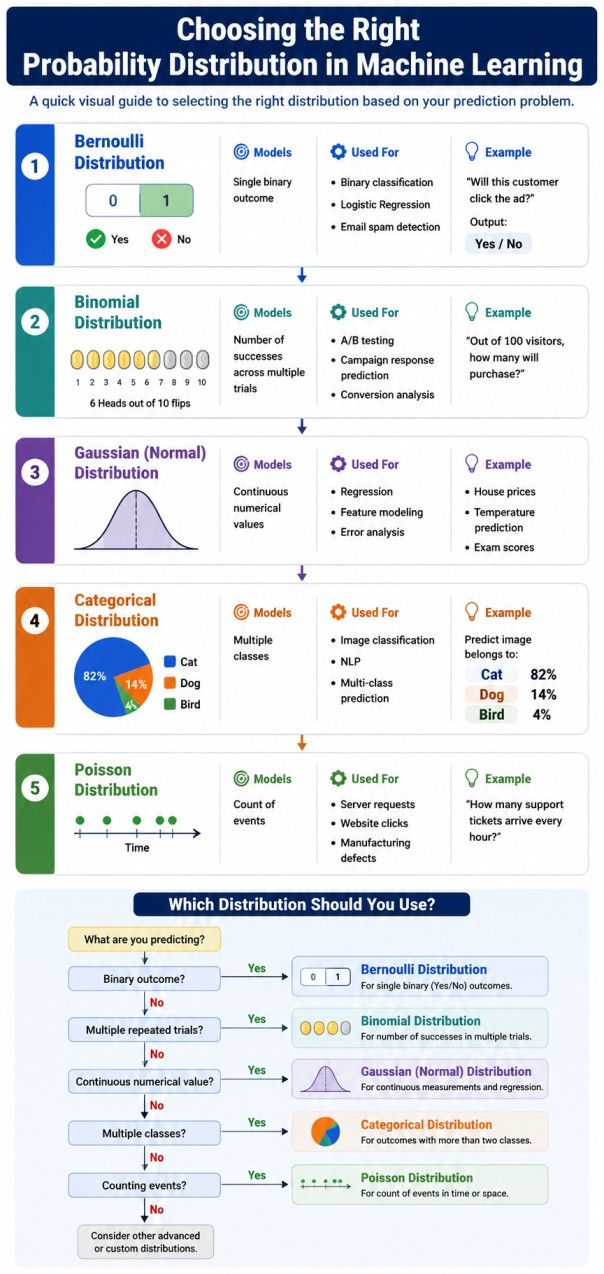
One thing people don't talk about enough is that in real ML projects, data rarely fits a textbook distribution perfectly. You'll often have to test your assumptions. Plotting a histogram and comparing it against a theoretical distribution before deciding is worth the extra five minutes.
Ready to apply these concepts in real AI systems? Explore upGrad's Applied AI & Agentic AI Executive Programme with IIIT Bangalore to build expertise in probability, machine learning, generative AI, autonomous AI agents, and production-ready AI applications through hands-on projects and industry-led learning.
Once you understand distributions, the next question is: how does an ML model learn? One core answer is maximum likelihood estimation (MLE).
MLE finds the parameter values that make the observed training data most probable. If you're fitting a Gaussian to a dataset, MLE tells you which mean and variance best explain what you're seeing.
This isn't just a statistics concept. It's directly what happens during model training. When you minimize cross-entropy loss in a classification model, you're doing MLE. When you minimize mean squared error in regression under Gaussian assumptions, you're also doing MLE. They're the same math wearing different clothes.
Inference is the process of drawing conclusions from a trained model. Probabilistic inference means the output isn't a hard label. It's a probability. That distinction matters in high-stakes applications.
A model predicting whether a patient has a condition shouldn't just say "yes" or "no." It should say "78% probability of condition X." That number changes what a clinician does next. A 78% call warrants a follow-up test. A 99% call might warrant immediate action.
Not every ML framework makes this easy. Many produce raw scores or logits, not calibrated probabilities. Techniques like Platt scaling and isotonic regression exist specifically to convert those raw scores into reliable probability estimates.
Also Read: Measures of Dispersion in Statistics: Meaning, Types & Examples
These concepts come from information theory, but they show up constantly in machine learning.
Entropy measures uncertainty. High entropy means a lot of uncertainty. Low entropy means the outcome is predictable.
The formula: H(X) = -sum[P(x) x log P(x)]
In a decision tree, the algorithm picks the feature that reduces entropy the most when you split on it. That reduction is called information gain. The feature with the highest information gain becomes the splitting criterion.
Why does this matter practically? It's why decision trees don't just pick features at random. Every split is a calculated bet on reducing uncertainty in your training labels. If a feature tells you nothing new, it won't get selected.
Cross-entropy is a related concept used as a loss function in classification. It measures how far a model's predicted probability distribution is from the actual distribution. When cross-entropy is low, the model's probability estimates are close to reality.
Probability isn't background theory you pick up later. It's active in every step of building, training, and evaluating a machine learning model. You can't escape it. What you can do is understand it well enough that it stops feeling abstract.
Once you see how Bayes' theorem drives classifiers, how distributions shape assumptions, and how entropy guides decision trees, the mechanics of ML models start making sense at a deeper level. That's when you go from running code to actually understanding what your models are doing.
Ready to start your journey? Book a free consultation with upGrad today to find the best path for your career.
You don't need to master advanced probability before learning machine learning. A solid understanding of events, conditional probability, Bayes' theorem, probability distributions, and likelihood is enough to begin. As you explore more advanced ML topics, you'll naturally build deeper mathematical knowledge through practical projects.
Several algorithms are built around probabilistic concepts, including Naive Bayes, Logistic Regression, Bayesian Networks, Hidden Markov Models, and Gaussian Mixture Models. Even neural networks often convert outputs into probability scores using functions like Softmax, making probability an essential part of prediction rather than an optional concept.
Probability measures the chance of observing data when the model parameters are already known. Likelihood works in the opposite direction. It evaluates which parameter values best explain the observed data. Most machine learning training methods, including Maximum Likelihood Estimation (MLE), are based on maximizing likelihood instead of probability.
Real-world data is noisy, incomplete, and constantly changing. Predicting probabilities allows models to express confidence instead of making absolute claims. This helps practitioners set decision thresholds, compare multiple outcomes, and decide when human review is needed, especially in applications like fraud detection and healthcare.
Probability and statistics solve different problems, and both are equally valuable. Probability helps models reason about future outcomes under uncertainty, while statistics helps analyze historical data and estimate model parameters. Together, they form the mathematical foundation behind modern machine learning algorithms.
A model predicting an 80% probability doesn't promise that every prediction will be correct. It means that, over many similar predictions, roughly 80% should be accurate if the model is well calibrated. Data quality, model bias, and changing patterns can all affect how reliable those probabilities are.
Probability allows you to evaluate more than just prediction accuracy. Metrics such as Log Loss, Cross-Entropy Loss, ROC-AUC, and calibration curves measure how confident a model is in its predictions. This gives a more complete picture of model performance than accuracy alone.
Probabilistic inference is the process of estimating the likelihood of different outcomes after a model has learned from data. Instead of returning only one prediction, the model assigns probabilities to multiple possibilities. This approach is widely used in recommendation systems, medical diagnosis, and speech recognition.
Not every algorithm is explicitly probabilistic, but many can produce or estimate probability scores. Models such as Decision Trees, Support Vector Machines, and Random Forests can be calibrated to generate probabilities, while algorithms like Naive Bayes naturally predict probability distributions.
Machine learning models deal with two kinds of uncertainty. One comes from randomness in the data itself, while the other comes from limited knowledge or insufficient training data. Understanding both helps practitioners decide whether collecting more data or improving the model is the better solution.
Start with small numerical problems and then implement them in Python using libraries like NumPy, SciPy, and scikit-learn. Visualize probability distributions, build simple classifiers, and interpret prediction confidence instead of focusing only on accuracy. Practical experimentation develops intuition much faster than memorizing formulas.
727 articles published
Sriram K is a Senior SEO Executive with a B.Tech in Information Technology from Dr. M.G.R. Educational and Research Institute, Chennai. With over a decade of experience in digital marketing, he specia...
Speak with AI & ML expert
By submitting, I accept the T&C and
Privacy Policy
Top Resources
Master's Degree
18 Months
Executive Diploma
12 Months
IIIT Bangalore
Executive Programme in Generative AI & Agentic AI for LeadersIndia’s #1 Tech University
Dual Certification
5 Months