Maximum Likelihood Estimation in Machine Learning
By Rahul Singh
Updated on Jun 23, 2026 | 10 min read | 4.07K+ views
Share:

All courses
Certifications
More
By Rahul Singh
Updated on Jun 23, 2026 | 10 min read | 4.07K+ views
Share:
Table of Contents
Maximum Likelihood Estimation (MLE) in machine learning is a statistical method used to find the parameter values that make the observed data most likely under a given model. By selecting the parameters that maximize the likelihood of the training data, MLE helps machine learning algorithms learn patterns effectively and build models that can make accurate predictions on new data.
In this blog, you will learn what maximum likelihood estimation in machine learning is, how it works mathematically, where it gets used in real ML systems, and how it connects to other concepts like loss functions and Bayesian inference.
Popular AI Programs
Here is a simple way to think about it. Suppose you flip a coin 10 times and get 7 heads. You want to figure out the probability of heads for that coin. MLE says: pick the probability that would have made getting "7 heads in 10 flips" the most likely outcome. In this case, that answer is 0.7.
That is MLE in one sentence: find the parameter values that maximize the probability of observing your data.
In machine learning, you are always trying to find model parameters (weights, biases, thresholds) that explain your training data well. MLE gives you a principled, mathematically grounded way to do that.
Many popular ML algorithms are directly built on MLE:
Understanding maximum likelihood estimation in machine learning gives you a window into why these algorithms are designed the way they are.
Free Courses
Let us walk through the core mechanics of maximum likelihood estimation in machine learning step by step. You do not need to be a mathematician to follow this.
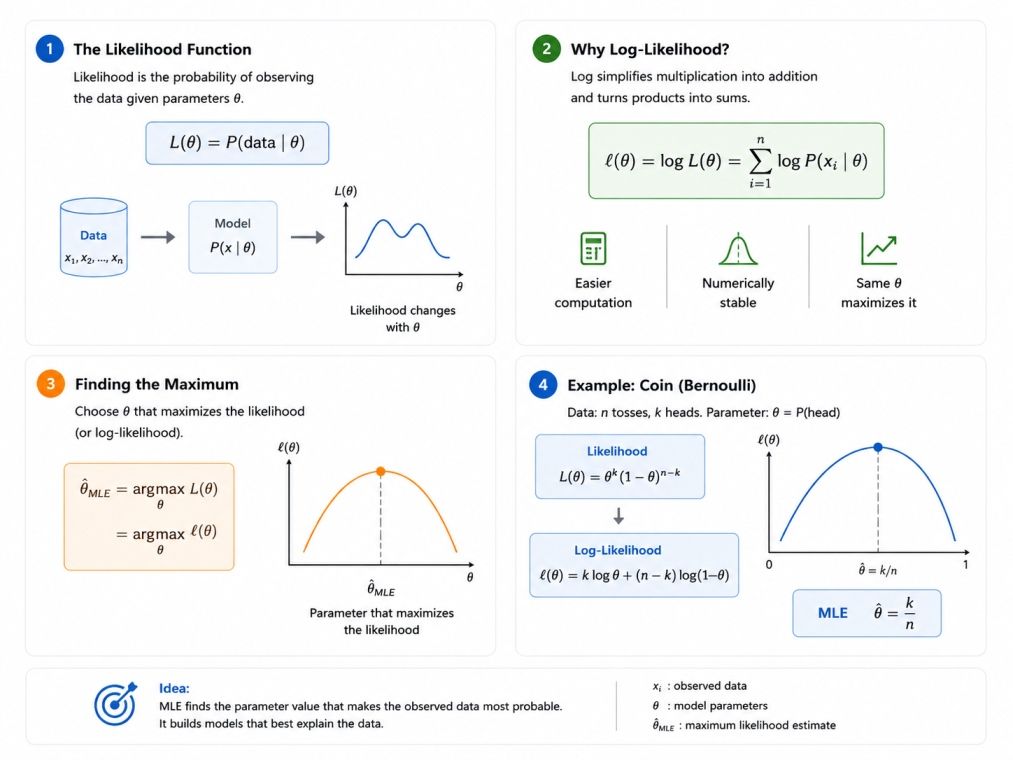
Suppose you have data points x1, x2, ..., xn, and a model with parameter theta. The likelihood function is:
L(theta) = P(x1, x2, ..., xn | theta)
This reads as: "the probability of observing this data, given that the parameter is theta."
If the data points are independent, you can write this as a product:
L(theta) = P(x1 | theta) x P(x2 | theta) x ... x P(xn | theta)
Multiplying many small probabilities together creates extremely small numbers that cause numerical issues in computers. So instead of maximizing the likelihood directly, we maximize the log-likelihood:
log L(theta) = sum of log P(xi | theta)
Maximizing log-likelihood gives you the same answer as maximizing likelihood because the logarithm is a monotonically increasing function.
To find the optimal theta, you take the derivative of the log-likelihood with respect to theta and set it to zero:
d/d(theta) [ log L(theta) ] = 0
Then you solve for theta. In many cases (like linear regression), this gives you a clean closed-form solution. In others (like neural networks), you use gradient descent to find it numerically.
Suppose your data comes from a Gaussian (normal) distribution with unknown mean mu and variance sigma squared. The maximum likelihood estimation in machine learning estimate for mu is simply the sample mean, and for sigma squared, it is the sample variance. These familiar formulas are, in fact, MLE solutions.
Parameter |
MLE Estimate |
| Mean (mu) | Average of all data points |
| Variance (sigma^2) | Average squared deviation from mean |
This shows that MLE often recovers intuitive, common-sense estimates through rigorous math.
Also Read: Math for Machine Learning: Essential Concepts You Must Know
AI Courses to upskill
Explore Artificial Intelligence Courses for Career Progression
It helps to understand how maximum likelihood estimation in machine learning compares to related approaches you will encounter in ML.
MAP estimation is like MLE but with one key addition: it incorporates a prior belief about the parameters.
Feature |
MLE |
MAP |
| Uses prior knowledge | No | Yes |
| Can overfit on small data | More likely | Less likely |
| Computationally simpler | Yes | Slightly more complex |
| Becomes MLE when? | Always | When prior is uniform |
MAP is the bridge between MLE and full Bayesian inference. When you add regularization to a model (like L2 regularization in ridge regression), you are actually doing MAP estimation without calling it that.
Bayesian inference goes further than MAP. Instead of picking a single best parameter value, it gives you a full probability distribution over all possible values.
For large datasets, all three methods tend to agree. The differences matter most with small data or when uncertainty quantification is important.
Here is something that surprises many people: when you train a neural network using cross-entropy loss, you are doing maximum likelihood estimation.
Minimizing cross-entropy loss is mathematically equivalent to maximizing the log-likelihood of your data under the model. This is why MLE is not just a statistical concept. It is baked into how deep learning optimizers work every day.
Maximum likelihood estimation in machine learning shows up across a wide range of machine learning algorithms. Here is a practical breakdown.
Logistic regression directly applies MLE. The model outputs a probability for each class, and training finds the weights that maximize the likelihood of the observed labels. This is why logistic regression is trained using gradient descent on the log-loss (also called binary cross-entropy).
Naive Bayes estimates the probability of each word (or feature) given each class using MLE. It simply counts the frequency of each feature in the training data. The "naive" assumption is that all features are independent, which simplifies the likelihood calculation enormously.
GMMs use the Expectation-Maximization (EM) algorithm, which is an iterative method that maximizes the likelihood of the data when you cannot solve directly for the optimal parameters. The EM algorithm alternates between:
Under the assumption that the errors follow a Gaussian distribution, minimizing the mean squared error in linear regression is equivalent to maximum likelihood estimation. The two approaches give identical solutions, but MLE provides the statistical justification for why squared error is a natural choice.
HMMs are used in speech recognition and sequence modeling. They use the Baum-Welch algorithm, another form of EM, to find transition and emission probabilities via maximum likelihood estimation.
Also Read: Importance of Statistics for Machine Learning Systems
Maximum likelihood estimation in machine learning is powerful, but it is not perfect. Here are the most important limitations to keep in mind.
Despite these limitations, MLE remains one of the most widely used estimation strategies because it is computationally tractable, statistically efficient (for large samples), and easy to reason about.
Also Read: What is Overfitting and Underfitting in Machine Learning?
Maximum likelihood estimation in machine learning is not just a theoretical concept from statistics. It is a practical foundation that explains how dozens of algorithms are trained, from logistic regression and Naive Bayes to GMMs and neural networks with cross-entropy loss.
The core idea is simple: find the model parameters that make your observed data most likely. From that simple idea, you can derive loss functions, connect to regularization, and understand why MAP and Bayesian methods exist as extensions.
Want personalized guidance on AI and upskilling? Speak with an expert for a free 1:1 counselling session today.
Maximum likelihood estimation finds the parameter values of a model that make the observed data most probable. You start with a probability distribution, look at your data, and ask: what settings would have made this data most likely to occur? The answer is your MLE estimate.
Maximum likelihood estimation in machine learning is used to train models like logistic regression, Naive Bayes, and Gaussian Mixture Models. It also underlies neural network training via cross-entropy loss, making it one of the most widely applied estimation frameworks in AI and ML.
MLE finds the parameters that maximize the probability of the data alone. MAP (Maximum A Posteriori) also maximizes the data probability but adds a prior distribution over parameters. Adding L2 regularization to a model is equivalent to MAP estimation with a Gaussian prior.
Multiplying many probabilities together creates very small numbers that cause numerical underflow in computers. Taking the logarithm converts the product into a sum, which is numerically stable and easier to differentiate. Since log is monotonically increasing, maximizing log-likelihood gives the same optimal parameters as maximizing likelihood directly.
Yes. When you assume that the errors in linear regression follow a Gaussian distribution, minimizing mean squared error is mathematically equivalent to performing maximum likelihood estimation. The MSE loss function is, in fact, the negative log-likelihood under Gaussian noise assumptions.
The Expectation-Maximization (EM) algorithm is an iterative method used when direct MLE optimization is not tractable, such as with latent variable models like Gaussian Mixture Models. It alternates between estimating hidden variables (E-step) and maximizing the likelihood given those estimates (M-step) until convergence.
Yes. MLE optimizes for the training data, so with small datasets, it can overfit by fitting noise. Adding regularization (which corresponds to MAP estimation) helps prevent this by incorporating a prior that penalizes extreme parameter values.
Minimizing cross-entropy loss during neural network training is mathematically identical to maximizing the log-likelihood of the training labels under the model's predicted probabilities. This connection is why cross-entropy is the standard loss for classification tasks.
Gaussian (normal) distribution is used for regression and density estimation. Bernoulli distribution is used for binary classification (logistic regression). Categorical distribution is used for multi-class classification. Poisson distribution is used for count data modeling.
MLE is a frequentist method in the sense that it does not assign probabilities to parameters or use prior beliefs. Bayesian methods, in contrast, treat parameters as random variables with prior distributions. That said, MLE and Bayesian estimates converge for large datasets.
Use maximum likelihood estimation in machine learning when you have a large dataset, need fast computation, and do not have strong prior domain knowledge. Use Bayesian inference when your dataset is small, you need uncertainty estimates (not just point estimates), or you have meaningful prior information that can improve model performance.
98 articles published
Rahul Singh is an Associate Content Writer at upGrad, with a strong interest in Data Science, Machine Learning, and Artificial Intelligence. He combines technical development skills with data-driven s...
Speak with AI & ML expert
By submitting, I accept the T&C and
Privacy Policy
Top Resources
Master's Degree
18 Months
Executive Diploma
12 Months
IIIT Bangalore
Executive Programme in Generative AI & Agentic AI for LeadersIndia’s #1 Tech University
Dual Certification
5 Months