Generative AI Solutions: Types, Benefits, and Use Cases
By Sriram
Updated on Jun 23, 2026 | 7 min read | 2.34K+ views
Share:

All courses
Certifications
More
By Sriram
Updated on Jun 23, 2026 | 7 min read | 2.34K+ views
Share:
Table of Contents
Generative AI solutions are changing how businesses make content, automate tasks, analyze data, and improve customer experiences. They help with writing ads, generating computer code, and designing images. This helps businesses work quicker and better. Generative AI solutions use computer models that can recognize tasks and automate solutions for easier and faster work.
In this blog, you’ll learn what Generative AI solutions are. You will also learn how they work. There are types of Generative AI solutions available today. We will look at their use, in business, how organizations can pick a Generative AI solution. If you are a student, a worker, or a business boss, this article will help you understand Generative AI solutions.
Transform your career with Generative AI skills, explore upGrad's cutting-edge Agentic AI Courses Online and Machine Learning Courses Online courses today.
Generative AI Courses to upskill
Explore Generative AI Courses for Career Progression
IIIT Bangalore
Executive Diploma in Machine Learning and AI360° Career Support
Generative AI solutions are computer programs that use intelligence to make new things, like ideas, predictions, or results from existing information. Traditional AI mostly looks at data. Makes choices but generative AI can make brand new things like words, pictures, sounds, videos and computer code.
These solutions work because of computer models, such as large language models, diffusion models, and transformer models. They find patterns in collections of data and use that to make new things when they get a prompt.
Also Read: Top 5 Generative AI Course by Microsoft: Complete Learning Guide
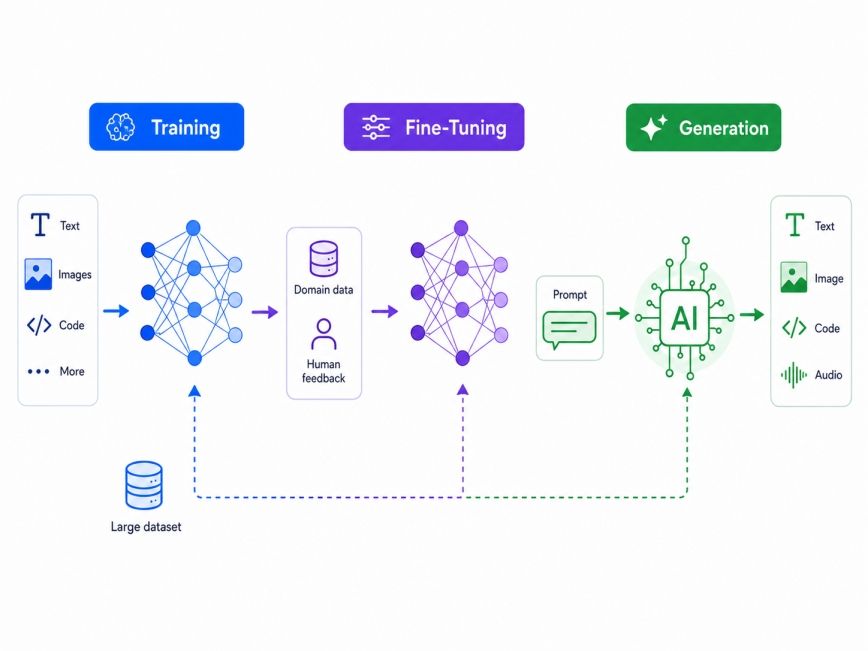
The process usually follows three stages:
Stage |
Purpose |
| Training | AI learns patterns from large datasets |
| Fine-Tuning | Models are adapted for specific tasks |
| Generation | AI creates content based on user input |
Generative AI solutions can create:
Also Read: Complete Guide to Synthetic Data Generation
Research and industry studies continue to show productivity improvements across several business functions when AI is implemented effectively.
Organizations are adopting generative AI solutions because they help:
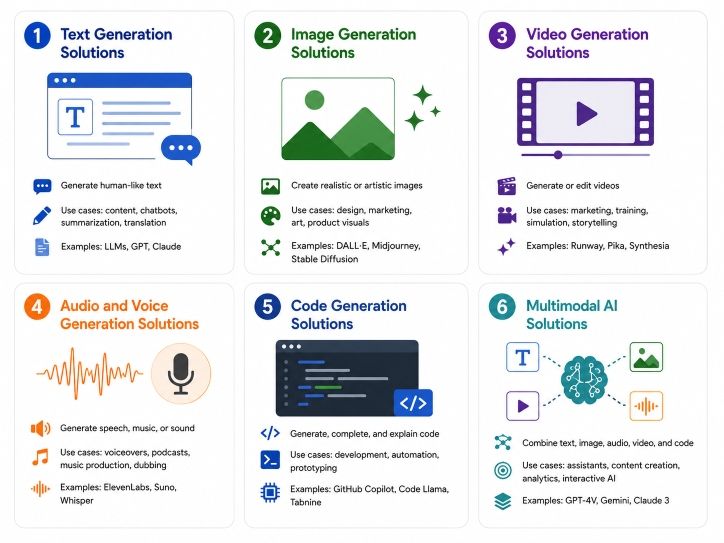
Not all generative AI solutions perform the same task. Different models are designed for different outputs and business needs.
These are among the most widely used AI systems today.
Common applications include:
Examples include AI writing assistants and enterprise knowledge bots.
These systems create images from text prompts.
Popular use cases:
Video-focused generative AI solutions can create or edit videos automatically.
Applications include:
These tools generate realistic speech and audio.
Common uses include:
Developers increasingly use AI-powered coding assistants.
Benefits include:
The newest generation of AI can process multiple content formats simultaneously.
Input |
Output |
| Text | Image |
| Image | Text |
| Text | Video |
| Audio | Text |
| Mixed Inputs | Multiple Outputs |
Also Read: Multimodal Generative AI: What It Is, How It Works, and Why It Matters
Many vendors now offer specialized generative AI solutions for:
These tools are trained in industry-specific data and workflows.
Also Read: Generative AI Assistants: How Are They Transforming Today
Generative AI solutions make an impact when implemented correctly. Their measurable business value is the reason for their growing popularity. Businesses see value in using generative AI solutions effectively.
One of the biggest advantages is efficiency.
Employees spend less time on repetitive tasks such as:
Studies have shown that AI-assisted workflows can improve productivity in several industries.
Marketing teams can produce:
in a fraction of the time required previously.
AI-powered chatbots and virtual assistants can provide:
This improves customer satisfaction while reducing support costs.
Also Read: Top 25+ AI Chatbot Project Ideas in 2026
Generative AI solutions can help teams brainstorm ideas and explore alternatives that may not have been considered otherwise.
Examples include:
Industry |
Use Case |
| Healthcare | Clinical documentation |
| Banking | Customer support automation |
| Retail | Product recommendations |
| Education | Personalized learning content |
| Manufacturing | Process documentation |
| Software | Code generation |
Also Read: Generative AI Examples: Real-World Applications Explained
Organizations often struggle with large volumes of information.
Generative AI solutions can:
Businesses can save money by using machines to do tasks that are done over and over. This way employees can work on things that are more important.
However, success depends on implementation quality. Studies suggest that poorly integrated AI projects often fail to generate meaningful business impact, highlighting the importance of selecting the right use case and deployment strategy.
Also Read: Future of Generative AI: Trends and What Comes Next
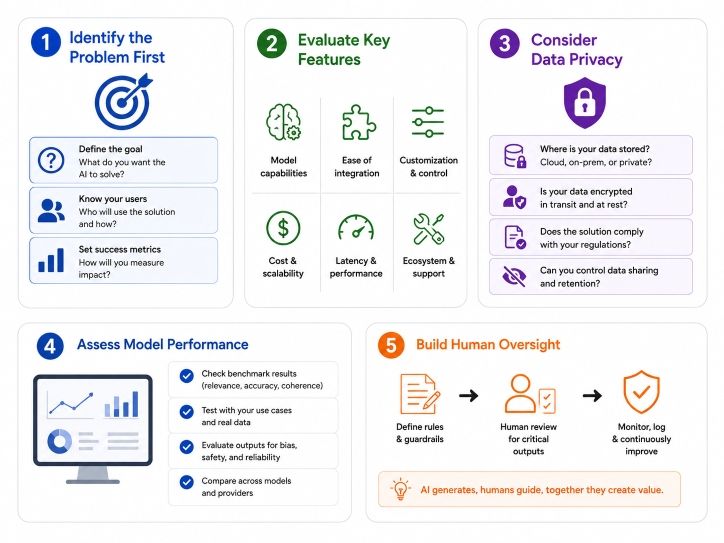
Choosing the generative AI solution is not easy. You need to do more than just use technology. The generative AI solution has to be the one for you.
Organizations should start with business goals.
Technology should solve a specific problem.
Ask questions such as:
Consider:
Feature |
Why It Matters |
| Accuracy | Reduces errors |
| Security | Protects data |
| Scalability | Supports growth |
| Integration | Fits existing systems |
| Customization | Matches business needs |
Many organizations work with sensitive information.
Look for solutions that provide:
Before deployment:
Generative AI should support people, not replace judgment.
Best practice includes:
Also Read: Top Generative AI Use Cases: Applications and Examples
Many organizations struggle because they:
These mistakes often limit ROI even when the technology itself is strong.
When people start adopting generative AI, the business focuses on practical implementation rather than experimentation alone is likely to be successful in the long run.
The future of generative AI solutions will likely include:
Generative AI solutions are rapidly becoming an important part of modern business operations. They can create content, automate repetitive work, support decision-making, and improve customer experiences. From text and image generation to coding and knowledge management, the applications continue to expand.
The real value of generative AI solutions comes from solving meaningful business problems. Organizations that focus on clear goals, responsible implementation, and human oversight are more likely to see lasting benefits. As technology evolves, understanding how these solutions work will become an increasingly valuable skill for professionals and businesses alike.
Want to explore more about Generative AI solutions? Book your free 1:1 personal consultation with our expert today.
Generative AI solutions are AI-powered systems that create new content such as text, images, videos, code, or audio based on user prompts and training data. Unlike traditional AI, they do more than analyze information. They generate original outputs that help automate creative and operational tasks.
Three common types of AI solutions are predictive AI, generative AI, and conversational AI. Predictive AI forecasts outcomes, generative AI creates content, and conversational AI enables human-like interactions through chatbots and virtual assistants. Many organizations use a combination of these approaches.
Traditional AI focuses on classification, prediction, and decision-making. Generative AI solutions go further by producing entirely new outputs such as written content, images, or code. This ability makes them useful for creative and productivity-focused applications.
Industries such as healthcare, finance, retail, education, software development, and manufacturing are seeing strong adoption. These sectors use generative AI solutions to improve efficiency, automate workflows, and enhance customer experiences while reducing repetitive manual work.
Yes. Many generative AI solutions are available through cloud-based platforms with affordable pricing models. Small businesses can use them for content creation, customer support, marketing campaigns, and productivity improvements without requiring large technology investments.
They can be safe when implemented responsibly. Organizations should establish governance policies, review outputs, protect sensitive data, and ensure human oversight. Security and compliance requirements should always be evaluated before deployment.
Basic digital literacy, prompt writing, data interpretation, and critical thinking are valuable skills. Technical roles may require machine learning or programming knowledge, while business users often focus on applying AI effectively within workflows.
Generative AI solutions are more likely to augment human work than fully replace it. They automate repetitive tasks and support decision-making, allowing employees to focus on strategic, creative, and relationship-driven responsibilities.
Costs vary depending on the platform, features, deployment model, and usage volume. Some tools offer free plans, while enterprise solutions may require significant investment for customization, security, and integration capabilities.
Common challenges include data privacy concerns, inaccurate outputs, integration complexity, employee training, and governance requirements. Organizations often achieve better outcomes when they start with clearly defined business objectives and measurable success metrics.
The future will likely include more advanced multimodal systems, AI agents, personalized experiences, and deeper integration with business software. As the technology matures, organizations will focus increasingly on practical business value rather than experimentation alone.
730 articles published
Sriram K is a Senior SEO Executive with a B.Tech in Information Technology from Dr. M.G.R. Educational and Research Institute, Chennai. With over a decade of experience in digital marketing, he specia...
Speak with AI & ML expert
By submitting, I accept the T&C and
Privacy Policy