Complete Guide to Synthetic Data Generation
By Rahul Singh
Updated on Jun 10, 2026 | 11 min read | 5.65K+ views
Share:

All courses
Certifications
More
By Rahul Singh
Updated on Jun 10, 2026 | 11 min read | 5.65K+ views
Share:
Table of Contents
Synthetic data generation is the process of creating artificial datasets that replicate the patterns, relationships, and statistical properties of real-world data. Instead of collecting information from actual users, transactions, or events, organizations use algorithms, machine learning models, or simulations to generate realistic data.
This approach helps train AI and machine learning models, test software applications, and conduct research while reducing privacy risks and lowering the cost of data collection. It is especially useful when real data is sensitive, limited, expensive to obtain, or difficult to access.
In this guide, you will learn what synthetic data generation is, why it matters, which tools are used, how to write Python code to generate synthetic data, and where this field is heading.
Transform your career with upGrad’s Data Science Course. Learn from industry experts, work on hands-on projects, and gain the skills top employer’s demand.
Popular Data Science Programs
Think of it this way. You want to train a fraud detection model, but your real transaction data contains sensitive customer information. Instead of using actual records, you generate synthetic transactions that behave like real ones, but with no real person behind them.
Your model trains on that data and learns the same patterns.
There are three main reasons teams turn to synthetic data generation:
Type |
Source |
Privacy Safe |
Volume Control |
Use Case |
| Real data | Collected from users/systems | No (without masking) | Limited | Training production models |
| Augmented data | Modified real data | Partial | Moderate | Expanding small datasets |
| Synthetic data | Algorithmically generated | Yes | Full | Privacy-sensitive, scarce, or large-scale needs |
The key difference: synthetic data has no direct relationship to any real individual or event. Augmented data is still based on real records.
Also Read: Fraud Detection in Machine Learning: What You Need To Know [2026]
Free Courses
Understanding the mechanics helps you choose the right approach for your use case.
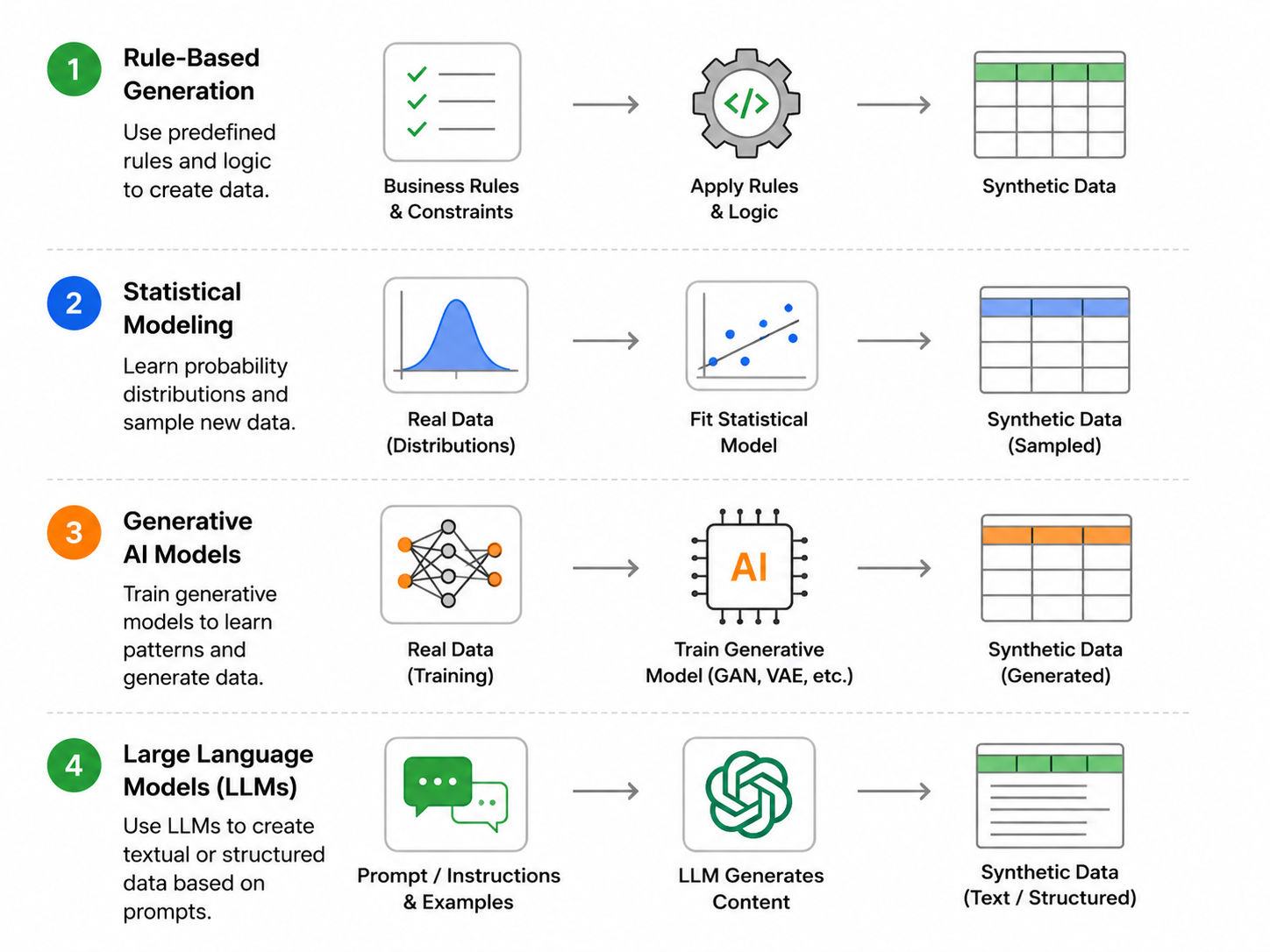
The simplest form. You define the schema, distributions, and constraints, and a tool generates data that follows those rules. For example, you tell the system that age must be between 18 and 90, income must follow a normal distribution, and gender must be one of three values. The tool fills in rows accordingly.
This works well for structured tabular data but struggles to capture complex relationships between variables.
More advanced. The system analyzes your real data, learns the statistical relationships between features, and generates new data that preserves those relationships. Tools like CTGAN and Copula-based synthesizers fall in this category.
Also Read: Machine Learning Tutorial: Basics, Algorithms, and Examples Explained
The most powerful approach. Models like Generative Adversarial Networks (GANs) and Variational Autoencoders (VAEs) learn the full distribution of real data and generate highly realistic synthetic samples. This works especially well for images, text, and complex tabular data.
How a GAN works for synthetic data:
Data Science Courses to upskill
Explore Data Science Courses for Career Progression
IIIT Bangalore
Executive Post Graduate Certificate in Data Science & AIPlacement Assistance
Picking the right tool depends on your data type, technical level, and use case.
Tool |
Best For |
Open Source |
Key Feature |
| Faker | Simple tabular and personal data | Yes | Easy Python integration |
| SDV (Synthetic Data Vault) | Relational and tabular data | Yes | Multi-table support |
| CTGAN | Complex tabular data | Yes | GAN-based, handles imbalanced data |
| Gretel.ai | Enterprise-grade synthesis | Freemium | Privacy scoring, cloud-based |
| Mostly AI | Structured and time-series data | Freemium | High fidelity, compliance-ready |
| Mimesis | Locale-specific mock data | Yes | Supports 30+ languages |
| DataSynthesizer | Differentially private data | Yes | Academic and research use |
If you are a beginner, start with Faker. It is simple, well-documented, and integrates into any Python project in minutes. Once you need statistical realism, move to SDV or CTGAN. For enterprise privacy compliance, Gretel.ai or Mostly AI are worth evaluating.
Also Read: NLP in Deep Learning: Models, Methods, and Applications
Here is where things get hands-on. These are practical, working examples for different use cases.
Faker is the easiest way to get started. Install it with pip, then generate structured fake records.
from faker import Faker
import pandas as pd

fake = Faker()

# Generate 100 synthetic customer records
data = []
for _ in range(100):
   data.append({
       "name": fake.name(),
       "email": fake.email(),
       "age": fake.random_int(min=18, max=65),
       "city": fake.city(),
       "signup_date": fake.date_between(start_date="-2y", end_date="today")
   })

df = pd.DataFrame(data)
print(df.head())
This generates a clean customer dataset instantly. No real data needed.
SDV is better when you need synthetic data that statistically mirrors a real dataset.
from sdv.tabular import GaussianCopula
import pandas as pd

# Load your real data (or a sample)
real_data = pd.read_csv("your_data.csv")

# Fit the model
model = GaussianCopula()
model.fit(real_data)

# Generate 500 synthetic rows
synthetic_data = model.sample(500)
print(synthetic_data.head())
The GaussianCopula model learns the correlations in your data and recreates them in the synthetic output.
CTGAN is designed for tabular data where columns have non-Gaussian distributions or class imbalances.
from sdv.tabular import CTGAN
import pandas as pd

real_data = pd.read_csv("transactions.csv")

model = CTGAN(epochs=300)
model.fit(real_data)

synthetic_data = model.sample(1000)
print(synthetic_data.describe())
CTGAN takes longer to train but produces more realistic samples for complex datasets.
Always check if the synthetic data matches the real data statistically before using it in training.
# Compare distributions
print("Real data mean:\n", real_data.mean())
print("Synthetic data mean:\n", synthetic_data.mean())

# Or use SDV's evaluation module
from sdv.evaluation import evaluate
score = evaluate(synthetic_data, real_data)
print("SDV Quality Score:", score)
A quality score above 0.8 generally means the synthetic data is a good stand-in for the real thing.
This is not just a niche research technique. It is actively used across industries.
Patient data is among the most protected data in the world. Hospitals and biotech firms use synthetic data generation to train diagnostic models without ever exposing real patient records. Clinical trial simulations, rare disease datasets, and imaging model training all rely on synthetic data today.
Also Read: Top 10 Uses of Artificial Intelligence
Banks generate synthetic transaction data for fraud detection, credit scoring, and stress testing. Regulators in several countries now accept models trained on validated synthetic data in place of real customer data during audits.
Self-driving systems need millions of hours of training data. Capturing every possible road scenario in the real world is impossible. Companies like Waymo and Tesla use synthetic environments and generated sensor data to cover edge cases that real-world collection cannot.
QA teams use synthetic data generation tools to create realistic test datasets without using production data. This protects users and keeps test environments compliant.
Also Read: 23+ Top Applications of Generative AI Across Different Industries in 2026
For chatbots, sentiment analysis, and text classifiers, teams generate synthetic conversations, reviews, and support tickets to balance training sets and improve model performance.
Subscribe to upGrad's Newsletter
Join thousands of learners who receive useful tips
Synthetic data is powerful but not perfect. Here are the real limitations you should know.
The more realistic synthetic data is, the higher the risk it accidentally resembles real records. Differential privacy techniques help reduce this risk, but they also reduce realism. Finding the right balance is still an active research problem.
When using GAN-based synthesis, the generator can sometimes learn to produce only a narrow set of outputs instead of the full diversity of the real data. This is called mode collapse, and it means your synthetic dataset lacks variety.
If your original data has bias, your synthetic data will likely inherit it. Synthetic data generation does not fix underlying data quality problems. It amplifies them.
Synthetic data generation is no longer an experimental technique. It is a core part of how modern AI teams solve data scarcity, privacy compliance, and training pipeline scalability. You can start with something as simple as Faker for quick tabular data, then graduate to CTGAN or SDV when you need statistical fidelity. For enterprise needs, platforms like Gretel.ai and Mostly AI give you compliance-grade outputs with less friction.
The field is moving fast. As generative AI models get stronger, synthetic data will only become more realistic and more widely adopted. If you work in data science, machine learning, or software engineering, this is a skill worth building now.
Want personalized guidance in Data Science and upskilling? Speak with an expert for a free 1:1 counselling session today.
Synthetic data generation is a method of creating artificial data that behaves like real data but contains no actual information about real people or events. It is made by algorithms that learn patterns from real datasets and reproduce them in new, privacy-safe records.
Synthetic data can be very close to real data in quality, especially when generated with advanced tools like CTGAN or SDV. For many tasks, models trained on high-quality synthetic data perform comparably to those trained on real data. However, results vary by use case, and validation is always recommended.
The most widely used synthetic data generation tools include Faker, the Synthetic Data Vault (SDV), CTGAN, Gretel.ai, Mostly AI, Mimesis, and DataSynthesizer. The best choice depends on your data type, privacy needs, and technical experience.
You can use the Faker library to generate completely artificial records from scratch. It does not require any existing dataset. Just import Faker, define the fields you need, and generate as many rows as required using a simple Python loop.
CTGAN stands for Conditional Tabular GAN. It is a GAN-based model built specifically for tabular data. You should use it when your dataset has complex distributions, class imbalances, or non-linear relationships between features. It produces more realistic outputs than simpler methods but requires more compute time.
Yes. Synthetic data that does not retain personal information from real individuals is generally considered GDPR-compliant. However, you should always involve legal counsel and run privacy audits to confirm your synthetic data generation process meets the specific compliance requirements of your project.
Data augmentation modifies existing real data to create new variants, such as rotating images or adding noise to text. Synthetic data generation creates entirely new data from scratch using statistical models or AI. Augmented data is still derived from real records, while synthetic data has no direct link to real individuals.
You can evaluate synthetic data using statistical comparisons, such as comparing column distributions and correlation matrices between real and synthetic datasets. SDV provides a built-in evaluate function. You can also train a classifier to distinguish real from synthetic data and check how well it performs.
Healthcare, finance, autonomous vehicles, software QA, and NLP are the leading adopters. These sectors deal with sensitive data, rare event modeling, or massive scale requirements where real data alone cannot meet demand.
Yes. LLMs like GPT-4 and Claude can generate synthetic text data, conversations, annotations, and structured records through prompting. This approach is particularly popular for creating training data for chatbots, text classifiers, and sentiment models.
Yes. If the real data used to train the synthetic data model contains bias, the synthetic output will likely reflect that same bias. Synthetic data generation does not correct existing data quality issues. You need to audit the original data for bias before using it as a source for synthesis.
98 articles published
Rahul Singh is an Associate Content Writer at upGrad, with a strong interest in Data Science, Machine Learning, and Artificial Intelligence. He combines technical development skills with data-driven s...
Speak with Data Science Expert
By submitting, I accept the T&C and
Privacy Policy
Start Your Career in Data Science Today
Top Resources
Executive Diploma
12 Months
Master's Degree
18 Months
Bootcamp
6 Months