Data Augmentation: A Complete Guide
By Rahul Singh
Updated on Jun 01, 2026 | 8 min read | 4.57K+ views
Share:

All courses
Certifications
More
By Rahul Singh
Updated on Jun 01, 2026 | 8 min read | 4.57K+ views
Share:
Table of Contents
Data augmentation is a widely used technique in machine learning and AI that increases the size and diversity of a dataset without collecting additional real-world data. It creates new training samples by applying meaningful transformations to existing data while preserving the original information.
By exposing models to different variations of the same data, data augmentation helps improve generalization, reduce overfitting, and enhance performance on unseen examples. It is commonly used in image processing, natural language processing, audio analysis, and deep learning applications.
In this blog, you'll learn what data augmentation is, why it matters, popular data augmentation techniques and practical applications.
Build practical AI and ML skills with upGrad’s Artificial Intelligence Courses. Learn machine learning, generative AI, and emerging technologies while working on real-world projects.
Popular AI Programs
Data augmentation is the process of expanding a training dataset by applying transformations to existing data points to create new, realistic variations. The original labels stay the same. Only the input changes. A photo of a cat flipped horizontally is still a photo of a cat. A sentence with two words swapped is still a sentence about the same topic.
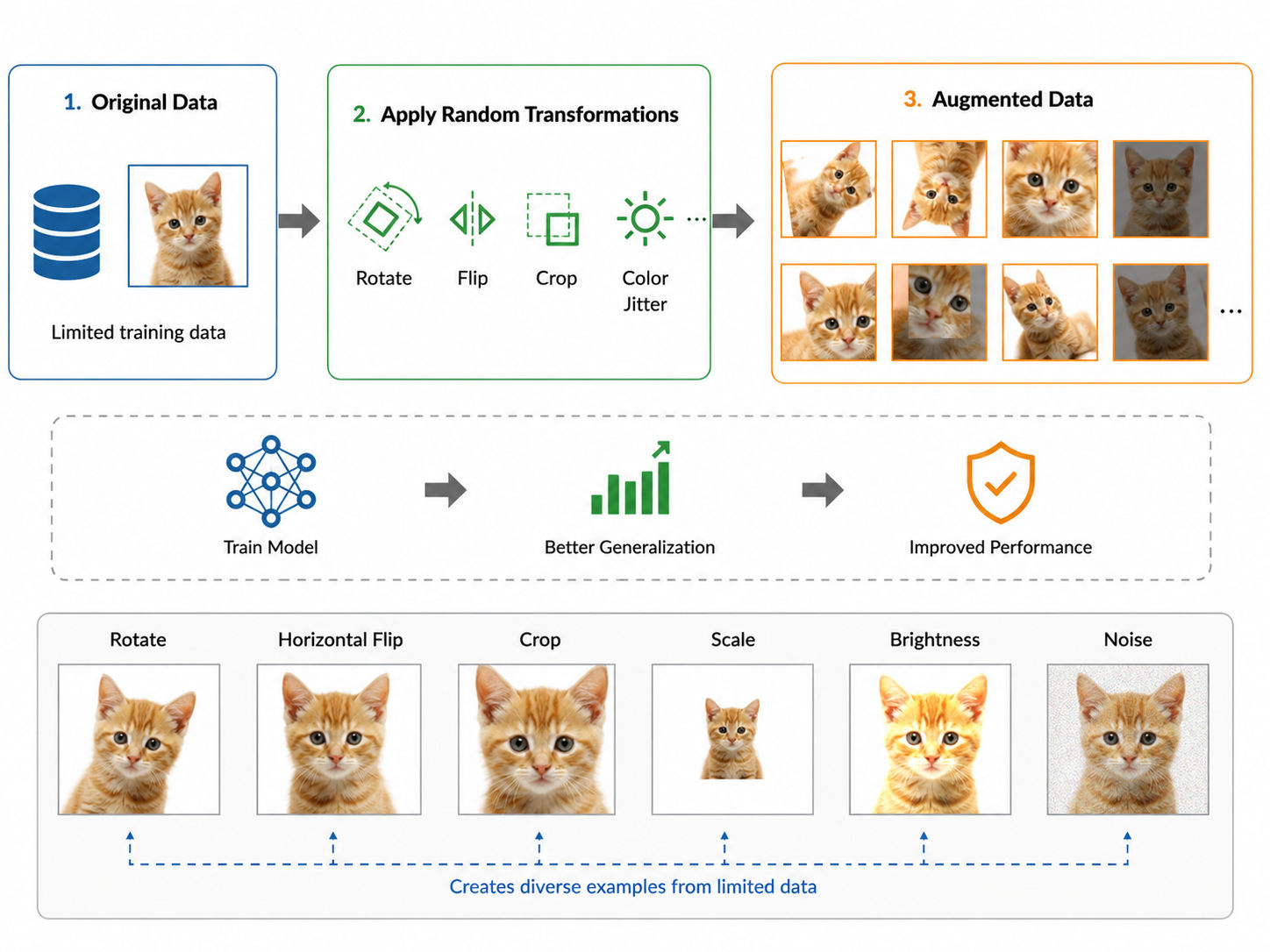
The goal is to expose the model to more diverse inputs during training so it learns patterns that generalize well to new, unseen data. Without enough variety in the training set, models tend to memorize the training examples rather than learning the underlying patterns. This is called overfitting, and data augmentation is one of the most effective tools to fight it.
In an ideal world, you would have millions of labeled examples covering every possible variation. In practice:
Data augmentation fills this gap. It is not a replacement for more real data, but it is often the best option when collecting more data is not feasible.
It is important to be clear about what this technique does not do:
| Concept | What It Does | Creates New Info |
| Data augmentation | Transforms existing samples | No |
| Data synthesis | Generates new samples from models | Yes |
| Data collection | Gathers real-world examples | Yes |
| Data balancing | Resamples existing classes | No |
Free Courses
Image data is where data augmentation is most widely used. Computer vision models are particularly hungry for labeled data, and image transformations are easy to apply without changing the label.
These transformations change the position, orientation, or size of the image while keeping the content the same.
These change the appearance of pixels without moving them.
Also Read: Applied Computer Vision: Core Techniques & Applications
| Technique | What It Does | Best For |
| Mixup | Blends two images and their labels | Classification tasks |
| CutOut | Randomly masks rectangular regions | Robustness training |
| CutMix | Replaces a region with a patch from another image | Image classification |
| AutoAugment | Learns the best augmentation policy from data | High-performance CV models |
| RandAugment | Applies a random sequence of transforms | Efficient policy search |
import torchvision.transforms as transforms
from PIL import Image

augment = transforms.Compose([
    transforms.RandomHorizontalFlip(p=0.5),
    transforms.RandomRotation(degrees=15),
    transforms.ColorJitter(
        brightness=0.2,
        contrast=0.2,
        saturation=0.2,
        hue=0.1
    ),
    transforms.RandomCrop(size=224, padding=16),
    transforms.ToTensor(),
    transforms.Normalize(mean=[0.485, 0.456, 0.406],
                         std=[0.229, 0.224, 0.225])
])

# Load and augment an image
image = Image.open("dog.jpg")
augmented = augment(image)import albumentations as A
import cv2
transform = A.Compose([
A.HorizontalFlip(p=0.5),
A.Rotate(limit=20, p=0.7),
A.GaussNoise(var_limit=(10, 50), p=0.3),
A.RandomBrightnessContrast(p=0.4),
A.Blur(blur_limit=3, p=0.2),
])
image = cv2.imread("dog.jpg")
image = cv2.cvtColor(image, cv2.COLOR_BGR2RGB)
augmented = transform(image=image)["image"]Albumentations is faster than most other libraries for image augmentation and supports bounding boxes, segmentation masks, and keypoints alongside the image.
Also Read: What Skills Do You Need to Be a Computer Vision Engineer?
AI Courses to upskill
Explore Artificial Intelligence Courses for Career Progression
Data augmentation in machine learning extends well beyond images. Text and audio are two other domains where augmentation has become important, especially as NLP and speech recognition models grow more complex.
Text Data Augmentation Techniques
Text is harder to augment than images because small changes can alter meaning or grammar. These techniques are the most commonly used ones that preserve the original intent:
Also Read: Top 10 Speech Processing Projects & Topics You Can’t Miss in 2026!
from transformers import pipeline
# Translate English to French
en_to_fr = pipeline("translation_en_to_fr",
                   model="Helsinki-NLP/opus-mt-en-fr")

# Translate French back to English
fr_to_en = pipeline("translation_fr_to_en",
                   model="Helsinki-NLP/opus-mt-fr-en")

sentence = "The model learns better with more varied training data."
french = en_to_fr(sentence)[0]["translation_text"]
back_translated = fr_to_en(french)[0]["translation_text"]

print("Original:", sentence)
print("Back-translated:", back_translated)For speech recognition and audio classification, these are the standard approaches:
Also Read: Hugging Face Model
| Domain | Top Techniques |
| Images | Flipping, rotation, color jitter, CutMix |
| Text | Synonym replacement, back-translation, EDA |
| Audio | Pitch shifting, noise injection, SpecAugment |
| Tabular | SMOTE, noise injection, feature perturbation |
Data augmentation in deep learning is most effective when applied thoughtfully. Using the wrong transformations or applying them too aggressively can actually hurt model performance. Here is how to do it right.
Augmentation should be applied to the training set only. The validation and test sets should reflect the true distribution of data the model will encounter in deployment. If you augment your test set, your evaluation metrics become unreliable.
train_transform = transforms.Compose([
    transforms.RandomHorizontalFlip(),
    transforms.RandomRotation(10),
    transforms.ToTensor(),
])

val_transform = transforms.Compose([
    transforms.ToTensor(),   # No augmentation for validation
])Every transformation you apply should produce an image, sentence, or audio clip that could plausibly exist in the real world. Rotating a satellite image 90 degrees makes sense. Rotating a chest X-ray 90 degrees does not, because doctors never take X-rays at that angle. Always ask: would a human encounter this variation in practice?
Also Read: Deep Learning Models: Types, Creation, and Applications
More augmentation is not always better. Aggressive transformations can destroy the signal the model needs to learn from. Start with mild augmentations and increase gradually while monitoring validation performance.
When you need maximum performance, AutoAugment and RandAugment learn which augmentation strategies work best for a specific dataset. This is especially useful in transfer learning settings where you are fine-tuning a pretrained model on a small domain-specific dataset.
Data augmentation is particularly valuable when classes are imbalanced. Instead of oversampling minority classes by duplicating examples, you can augment them to create genuinely different variations. This improves the quality of oversampling compared to naive duplication.
Also Read: Top 15 Deep Learning Frameworks Every AI Expert Should Know
Data augmentation in machine learning is now standard practice across nearly every industry that uses AI. Here are the domains where it has the biggest impact.
Medical datasets are notoriously small. Labeling a CT scan requires a specialist, which is expensive and time-consuming. Data augmentation allows radiology AI models to train on thousands of variations from a few hundred scans. Techniques like random rotations, elastic deformations, and intensity shifts are widely used for tumor detection, organ segmentation, and pathology classification.
Self-driving car models need to handle rain, fog, night driving, and unusual road conditions. Data augmentation techniques like synthetic fog overlays, brightness reduction, and weather simulation help models handle conditions that may be rare in the training data but critical to handle correctly in deployment.
Sentiment analysis, intent classification, and text categorization models all benefit from text augmentation. Back-translation is particularly popular for low-resource languages where labeled data is scarce. Synonym replacement has been shown to improve classification accuracy by several percentage points on standard benchmarks.
Fraud events are rare by nature. A dataset with 10,000 normal transactions and 50 fraudulent ones will produce a model that simply ignores fraud. Augmenting the fraud examples and combining this with SMOTE creates a more balanced training set that forces the model to actually learn what fraud looks like.
Satellite imagery models use rotation, flipping, and brightness augmentation heavily because aerial objects appear at arbitrary orientations and under varying atmospheric conditions. A building from above looks the same whether viewed from the north or the south, so rotational augmentation makes strong physical sense.
Subscribe to upGrad's Newsletter
Join thousands of learners who receive useful tips
Data augmentation is one of the most cost-effective tools in any machine learning or deep learning workflow. When you do not have enough labeled data, and you almost never do, augmentation lets you squeeze more learning out of what you already have. It reduces overfitting, improves generalization, and in some cases directly enables model training on datasets that would otherwise be too small to use.
Whether you are building an image classifier, a text categorization model, or a speech recognition system, the right data augmentation strategy will make your model more robust without a single additional data collection effort.
Want personalized guidance on AI and upskilling? Speak with an expert for a free 1:1 counselling session today.
It depends on the implementation. If you pre-generate and save all augmented samples, the dataset size on disk increases. Most modern frameworks apply augmentation on-the-fly during training, meaning each batch receives freshly augmented samples without storing them. This approach saves storage and produces more variety because each epoch sees different transformations.
Yes, though it is less straightforward than for images. Common techniques for tabular data include adding Gaussian noise to continuous features, using SMOTE to generate synthetic minority class samples, and randomly swapping feature values within the same class. The challenge is ensuring augmented rows remain statistically realistic and do not introduce impossible feature combinations.
Yes, especially when fine-tuning a pretrained model on a small dataset. The pretrained model already has strong feature representations, but augmentation prevents overfitting to the small fine-tuning set. Standard augmentations like flipping and color jitter are usually sufficient. Policy-based methods like RandAugment can provide additional gains when the fine-tuning dataset is extremely small.
Offline augmentation generates and saves all augmented samples before training begins, increasing dataset size permanently on disk. Online augmentation applies transformations in real time during training, typically within the data loader. Online augmentation is preferred because it produces a different augmented version of each sample every epoch, giving the model more variety to learn from over time.
Start by thinking about what variations the model will encounter in deployment. If your test images might be taken in different lighting, use brightness and contrast augmentation. If orientation varies, use rotation and flipping. Always validate your choices by checking whether augmented samples still look realistic to a human. Then measure the impact on validation accuracy to confirm the techniques are helping.
Yes. Aggressive augmentation can destroy the signal the model needs to learn. If images are rotated too much, cropped too aggressively, or distorted beyond recognition, the model cannot learn the correct features. Start with mild augmentations and increase intensity gradually. Monitor both training and validation loss to detect if augmentation is making the task too hard for the model.
No. Data augmentation transforms existing samples using rule-based operations like flipping or synonym replacement. Generative AI for synthetic data uses models like GANs or diffusion models to create entirely new samples from scratch. Synthetic data generation is more powerful but also more complex and computationally expensive. Augmentation is simpler, faster, and works well in most standard scenarios.
Online augmentation adds some computational overhead per batch because transformations are applied in real time. However, the increase is usually small compared to the forward and backward pass through the network. In most cases, augmentation slightly increases the time per epoch but reduces the total number of epochs needed to converge, often resulting in less total training time overall.
For images, Albumentations is fast and feature-rich, while PyTorch's torchvision.transforms and TensorFlow's tf.image are good native options. For text, the NLPAug library and Hugging Face's translation pipelines are widely used. For audio, the Audiomentations library covers most standard techniques. For tabular data, imbalanced-learn provides SMOTE and related methods.
Yes, even with large datasets, augmentation improves robustness by exposing the model to variations that may be underrepresented in the original data. Advanced techniques like Mixup and CutMix have been shown to improve accuracy on large benchmarks like ImageNet even when millions of labeled images are already available. Augmentation complements large datasets rather than replacing them.
Overfitting happens when a model memorizes training examples instead of learning generalizable patterns. Augmentation prevents this by ensuring the model rarely sees the exact same input twice. Each augmented version of a sample looks slightly different, so the model is forced to focus on the underlying pattern rather than superficial details. This acts as a form of regularization that directly reduces the gap between training and validation performance.
96 articles published
Rahul Singh is an Associate Content Writer at upGrad, with a strong interest in Data Science, Machine Learning, and Artificial Intelligence. He combines technical development skills with data-driven s...
Speak with AI & ML expert
By submitting, I accept the T&C and
Privacy Policy
Top Resources
Master's Degree
18 Months
Executive Diploma
12 Months
IIIT Bangalore
Executive Programme in Generative AI & Agentic AI for LeadersIndia’s #1 Tech University
Dual Certification
5 Months