Data Collection Methods: A Complete Guide
By Sriram
Updated on Jul 09, 2026 | 12 min read | 4.39K+ views
Share:

All courses
Certifications
More
By Sriram
Updated on Jul 09, 2026 | 12 min read | 4.39K+ views
Share:
Table of Contents
Quick Overview
In this blog, you will learn what Data collection methods are, the different types of data collection methods available, how they compare, and how to pick the right one for your project. We will also cover common challenges, practical tools, and answers to frequently searched questions on this topic.
Concepts like data collection methods become truly valuable when you can apply them to solve real-world research and business problems. Explore our Machine Learning courses and build practical skills through hands-on projects.
Popular Data Science Programs
Data collection methods are the specific techniques used to gather information for a study, survey, or analysis. They define how data is sourced, whether through direct interaction with people, observation, digital tracking, or existing records. The technique you choose shapes the quality, accuracy, and usefulness of your results.
At its core, every method of data collection falls into one of two broad categories: primary or secondary. Primary approaches involve collecting fresh data directly from the source. Secondary approaches involve using data that already exists, collected by someone else for a different purpose.
Choosing the right method of data collection is not just a technical decision. It affects your budget, timeline, and the depth of insight you can draw from your research. A poorly chosen approach can lead to biased results, wasted resources, or conclusions that do not hold up under scrutiny.
Also Read: The Data Science Process: Key Steps to Build Data-Driven Solutions
Good decisions rely on quality data. Whether you are a student, market researcher, or business analyst, your data collection method directly affects the reliability of your findings.
Here is why this matters:
Without a clear, well-planned method of data collection, even a great research question can produce weak or misleading answers.
Before diving into types and processes, it helps to understand a few terms that come up often in this space.
Term |
Meaning |
| Population | The entire group you want to study or draw conclusions about |
| Sample | A smaller subset of the population that you actually collect data from |
| Sampling Frame | The list or source from which your sample is drawn |
| Census | Data collection covering the entire population, not just a sample |
| Sampling Bias | When your sample does not accurately represent the population |
| Non-response Error | Error that occurs when selected participants do not respond |
| Measurement Validity | Whether your method actually measures what it claims to measure |
| Cross-sectional Data | Data collected at a single point in time |
| Longitudinal Data | Data collected repeatedly over a period of time |
Knowing these terms will help you understand the rest of this guide and make better choices as you plan your own research.
Free Courses
There are several methods of data collection in research, and each one fits a different kind of question. Broadly, they fall into two categories: primary data collection methods and secondary data collection methods. Within these, you also have qualitative and quantitative approaches.
Primary data collection methods involve gathering information directly from the source for the first time. This data is original and specific to your research question, which makes it highly relevant but often more time-consuming and costly to collect.
Common examples include:
These methods give you control over exactly what data you collect and how. They are ideal when existing data does not answer your specific question, or when you need first-hand insight into behavior, opinions, or experiences.
Secondary data collection methods involve using data that has already been collected by someone else, often for a different purpose. This could be published reports, government records, academic journals, or internal company data.
This approach is generally faster and cheaper since the data already exists. However, it may not perfectly match your research needs, and you have less control over how the data was originally gathered.
Published sources include information that has been made publicly available, such as:
These sources are usually reliable since they go through some form of review or verification before release.
Unpublished sources include data that has not been formally released to the public, such as:
These sources can offer unique insight but often need extra verification since they lack formal review.
Qualitative approaches focus on gathering non-numerical information such as opinions, experiences, and behaviors. They help you understand the "why" behind a trend or decision. Common examples include interviews, focus groups, and open-ended survey questions.
Quantitative approaches focus on numerical data that can be measured and analyzed statistically. They help you understand the "how much" or "how many" behind a question. Common examples include structured surveys, experiments, and numerical tracking through sensors or systems.
Concepts like data collection methods become truly valuable when you can apply them to solve real-world research and business problems. Explore our Executive Diploma in Data Science & Artificial Intelligence from IIITB and build practical skills through hands-on projects.
Data Science Courses to upskill
Explore Data Science Courses for Career Progression
IIIT Bangalore
Executive Post Graduate Certificate in Data Science & AIPlacement Assistance
Understanding the difference between primary and secondary data collection helps you decide which approach fits your project.
Aspect |
Primary Data Collection |
Secondary Data Collection |
| Source | Collected directly by the researcher | Collected by someone else earlier |
| Cost | Usually higher | Usually lower |
| Time | Takes longer | Faster to access |
| Relevance | Highly specific to your question | May not fully match your needs |
| Control | Full control over the process | Limited control over quality |
Most strong research projects use a mix of both. Secondary data helps you build context and background, while primary data helps you answer your specific research question directly.
Another important comparison is between qualitative and quantitative approaches, since they serve very different purposes.
Aspect |
Qualitative Methods |
Quantitative Methods |
| Data type | Descriptive, non-numerical | Numerical, measurable |
| Goal | Understand reasons and patterns | Measure and compare variables |
| Sample size | Usually smaller | Usually larger |
| Analysis | Thematic or content analysis | Statistical analysis |
| Example | Open-ended interviews | Structured surveys with rating scales |
When you need to understand quantitative vs qualitative data collection, ask yourself what you are trying to learn. If you want numbers and trends, go quantitative. If you want context and depth, go qualitative. Many researchers combine both for a fuller picture.
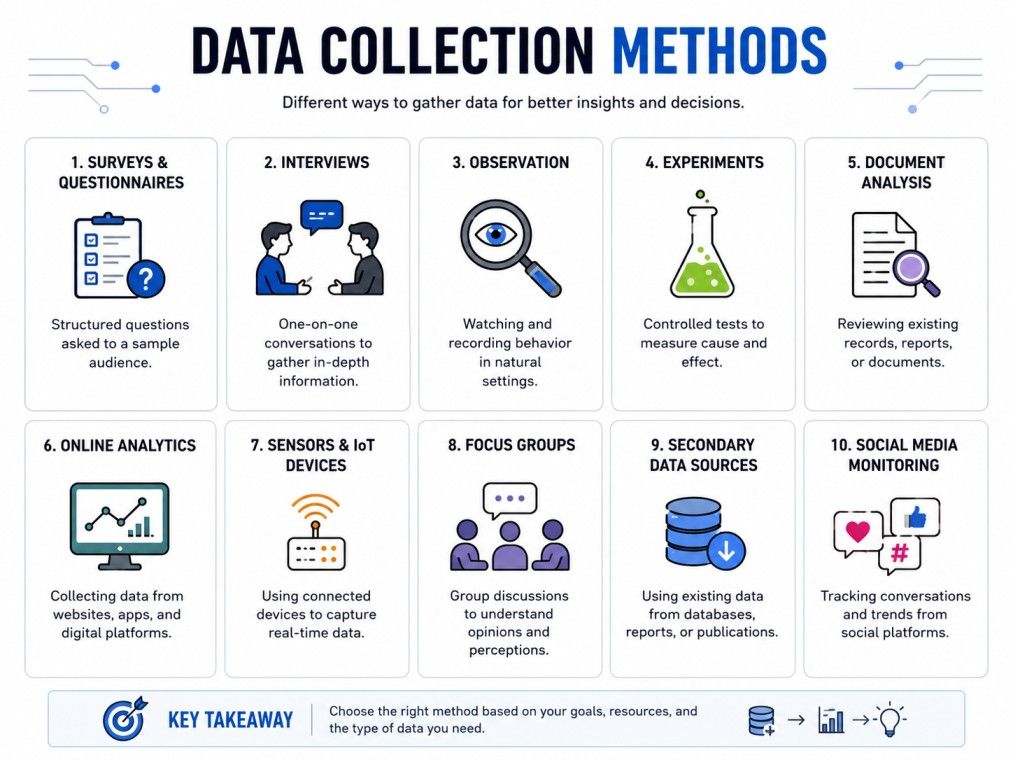
Now let us look closer at the specific methods of data collection in research that show up most often across academic and business settings.
The survey data collection method involves asking a set of questions to a group of people, usually through forms, either online or offline. Surveys are one of the most widely used approaches because they are scalable, cost-effective, and can reach large audiences quickly.
The questionnaire method of data collection is closely related to surveys but refers specifically to the structured set of questions used. A good questionnaire method of data collection follows a few basic rules:
A well-designed questionnaire method of data collection reduces confusion and improves the quality of responses you receive.
Using an interview as a data collection method means gathering data through direct conversation, either in person, over the phone, or via video call. Interviews allow for deeper follow-up questions and richer detail, but they take more time and are harder to scale than surveys.
The observation method of data collection involves watching and recording behavior as it happens, without direct interaction with the subject. This method works well when self-reported data might be biased or inaccurate, such as studying shopping habits or workplace behavior.
Focus group data collection brings together a small group of people to discuss a topic under the guidance of a moderator. This method is useful for exploring opinions, testing ideas, or understanding group dynamics around a product or issue.
Surveys and interviews are both popular, but they work differently depending on your goal.
Factor |
Surveys |
Interviews |
| Scale | Can reach large audiences | Limited to smaller groups |
| Depth | Surface-level responses | Deeper, detailed answers |
| Time per respondent | Short | Longer |
| Flexibility | Fixed questions | Can adapt based on responses |
| Best for | Broad trends and patterns | In-depth understanding |
If you need breadth, choose surveys. If you need depth, interviews work better. Many studies use both together for balanced results.
Subscribe to upGrad's Newsletter
Join thousands of learners who receive useful tips
The right data collection tools depend on your scale, budget, and the type of data you need. Here's a breakdown of what to consider.
Data collection instruments are the tools used to actually gather data, such as questionnaires, interview guides, observation checklists, or sensor devices. Choosing the right instrument keeps your data collection process consistent and reliable.
Different methods call for different tools:
Also Read: Top Data Collection Tools
Online methods use digital platforms like web forms, apps, and email surveys. They're faster and cheaper to scale. Offline methods rely on paper forms, in-person interviews, or physical observation, and work better in areas with limited digital access or where personal interaction improves data quality.
Manual data collection relies on people, through interviews or paper surveys. Automated data collection uses technologies such as sensors, tracking software, or digital forms, with minimal human involvement. Automation reduces human error, but manual methods can capture nuance that automated tools often miss.
Sampling determines how you select participants or data points from a larger population, and getting it right matters. A poor sample can skew your entire study.
Common sampling methods:
The sampling method you choose directly affects how well your results represent the population you're studying.
A clear data collection process helps you avoid wasted effort and low-quality results. Here are the key steps.
Start by clarifying what you want to learn and why. A clear objective keeps your effort focused and prevents you from gathering irrelevant information.
Decide whether you need primary data, secondary data, or a mix of both. This decision shapes your entire approach going forward.
Build your questionnaire, interview guide, or observation checklist. Test it on a small group first to catch confusing questions or design flaws early.
Decide how many people or data points you need and how you will select them, using one of the sampling methods covered earlier.
Carry out the actual collection, whether through surveys, interviews, observation, or automated tools. Stay consistent with your instrument, and check for missing values, duplicates, or inconsistent responses as you go rather than waiting until the end.
Store your data securely and keep clear notes on how it was collected. This makes future analysis easier and helps others verify your work if needed.
Even well-planned research runs into problems. Every data collection method comes with challenges that can affect data quality, reliability, and the accuracy of business insights. Here are common issues and fixes.
Bias can creep in through leading questions, unrepresentative samples, or researcher influence during interviews. Use neutral language, randomize your sample where possible, and pilot test your instruments before full rollout.
Build in checks at every stage. Train your data collectors properly, use standardized instruments, and review incoming data regularly instead of waiting until the end.
Common errors include duplicate entries, incomplete responses, and inconsistent formatting. Fix these by using validation rules in your digital forms, running regular audits, and setting clear entry guidelines for your team.
Missing data is common, especially with longer questionnaires. Handle it by following up with non-respondents, keeping surveys shorter and more focused, or applying statistical techniques to estimate missing values during analysis.
Keep surveys short, explain why the data matters, offer incentives where appropriate, and send reminders at the right intervals without being overly persistent.
With so many options available, choosing the right one comes down to a few practical questions:
There is no single method that is most reliable across every situation. The best method of data collection is the one that matches your specific research question, resources, and timeline. A small qualitative study might rely entirely on interviews, while a large market research project might combine surveys, secondary data, and observation.
A simple selection framework:
If you need |
Consider using |
| Large-scale numerical data | Surveys or quantitative methods |
| Deep insight into behavior | Interviews or focus groups |
| Quick background context | Secondary data sources |
| Real-world behavior tracking | Observation methods |
Different fields apply these techniques in slightly different ways depending on their goals.
In market research, teams often combine surveys, focus groups, and secondary data like industry reports.
Market research uses both primary and secondary data collection methods to understand customer needs, market trends, and competitive landscapes. Common methods include:
The goal is usually to understand customer preferences, test new product ideas, or track market trends over time.
For business analytics, teams often lean toward automated and quantitative approaches, such as tracking sales data, website analytics, or customer transaction records
Common data collection methods include:
These support ongoing decision-making rather than one-time research projects.
Data collection methods form the backbone of any solid research project, whether academic, business, or market-focused. From primary data collection methods like surveys and interviews to secondary data collection methods like published reports and internal records, each approach has its place depending on your goal.
The key is matching your method of data collection to your research question, timeline, and resources. Combine qualitative and quantitative approaches when needed, use reliable data collection methods and tools to support accuracy, and always plan for quality checks along the way. Get this foundation right, and everything that follows, from analysis to decision-making, becomes far more reliable.
Want personalized guidance on Data Science and upskilling? Speak with an expert for a free 1:1 counselling session today.
Data collection is the process of gathering raw information, while data analysis involves interpreting that information to find patterns or answers. Collection comes first and directly affects how accurate and useful your later analysis will be.
Surveys are often the easiest starting point for beginners since they are simple to design, distribute, and analyze. They also work well across both qualitative and quantitative research needs without requiring advanced tools or training.
The right sample size depends on your population size, desired confidence level, and research goal. Larger samples generally improve reliability, but even a smaller, well-selected sample can produce solid results if your sampling method is sound.
Yes, and it is often recommended. Secondary data can provide useful background and context, while primary data collection methods let you gather specific, first-hand information that directly answers your unique research question.
Triangulation means using multiple techniques or sources to study the same question. It helps confirm findings, reduces bias, and gives you a more complete and trustworthy picture than relying on a single method alone.
Timelines vary widely based on method, sample size, and scope. A simple online survey might take a few days to a couple of weeks, while in-depth interviews or large-scale field research can take several months to complete.
The population is the entire group you want to study, while a sample is a smaller portion drawn from that population. Researchers study samples because collecting data from an entire population is often impractical or too costly.
Online surveys can be just as reliable when designed well, though they may face lower response rates or self-selection bias. In-person data collection often allows for richer detail but takes more time and resources to execute.
Researchers commonly use online form builders, mobile data collection apps, video conferencing tools for interviews, and automated tracking systems for quantitative data. The right data collection methods and tools depend on your specific research method and scale.
Watch for warning signs like a non-representative sample, leading questions, or low response rates from certain groups. Reviewing your sampling method and testing your instrument on a small group beforehand can help catch bias early.
The questionnaire method of data collection is used to gather structured responses from a large group efficiently. It works well for both qualitative and quantitative research and is widely used in market research, academic studies, and customer feedback programs.
695 articles published
Sriram K is a Senior SEO Executive with a B.Tech in Information Technology from Dr. M.G.R. Educational and Research Institute, Chennai. With over a decade of experience in digital marketing, he specia...
Speak with Data Science Expert
By submitting, I accept the T&C and
Privacy Policy
Start Your Career in Data Science Today
Top Resources
Executive Diploma
12 Months
Master's Degree
18 Months
Bootcamp
6 Months