Tracking Methods in Machine Learning: A Complete Guide
By Sriram
Updated on Jun 30, 2026 | 7 min read | 1.89K+ views
Share:

All courses
Certifications
More
By Sriram
Updated on Jun 30, 2026 | 7 min read | 1.89K+ views
Share:
Table of Contents
Tracking methods in machine learning refer to the techniques used to monitor, follow, and predict the state or position of objects, data points, or model behavior over time. Whether you're building a self-driving car system, a sports analytics tool, or a fraud detection pipeline, tracking is what ties observations across time into something meaningful.
Machine learning models don't stop evolving after they're trained. Their performance can change as new data arrives, user behavior shifts, or business requirements grow. That's why tracking methods in machine learning have become a core part of building reliable AI systems. They help data teams monitor experiments, datasets, models, and predictions throughout the machine learning lifecycle.
This blog covers the most widely used tracking methods in machine learning, how each one works, where they're actually applied, and what trade-offs you should know before picking one for your project.
Explore upGrad's Machine learning programs to build practical machine learning skills. Learn computer vision, deep learning, MLOps, and model deployment through hands-on projects that cover real-world AI applications, including object tracking and intelligent systems.
Popular AI Programs
Tracking, at its core, is about continuity. You're not just detecting something once. You're following it across frames, timesteps, or data streams and answering the question: is this the same object I saw before?
In ML, this gets complicated fast. Objects move. They get occluded. Sensors introduce noise. Two objects can look identical. These aren't edge cases; they happen constantly in real-world deployments.
Tracking methods solve this by combining detection (finding something) with association (linking that detection to a past observation). The method you use determines how well your system handles each of those challenges.
There are two broad categories worth knowing:
Tracking Method |
Description |
Best Use Cases |
| Model-based Tracking | Uses a mathematical model to predict an object's next position or state. | Autonomous vehicles, robotics, motion prediction, and video surveillance with continuous object movement. |
| Detection-based Tracking | Detects objects in each frame and matches them across frames to track movement. | Multi-object tracking, pedestrian tracking, sports analytics, traffic monitoring, and real-time video analysis. |
Do read: Machine Learning Methods: A Complete Beginner's Guide
Free Courses
The Kalman filter is one of the oldest and most widely used tracking methods in machine learning and signal processing. It was developed in the 1960s, but it's still the backbone of many modern tracking pipelines.
Here's why it works. The filter maintains two things: a predicted state (where the object is expected to be) and an uncertainty estimate (how confident the model is). Every time a new observation comes in, the filter updates both.
It's fast, interpretable, and works well when object motion is roughly linear. Think vehicle tracking on a highway or trajectory prediction in robotics.
It struggles in:
The Extended Kalman Filter (EKF) and Unscented Kalman Filter (UKF) are variants built to handle non-linear systems. They're more computationally expensive, but they're worth it when motion patterns are complex.
Variant |
Best For |
Trade-off |
| Kalman Filter | Linear motion, low noise | Breaks down with non-linear paths |
| EKF | Mild non-linearity | Approximation errors at high curvature |
| UKF | Strong non-linearity | Higher compute cost |
Must read: Labeled Data in Machine Learning: What It Is and Why It Matters
AI Courses to upskill
Explore Artificial Intelligence Courses for Career Progression
Single-object tracking is the easier problem. Multi-object tracking (MOT) is where things get genuinely hard. You have to detect multiple objects, assign consistent IDs to each, and handle cases where they disappear and reappear.
SORT (Simple Online and Realtime Tracking) combines the Kalman filter with the Hungarian algorithm. It predicts where each tracked object will be in the next frame, runs a detector, then uses Hungarian assignment to match predictions to detections.
It's really fast. But it doesn't use any appearance information, which means it fails badly when objects cross paths or look similar.
DeepSORT fixes this by adding a deep learning component. It extracts appearance features from a CNN and uses them alongside motion cues to make better associations. The result is a system that can re-identify objects even after they've been occluded.
Why this matters practically: if you're building a pedestrian tracking system for a retail store, SORT might confuse two people wearing similar clothes. DeepSORT handles that much better.
DeepSORT |
SORT |
DeepSORT uses position, velocity, and appearance features
|
SORT uses only position and velocity for matching
|
DeepSORT performs better in crowded scenes
|
SORT is faster and simpler to deploy
|
Explore upGrad's Master of Science in Machine Learning & AI from Liverpool John Moores University to build advanced expertise in AI, machine learning, computer vision, deep learning, MLOps, and generative AI.
The particle filter (also called Sequential Monte Carlo) takes a fundamentally different approach. Instead of representing state as a single estimate with uncertainty, it represents state as a set of particles, where each particle is a possible state.
More particles in one region means the model thinks the object is more likely to be there. As new observations arrive, particles are reweighted and resampled. The result is a distribution over possible states rather than a single point estimate.
This makes particle filters much better than Kalman filters when:
The catch? They're computationally expensive. The more particles you use, the better the estimate, but also the higher the cost. For real-time tracking with limited hardware, this is a real constraint, not a minor footnote.
Particle filters see heavy use in robotics (robot localization is a classic application), GPS-denied navigation, and augmented reality systems.
Also read: How to Implement Machine Learning Steps: A Complete Guide
Optical flow is different from the methods above. It doesn't track objects explicitly. It tracks motion at the pixel level, estimating how each pixel (or region) has moved between two frames.
Method / Aspect |
Description |
Best For |
| Lucas-Kanade Method | Tracks small, smooth movements using local pixel motion. Fast and efficient. | Feature tracking, real-time applications |
| Farneback Method | Computes motion for every pixel. More detailed but computationally heavier. | Dense motion estimation, video analysis |
| Applications | Detects moving objects, estimates camera motion, and tracks feature points. | Autonomous driving, robotics, surveillance |
| Limitation | Struggles with large, fast movements. Often combined with other tracking methods. | High-speed object tracking |
Must read: Complete Guide to Types of Probability Distributions: Examples Explained
Siamese networks brought a shift in how visual tracking is done. Instead of using handcrafted features or motion models, they learn to compare two patches of an image directly.
The setup is simple in concept. You have a target patch (what you're tracking) and a search region (where you're looking). The Siamese network takes both as input and produces a similarity score across the search region. The location with the highest score is where the object is.
SiamFC and SiamRPN are two well-known architectures in this family. SiamRPN adds a region proposal network on top, which makes it better at handling scale changes and aspect ratio shifts.
What makes these networks appealing is that they're fast at inference time. The template is processed once, and you only need to run the search side on each new frame.
Where they're used today:
Also read: What is Probability Density Function? A Complete Guide to Its Formula, Properties and Applications
There's no universal answer here. The right method depends on your constraints.
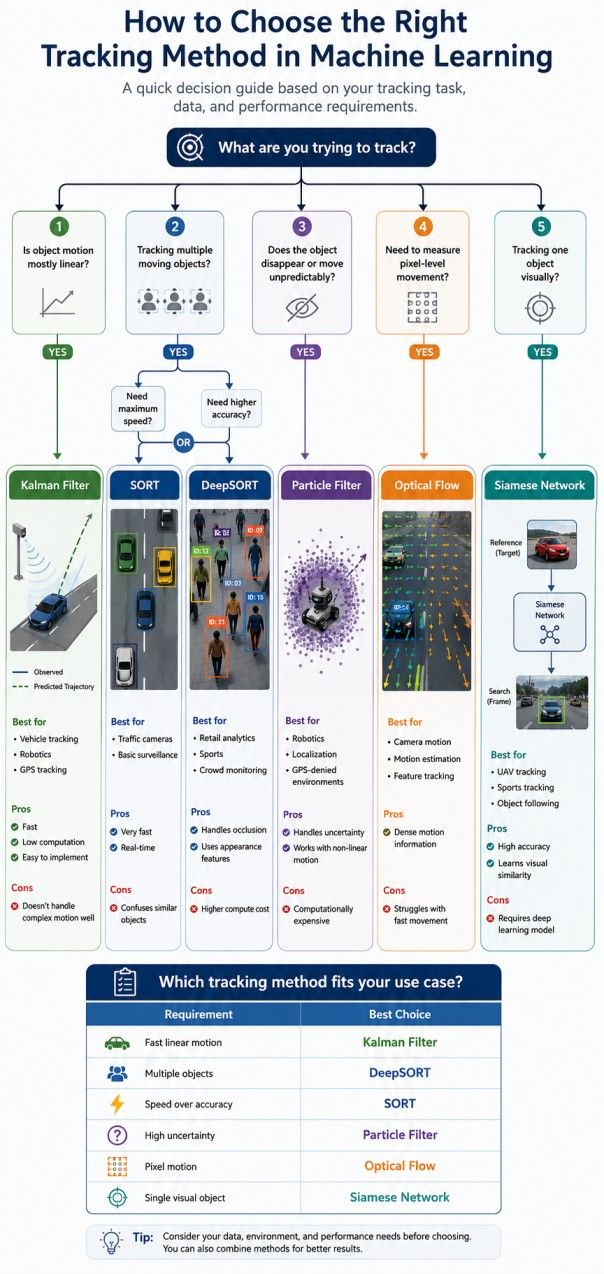
No single tracking method works best for every application. Your choice depends on motion patterns, the number of objects, available computing power, and how much accuracy your application requires.
Ask yourself these questions before committing to one approach:
Answering these honestly will narrow your options fast.
Tracking methods in machine learning range from mathematically elegant filters to deep learning architectures that can re-identify objects after occlusion. None of them is perfect. Each involves trade-offs between accuracy, speed, and complexity.
If you're starting out, SORT or Kalman filtering is the right place to begin. They're transparent, well-documented, and easier to debug. As your requirements grow, DeepSORT and Siamese networks give you more tools. And for robotics or sensor fusion work, particle filters remain hard to beat.
Pick based on your actual constraints, not theoretical performance numbers from benchmarks.
Ready to start your journey? Book a free consultation with upGrad today to find the best path for your career.
Tracking in AI is the process of continuously following an object, person, or feature across multiple frames, images, or time steps. Unlike simple detection, tracking maintains the identity of the target over time, making it useful for applications like autonomous vehicles, video surveillance, and sports analytics.
Tracking in machine learning refers to connecting observations across time so a system can recognize that it is monitoring the same object or pattern. Depending on the application, tracking can involve mathematical prediction models, computer vision algorithms, or deep learning techniques to improve consistency and decision-making.
ML tracking usually refers to two different concepts. In computer vision, it means following objects across video frames. In MLOps, it refers to recording experiments, datasets, model versions, and performance metrics during model development. The context determines which meaning applies, and both play an important role in machine learning workflows.
Object detection identifies where objects appear in a single image or video frame. Object tracking goes a step further by assigning each detected object a consistent identity and following its movement across future frames. This continuity makes tracking essential for real-time applications such as surveillance and traffic monitoring.
Tracking methods in machine learning are widely used in autonomous driving, robotics, sports analytics, drone navigation, medical imaging, intelligent surveillance, and augmented reality. They help systems understand movement, predict future positions, and maintain object identities even when the environment changes over time.
For applications where speed is the highest priority, Kalman Filter and SORT are often preferred because they require relatively little computation while delivering reliable performance. If the environment is crowded or objects frequently overlap, DeepSORT provides better accuracy at the cost of additional processing power.
Occlusion occurs when an object becomes partially or completely hidden by another object. Many tracking algorithms lose the object's identity during this period, especially if appearance information is unavailable. Advanced approaches like DeepSORT and particle filters are designed to recover object identities more effectively after occlusion ends.
Single-object tracking follows one predefined target throughout a sequence, making it relatively simpler to manage. Multi-object tracking must detect, identify, and maintain separate identities for several moving objects at the same time, which introduces challenges such as identity switching and overlapping trajectories.
The four primary types of machine learning are supervised learning, unsupervised learning, semi-supervised learning, and reinforcement learning. Tracking methods are not considered a separate type of machine learning. Instead, they are computer vision techniques that often use one or more of these learning approaches depending on the application.
Deep learning models learn rich visual features instead of relying only on object motion. Networks such as Siamese Networks and DeepSORT compare appearance patterns across frames, allowing them to recognize the same object even after changes in lighting, viewpoint, scale, or temporary occlusion.
A strong foundation in Python, linear algebra, probability, and computer vision makes learning tracking methods much easier. Familiarity with libraries like OpenCV, PyTorch, or TensorFlow, along with concepts such as object detection and image processing, helps beginners understand modern tracking algorithms and build practical machine learning projects.
730 articles published
Sriram K is a Senior SEO Executive with a B.Tech in Information Technology from Dr. M.G.R. Educational and Research Institute, Chennai. With over a decade of experience in digital marketing, he specia...
Speak with AI & ML expert
By submitting, I accept the T&C and
Privacy Policy
Top Resources
Master's Degree
18 Months
Executive Diploma
12 Months
IIIT Bangalore
Executive Programme in Generative AI & Agentic AI for LeadersIndia’s #1 Tech University
Dual Certification
5 Months