Transformers in Machine Learning: A Complete Beginner’s Guide
By Sriram
Updated on Jun 30, 2026 | 8 min read | 2.26K+ views
Share:

All courses
Certifications
More
By Sriram
Updated on Jun 30, 2026 | 8 min read | 2.26K+ views
Share:
Table of Contents
Transformers in Machine Learning helps Machine learning to excel at understanding language and images, even human conversations. Transformers in machine learning were first used in 2017. Now they are a big part of many AI systems like chatbots and tools that translate languages and suggest things you might like and models that create content. You have probably used transformers in machine learning if you have ever used ChatGPT or Google Translate or AI-powered search. Transformers, in machine learning, are very important and have a lot of usage.
In this blog, you'll learn what transformers in machine learning are, how they work, real-world applications, and why they outperform older deep learning models. By the end, you'll have a solid understanding of transformers without needing an advanced background in artificial intelligence.
Transformers are reshaping ML careers worldwide. Gain hands-on expertise in this game-changing architecture through upGrad's Machine Learning Courses Online and Artificial Intelligence Courses.
Popular AI Programs
Transformers in machine learning are really good at handling sequences of data. They do this job better than style neural networks. The idea of transformers was first talked about in a research paper called "Attention Is All You Need" by Ashish Vaswani and his team at Google in 2017.
The old models, like Recurrent Neural Networks and Long Short-Term Memory networks, used to look at information one step at a time. They had trouble with long texts. This was because they would forget some of the information from the start of the text as they kept reading.
Transformers are better because they look at the text at the same time. They can see how all the words and sentences are connected. This helps them understand what is going on better. Transformers use something called self-attention to figure out which parts of the text are important when they are trying to make a prediction.
Related Article: What is a Transformer Model?
Each of these components works together to help transformers understand context instead of simply memorizing patterns.
Component |
Purpose |
| Input Embeddings | Convert words into numerical vectors |
| Positional Encoding | Preserve word order within a sentence |
| Self-Attention | Identify relationships between different words |
| Feedforward Network | Learn complex patterns from attention outputs |
| Layer Normalization | Improve training stability |
| Output Layer | Generate predictions or probabilities |
Feature |
RNN/LSTM |
Transformer |
| Processing | Sequential | Parallel |
| Long-term context | Limited | Strong |
| Training speed | Slower | Faster |
| Scalability | Moderate | Excellent |
| Modern NLP tasks | Moderate | Excellent |
Related Article: Why Is GPT Called Transformer?
Free Courses
People who are new to this field often get transformer models mixed up with changing features in machine learning or changing data, in machine learning. In a lot of projects that happen in the world, people change the data first then they might work on the features and after that they teach the transformer models what to do.
Even though the names of these things sound much the same, they are actually talking about different ideas.
Future-proof your career with in-demand skills in MLOps, Generative AI, and Agentic AI. Enroll in Ex. Diploma in Machine Learning & AI with MLOps, Gen AI & Agentic AI program today.
AI Courses to upskill
Explore Artificial Intelligence Courses for Career Progression
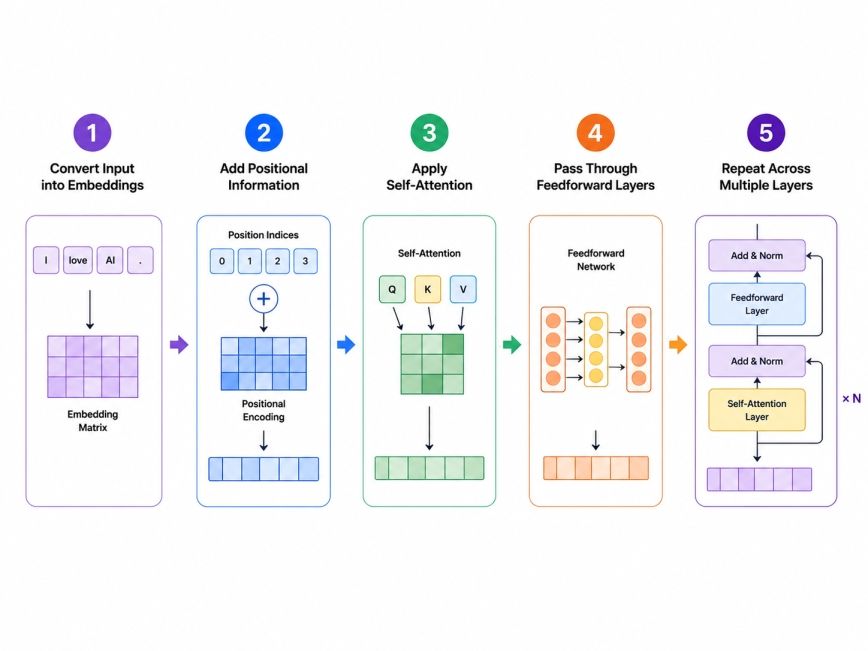
So, when we look at how transformers work on the inside, it helps us understand why they are the choice for a lot of artificial intelligence applications. Transformers are different from models that look at information one piece at a time.
Transformers look at the sequence all at once, and they pay attention to how different parts of the input are related to each other. They really focus on these relationships, between parts of the transformer input.
Computers cannot understand plain text. Every word is converted into a numerical representation called an embedding.
For example:
Word |
Example Representation |
| AI | [0.12, 0.84, 0.37...] |
| Machine | [0.56, 0.21, 0.74...] |
| Learning | [0.91, 0.42, 0.13...] |
These vectors capture semantic meaning rather than simple word IDs.
Because transformers process all words at once, they need a way to understand word order. Positional encoding provides this information.
Without it, these sentences would appear almost identical:
Although the same words are used, the meaning changes because of the order.
This is the core innovation behind transformers in machine learning. The model compares every query with every key to calculate attention scores. These scores determine which words deserve greater focus.
Each word receives three mathematical representations:
For example:
Sentence: "She deposited money in the bank."
The word bank could mean a financial institution or the side of a river. Self-attention uses surrounding words like deposited and money to infer the correct meaning.
After attention is calculated, the information moves through fully connected neural network layers. These layers learn increasingly complex patterns and improve prediction quality.
Modern transformer models stack dozens or even hundreds of transformer blocks. Each layer develops a deeper understanding of language. Early layers learn grammar. Middle layers identify relationships. Later layers capture abstract concepts and reasoning patterns.
Some modern models only use encoders, while others only use decoders depending on the task. Many transformer models include two major parts.
Component |
Function |
| Encoder | Understands the input sequence |
| Decoder | Generates the output sequence |
For example:
Input: "Translate 'Good Morning' into French."
Encoder: Learns the meaning of the English phrase.
Decoder - Generates: "Bonjour."
Also Read: The Evolution of Generative AI From GANs to Transformer Models
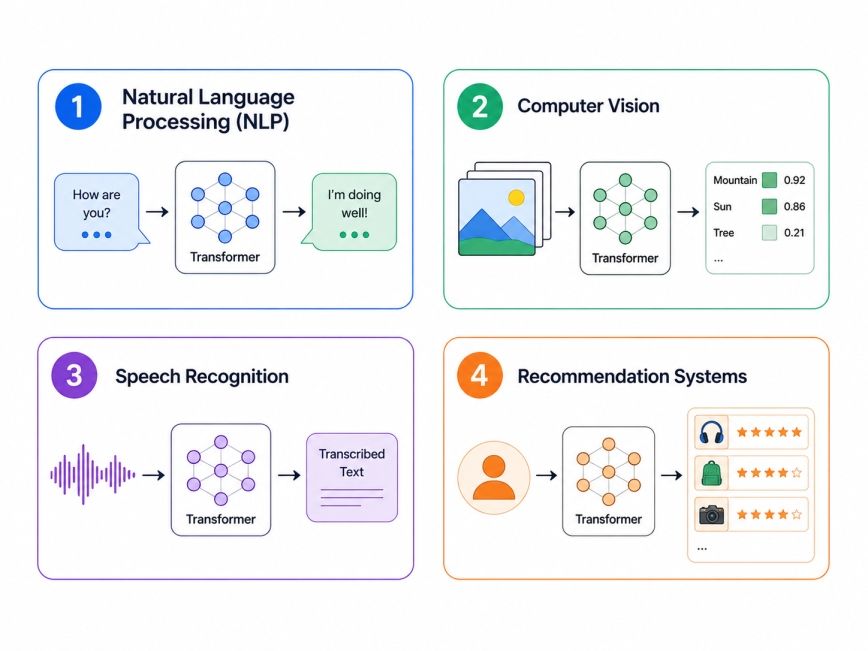
The rise of transformers in machine learning has really changed how AI systems solve problems. Transformers were first used for natural language processing. Now they are used in many industries and domains.
They are good at understanding context processing lots of data and learning relationships. This makes transformers one of the versatile deep learning architectures available today, transformers are useful for many tasks. The transformer architecture is widely used because it can handle amounts of data.
Popular AI tools like ChatGPT and Google Translate use transformer-based architectures. They help understand and generate text that sounds like a human wrote it. This is the most common use case for transformer models.
Applications include:
Also Read: 15+ Top Natural Language Processing Techniques To Learn in 2026
Transformers are not just for text anymore. Vision Transformers or (ViTs) work with images by cutting them into pieces. This helps models to really understand what they are looking at and spot things and patterns accurately.
Common use cases include:
Speech-based AI systems really get a lot out of transformers. They are good at understanding sequences of things people say. This means transformers can make transcripts that are more accurate than what older models can do.
Examples include:
Streaming services and e-commerce platforms use transformer models to know how users behave. They help the model learn how previous actions are connected. It uses interactions to predict future ones.
Typical applications include:
Industry |
Example Use Case |
| Healthcare | Medical report analysis |
| Finance | Fraud detection and document processing |
| Retail | Personalized recommendations |
| Education | AI tutoring and automated feedback |
| Customer Support | Intelligent chatbots |
| Media | Content generation and summarization |
Although transformers learn features on their own, they still need to input data. Most projects start with data transformation in machine learning. This is where we clean, standardize, and format information for training.
Teams also do feature transformation, in machine learning. They select variables or reduce dimensionality to improve structured datasets. These steps help improve accuracy and reduce noise before training transformer models.
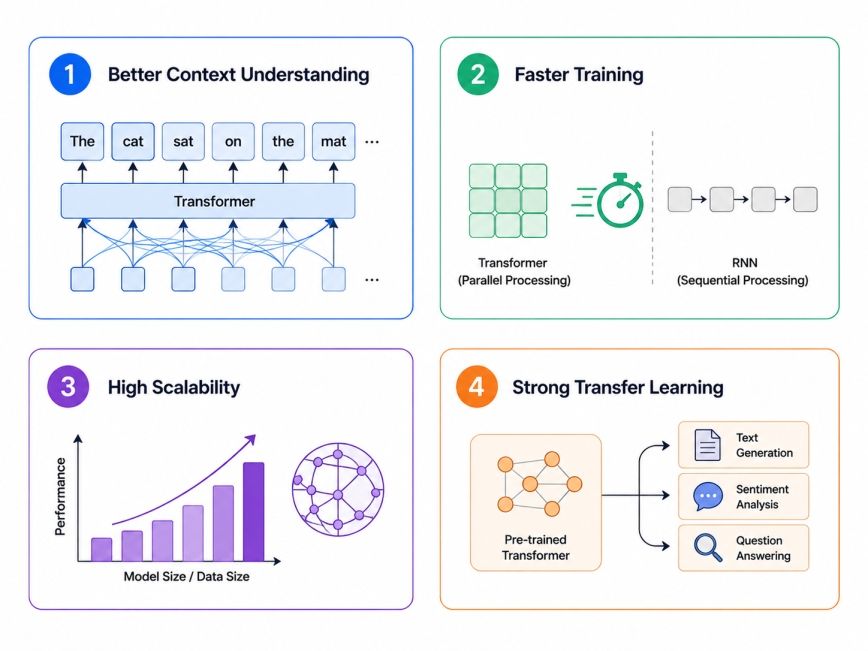
Like every machine learning architecture, transformers have strengths.
1. Better Context Understanding: Transformers consider the entire input sequence instead of reading one token at a time. This helps them understand the meaning more accurately.
2. Faster Training: Since transformers process inputs in parallel, they train much faster than RNNs and LSTMs on modern hardware.
3. High Scalability: Transformer models continue to perform well even when trained on massive datasets containing billions of words or images.
4. Strong Transfer Learning: Many pretrained transformer models can be fine-tuned for specific tasks using relatively small datasets. This reduces training time and computational costs.
Subscribe to upGrad's Newsletter
Join thousands of learners who receive useful tips
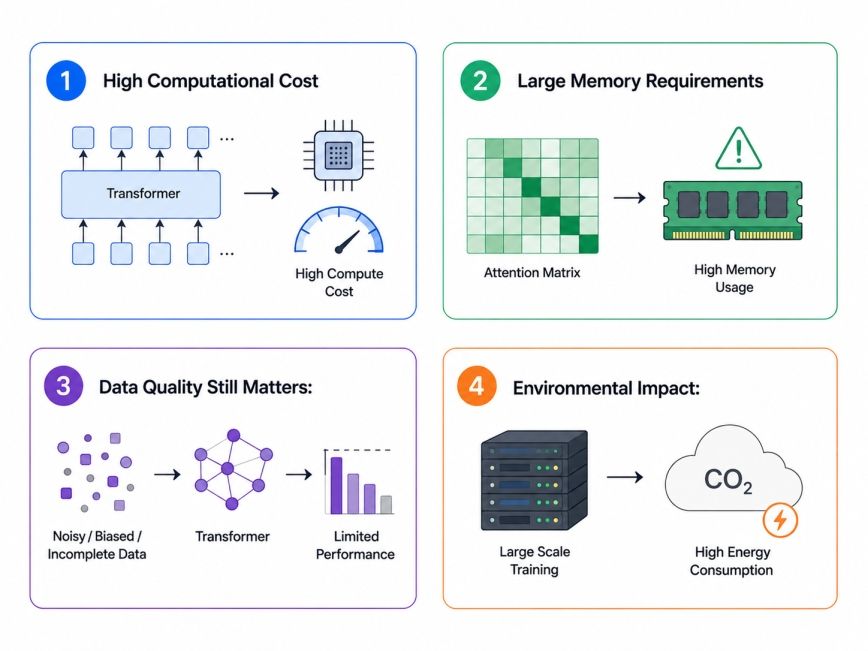
Despite their success, transformers are not perfect.
For smaller structured datasets, simpler machine learning algorithms may still be more practical. Transformers are an excellent choice if your project involves:
Transformers in machine learning have become one of the most important innovations in artificial intelligence. Their self-attention mechanism, parallel processing capability, and ability to understand context have transformed how machines process text, images, speech, and other forms of data.
While transformers automate much of the learning process, they are most effective when paired with good data preparation. Techniques such as data transformation in machine learning and feature transformation in machine learning continue to play an important role in building accurate, reliable AI systems.
Want to explore more about management accounting? Book your free 1:1 personal consultation with our expert today.
A transformer in machine learning is a deep learning architecture that uses a self-attention mechanism to understand relationships within data. Unlike older sequence models, it processes inputs in parallel, making it faster and better at handling long-range dependencies in tasks like translation, text generation, and question answering.
Transformers are used because they capture context more effectively than traditional sequence models. Their parallel processing capability reduces training time while improving accuracy across natural language processing, computer vision, speech recognition, and recommendation systems. This combination has made them the preferred architecture for many modern AI applications.
Four major applications of transformers are natural language processing, computer vision, speech recognition, and recommendation systems. These models power chatbots, image classification tools, voice assistants, search engines, and personalized recommendations across industries such as healthcare, finance, education, and retail.
Transformers are a type of neural network, but they use self-attention instead of sequential processing. This allows them to analyze an entire input at once, understand long-range relationships, and train more efficiently on large datasets than many traditional neural network architectures.
No. Feature transformation in machine learning refers to modifying or creating input features before model training. Transformer models are deep learning architectures designed to learn patterns automatically. Although the names sound similar, they serve different purposes within the machine learning workflow.
Data transformation in machine learning improves data quality by cleaning, normalizing, encoding, and organizing information before training begins. Even powerful transformer models depend on high-quality input data, making preprocessing an essential step for better accuracy and more reliable predictions.
Not always. Transformers perform exceptionally well on text, images, audio, and other unstructured data. However, traditional machine learning algorithms often remain a better choice for smaller structured datasets because they require fewer computational resources and are easier to interpret.
No. Although transformers first gained popularity through natural language processing, they are now widely used in computer vision, speech recognition, recommendation systems, robotics, healthcare, and scientific research. Their flexibility allows them to solve many different machine learning problems.
Python is the most widely used programming language for transformer development. Popular frameworks include PyTorch, TensorFlow, Keras, and Hugging Face Transformers, which provide pretrained models and tools for training, fine-tuning, and deploying transformer-based applications.
Beginners can understand the basic concepts of transformers, but learning neural networks and deep learning fundamentals first makes advanced topics much easier. A gradual learning path helps build intuition about embeddings, attention mechanisms, and model training.
Research is focused on making transformer models smaller, faster, and more energy efficient. New architectures continue to improve performance while reducing computational costs, allowing transformers to expand into edge devices, scientific discovery, healthcare, autonomous systems, and enterprise AI applications.
730 articles published
Sriram K is a Senior SEO Executive with a B.Tech in Information Technology from Dr. M.G.R. Educational and Research Institute, Chennai. With over a decade of experience in digital marketing, he specia...
Speak with AI & ML expert
By submitting, I accept the T&C and
Privacy Policy
Top Resources
Master's Degree
18 Months
Executive Diploma
12 Months
IIIT Bangalore
Executive Programme in Generative AI & Agentic AI for LeadersIndia’s #1 Tech University
Dual Certification
5 Months