Grokking Machine Learning: A Complete Guide
By Sriram
Updated on Jul 07, 2026 | 7 min read | 4.58K+ views
Share:

All courses
Certifications
More
By Sriram
Updated on Jul 07, 2026 | 7 min read | 4.58K+ views
Share:
Grokking machine learning commonly refers to the popular beginner-friendly book by Luis G. Serrano, which simplifies machine learning concepts for new learners. In AI research, however, grokking describes a unique phenomenon where a neural network unexpectedly shifts from memorizing training data to understanding underlying patterns, resulting in improved generalization and performance on unseen data.
In this blog, you will learn what grokking machine learning is, how it works, why it matters, its applications, benefits, challenges, and future implications for artificial intelligence research.
Want to master the concepts behind grokking and neural networks? Enroll in upGrad's Machine Learning, courses designed by industry experts.
Popular AI Programs
Grokking machine learning refers to a learning phenomenon in which a neural network initially overfits a dataset but eventually transitions to discovering the underlying rules governing the data.
The concept of grokking gained attention through research on deep neural networks that exhibited an unusual learning pattern. Unlike traditional training behavior, these models appeared to learn the correct solution long after achieving perfect training accuracy.
Researchers observed that some neural networks continue improving long after achieving perfect training accuracy. During this extended training period, test accuracy suddenly improves, indicating that the model has learned the fundamental structure of the problem.
Key Characteristics of Grokking :
Also Read: Machine Learning Tutorial: Basics, Algorithms, and Examples Explained
Traditional machine learning theory assumes that models gradually improve as training progresses. Grokking challenges this assumption by demonstrating that meaningful learning can occur much later in the training process.
Understanding this phenomenon helps researchers:
As AI models become increasingly complex, understanding grokking may provide insights into how intelligence emerges from large-scale learning systems.
Also Read : Markov Random Fields in Machine Learning: A Complete Guide
The journey from memorization to genuine understanding does not happen immediately.
Instead, grokking machine learning follows a unique learning path where a neural network gradually transitions from overfitting to strong generalization.
During the early stages of training, the model rapidly learns patterns from the available dataset. Training accuracy increases quickly as the network begins fitting the examples it has seen.
What Happens?
As training continues, the model achieves near-perfect performance on the training dataset. However, it relies heavily on memorized examples rather than understanding the underlying rules.
What Happens?
Unlike traditional machine learning workflows that stop after reaching high training accuracy, grokking requires continued training. During this period, the network slowly reorganizes its internal representations.
Key Outcomes
After many additional training iterations, a sudden shift occurs. Validation accuracy improves dramatically, indicating that the model has moved beyond memorization.
What Happens?
And Generalization capabilities emerge unexpectedly
The model develops a deeper understanding of the problem and can successfully apply learned concepts to new data. This stage represents true grokking.
Key Outcomes
Want to go beyond the basics of machine learning and build production-ready AI solutions? Explore these upGrad's programs:
Initial Learning → Memorization → Extended Training → Grokking Breakthrough → Generalized Understanding
This progression explains why grokking is often described as a delayed "aha!" moment in machine learning, where a model suddenly transitions from memorizing data to understanding the underlying rules that govern it.
Also read : Standardization in Machine Learning: Complete Guide
Free Courses
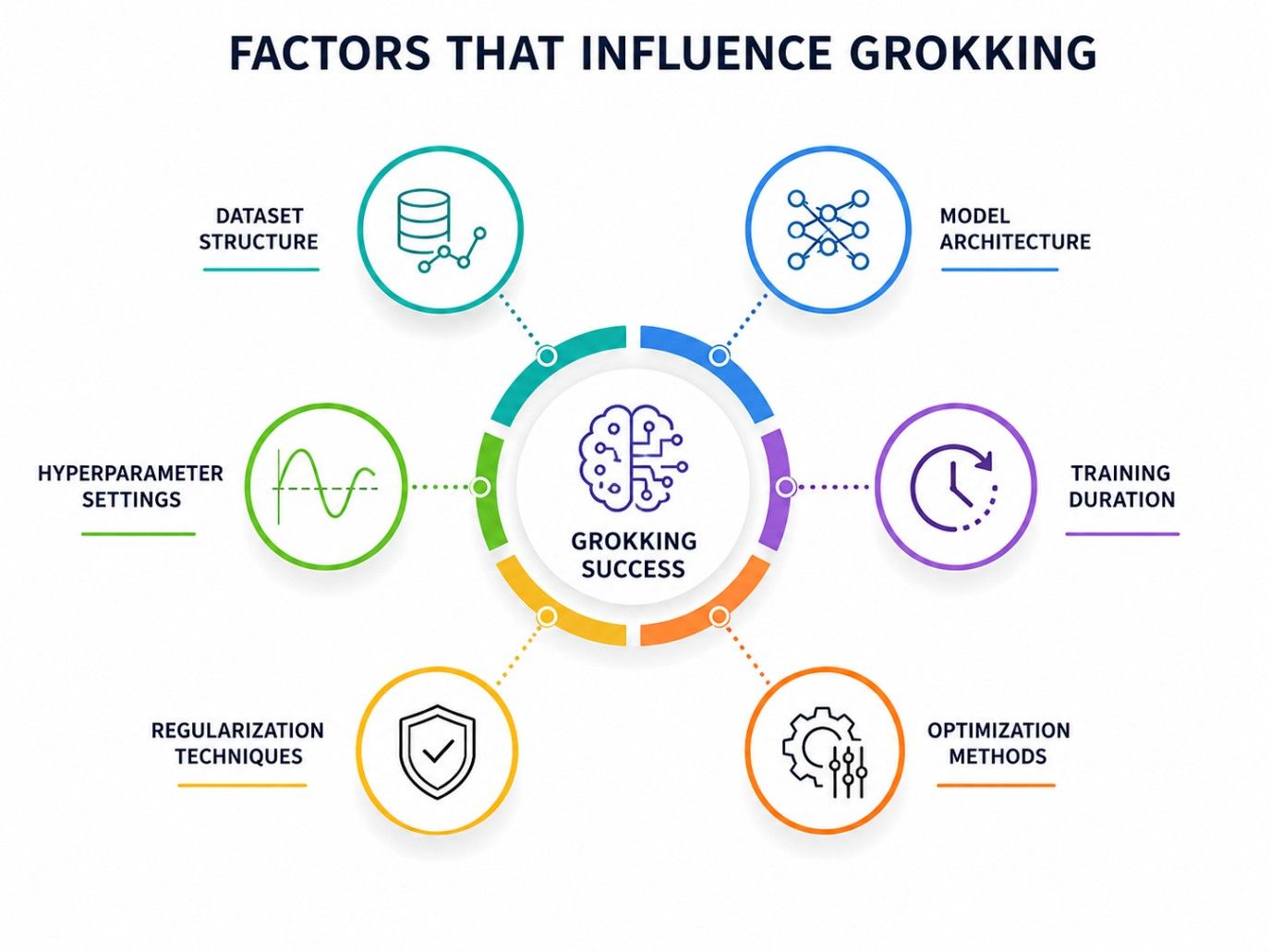
The emergence of grokking depends on multiple training and model-related factors that influence how neural networks learn and generalize.
AI Courses to upskill
Explore Artificial Intelligence Courses for Career Progression
As researchers gain a deeper understanding of grokking machine learning, its principles are being explored across various AI domains.
The ability to transition from memorization to true generalization has significant implications for building more intelligent, reliable, and adaptable systems.
Grokking provides valuable insights into how neural networks develop deeper understanding over time. Researchers use it to study learning dynamics, model behavior, and the emergence of intelligence in AI systems.
How It Helps
Modern language models must understand context, grammar, and meaning rather than simply memorize text patterns. Insights from grokking can help improve how NLP models generalize across different tasks and languages.
Why It Matters
And reduces dependence on memorised training examples
Many scientific and mathematical problems require discovering hidden patterns and relationships within large datasets. Grokking-inspired approaches can help models identify fundamental rules instead of relying on surface-level correlations.
How It Helps
Adaptive learning platforms need to understand how students learn and apply knowledge. Grokking principles can help create systems that focus on conceptual understanding rather than rote memorization.
Why It Matters
Autonomous vehicles and robotic systems operate in dynamic environments where memorized responses are often insufficient. They require models that can recognize patterns and make decisions in unfamiliar situations.
How It Helps
And Enhances real-time problem-solving capabilities
Cybersecurity systems must identify new and evolving threats that may not resemble previously seen attacks. Models capable of true generalization are better equipped to detect suspicious patterns and anomalies.
Why It Matters
The core value of grokking lies in its ability to help AI systems move beyond memorization and develop a deeper understanding of patterns. As researchers continue exploring this phenomenon, its insights may influence the next generation of AI applications across research, education, automation, cybersecurity, and intelligent decision-making systems.
Also Read: What Is Scaling in Machine Learning? Methods, Benefits, and Use Cases
Organizations and researchers are increasingly interested in grokking because of its potential advantages.
Benefit |
Impact |
| Improved Generalization | Better performance on unseen data |
| Enhanced Reliability | More robust predictions in real-world situations |
| Deeper Pattern Recognition | Understanding underlying rules instead of memorization |
| Better Explainability | Easier interpretation of learned behaviors |
| Stronger AI Development | Insights into how intelligent systems learn |
These benefits make grokking a valuable area of study in modern AI research.
Although promising, grokking presents several challenges.
Challenge |
Description |
| Long Training Times | Grokking may require extensive computational resources |
| Limited Understanding | Researchers are still uncovering why grokking occurs |
| Reproducibility Issues | Not all models consistently exhibit the phenomenon |
| Computational Costs | Extended experiments can be expensive |
| Scaling Complexity | Grokking behavior may differ in large-scale systems |
Addressing these challenges remains a major focus of ongoing machine learning research.
Also read : Traditional Programming vs Machine Learning
The future of grokking machine learning is closely tied to advancements in neural network theory and AI development.
Emerging research areas include:
As researchers continue exploring grokking, it may reveal fundamental insights into how intelligent systems learn and reason.
Grokking machine learning is a fascinating phenomenon where neural networks move beyond memorizing training data and begin understanding the underlying patterns and rules. This transition often occurs after extended training, leading to a sudden improvement in performance on unseen data.
By studying grokking, researchers gain valuable insights into how AI systems learn, generalize, and develop intelligent behavior. As artificial intelligence advances, grokking could help create more accurate, reliable, and explainable AI models for real-world applications.
Ready to start your journey? Book a free consultation with upGrad today to find the best path for your career.
Grokking refers to a phenomenon where a neural network initially memorizes training data but later learns the underlying rules governing the dataset. This delayed transition results in a significant improvement in generalization performance and provides researchers with insights into how deep learning systems develop meaningful understanding.
Grokking helps researchers understand how neural networks move beyond memorization and develop generalized knowledge. By studying this behavior, scientists can improve model reliability, interpretability, and learning efficiency while gaining deeper insights into the mechanisms that drive artificial intelligence.
Overfitting occurs when a model memorizes training data and performs poorly on new examples. Grokking begins with overfitting but eventually transitions into strong generalization. The model discovers underlying patterns and performs significantly better on unseen data despite initially appearing overfit.
No. Grokking is not observed in every machine learning model. It depends on factors such as dataset structure, model architecture, training duration, optimization methods, and regularization techniques. Researchers continue investigating the conditions that encourage grokking behavior.
The grokking phenomenon gained attention through research conducted by scientists studying neural network learning dynamics. Their experiments revealed unexpected improvements in generalization long after models achieved perfect training accuracy, challenging traditional assumptions about machine learning.
Researchers believe that similar learning dynamics may occur in large language models, although the exact mechanisms remain under investigation. Understanding grokking could help explain how advanced AI systems develop complex reasoning and contextual understanding.
Regularization techniques encourage simpler and more generalized solutions. Studies suggest that methods such as weight decay can help models move away from memorization and discover the deeper patterns necessary for grokking to occur.
The timing varies depending on the model and dataset. In some experiments, grokking occurs after many additional training iterations beyond the point where training accuracy reaches 100%, making it a delayed but significant learning event.
Yes. Better generalization can improve performance in areas such as healthcare, natural language processing, autonomous systems, and predictive analytics. Insights from grokking research may lead to more reliable and adaptable AI solutions.
Some researchers compare grokking to moments of sudden understanding in human learning. While neural networks and human cognition differ significantly, both can exhibit transitions from memorization to deeper conceptual understanding.
Future research aims to uncover why grokking occurs, how it scales to larger models, and how it can be leveraged to improve AI performance. Understanding this phenomenon may contribute to more explainable, efficient, and intelligent machine learning systems.
730 articles published
Sriram K is a Senior SEO Executive with a B.Tech in Information Technology from Dr. M.G.R. Educational and Research Institute, Chennai. With over a decade of experience in digital marketing, he specia...
Speak with AI & ML expert
By submitting, I accept the T&C and
Privacy Policy
Top Resources
Master's Degree
18 Months
Executive Diploma
12 Months
IIIT Bangalore
Executive Programme in Generative AI & Agentic AI for LeadersIndia’s #1 Tech University
Dual Certification
5 Months