Weka Machine Learning: A Complete Guide for Beginners
By Sriram
Updated on Jun 25, 2026 | 5 min read | 4.54K+ views
Share:

All courses
Certifications
More
By Sriram
Updated on Jun 25, 2026 | 5 min read | 4.54K+ views
Share:
Table of Contents
Weka machine learning is a free and open-source machine learning platform developed in Java by the University of Waikato, New Zealand. The Weka machine learning tool provides an intuitive graphical user interface that enables users to preprocess data, build predictive models, apply various algorithms, and evaluate results without extensive programming knowledge. Its user-friendly design makes it a popular choice among students, researchers, educators, and beginners learning machine learning and data mining.
This blog explores what Weka is, how it works, its key features, popular algorithms, benefits, applications, limitations, and future relevance in the evolving AI landscape.
Start your machine learning journey with upGrad’s AI and Machine Learning courses. Learn Weka, data mining, model development, and modern AI techniques
Popular AI Programs
Weka machine learning refers to the use of the Weka platform for building, training, testing, and evaluating machine learning models.
Weka (Waikato Environment for Knowledge Analysis) is an open-source machine learning software developed at the University of Waikato. It provides a collection of machine learning algorithms and data mining tools through an easy-to-use graphical interface.
The platform enables users to:
Because of its accessibility, Weka is widely used in academic research, machine learning education, and prototype development.
Must Read : Machine Learning Course Syllabus: A Complete Guide to Your Learning Path
Free Courses
Weka simplifies the machine learning process by providing a structured workflow for data preparation, model building, evaluation, and analysis. This workflow approach helps users efficiently develop and test machine learning models without extensive programming knowledge.
Typical Weka Workflow :
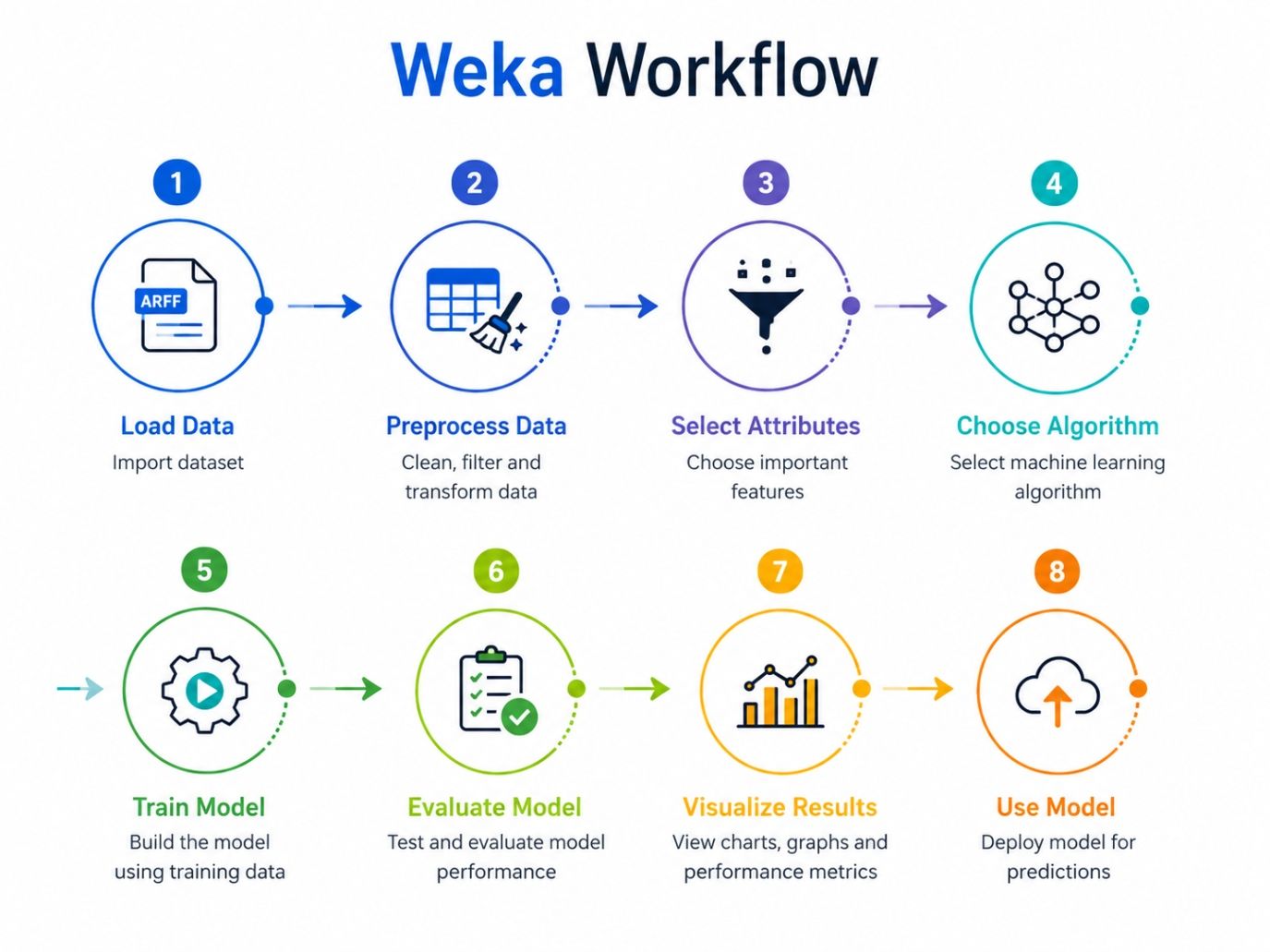
This streamlined process allows users to experiment with various algorithms and compare results efficiently.
Do Read : AI Skills in Demand: 25 Essential Skills Required for a Career in AI Engineering
AI Courses to upskill
Explore Artificial Intelligence Courses for Career Progression
The popularity of the Weka machine learning tool comes from its comprehensive set of features that support the complete machine learning lifecycle.
Feature |
Description |
| User-Friendly Interface | Weka offers graphical tools that allow users to build machine learning models without extensive programming knowledge. |
| Extensive Algorithm Library | The platform includes numerous classification, clustering, regression, and association rule algorithms. |
| Data Preprocessing Tools | Users can clean, normalize, transform, and prepare datasets before training models. |
| Visualization Capabilities | Weka provides charts and graphs that help users understand data distributions and model outcomes. |
| Open-Source Platform | Since Weka is open source, users can modify and extend its capabilities according to project requirements. |
| Cross-Platform Compatibility | The software runs on Windows, macOS, and Linux environments through Java support. |
Read : Machine Learning vs Data Analytics: Key Differences, Tools & Career Paths
One of the biggest strengths of Weka is its extensive collection of machine learning algorithms.
The available weka machine learning algorithms support supervised and unsupervised learning tasks.
Classification predicts categorical outcomes.
Popular options include:
Applications include:
Regression predicts continuous values.
Common regression algorithms include:
Typical use cases
Clustering groups similar data points without predefined labels.
Examples include:
Applications:
Association algorithms identify relationships between variables.
Popular algorithm:
Common applications:
Read : Can I Learn Machine Learning While Working Full-Time? A Practical Guide for Professionals
Data quality directly impacts machine learning performance.
Weka offers powerful preprocessing features that help prepare datasets for modeling.
Handling Missing Values-The platform can replace or remove incomplete records.
Data Normalization- Normalisation ensures variables are scaled consistently.
Feature Selection -Users can identify the most relevant attributes and remove unnecessary features.
Data Transformation- Weka supports attribute conversion and transformation methods that improve model accuracy.
Proper preprocessing often leads to better prediction results and improved model reliability.
The weka machine learning tool provides several advantages for learners and professionals.
Advantage |
Description |
| Easy to Learn | Its graphical interface eliminates many coding barriers for beginners. |
| Rich Algorithm Collection | Users can experiment with numerous machine learning techniques in one platform. |
| Strong Educational Value | Weka is widely used in universities and training programs for teaching machine learning concepts. |
| Rapid Prototyping | Researchers can quickly test ideas before implementing production-level solutions. |
| Free and Open Source | Organizations can use Weka without licensing fees. |
| Strong Community Support | Years of development have resulted in extensive documentation and community resources. |
Read : What Is Concept Learning in Machine Learning? A Complete Guide
Despite its strengths, Weka also has certain limitations.
Limitation |
Description |
| Memory Constraints | Large datasets can consume significant memory resources |
| Limited Deep Learning Support | Modern deep learning capabilities are not a primary focus |
| Scalability Challenges | Enterprise-scale big data projects may require additional tools |
| Java Dependency | Requires Java environment setup |
| Deployment Complexity | Production deployment options are more limited compared to modern ML frameworks |
Understanding these limitations helps organizations determine when Weka is the right choice.
Weka machine learning is widely used for data mining, predictive analytics, and machine learning tasks across various industries.
Its versatile algorithms help organisations extract insights, identify patterns, and make data-driven decisions.
These applications demonstrate the versatility of Weka across different sectors.
Although modern AI development increasingly relies on Python frameworks and deep learning platforms, Weka continues to hold value in education and research.
Several trends may influence its future:
1.Enhanced Integration
Future versions may integrate more closely with modern AI ecosystems.
2. Improved User Experience
Interface improvements can make machine learning even more accessible.
3. Hybrid Learning Environments
Weka may continue serving as an educational bridge between traditional machine learning and advanced AI systems.
4. Continued Academic Adoption
Universities are likely to continue using Weka for teaching core machine learning concepts due to its simplicity and transparency.
If you are new to machine learning, Weka offers an excellent starting point.
A practical learning path includes:
This hands-on approach helps users develop a strong understanding of machine learning fundamentals.
Also Read: 12 Issues in Machine Learning: Key Problems in Training, Testing, and Deployment
Weka machine learning is a popular platform for learning and applying machine learning techniques. Its user-friendly interface, extensive algorithm library, visualization tools, and open-source nature make it an ideal choice for students, educators, researchers, and beginners exploring data science and analytics.
Although modern frameworks offer advanced AI capabilities and greater scalability, the Weka machine learning tool remains valuable for experimentation, model development, and education. Learning weka machine learning algorithms, data preprocessing methods, and best practices helps users build a strong foundation in machine learning and data mining.
Want personalized guidance on AI and upskilling? Speak with an expert for a free 1:1 counselling session today
Yes, Weka is designed for users who want to build machine learning models without extensive programming knowledge. Its graphical interface allows you to import data, preprocess datasets, train models, and evaluate results through visual tools. This makes it particularly useful for students, educators, and professionals who want to understand machine learning concepts before moving to code-based frameworks.
Weka supports several file formats, including ARFF, CSV, XRFF, and database connections through JDBC. ARFF is the native format and provides detailed information about attributes and datasets. Many users begin with CSV files because they are easy to export from spreadsheets and business databases. The flexibility of supported formats helps simplify data preparation and analysis.
Yes, Weka can be used for many practical business applications such as customer segmentation, sales forecasting, churn prediction, and fraud detection. While it may not be the preferred solution for massive enterprise-scale deployments, it performs well for small and medium-sized datasets used in research, analytics, and proof-of-concept projects.
Data preprocessing is one of Weka’s strongest features. Users can remove missing values, normalize data, select relevant features, and transform attributes before model training. These capabilities help improve model accuracy and reduce the risk of poor predictions caused by inconsistent or low-quality datasets.
Yes, Weka is considered a good platform for learning and applying machine learning techniques, especially for beginners. It includes a wide range of classification, clustering, regression, and data mining algorithms within a simple interface. While modern frameworks may offer more advanced AI capabilities, Weka machine learning remains valuable for education, experimentation, and rapid model development.
Weka is widely used in academic and research environments because it enables fast experimentation with multiple machine learning algorithms. Researchers can compare models, analyze datasets, and evaluate results without spending significant time on coding. Its extensive documentation and algorithm library also support reproducible research workflows.
Weka focuses on simplicity and visual model development, while Python libraries offer greater flexibility and customization. Beginners often prefer Weka because they can build models quickly without coding. Python frameworks become more useful when projects require automation, advanced AI techniques, deep learning, or large-scale deployment capabilities.
Yes, Weka supports predictive analytics through various classification and regression algorithms. Users can build models that forecast outcomes, identify trends, and generate predictions from historical data. These capabilities make Weka useful for applications such as customer behavior analysis, sales forecasting, and risk assessment.
Weka is a free, open-source machine learning platform developed for data mining and predictive analytics. It is used because it provides a complete environment for data preprocessing, visualization, model training, and evaluation through an easy-to-use graphical interface. Many universities and organizations use it to teach and apply machine learning concepts efficiently.
No, Weka machine learning software is not an Israeli company. The Weka machine learning platform was developed by the University of Waikato in New Zealand as an open-source project. It is commonly used for machine learning education, research, and data mining. It should not be confused with WEKA, the separate data infrastructure company that operates in the technology sector.
No, Weka is not a programming language. It is a machine learning and data mining software platform written in Java. Users interact with its graphical interface or APIs to build and evaluate machine learning models. While programming knowledge can help with advanced usage, many tasks can be completed without writing code, making Weka accessible to a broader audience.
730 articles published
Sriram K is a Senior SEO Executive with a B.Tech in Information Technology from Dr. M.G.R. Educational and Research Institute, Chennai. With over a decade of experience in digital marketing, he specia...
Speak with AI & ML expert
By submitting, I accept the T&C and
Privacy Policy
Top Resources
Master's Degree
18 Months
Executive Diploma
12 Months
IIIT Bangalore
Executive Programme in Generative AI & Agentic AI for LeadersIndia’s #1 Tech University
Dual Certification
5 Months