What Is Concept Learning in Machine Learning? A Complete Guide
By Sriram
Updated on Jun 22, 2026 | 6 min read | 4.49K+ views
Share:

All courses
Certifications
More
By Sriram
Updated on Jun 22, 2026 | 6 min read | 4.49K+ views
Share:
Table of Contents
What is concept learning in machine learning? Concept learning in machine learning is the process of enabling a model to learn and define a general concept by analyzing labeled examples. It identifies patterns and relationships within positive and negative instances to create rules that can classify new, unseen data accurately. The ultimate goal is to generalize from training examples and make reliable predictions in real-world scenarios.
In this blog , you will learn what concept learning is, how it works, its relationship with supervised learning, common algorithms, applications, challenges, and best practices.
Build hands-on AI & ML skills with upGrad’s Artificial Intelligence courses and machine learning. Learn generative AI, ML and programming technologies through real-world projects.
Popular AI Programs
Concept learning in machine learning is the problem of inferring a general definition of a concept from a set of training examples.
A concept can be thought of as a category or class that a machine must learn to recognize. The machine learns patterns that define the concept by looking at examples labeled positive or negative.
Let's think about an email filtering system. What you are trying to learn is if an email is spam, or not spam. The machine analyzes thousands of emails and finds characteristics that will help correctly classify future messages.
Concept learning is important because it allows machines to:
Many machine learning applications rely on concept learning to recognize patterns and make accurate predictions.
Also read : Traditional Programming vs Machine Learning
Free Courses
Concept learning relies on several fundamental elements that help a machine identify patterns and form generalized rules from training data. Together, these components enable the model to learn concepts accurately and apply them to new, unseen examples.
Key Component |
Definition |
| Instances | Individual observations or examples within a dataset that the model analyzes to learn a concept. Each instance contains specific attribute values and an associated outcome. |
| Attributes | Features or characteristics that describe each instance and provide information for classification. These attributes help distinguish one concept from another. |
| Target Concept | The desired concept or category that the machine learning model aims to learn and predict accurately. |
| Hypothesis | A proposed rule or assumption that explains the relationship between attributes and the target concept. The model refines hypotheses during the learning process. |
| Training Data | A collection of labeled examples used to teach the model how to recognize patterns and learn the target concept. |
Also Read: Artificial Intelligence Tools: Platforms, Frameworks, & Uses
AI Courses to upskill
Explore Artificial Intelligence Courses for Career Progression
Concept learning relies on specialized algorithms that analyze training examples and identify patterns defining a concept. These algorithms help machines generate hypotheses, refine rules, and accurately classify new data based on learned knowledge.
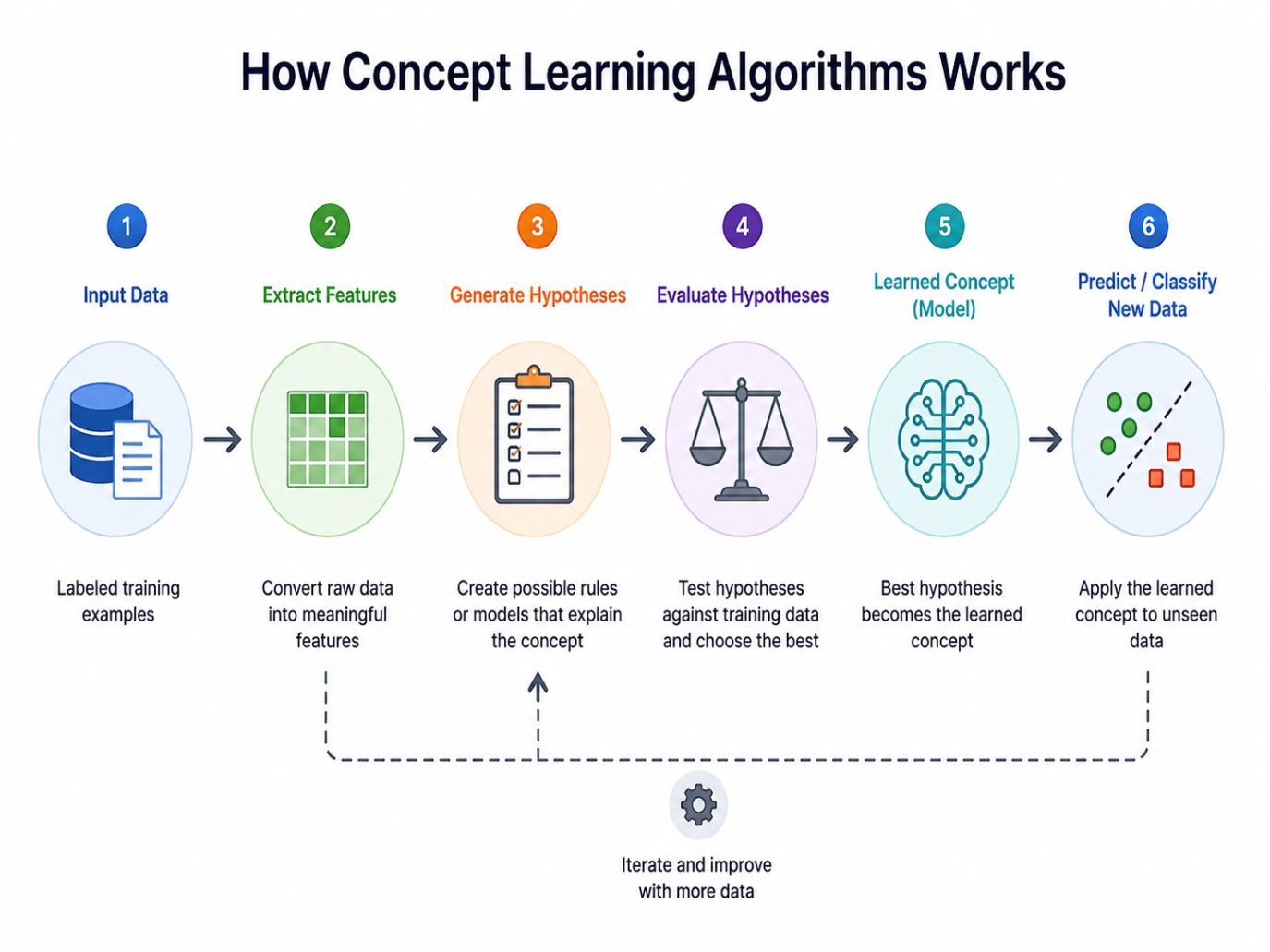
Step 1: Collect Data
Gather labeled examples related to the concept.
Step 2: Define the Target Concept
Determine what the machine should learn.
Step 3: Generate Hypotheses
Create possible explanations for the observed examples.
Step 4: Test Hypotheses
Compare hypotheses against training data.
Step 5: Select the Best Concept
Choose the hypothesis that best fits the data.
Step 6: Apply to New Data
Use the learned concept to classify unseen instances.
Imagine a weather-based system that decides whether a person should play tennis.
Outlook |
Temperature |
Humidity |
Play Tennis |
| Sunny | Warm | Normal | Yes |
| Rainy | Cold | High | No |
| Sunny | Hot | Normal | Yes |
The machine studies these examples and learns patterns.
Possible learned rule:
"If the weather is sunny and humidity is normal, play tennis."
This learned rule becomes the concept used for future predictions.
Concept learning relies on specialised algorithms that analyze training examples and identify patterns defining a concept. These algorithms help machines generate hypotheses, refine rules, and accurately classify new data based on learned knowledge.
The Find-S algorithm begins with the most specific hypothesis and gradually generalizes it using positive examples.
Advantages
Limitations
Candidate Elimination narrows the hypothesis space by eliminating inconsistent hypotheses.
Key Features
Benefits
Although different, concept learning is often viewed as a foundational form of supervised learning.
Also Read: What is Overfitting and Underfitting in Machine Learning?
Concept learning is a fundamental part of many machine learning systems used today. By learning patterns from labeled examples, it helps models classify, predict, and make decisions more accurately. From filtering unwanted emails to detecting fraud, concept learning supports a wide range of real-world applications across industries.
Here is the clear breakdown:
Application |
How Concept Learning Is Used |
| Email Spam Detection | Learns patterns from spam and legitimate emails to automatically classify incoming messages and reduce unwanted content in users' inboxes. |
| Medical Diagnosis | Analyzes symptoms, medical records, and test results to identify diseases and assist healthcare professionals in making accurate diagnoses. |
| Fraud Detection | Detects unusual transaction patterns and behaviors that may indicate fraudulent activities in banking, insurance, and online payments. |
| Image Classification | Learns visual features from labeled images to categorize objects, faces, animals, or products into predefined classes. |
| Customer Segmentation | Groups customers based on demographics, purchasing behavior, and preferences to improve marketing and personalization strategies. |
Also read: Embodied AI Explained and Future Applications
Quality data, appropriate feature selection and proper evaluation of models are critical for effective concept learning. Best practices are helpful to improve accuracy, reduce errors and to ensure the model performs well on new, unseen data.
For enhanced concept learning outcomes:
With advances in artificial intelligence, concept learning is advancing to enable more accurate, explainable and adaptive machine learning systems. Its capability to learn meaningful concepts from data will remain valuable in the development of next-generation AI applications.
Some of the emerging trends include:
With organizations demanding more transparent AI systems, concept learning is becoming increasingly valuable.
Also Read: Applications of Artificial Intelligence and Its Impact
Concept learning is a fundamental machine learning technique that enables systems to identify patterns, develop generalized rules, and classify new data based on past examples. It plays a key role in helping machines make accurate and informed decisions.
Closely related to supervised learning, concept learning relies on labeled data to understand relationships and improve predictions. Its applications span spam detection, fraud prevention, medical diagnosis, and many other real-world AI systems.
Want personalized guidance on AI and upskilling? Speak with an expert for a free 1:1 counselling session today.
Concept learning focuses on discovering the underlying rule or concept that separates different classes. Classification is the broader task of assigning labels to data points. In practice, concept learning helps create the logic that a classification model uses to make predictions. It is more concerned with understanding the concept itself than simply producing an output.
Yes, concept learning can work with small datasets when the examples are representative and accurately labeled. However, limited data may reduce the model's ability to generalize to unseen cases. Using relevant features and maintaining data quality often has a greater impact than simply increasing the dataset size.
Positive and negative examples help a model understand what belongs to a concept and what does not. Without both types of examples, the learning process may become biased. For instance, a spam detection model needs examples of both spam and legitimate emails to learn meaningful distinctions and improve prediction accuracy.
Concept learning is used in healthcare, finance, cybersecurity, retail, and education. Healthcare systems use it for disease prediction, while financial institutions apply it to fraud detection. Retail companies use concept learning to understand customer behavior, and cybersecurity tools rely on it to identify suspicious activities and potential threats.
One common example is email spam filtering. The system learns patterns from labeled spam and non-spam emails and creates rules for classification. This practical example helps explain what is concept learning in machine learning, as the model learns a concept from examples and applies it to new emails automatically.
Feature selection directly impacts the quality of learned concepts. Relevant features help the model focus on meaningful patterns, while irrelevant features introduce noise and confusion. For example, in loan approval prediction, income and credit history are generally more valuable features than unrelated demographic information.
The three main types are classification, regression, and ranking. Classification predicts categories, regression predicts numerical values, and ranking organizes results based on relevance. Concept learning is most closely associated with classification-based supervised
Yes, concept learning remains highly relevant, especially in explainable AI. While deep learning models often act as black boxes, concept learning helps create systems that provide understandable reasoning behind decisions. This transparency is increasingly important in industries such as healthcare, finance, and legal technology.
A practical use case is fraud detection in banking. The model learns patterns from legitimate and fraudulent transactions and develops rules that identify suspicious behavior. This demonstrates what is concept learning in machine learning because the system learns a concept from historical examples and applies it to new transactions in real time.
When the underlying pattern changes, the model may experience concept drift. For example, customer preferences, fraud tactics, or market conditions can evolve. If the training data no longer reflects current behavior, prediction accuracy declines. Regular retraining and updated datasets help maintain performance in changing environments.
What is supervised learning in machine learning concept refers to learning from labeled data where the correct output is already known. Concept learning operates within this framework by helping models discover rules and patterns that map inputs to outputs, making accurate predictions possible on unseen data.
730 articles published
Sriram K is a Senior SEO Executive with a B.Tech in Information Technology from Dr. M.G.R. Educational and Research Institute, Chennai. With over a decade of experience in digital marketing, he specia...
Speak with AI & ML expert
By submitting, I accept the T&C and
Privacy Policy
Top Resources
Master's Degree
18 Months
Executive Diploma
12 Months
IIIT Bangalore
Executive Programme in Generative AI & Agentic AI for LeadersIndia’s #1 Tech University
Dual Certification
5 Months