What is Inference in Machine Learning? A Complete Guide
By Sriram
Updated on Jun 24, 2026 | 7 min read | 7.16K+ views
Share:

All courses
Certifications
More
By Sriram
Updated on Jun 24, 2026 | 7 min read | 7.16K+ views
Share:
Table of Contents
Inference is the stage in machine learning where a trained model uses its learned knowledge to process new, unseen data and generate predictions, decisions, or content. Understanding what inference in machine learning is important because it represents the phase where AI systems apply learned patterns to real-world scenarios. While training focuses on learning from historical data, inference delivers practical outcomes, automation, and valuable insights for users and businesses.
This blog explains machine learning inference, its process, types, applications, challenges, optimization techniques, and differences from training.
Ready to turn your AI knowledge into practical expertise? Explore upGrad’s AI Course and Machine Learning Course to gain hands-on experience in model deployment, inference, and real-world applications.
Popular AI Programs
Inference is the stage where machine learning models deliver measurable value by enabling intelligent, scalable, and efficient business operations.
Also Read: 12 Issues in Machine Learning: Key Problems in Training, Testing, and Deployment
Free Courses
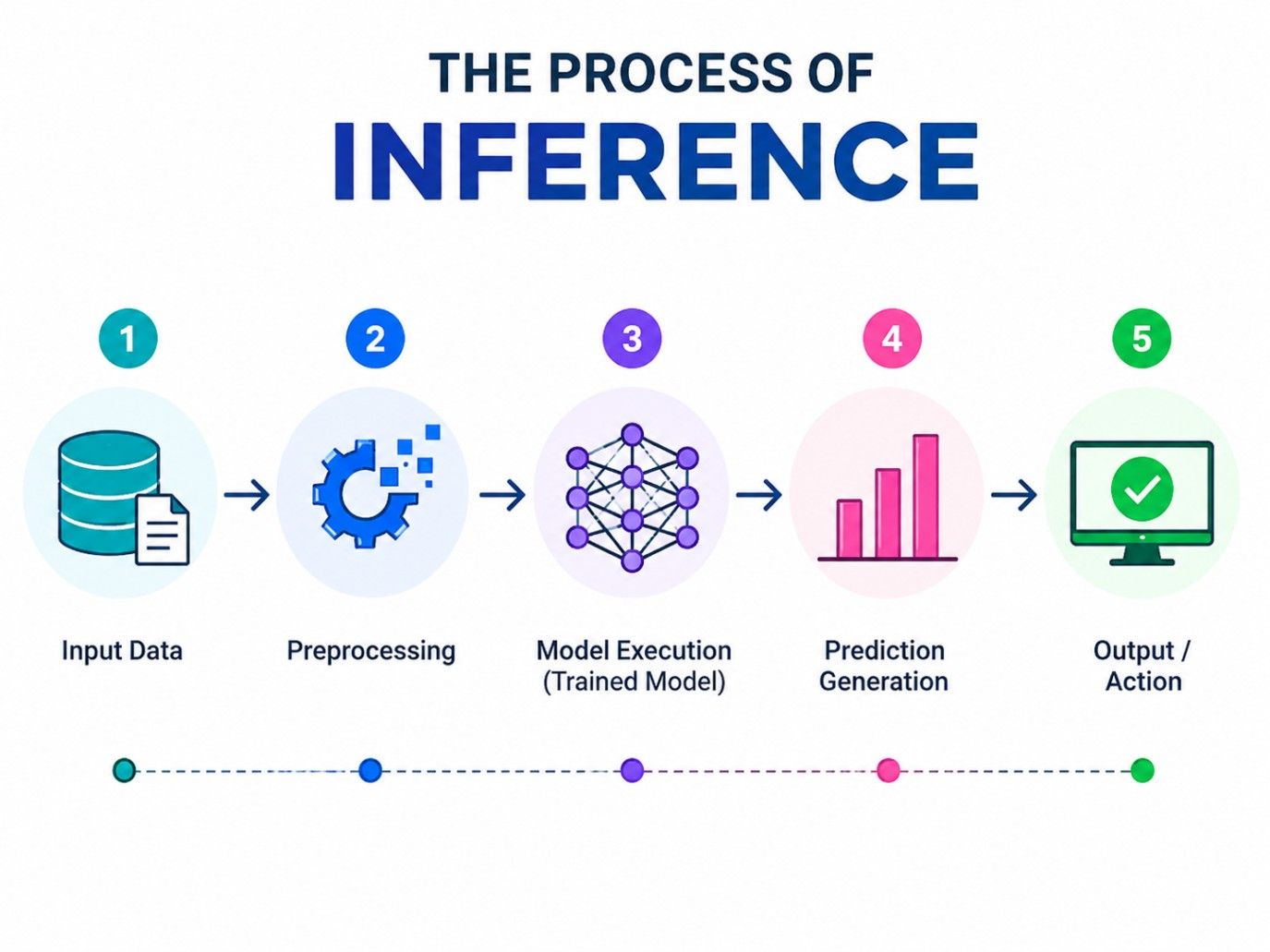
Machine learning models learn during training, but they create value during inference. Understanding inference helps explain how AI systems make predictions and decisions.
The inference process generally follows several steps:
AI Courses to upskill
Explore Artificial Intelligence Courses for Career Progression
Training and inference are two fundamental stages of machine learning. Understanding their differences help explain how AI systems learn and operate.
Training vs Inference:
Feature |
Training |
Inference |
| Purpose | Learn patterns from data | Make predictions |
| Data Used | Historical labeled data | New unseen data |
| Resource Requirement | High | Lower |
| Frequency | Periodic | Continuous |
| Output | Trained model | Predictions |
When discussing what is inference in machine learning, it is important to recognize that inference happens after training and often occurs millions of times daily in production environments.
Read : Weka Machine Learning: A Complete Guide for Beginners
Inference can be performed in different ways depending on application requirements, response time expectations, data volume, and infrastructure capabilities.
The three most common approaches are batch, real-time, and streaming inference.
Different applications require different inference approaches.
Batch inference processes large volumes of data simultaneously.
Examples:
Benefits include:
Real-time inference generates predictions immediately after receiving input.
Examples:
Benefits include:
Streaming inference continuously processes incoming data streams.
Examples:
Benefits include:
Machine learning inference drives countless everyday applications, enabling AI systems to analyze data, generate predictions, and automate decisions.
Real-World Applications of Machine Learning Inference:
Industry/Application |
How Inference is Used |
Examples |
| Recommendation Systems | Suggests relevant content and products based on user behavior and preferences. | Movie recommendations, product suggestions, personalized advertisements |
| Healthcare | Analyzes medical data to support diagnosis and treatment decisions. | Disease prediction, medical imaging analysis, treatment recommendations |
| Financial Services | Evaluates financial data to detect risks and support decision-making. | Fraud detection, credit scoring, risk assessment |
| Natural Language Processing (NLP) | Processes and generates human language for various AI applications. | Text generation, language translation, question answering, document summarization |
| Computer Vision | Interprets and analyzes visual information from images and videos. | Facial recognition, object detection, quality inspection, autonomous navigation |
Must Read : Machine Learning Course Syllabus: A Complete Guide to Your Learning Path
Although inference appears straightforward, organizations often face several challenges.
Key Challenges in Machine Learning Inference :
Challenge |
Description |
| Latency Issues | Slow inference times can delay predictions and negatively impact user experience, especially in real-time applications such as chatbots and fraud detection systems. |
| Infrastructure Costs | Large machine learning models often require powerful hardware and significant computing resources, increasing operational and deployment expenses. |
| Scalability Problems | Managing and processing millions of inference requests simultaneously can be challenging without robust infrastructure and optimization strategies. |
| Model Drift | As real-world data changes over time, model performance may decline, leading to less accurate predictions and the need for regular updates. |
| Security Concerns | Protecting machine learning models, sensitive data, and inference pipelines is crucial to prevent unauthorized access, attacks, or data breaches. |
Read : Can I Learn Machine Learning While Working Full-Time? A Practical Guide for Professionals
Efficient inference is essential for delivering fast predictions and reducing costs. Various optimization techniques help improve model performance.
Reduces model size by lowering numerical precision.
Benefits include:
Removes unnecessary parameters from trained models
Benefits include:
Specialized hardware improves inference speed.
Examples include:
Predictions occur directly on devices rather than cloud servers.
Benefits include:
Read: What Is Concept Learning in Machine Learning? A Complete Guide
As AI models become larger and more sophisticated, inference technologies continue to evolve.
Key trends include:
Organizations increasingly focus on balancing accuracy, speed, and cost to maximize AI performance at scale.
Understanding what is inference in machine learning is fundamental for anyone exploring artificial intelligence and data science. While training teaches a model how to recognize patterns, inference is the stage where those learned patterns are applied to solve real-world problems.
From recommendation engines and fraud detection systems to healthcare diagnostics and generative AI tools, inference enables machine learning models to deliver practical outcomes. As AI adoption expands across industries, optimizing inference performance will remain a key priority for businesses seeking faster decisions, better user experiences, and scalable intelligent systems.
Want personalised guidance on Machine learning and upskilling? Speak with an expert for a free 1:1 counselling session today
Training teaches a model how to recognize patterns, but inference is what users actually interact with. A recommendation engine, chatbot, or fraud detection system may be trained occasionally, but it performs inference thousands or millions of times every day. This makes inference performance, speed, and reliability critical for real-world AI applications.
Inference speed directly impacts how quickly an application responds to user actions. Slow inference can cause delays in search results, chatbot conversations, recommendation systems, or fraud detection alerts. Faster inference improves responsiveness, reduces waiting time, and helps users trust AI-powered systems during everyday interactions.
Inference in learning refers to using previously acquired knowledge to draw conclusions or make decisions. In machine learning, a trained model applies patterns learned from historical data to new inputs. Instead of learning additional information, the system focuses on producing predictions, classifications, recommendations, or other outputs based on existing knowledge.
ChatGPT performs inference whenever it generates responses to prompts. The underlying model was trained on large datasets beforehand. During conversations, it does not retrain itself. Instead, it uses learned patterns to predict the most relevant sequence of words, making inference the core process behind every response you receive.
Training and inference serve different purposes. Training helps a model learn patterns from historical data by adjusting internal parameters. Inference happens after training and involves applying those learned patterns to new data. If training is the learning phase, inference is the practical execution phase where predictions and decisions are generated.
An inference in AI is the process of producing an output based on learned information. The output could be a prediction, recommendation, classification, generated image, translated sentence, or risk score. Understanding what is inference in machine learning helps explain how AI systems transform data into useful actions and decisions.
Yes. Many organizations deploy models directly on smartphones, cameras, IoT sensors, and other edge devices. This approach reduces dependence on cloud infrastructure, lowers latency, improves privacy, and enables real-time decision-making. Edge inference is increasingly common in smart homes, healthcare devices, and autonomous systems.
Large models often contain billions of parameters, which increases computing requirements and response times. Without optimization, costs can rise significantly and user experiences may suffer. Techniques such as quantization, pruning, caching, and hardware acceleration help organizations deliver faster predictions while controlling infrastructure expenses.
Generative AI relies on inference whenever it creates content from a user prompt. Whether generating text, code, images, audio, or video, the model uses learned patterns from training to produce outputs. Every interaction with a generative AI tool involves inference running behind the scenes.
Organizations typically evaluate inference using metrics such as latency, throughput, accuracy, memory usage, and operational cost. For example, a chatbot may prioritize low response times, while a medical diagnostic system may focus more heavily on prediction accuracy. The ideal balance depends on the application's goals.
What is inference in machine learning is a common question because inference is where business value is created. It enables automated decisions, personalized recommendations, fraud detection, customer support, and predictive analytics. Without efficient inference, trained models cannot deliver meaningful outcomes that improve operations, customer experiences, or business performance.
730 articles published
Sriram K is a Senior SEO Executive with a B.Tech in Information Technology from Dr. M.G.R. Educational and Research Institute, Chennai. With over a decade of experience in digital marketing, he specia...
Speak with AI & ML expert
By submitting, I accept the T&C and
Privacy Policy
Top Resources
Master's Degree
18 Months
Executive Diploma
12 Months
IIIT Bangalore
Executive Programme in Generative AI & Agentic AI for LeadersIndia’s #1 Tech University
Dual Certification
5 Months