PAC Learning in Machine Learning: A Complete Guide
By Rahul Singh
Updated on Jun 23, 2026 | 9 min read | 4.27K+ views
Share:

All courses
Certifications
More
By Rahul Singh
Updated on Jun 23, 2026 | 9 min read | 4.27K+ views
Share:
Table of Contents
PAC learning in machine learning is one of the foundational ideas that explains how a model can actually "learn" from data. It gives us a way to measure whether learning has happened at all, and under what conditions we can trust what a model has learned. The concept was introduced by Leslie Valiant in 1984 and has shaped the theoretical side of machine learning ever since.
This blog breaks down PAC learning in machine learning from scratch. You will understand what it means, why it matters, how the PAC learning model works, what the PAC hypothesis says, and how it all connects to practical machine learning.
Popular AI Programs
PAC stands for Probably Approximately Correct. It is a formal framework that defines when a machine learning algorithm has truly learned something useful.
Let us break the name down:
In simpler terms, PAC learning in machine learning asks: "Can an algorithm learn a concept from training examples well enough that it will work correctly on most new examples, most of the time?"
This might sound obvious, but turning it into a precise mathematical statement is what makes PAC theory powerful. It gives us a way to guarantee learning performance, not just hope for it.
Also Read: Top 5 Machine Learning Models Explained For Beginners
Before PAC learning, there was no formal way to say whether a learning algorithm was actually working or just memorizing data. Valiant's framework gave ML researchers a rigorous foundation to answer questions like:
These are not just academic questions. They directly affect how you design, evaluate, and trust machine learning systems.
Also Read: Machine Learning System Design: Beginner-to-Advanced Guide
Free Courses
The PAC learning model in machine learning defines the conditions under which learning is considered successful. It involves several key components.
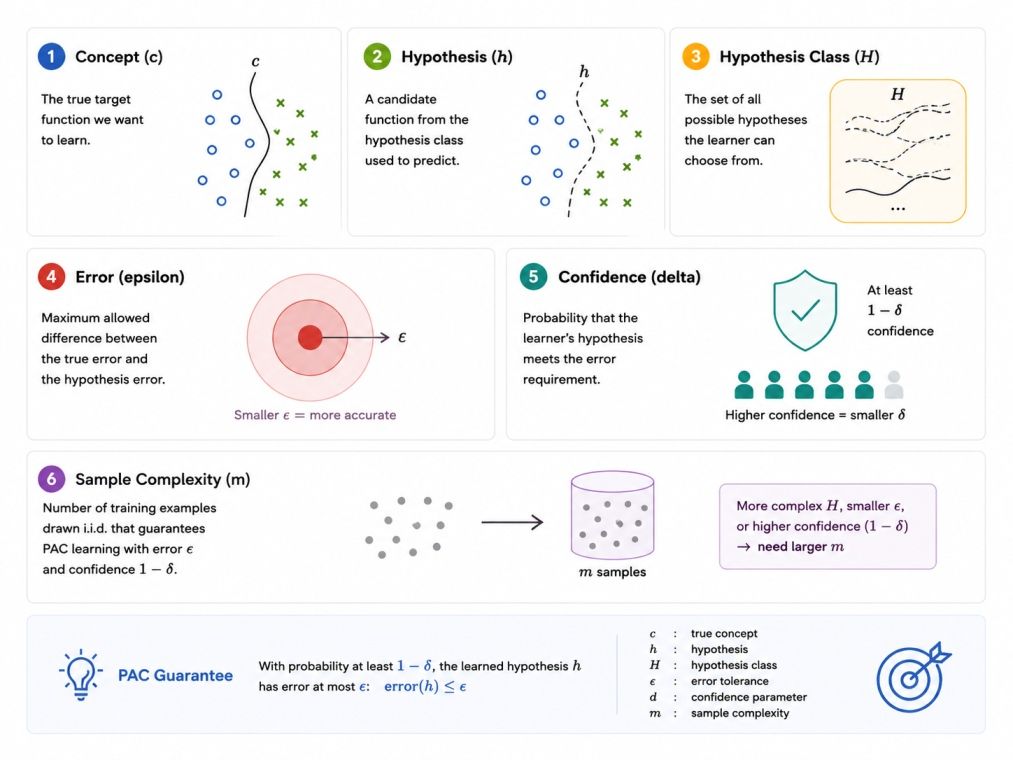
The algorithm takes in training examples and produces a hypothesis. PAC learning says that this hypothesis is "good enough" if:
So the algorithm must output an approximately correct hypothesis (within error epsilon) with high probability (at least 1 minus delta). That is where the name comes from.
One of the most useful outputs of the PAC learning model is the sample complexity bound. This tells you the minimum number of training examples needed to guarantee PAC learning.
The formula generally takes this form:
m >= (1 / epsilon) * (ln|H| + ln(1 / delta))
Where:
This means the harder the problem (smaller epsilon, smaller delta, or larger H), the more examples you need. It is a precise, provable result, not a rule of thumb.
Also Read: Math for Machine Learning: Essential Concepts You Must Know
AI Courses to upskill
Explore Artificial Intelligence Courses for Career Progression
The PAC hypothesis in machine learning refers to the hypothesis produced by a PAC learning algorithm after training. It is the algorithm's best guess at the true concept, based on the training data.
A hypothesis h is considered PAC-valid if:
The generalization error is the probability that h will misclassify a new, randomly drawn example. PAC theory does not ask for zero errors. It only asks that errors stay below a threshold with high confidence.
A hypothesis is called consistent if it correctly classifies all the training examples. PAC theory shows that if an algorithm can always find a consistent hypothesis, and the hypothesis class is finite, then PAC learning is achievable.
This is a key result. It means you do not need an infinitely complex model. A finite hypothesis class with a consistent learner is enough to guarantee PAC-style learning guarantees.
For infinite hypothesis classes (like neural networks), the VC dimension extends PAC theory. VC dimension measures the complexity of a hypothesis class by looking at how many points it can shatter (classify in all possible ways).
A lower VC dimension means simpler hypotheses, fewer examples needed, and better generalization. A higher VC dimension means the model is more expressive but also harder to learn PAC-style.
Hypothesis Class |
VC Dimension |
Notes |
| Threshold functions | 1 | Very simple |
| Intervals on a line | 2 | Slightly more complex |
| Linear classifiers in 2D | 3 | Classic example |
| Neural networks | Very high | Depends on architecture |
Also Read: Convolutional Neural Networks: Ultimate Guide for Beginners in 2024
PAC learning does not work under all conditions. There are specific assumptions that must hold for the framework to apply.
One major assumption is that training and test examples are drawn from the same fixed distribution. The algorithm does not need to know what that distribution is, but it must be the same for both.
This is sometimes called the distribution-free or agnostic setting, depending on whether the true concept is assumed to be in the hypothesis class.
Also Read: Generalization in Machine Learning: Why It Matters and How It Works
Realizable PAC learning assumes the true concept exists within the hypothesis class. The algorithm just needs to find it.
Agnostic PAC learning makes no such assumption. The true concept might not be in H at all. The algorithm just tries to find the best hypothesis in H.
Setting |
Assumption |
Difficulty |
| Realizable | True concept is in H | Easier to analyze |
| Agnostic | True concept may not be in H | More realistic, harder to bound |
Most real-world machine learning is closer to the agnostic setting. That is why agnostic PAC learning is more relevant to practice, even if realizable PAC learning is easier to study.
PAC learning also considers whether a learning algorithm is computationally efficient. An algorithm can be PAC learnable in theory (given enough examples) but still take too long to run in practice.
A PAC learning algorithm is called efficient if it runs in polynomial time relative to the problem parameters. This is an important distinction when evaluating real algorithms.
Also Read: Image Recognition Machine Learning: Brief Introduction
PAC learning is a theoretical framework, but it has direct implications for how machine learning works in practice.
PAC theory tells us that simpler models (smaller hypothesis classes or lower VC dimension) require fewer examples to learn reliably. This supports the common practice of regularization and model simplification in ML pipelines.
When you add L1 or L2 regularization to a neural network, you are effectively reducing the model complexity, which aligns with PAC principles.
The PAC framework gives a theoretical basis for why models can generalize. If the training set is large enough relative to the hypothesis class complexity, the model's performance on training data will transfer to test data.
This is directly related to the concepts of overfitting and underfitting:
PAC theory formalizes both situations and tells you how to balance them.
When a team at a company asks "how much data do we need to train this model?", the honest theoretical answer comes from PAC-style analysis. While exact bounds are often too conservative for practice, the direction is right: more complex models need more data.
Several learning algorithms have been analyzed under the PAC framework, including:
Understanding PAC learning helps you reason about which algorithms are theoretically sound for a given task and dataset size.
PAC learning in machine learning is more than a theoretical concept. It is a precise language for talking about what it means to learn from data. The PAC learning model tells us how many examples are needed, how complex a hypothesis class can be, and when we can trust that a model has genuinely learned. The PAC hypothesis gives us a concrete target: approximately correct, with high probability. And PAC in machine learning connects directly to everyday decisions in model building, from choosing architecture complexity to deciding how much data to collect.
If you want to truly understand why machine learning works (or why it sometimes fails), PAC learning is the right place to start.
Want personalized guidance on AI and upskilling? Speak with an expert for a free 1:1 counselling session today.
PAC stands for Probably Approximately Correct. It is a theoretical framework that defines conditions under which a machine learning algorithm can be said to have learned a concept successfully from training data.
PAC learning was introduced by Leslie Valiant in 1984. His work laid the foundation for the theoretical analysis of machine learning and earned him the Turing Award in 2010 for this and related contributions.
Traditional machine learning focuses on building models that perform well on data. PAC learning provides the formal guarantees for when and why this can work. It defines exact conditions, such as sample size and error bounds, to ensure the model generalizes correctly.
A PAC hypothesis is the output of a PAC learning algorithm after training. It is considered valid if its generalization error stays below a threshold (epsilon) with high probability (at least 1 minus delta), even on unseen examples.
Sample complexity is the minimum number of training examples needed to ensure PAC learning. It depends on the allowed error rate, the confidence level, and the size or complexity of the hypothesis class.
VC dimension measures the complexity of a hypothesis class. It is used to extend PAC learning bounds to infinite hypothesis classes, such as neural networks. A higher VC dimension generally requires more training examples to achieve PAC-style guarantees.
Agnostic PAC learning is a version of PAC in machine learning where the true concept may not exist within the hypothesis class. The algorithm finds the best possible hypothesis in the class, even if no perfect solution exists. This setting is more realistic for most practical problems.
Yes, PAC theory applies to deep learning through extensions involving VC dimension and Rademacher complexity. While exact bounds are hard to compute for large neural networks, the principles of PAC in machine learning guide our understanding of generalization in deep learning.
Realizable PAC learning assumes the true concept exists in the hypothesis class, making analysis simpler. Agnostic PAC learning makes no such assumption. Agnostic learning is harder to bound but more applicable to real-world machine learning tasks.
The PAC learning model explains overfitting as a case where the hypothesis class is too large relative to the available training data. When sample complexity requirements are not met, the learned hypothesis may perform well on training data but generalize poorly, which is exactly overfitting.
No. PAC learning in machine learning does not guarantee perfect performance. It guarantees that the error will be below a small threshold with high probability. The framework accepts a controlled level of error and imperfection, which reflects realistic expectations for any learning algorithm.
98 articles published
Rahul Singh is an Associate Content Writer at upGrad, with a strong interest in Data Science, Machine Learning, and Artificial Intelligence. He combines technical development skills with data-driven s...
Speak with AI & ML expert
By submitting, I accept the T&C and
Privacy Policy
Top Resources
Master's Degree
18 Months
Executive Diploma
12 Months
IIIT Bangalore
Executive Programme in Generative AI & Agentic AI for LeadersIndia’s #1 Tech University
Dual Certification
5 Months