Machine Learning System Design: Beginner-to-Advanced Guide
By Sriram
Updated on Jun 19, 2026 | 7 min read | 2.29K+ views
Share:

All courses
Certifications
More
By Sriram
Updated on Jun 19, 2026 | 7 min read | 2.29K+ views
Share:
Table of Contents
Machine Learning System Design is about building pipelines that actually works in production, not just training a model and calling it done. It's an iterative process that turns business goals into real, scalable software. That means thinking beyond the model itself to everything around it: how data flows in, the infrastructure that supports it, how it scales under real demand, how you monitor it once it's live, and how it keeps adapting as the world it's predicting changes.
In this blog, you’ll learn about the basics of machine learning system design, parts of a machine learning pipeline, principles, and common problems that people face. This article will benefit anyone who wants to learn whether you are a student or someone in machine learning systems.
Want to design ML systems that scale? Explore Machine Learning Courses Online and Artificial Intelligence Courses from upGrad and build skills that power real-world AI.
Popular AI Programs
Machine learning system design is a process of building a system that is reliable, scalable, and machine learning systems solve real-world business problems. Creating a machine learning model is important for machine learning solutions to work properly.
We must think about the whole system; it is what makes the model succeed in production. Machine learning system design is about planning, building, deploying, and maintaining machine learning solutions that can efficiently operate in the world.
A lot of beginners think only about training models. Machine learning (ML) applications that actually work involve a lot more than just developing models. You must think about collecting data, storing data, deploying the machine learning solution, keeping an eye on it, and improving it better all the time.
A machine learning system typically includes:
Component |
Purpose |
| Data Sources | Collect raw information |
| Data Pipeline | Process and prepare data |
| Feature Engineering | Create useful model inputs |
| Model Training | Learn patterns from data |
| Model Serving | Generate predictions |
| Monitoring | Track performance |
| Feedback Loop | Improve models over time |
Also Read: How to Learn Artificial Intelligence and Machine Learning
Free Courses
If you do not have a proper design, even the best machine learning models can fail.
Common reasons may include:
On the other hand, a proper designed machine learning system is helpful because it:
Read: Top 5 Machine Learning Models Explained For Beginners
Let's take an example of an online shopping platform.
The recommendation model may predict the products users wanted to buy. However, the complete machine learning system design must also handle:
The model is only one piece of the larger system.
AI Courses to upskill
Explore Artificial Intelligence Courses for Career Progression
This engineer's approach is helpful because it means the system will still be useful even when the data and people’s behavior changes over time.
When designing a learning system in machine learning, engineers start by identifying:
Also Read: How to Learn Machine Learning – Step by Step
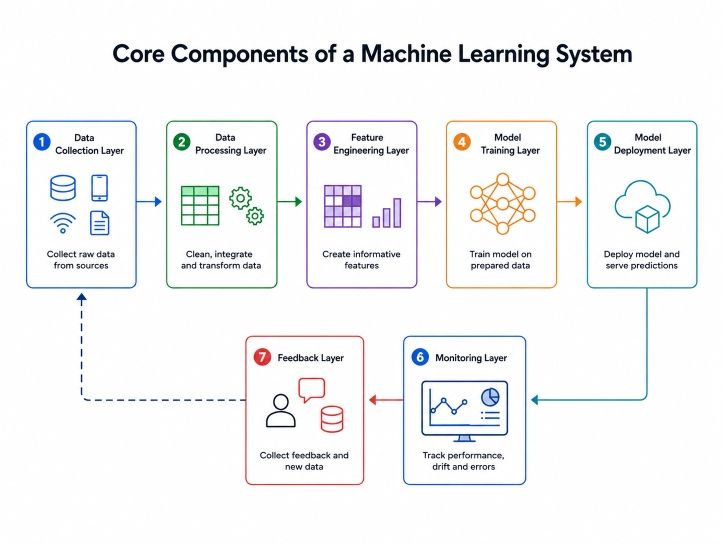
Every production-ready ML solution contains several interconnected components. Understanding these building blocks is essential before attempting to design a learning system in machine learning.
When engineers design a learning system in ML, they make sure all these components work well together in practice. They do not just focus on how accurate the model is.
Machine learning systems rely heavily on data.
Sources may include:
The quality of collected data directly impacts model performance.
Raw data often contains:
Data processing helps clean and standardize information before training. Good features often improve performance more than complex algorithms.
Feature engineering transforms raw data into meaningful inputs.
Examples include:
Raw Data |
Engineered Feature |
| Purchase Date | Days Since Last Purchase |
| User Age | Age Group |
| Website Visits | Weekly Average Visits |
This stage involves:
Popular algorithms include:
After training, the model must serve predictions.
Common deployment approaches include:
Performance can change after deployment.
Monitoring tracks:
A strong feedback mechanism helps improve future models.
Examples include:
Also Read: Machine Learning Pipeline: A Complete Guide to Building Reliable ML Systems
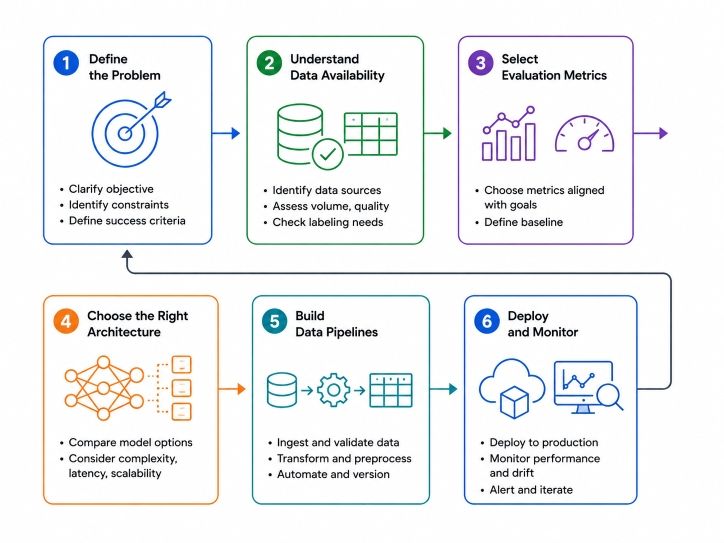
Building a machine learning system needs a proper plan. Many people who are new to this jump into developing models. While experienced engineers start by defining the problem first.
Ask questions such as:
Often insufficient data is the biggest obstacle. So, before model selection, evaluate:
Different use cases require different metrics.
Use Case |
Metric |
| Classification | Accuracy, Precision, Recall |
| Regression | RMSE, MAE |
| Ranking | NDCG, MAP |
| Recommendations | CTR, Conversion Rate |
Step 4: Choose the Right Architecture
System architecture depends on:
Reliable pipelines ensure consistent data flow.
Important considerations:
Deployment is not the end.
Teams must monitor:
One mistake people make when designing a learning system with ML is focusing only on how well the model works. In reality, a model that is a little less accurate but easier to take care of often gives more value to the business.
That's why designing a machine learning system is about balancing things like accuracy, reliability, scalability, and how easy it can run day to day.
Subscribe to upGrad's Newsletter
Join thousands of learners who receive useful tips
Successful ML systems share several common principles. To avoid costly mistakes let's try to understand these practices.
Avoid unnecessary complexity. A simple baseline model often provides valuable insights before advanced experimentation.
Researchers study from multiple industries and found out that bad data is one of the reasons why machine learning projects fail.
Key practices include:
The operational burden of repetitive tasks can be reduced through automation.
Examples include:
User growth can quickly overwhelm systems.
Plan for:
Also Read: Data Preprocessing in Machine Learning: 11 Key Steps You Must Know!
Challenge |
Impact |
| Data Drift | Reduced model accuracy |
| Concept Drift | Changing user behavior |
| Infrastructure Costs | Higher operational expenses |
| Model Explainability | Reduced trust |
| Security Risks | Data exposure |
Organizations are moving from isolated models toward complete machine learning platforms. As a result, machine learning system design has become important for people who work with ML and AI.
People who understand machine learning system design, from both of technical and business technical and business perspectives can make AI products that actually makes a difference
Modern systems increasingly focus on:
Machine learning system design goes far beyond training algorithms. It involves creating complete systems that collect, process, and generate data, and also continuously improve over time. As AI adoption continues to grow, professionals who can design a learning system in ML from end to end will remain in high demand across industries.
A successful ML system combines strong architecture, reliable data pipelines, effective monitoring, and scalable deployment strategies. Whether you're building recommendation engines, fraud detection systems, chatbots, or forecasting tools, understanding machine learning system design is essential for long-term success.
Want to explore more about, Machine learning system design? Book your free 1:1 personal consultation with our expert today.
Machine learning system design is the process of creating an end-to-end machine learning solution that includes data collection, model development, deployment, monitoring, and maintenance. It focuses on how models operate in real-world environments rather than just training algorithms.
Machine learning models rarely operate in isolation. They depend on data pipelines, infrastructure, deployment mechanisms, and monitoring systems to function effectively. Machine learning system design ensures these components work together efficiently. This improves prediction, quality, user experience, and operational stability.
Designing a learning system in machine learning starts by defining the business problem and understanding available data. Engineers then choose evaluation of metrics, build data pipelines, train models, and deploy them into production. Monitoring and continuous improvement are also important stages. The process is iterative rather than a one-time activity.
Professionals need knowledge of machine learning, software engineering, databases, cloud computing, and system architecture. Understanding MLOps and deployment workflows is also valuable. Strong problem-solving skills help engineers make practical trade-offs between accuracy, speed, scalability, and cost.
Common challenges include data drift, model degradation, infrastructure costs, data quality issues, and security concerns. These factors can impact system performance after deployment. Addressing these challenges requires continuous monitoring and regular model updates.
Model design focuses on selecting algorithms and improving predictive performance. System design covers the broader ecosystem needed to support the model. This includes data engineering, deployment, monitoring, scalability, and operational maintenance.
MLOps applies DevOps principles to machine learning workflows. It helps automate model training, deployment, testing, monitoring, and retraining. This makes machine learning systems more reliable, scalable, and easier to maintain over time.
Machine learning system design is widely used in finance, healthcare, retail, manufacturing, logistics, education, and entertainment. Applications include fraud detection, recommendation systems, predictive maintenance, customer support automation, and demand forecasting.
The Turing test is a benchmark proposed by computer scientist Alan Turing in 1950. It evaluates whether a machine can engage in conversation that is indistinguishable from a human. The test focuses on conversational behavior rather than intelligence itself. It remains one of the most discussed concepts in artificial intelligence.
There is no universally accepted official result confirming that ChatGPT has definitively passed the Turing test. In some controlled experiments, participants have mistaken AI responses for human responses. However, researchers continue to debate whether passing a conversational test alone demonstrates true intelligence or understanding.
The Turing test for AI measures whether a machine can imitate human conversation closely enough to fool an evaluator. The focus is on communication rather than internal reasoning. The three participants are a human judge, a human respondent, and a machine respondent. The judge communicates with both and attempts to identify which one is the machine.
727 articles published
Sriram K is a Senior SEO Executive with a B.Tech in Information Technology from Dr. M.G.R. Educational and Research Institute, Chennai. With over a decade of experience in digital marketing, he specia...
Speak with AI & ML expert
By submitting, I accept the T&C and
Privacy Policy
Top Resources
Master's Degree
18 Months
Executive Diploma
12 Months
IIIT Bangalore
Executive Programme in Generative AI & Agentic AI for LeadersIndia’s #1 Tech University
Dual Certification
5 Months