Locally Linear Embedding in Machine Learning: A Beginner-Friendly Guide
By Sriram
Updated on Jun 25, 2026 | 7 min read | 2.4K+ views
Share:

All courses
Certifications
More
By Sriram
Updated on Jun 25, 2026 | 7 min read | 2.4K+ views
Share:
Table of Contents
Linear embedding in machine learning is a really good way to make complex datasets simpler. It helps to keep the parts of the data intact. The old ways of doing things look at how all the data points are connected. Locally linear embedding (LLE) looks at the data points that are close to each other. This is very helpful when the data is not in a line, and other methods like PCA do not work well.
In this guide, you'll learn what locally linear embedding in machine learning is, how it works, why it matters, and where it is used in real-world applications. You'll also compare it with other dimensionality reduction techniques, explore its advantages and limitations.
Advance your career in Machine Learning Courses Online and Artificial Intelligence Courses with upGrad’s practical, project-based programs designed for the next generation.
Popular AI Programs
Locally linear embedding in machine learning is a way to simplify data. It is a manifold learning algorithm that helps with dimensionality reduction. This algorithm was introduced by Sam Roweis and Lawrence Saul in 2000. They wanted to find a way to uncover patterns in complex data.
The main idea of linear embedding is pretty simple. When you look at data in a lot of detail, it can seem complicated. If you look at small parts of the data, they often behave in a straightforward way. This simpler picture is easier to understand because it has dimensions. Linear embedding is good at capturing how small parts of the data relate to each other, and it uses this information to make the simpler picture.
When we look at datasets, we usually find that they have a lot of features, sometimes hundreds or even thousands of features. These features are all part of the dataset.
Examples include:
Working with high-dimensional data creates challenges:
Dimensionality reduction helps solve these problems.
Also Read: 15 Dimensionality Reduction in Machine Learning Techniques
Instead of preserving distances between all points, LLE preserves the relationships between neighboring points.
The algorithm assumes:
Quick Overview
Feature |
Locally Linear Embedding |
| Learning Type | Unsupervised |
| Purpose | Dimensionality Reduction |
| Data Structure | Nonlinear Manifolds |
| Preserves | Local Neighborhood Structure |
| Common Use Cases | Visualization, Feature Extraction |
Imagine you have a piece of paper that is rolled up. When you look at the rolled-up paper, it seems complicated because it is in three dimensions. If you were to unroll the paper, it would become a simple flat piece of paper. The idea behind LLE is that it tries to find this shape on its own.
The thing that makes LLE so useful in machine learning is that it can show us the geometry that we cannot see. This is really valuable when we are dealing with datasets, like LLE.
Related article: Multiple Linear Regression in Machine Learning: Concepts and Implementation
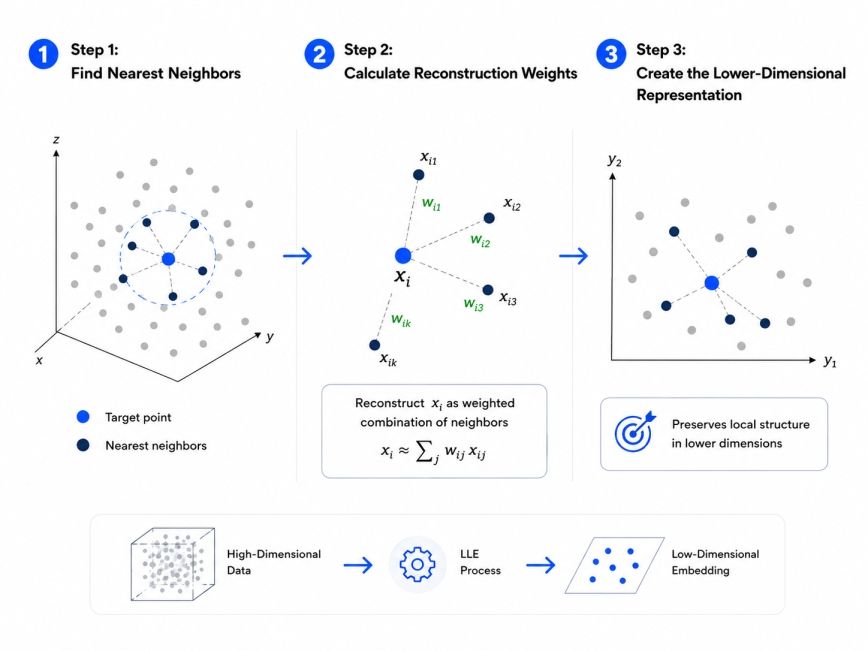
Understanding how Local Linear Embedding (LLE) works helps to see why it does well with data that's not straight.
The LLE process has three steps.
For every data point, the algorithm finds a bunch of points that are close to it. These nearby points, which are called neighbors, show us what the area around the data point looks like.
For example:
Point |
Neighbors |
| A | B, C, D |
| B | A, C, E |
| C | A, B, F |
Each data point is a mix of its points, with some points being more important than others. To find these points, LLE looks at the data and finds the best weights to use.
It tries to rebuild the point using its neighbors. The goal is to get really close to the point.
The goal is:
For instance:
Point A might be represented as:
These weights will become critical in the next stage.
The algorithm generates a lower-dimensional embedding. During this process, it ensures the reconstruction weights remain unchanged.
As a result:
Traditional methods like PCA assume data follow a linear structure. Often produces more meaningful embeddings for complex datasets.
LLE takes a different approach.
It focuses on:
AI Courses to upskill
Explore Artificial Intelligence Courses for Career Progression
Data scientists use Azure Machine Learning Studio to put dimensionality reduction workflows in place. This platform helps users create data pipelines and evaluate models. It also helps users visualize the datasets that have been transformed.
Azure Machine Learning Studio from Microsoft is a tool. It provides a place in the clouds where people can try out things. People can use learning techniques with other machine learning workflows, in Azure Machine Learning Studio.
Many machine learning libraries support LLE.
Popular options include:
Like every machine learning technique, Local Linear Embedding (LLE) has strengths:
1. Captures Nonlinear Structures: Many datasets contain curved or nonlinear relationships. LLE can uncover these patterns effectively.
2. Preserves Local Relationships: The algorithm maintains neighborhood structures during transformation. This often leads to more meaningful visualizations.
3. Useful for Data Exploration:
4. No Need for Labels: Since LLE is unsupervised, labeled data is not required.
Knowing the strengths and weaknesses of both LLE helps determine when to use LLE for a task.
Advantages |
Limitations |
| Handles nonlinear data | Sensitive to noise |
| Preserves local structure | Computationally expensive |
| Great for visualization | Parameter tuning required |
| Unsupervised method | Struggles with very large datasets |
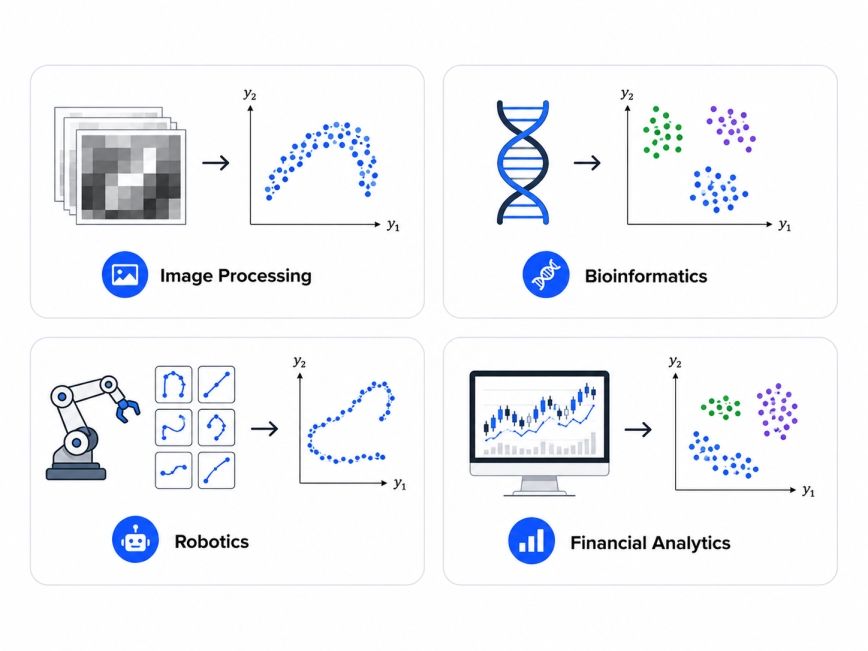
Locally linear embedding in machine learning is commonly used in:
1. Image Processing
Applications include:
2. Bioinformatics
Researchers use LLE for:
3. Robotics
LLE helps simplify sensor data and improve navigation systems.
4. Financial Analytics
Analysts use dimensionality reduction to identify hidden market patterns.
A common question among beginners is whether LLE is better than PCA. The answer depends on the data.
PCA assumes linear relationships. LLE handles nonlinear structures.
Feature |
LLE |
PCA |
| Data Assumption | Nonlinear | Linear |
| Preserves | Local Structure | Global Variance |
| Complexity | Higher | Lower |
| Visualization Quality | Often Better | Good for Linear Data |
t-SNE is popular for visualization but serves a different purpose.
Feature |
LLE |
t-SNE |
| Interpretability | High | Moderate |
| Speed | Faster on some datasets | Often Slower |
| Local Structure | Preserved | Preserved |
| Global Structure | Better Retained | Often Distorted |
UMAP has gained popularity in recent years.
Comparison highlights:
Feature |
LLE |
UMAP |
| Mathematical Simplicity | High | Moderate |
| Scalability | Moderate | High |
| Speed | Moderate | Fast |
| Large Dataset Support | Limited | Strong |
Consider locally linear embedding in machine learning when:
Avoid it when:
Subscribe to upGrad's Newsletter
Join thousands of learners who receive useful tips
Locally linear embedding in machine learning is a powerful dimensionality reduction technique designed for nonlinear datasets. By preserving local neighborhood relationships, it uncovers hidden structures that traditional linear methods often miss.
While LLE requires careful parameter selection and can be computationally intensive, its ability to reveal meaningful low-dimensional representations make it valuable for visualization, feature extraction, bioinformatics, image analysis, and many other applications.
Want to explore more about Locally linear embedding in machine learning? Book your free 1:1 personal consultation with our expert today.
Locally linear embedding is an unsupervised dimensionality reduction technique that preserves local relationships between neighboring data points. It assumes that each point can be reconstructed using its nearest neighbors and maintains those relationships in a lower-dimensional space. This helps reveal hidden structures in complex datasets.
The term "locally linear" means that although a dataset may be nonlinear overall, small neighborhoods within the data can often be approximated using linear relationships. LLE takes advantage of this assumption to learn a lower-dimensional representation while preserving local geometry.
LLE is used to reduce dimensionality while maintaining neighborhood relationships. This makes visualization easier and can improve downstream machine learning tasks. It is particularly effective when data lies on a nonlinear manifold where traditional methods struggle.
Locally linear embedding is an unsupervised learning technique. It does not require labeled data because it focuses on discovering intrinsic structures within the dataset. This makes it useful for exploratory data analysis and feature extraction tasks.
PCA preserves global variance and assumes linear relationships among features. LLE focuses on preserving local neighborhood structures and can capture nonlinear patterns. As a result, LLE often performs better when the underlying data geometry is curved or complex.
Common applications include image recognition, bioinformatics, robotics, speech processing, and data visualization. Researchers use LLE to uncover hidden structures in high-dimensional datasets and simplify data before further analysis.
LLE can be sensitive to noise and requires careful selection of the number of neighbors. It may also become computationally expensive when working with large datasets. Poor parameter choices can negatively affect embedding quality.
Yes. Azure Machine Learning Studio can be used to build machine learning pipelines that include dimensionality reduction techniques. While implementation approaches vary, users can integrate preprocessing workflows and evaluate how transformed features impact model performance.
Microsoft Azure Machine Learning Studio provides cloud-based tools for experimentation, model development, and data preparation. Data scientists can test dimensionality reduction strategies, compare outputs, and integrate transformed data into machine learning workflows.
There is no universal answer. The ideal number depends on dataset size and structure. Practitioners often experiment with different values and evaluate visualization quality or model performance before choosing the most suitable neighborhood size.
Yes. Despite newer techniques such as UMAP, locally linear embedding remains an important manifold learning method. It provides valuable insights into nonlinear data structures and continues to be used in research, education, and specialized machine learning applications.
708 articles published
Sriram K is a Senior SEO Executive with a B.Tech in Information Technology from Dr. M.G.R. Educational and Research Institute, Chennai. With over a decade of experience in digital marketing, he specia...
Speak with AI & ML expert
By submitting, I accept the T&C and
Privacy Policy
Top Resources
Master's Degree
18 Months
Executive Diploma
12 Months
IIIT Bangalore
Executive Programme in Generative AI & Agentic AI for LeadersIndia’s #1 Tech University
Dual Certification
5 Months