Agentic Commerce: A Complete Guide
By Sriram
Updated on Jun 25, 2026 | 5 min read | 4.58K+ views
Share:

All courses
Certifications
More
By Sriram
Updated on Jun 25, 2026 | 5 min read | 4.58K+ views
Share:
Table of Contents
Agentic Commerce represents the next evolution of digital shopping, where intelligent AI agents handle the entire purchasing journey on behalf of consumers. Instead of manually searching and comparing products, users simply define their goals, and AI assistants research options, evaluate prices, analyze reviews, and complete transactions through connected APIs. By automating decision-making and execution, Agentic Commerce makes shopping faster, more personalized, and increasingly proactive.
In this blog, you'll learn how Agentic Commerce works, its core technologies, use cases, benefits, challenges, and future potential.
Build an Agentic AI and AI course with upGrad’s to develop practical skills in large language models (LLMs), generative AI, machine learning, model evaluation and data-driven decision-making.
Agentic AI Courses to upskill
Explore Agentic AI Courses for Career Progression
IIIT Bangalore
Executive Diploma in Machine Learning and AI360° Career Support
Agentic Commerce combines AI agents, real-time data access, decision-making capabilities, and transaction systems to automate shopping journeys.
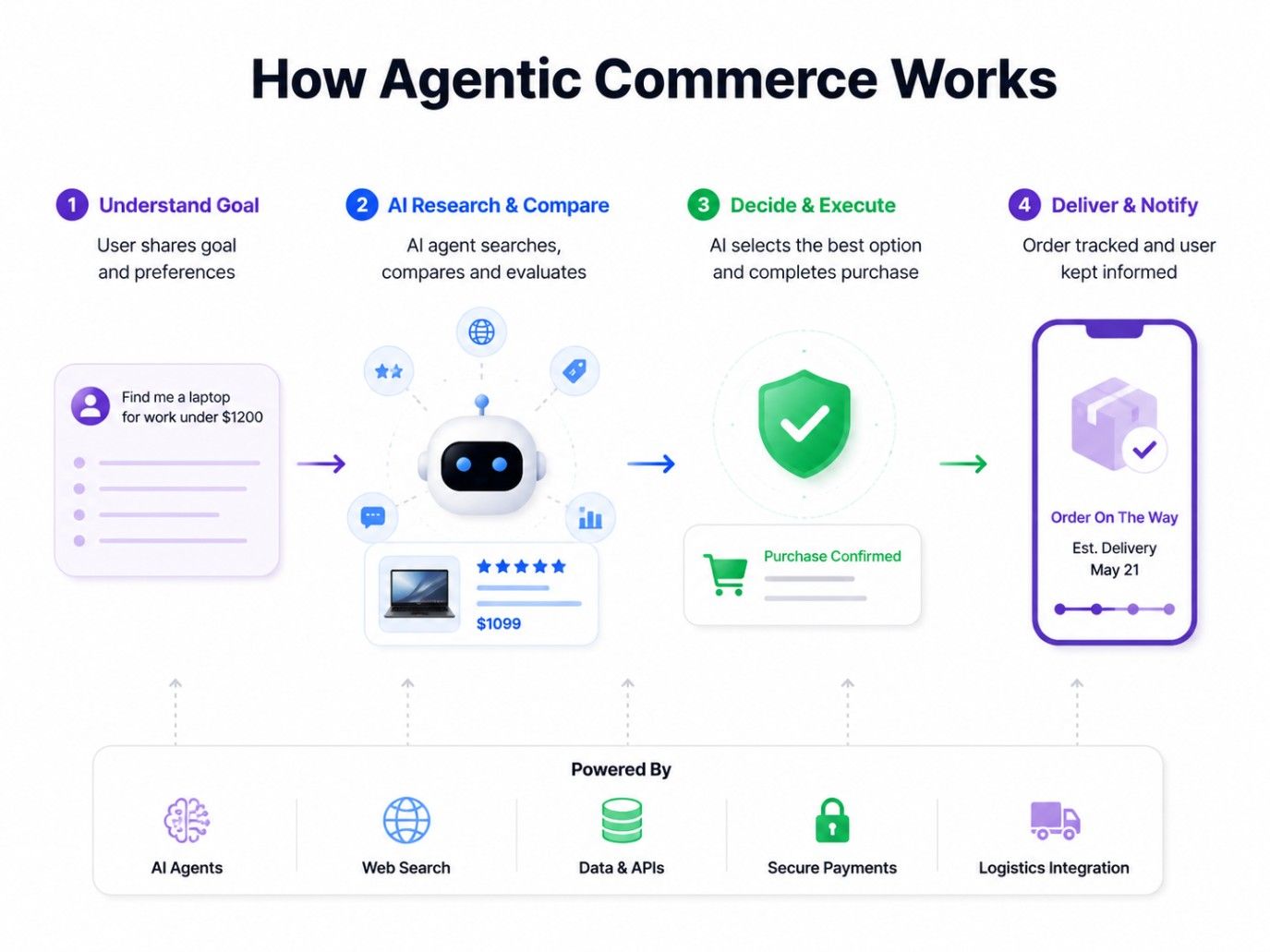
The process can be understood in four simple stages.
The AI agent collects information about customer preferences, budget, purchase history, and requirements. Rather than responding to keywords alone, it understands the broader shopping objective.
The agent scans multiple websites, marketplaces, reviews, and product databases to identify suitable options. It evaluates products based on factors such as price, quality, ratings, and availability.
Using predefined preferences and contextual information, the AI ranks available options and selects the most suitable choice.
Once approved or automatically, depending on user settings the AI completes transactions, tracks orders, and provides updates.
Also Read: How to Build Your Own AI System: Step-by-Step Guide
Several technologies work together to enable intelligent shopping agents.
Here is a clear breakdown of each component and how it works:
Component |
What It Does |
Why It Matters |
| AI Agent | Acts on behalf of the customer | Automates shopping tasks |
| Large Language Models | Understand and process natural language | Enables human-like interaction |
| Product Data Sources | Provide product information and inventory details | Supports informed decisions |
| Recommendation Engine | Matches products to user needs | Improves relevance |
| Payment Integration | Enables secure transactions | Facilitates purchases |
| Personalization Layer | Learns customer preferences | Delivers customized experiences |
| Analytics Engine | Tracks behavior and performance | Improves future recommendations |
| Security Framework | Protects data and transactions | Builds trust and compliance |
Also Read : Agentic AI vs Generative AI: What Sets Them Apart
Modern Agentic Commerce systems combine artificial intelligence, machine learning, automation, and connected APIs to make autonomous purchasing possible. These technologies work together to understand user intent, analyze options in real time, and execute transactions with minimal human intervention.
Large Language Models (LLMs)
LLMs help agents understand customer requests, ask clarifying questions, and provide natural responses.
Retrieval-Augmented Generation (RAG)
RAG enables agents to access current product catalogs, reviews, and pricing information instead of relying solely on training data.
Machine Learning Models
These models identify purchasing patterns and continuously improve recommendations.
API Integrations
APIs connect agents with payment gateways, e-commerce platforms, logistics providers, and inventory systems.
Multi-Agent Systems
Multiple AI agents can collaborate, with different agents handling product research, pricing analysis, inventory checks, and transaction management.
Read : RAG Agents: What They Are, How They Work, and What They Actually Cost
Agentic Commerce is transforming how businesses and consumers engage with each other across the entire purchase journey, thanks to the continued evolution of AI capabilities.
Autonomous shopping agents are making decisions easier, improving personalization and automating transactions at scale from retail and travel to financial services and healthcare.
AI agents understand user preferences and recommend products that closely match individual needs.
If stock levels are low, agents can automatically reorder recurring products such as groceries, office supplies, or household essentials.
Compare flights, hotels, transportation, and travel packages to create an optimal itinerary.
Organizations use intelligent agents to automate supplier evaluation, quote comparisons, and purchase workflows.
AI agents can compare insurance policies, loans and investment products against customer needs and eligibility.
Read : Google Agent Development Kit: Guide for Building AI Agents
Businesses and consumers both gain significant advantages from this emerging approach.
For Customers
For Businesses
As adoption grows, Agentic Commerce has the potential to redefine how consumers interact with brands and digital marketplaces.
Do read : Rational Agents in AI: A Detailed Guide on How They Function
Despite its promise, organizations face several implementation challenges.
Challenge |
Impact |
Possible Solution |
| Data Privacy Concerns | Reduced user trust | Strong security and consent frameworks |
| Inaccurate Recommendations | Poor customer experience | Continuous model training |
| Integration Complexity | Slower deployment | Standardized APIs |
| Regulatory Compliance | Legal risks | Compliance monitoring |
| Limited Context Understanding | Incorrect purchases | Improved personalization models |
| Security Threats | Financial losses | Advanced fraud detection systems |
| User Adoption Barriers | Lower engagement | Transparent AI interactions |
Successfully addressing these challenges is essential for scaling Agentic Commerce solutions.
Also Read : AWS Agentic AI: A Beginner’s Guide
The future of shopping is likely to become increasingly autonomous. AI agents will evolve from recommendation tools into fully capable digital assistants that can negotiate prices, manage subscriptions, coordinate deliveries, and optimize purchases across multiple platforms.
Several emerging trends are expected to shape the future:
As AI technology advances, Agentic Commerce will continue transforming the relationship between consumers, retailers, and digital marketplaces.
Must Read : AI Agents for Business: Complete Guide for Modern Organizations
Agentic Commerce represents the next major evolution in e-commerce. By combining AI agents, language models, personalization systems, and real-time data access, businesses can deliver highly efficient and personalized shopping experiences.
While challenges related to privacy, security, and trust remain important considerations, the benefits of automation, convenience, and intelligent decision-making are driving rapid adoption across industries. As organizations continue investing in AI-powered commerce solutions, Agentic Commerce is expected to become a foundational component of future digital shopping experiences.
Want personalized guidance on AI and upskilling? Speak with an expert for a free 1:1 counselling session today
Agentic Commerce is expected to reduce the amount of manual effort involved in shopping. Instead of comparing dozens of products yourself, AI agents can handle research, price checks, and purchase execution based on your preferences. As retailers improve API connectivity and AI capabilities, shopping experiences may become more automated, personalized, and efficient for both consumers and businesses.
Yes. Agentic Commerce can support customer retention by understanding purchasing habits and automating repeat purchases when appropriate. Businesses can also use AI agents to provide personalized recommendations, timely offers, and product suggestions that align with customer needs. This creates a smoother buying experience that encourages long-term engagement.
A practical example of Agentic Commerce is an AI assistant purchasing a laptop for you. You provide a budget, preferred specifications, and delivery timeline. The AI agent searches multiple retailers, compares prices and reviews, selects the best option, completes the transaction, and tracks the shipment without requiring further input from you.
Many AI shopping agents continuously monitor product listings and pricing information through connected systems. If prices change before a purchase is completed, the agent can adjust recommendations or identify better alternatives. This helps users make decisions based on current market conditions rather than outdated information.
Yes. Agentic Commerce is already emerging through AI-powered assistants capable of researching products, making recommendations, and completing transactions. While the technology is still evolving, major developments in generative AI, autonomous agents, and API ecosystems are making real-world implementations increasingly practical across several industries.
Agentic Commerce is particularly useful for recurring purchases. AI agents can monitor inventory levels, identify when supplies are running low, compare current prices, and reorder products automatically. This can be valuable for household goods, office supplies, software subscriptions, and other routine purchases that require minimal decision-making.
Traditional e-commerce requires customers to search, compare, and purchase products themselves. Agentic Commerce shifts much of that responsibility to autonomous AI agents. Instead of browsing websites manually, users provide goals and preferences while the AI agent performs product discovery, evaluation, and transaction execution on their behalf.
Product discovery becomes more goal-oriented rather than search-oriented. Instead of browsing hundreds of listings, users describe what they want, and AI agents identify suitable options. This can reduce information overload and help consumers find products that better match their requirements, budget, and purchase intent.
The term "agentic" refers to the ability of a system to act independently in pursuit of a goal. In AI, agentic systems can make decisions, plan actions, and execute tasks with limited human intervention. Agentic Commerce applies this concept to shopping by enabling AI agents to complete purchasing activities autonomously.
As Agentic Commerce grows, brands may need to optimize not only for human shoppers but also for AI agents evaluating products. Factors such as accurate product data, transparent pricing, inventory availability, customer reviews, and API accessibility could play a larger role in influencing AI-driven purchasing decisions.
Businesses can prepare by improving product data quality, adopting structured catalogs, strengthening API integrations, and maintaining accurate pricing and inventory information. Companies that make their products easier for AI agents to evaluate and purchase may be better positioned as Agentic Commerce becomes more widely adopted.
730 articles published
Sriram K is a Senior SEO Executive with a B.Tech in Information Technology from Dr. M.G.R. Educational and Research Institute, Chennai. With over a decade of experience in digital marketing, he specia...
Speak with AI & ML expert
By submitting, I accept the T&C and
Privacy Policy