Agentic Operating System: A Complete Guide
By Sriram
Updated on Jun 23, 2026 | 7 min read | 7.28K+ views
Share:

All courses
Certifications
More
By Sriram
Updated on Jun 23, 2026 | 7 min read | 7.28K+ views
Share:
Table of Contents
An Agentic Operating System is an AI-native platform that manages and coordinates autonomous AI agents. Similar to how a traditional operating system controls applications and system resources, an Agentic Operating System provides agents with persistent memory, access to specialized tools, and collaboration capabilities. This enables AI agents to work together, make decisions, and execute complex business processes efficiently and autonomously.
In this blog, you'll learn what an Agentic Operating System is, how it works, its core components, benefits, real-world applications, challenges, and future potential.
Build an Agenti AI and AI programs with upGrad’s to develop practical skills in large language models (LLMs), generative AI, machine learning, model evaluation and data-driven decision-making.
Agentic AI Courses to upskill
Explore Agentic AI Courses for Career Progression
IIIT Bangalore
Executive Diploma in Machine Learning and AI360° Career Support
An Agentic Operating System is a software framework that allows autonomous AI agents to function, collaborate, and perform tasks across multiple applications, databases, APIs and digital environments.
The primary goal is to create a coordinated environment in which intelligent agents can function like human workers handling complex processes.
Instead of requiring constant human instructions, the system allows AI agents to:
Also read : Top 15 Agentic AI Books for Beginners to Advanced Learners
An Agentic Operating System combines AI reasoning, memory, orchestration, and execution capabilities to complete tasks autonomously.
The workflow typically follows these stages:
Stage 1: Goal Understanding
The AI agent receives an objective from the user or another system. It analyzes the request, identifies requirements, and determines the desired outcome.
Stage 2: Task Planning
The system breaks large objectives into smaller actionable tasks. Agents prioritize activities and determine the most efficient execution path.
Stage 3: Resource Access
Agents connect to external tools, APIs, databases, software applications, and knowledge repositories to gather information and perform actions.
Stage 4: Decision Making
Using contextual data and reasoning models, agents evaluate options and select the most suitable course of action.
Stage 5: Execution and Monitoring
The system executes tasks, monitors progress, adapts to changing conditions, and reports outcomes.
Also Read : Exploring Agentic AI Platforms: Capabilities, Challenges, and Future Trends
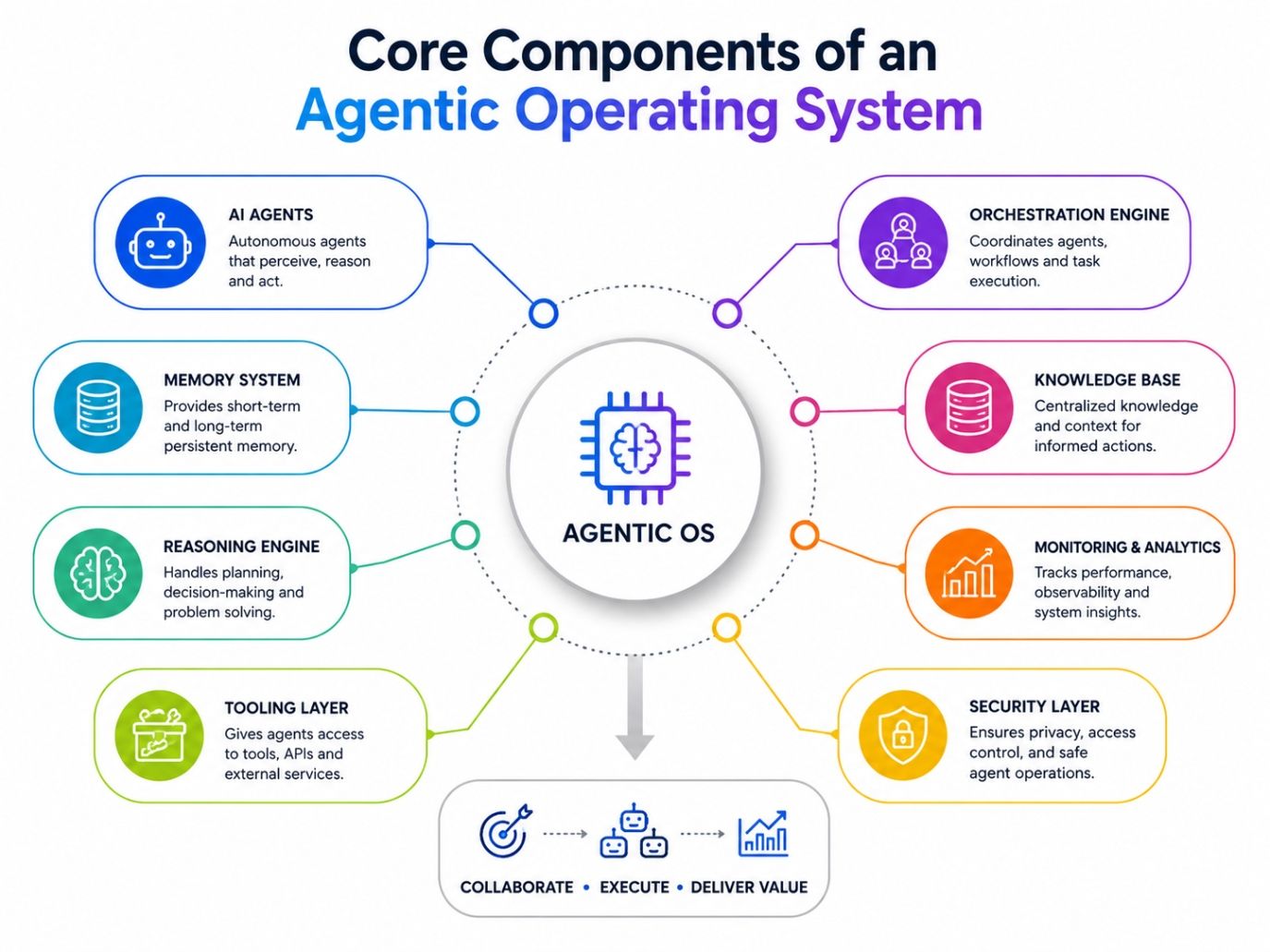
The core components of an Agentic Operating System show how AI agents, memory, reasoning, orchestration, knowledge, security, and monitoring layers work together to enable autonomous decision-making and workflow execution.
Do read : AI Agents for Business: Complete Guide for Modern Organizations
An Agentic Operating System relies on a combination of advanced AI technologies that enable autonomous agents to reason, learn, collaborate, and execute tasks efficiently.
These technologies work together to provide the intelligence, memory, and connectivity needed for complex decision-making and workflow automation.
LLMs enable agents to understand instructions, interpret context, generate responses, and perform reasoning tasks.
RAG allows agents to retrieve real-time information from knowledge sources instead of relying solely on pre-trained data.
Multiple agents can work together, with specialized agents handling planning, execution, analysis, monitoring, and reporting.
Machine learning helps agents improve performance by learning from previous interactions and outcomes.
APIs allow agents to interact with external software, cloud services, databases, and enterprise applications.
Workflow engines automate task execution while maintaining governance and operational control.
Do read : AI Agent Marketplace: Guide for Businesses and Developers
Organizations adopting Agentic Operating Systems can streamline operations, reduce manual effort, improve decision-making, and enhance overall business productivity.
For Businesses :
For Teams :
As AI adoption grows, the Agentic Operating System is becoming a strategic advantage for organizations seeking intelligent automation.
Also Read: Understanding Multi Agent Systems: A Complete Beginner Guide
As organizations embrace AI-driven automation, Agentic Operating Systems are being deployed across various industries to manage complex workflows and enhance operational efficiency.
Use Case |
How Agentic Operating Systems Help |
| Enterprise Workflow Automation | AI agents automate approvals, document processing, reporting, and operational workflows, reducing manual effort and improving efficiency. |
| Customer Support Operations | Autonomous agents handle customer inquiries, resolve issues, escalate complex cases, and manage support tickets around the clock. |
| Software Development | AI agents assist developers with coding, testing, debugging, deployment, and continuous system monitoring. |
| Financial Services | Intelligent agents support risk assessment, compliance monitoring, fraud detection, financial forecasting, and data analysis. |
| Healthcare Administration | Agentic systems streamline appointment scheduling, medical documentation, patient communication, and healthcare data management. |
| Supply Chain Management | AI agents coordinate procurement, inventory tracking, logistics planning, supplier management, and demand forecasting. |
Also Read: What Is Agentic AI? The Simple Guide to Self-Driving Software
While both manage resources and processes, their functions differ significantly.
The table shows the difference between the traditional system and agentic operating systems :
Feature |
Traditional OS |
Agentic Operating System |
| Purpose | Manage hardware and software | Manage autonomous AI agents |
| Decision-Making | Human-driven | AI-driven |
| Task Execution | User initiated | Goal-oriented automation |
| Learning Capability | Limited | Continuous improvement |
| Collaboration | Process-based | Multi-agent collaboration |
| Adaptability | Static workflows | Dynamic workflows |
This shift from process management to intelligent decision-making is what makes the Agentic Operating System unique.
Despite the benefits, organizations face several implementation challenges.
Here is the clear breakdown:
Challenge |
Impact |
Potential Solution |
| Data Privacy Risks | Security concerns | Strong governance policies |
| Complex Integration | Deployment delays | Standardized APIs |
| Limited Context Awareness | Inaccurate decisions | Better memory systems |
| Regulatory Compliance | Legal challenges | Continuous monitoring |
| Agent Coordination Issues | Workflow failures | Improved orchestration |
| Security Vulnerabilities | Unauthorized access | Advanced security controls |
Addressing these challenges is essential for successful deployment.
Also Read: Agentic AI Learning Path: A Complete Guide for Developers and AI Professionals
The future of AI automation is moving towards more autonomous ecosystems.
Several trends are likely to shape the next generation of agentic platforms:
As AI capabilities continue to advance, the Agentic Operating System is expected to become the backbone of intelligent enterprise infrastructure.
The Agentic Operating System is a significant leap forward in AI-powered automation. They are reshaping the way organisations function by coordinating intelligent agents, managing workflows, integrating external tools and enabling autonomous decision-making.
The benefits of scalability, efficiency and intelligent automation, however, make agentic platforms increasingly valuable, though challenges with security, governance and implementation remain important. With businesses continuing to invest in AI transformation, Agentic Operating Systems are set to become central to the future of work and digital operations.
Want to explore more about agentic AI? Book your free 1:1 personal consultation with our expert today.
Success depends on the goals you set before deployment.
You can track:
For example, if AI agents reduce report generation from four hours to thirty minutes, the impact becomes easy to measure. Focus on business outcomes rather than technical metrics alone.
Yes, but the level of integration varies.
Many organizations connect existing ERP, CRM, and database systems through APIs, middleware, or custom connectors. Before implementation, evaluate which systems can share data easily and which may require upgrades.
A phased rollout often works better than replacing existing infrastructure all at once.
Most organizations benefit from professionals with:
The focus should be on managing business processes and outcomes rather than building AI models from scratch.
An Agentic Operating System is a platform that manages autonomous AI agents and helps them perform tasks across multiple tools and systems.Unlike traditional software that follows fixed instructions, it enables agents to plan actions, access resources, share information, and complete objectives independently. Businesses increasingly use an Agentic Operating System to automate workflows that would otherwise require significant human involvement.
The four commonly recognized types of operating systems are:
Each type serves different computing requirements. While these systems manage hardware and software resources, modern AI environments are introducing new concepts such as the Agentic Operating System, which focuses on coordinating intelligent agents rather than computer hardware.
ChatGPT is primarily a Large Language Model (LLM)-based application.
By itself, it generates responses based on prompts. However, when connected to tools, memory systems, APIs, and task execution frameworks, it can function as part of an AI agent. The distinction is important because an agent can take actions, while an LLM mainly generates text and reasoning outputs.
There is no official industry list of the "big four" AI agents.
However, discussions often highlight agent frameworks and assistants developed by major AI companies. Examples include autonomous systems built around OpenAI, Google, Anthropic, and Microsoft ecosystems. The landscape changes rapidly, making it more useful to compare capabilities such as planning, tool usage, memory, and workflow execution rather than specific rankings.
Most organizations use agentic systems to remove repetitive work rather than eliminate human roles.
Employees can focus on:
The technology handles routine coordination, data gathering, and execution tasks, allowing teams to spend more time on activities that require human judgment and expertise.
Small businesses can benefit as well.
Even limited deployments can automate:
Many cloud-based solutions allow smaller organizations to start with a single workflow and expand gradually as operational needs grow.
Industries with large volumes of repetitive decision-making are expected to move first.
These include:
Organizations in these sectors often manage large amounts of data and workflows, making them suitable environments for autonomous agent deployment.
Future developments are expected to focus on stronger collaboration between multiple AI agents, better long-term memory, improved reasoning capabilities, and deeper integration with enterprise systems.Rather than handling isolated tasks, an Agentic Operating System may coordinate entire business functions across departments. This shift could help organizations automate increasingly complex workflows while maintaining oversight and governance.
730 articles published
Sriram K is a Senior SEO Executive with a B.Tech in Information Technology from Dr. M.G.R. Educational and Research Institute, Chennai. With over a decade of experience in digital marketing, he specia...
Speak with AI & ML expert
By submitting, I accept the T&C and
Privacy Policy