Performance Management System: Complete Guide
By upGrad
Updated on Jul 02, 2026 | 6 min read | 2.23K+ views
Share:

All courses
Certifications
More
By upGrad
Updated on Jul 02, 2026 | 6 min read | 2.23K+ views
Share:
Table of Contents
A Performance Management System, or PMS, is essentially a tool that helps companies see how well their employees are doing and keeps everyone moving in the same direction. It is not a one-time event; rather an ongoing framework that connects what each employee is working on to what the business actually needs to achieve. It gives employees feedback and finds out what skills they are missing and helps them keep getting better.
In this blog, you'll learn what a performance management system is, why it matters, how the process works, its key stages, common frameworks, challenges, software, and best practices.
Ready to lead high-performing teams? Enrol in upGrad's Online MBA Courses and gain practical performance management skills now.
Popular MBA Programs
A performance management system is a process that helps companies work better. It is a process that helps them plan, monitor, evaluate, and improve employee performance over time. This system does not just look at how employees are performing on a yearly basis but helps managers and employees to talk to each other regularly.
The main goal of a performance management system is easy to understand; it helps employees do their jobs better and companies work towards their goals.
Also Read: Performance Management: Definition, Process, Benefits & Best Practices (2026 Guide)
A good performance management system or HRM helps to clear confusion. On one page, everyone has access to this means; employees know what they need to do.
Managers can see how their team members are doing and make judgments accordingly. Organizations can then decide who deserves a promotion, reward, or some extra training. This system helps employees, managers, and the organization as a whole.
This approach makes performance management more useful than a once-a-year rating exercise.
Component |
Purpose |
| Goal setting | Defines expectations |
| Continuous feedback | Improves performance regularly |
| Performance reviews | Measures progress |
| Coaching | Develops employee skills |
| Development planning | Prepares employees for future roles |
| Rewards and recognition | Motivates high performance |
Imagine a sales executive whose annual target is ₹1 crore.
Instead of waiting until the end of the year, the manager schedules monthly check-ins. They review progress, discuss challenges, suggest training, and revise goals if market conditions change.
Related Article: A Guide to Training Management System
Many organizations now put together their performance management and reward system with career development, learning programs, and succession planning. This makes the employee's experience much better and also helps to improve the business outcomes of the organization.
Traditional Appraisal |
Modern Performance Management |
| Annual review | Continuous process |
| Focus on ratings | Focus on growth |
| One-way feedback | Two-way conversations |
| Past performance | Future improvement |
| Limited coaching | Ongoing development |
Free Courses
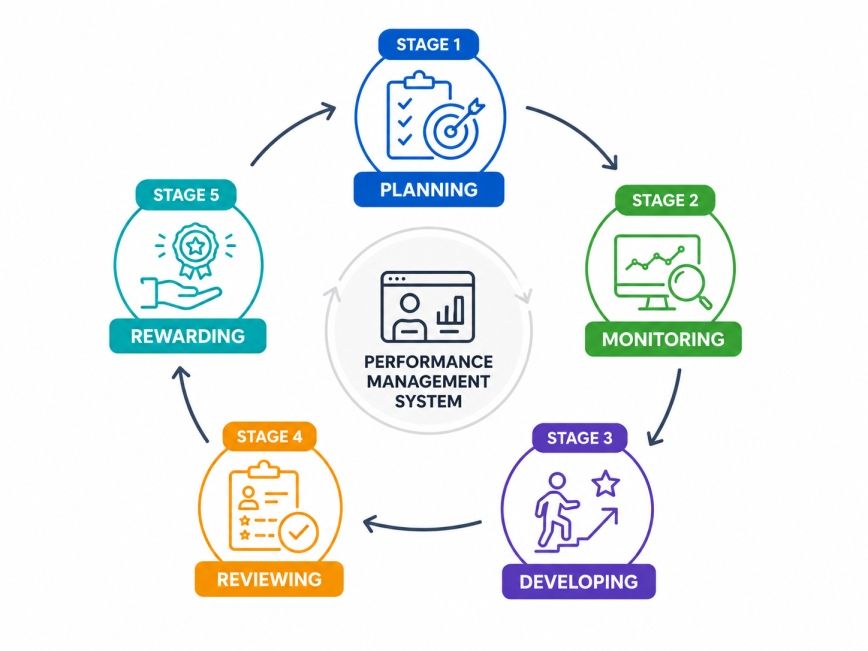
A successful performance management system is something that keeps going on like a cycle. It does not just happen at one time.
When everyone knows what is expected, it reduces confusion. Thus, managers and employees set goals, and both agree on these SMART goals.
By monitoring, organizations' performance is always checked. We solve problems with performance before they become a big issue. This helps a lot because a small performance issue when dealing on time does not become a big problem.
We keep an eye on performance all the time through:
This stage of the process makes performance management systems, in the human resources department focus on helping employees in improvement instead of just punishing.
Managers help employees at their company through:
While ratings can still be good, a performance management system with real impact will help us have real conversations about what is impacting the organization and the employee. Ratings should not be the only thing we talk about.
Formal reviews should tell us about a few things:
An effective performance management is about more than rewards. It is about creating a work environment that supports employee growth and helps employees succeed. Employees of these organizations are motivated. Thus, work harder and the organization succeeds.
Organizations connect performance with:
Different departments use Key Performance Indicators according to what is suitable for the departments.
Department |
Sample KPIs |
| Sales | Revenue, conversion rate |
| Marketing | Leads generated, ROI |
| HR | Employee retention |
| Customer Support | CSAT, response time |
| Finance | Budget accuracy |
Also Read: Management Information Systems: Meaning, Components & Examples (2026)
Modern organizations rely more on performance management system software. This software helps them automate goal tracking, collecting feedback, and managing review cycles.
MBA Courses to upskill
Explore MBA Courses for Career Progression
O.P.Jindal Global University
MBA (with Career Acceleration Program by upGrad)Become interview ready with Career Services
PSB MBA + IIML Certification
MBA from Paris School of Business with Certification from IIM Lucknow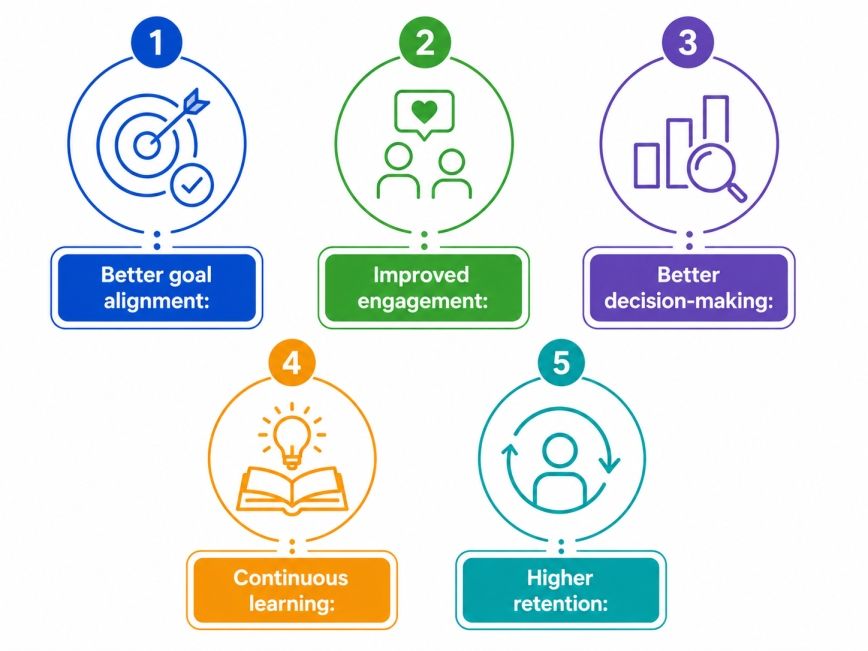
Organizations invest in a performance management system to improve employee performance and business results.
1. Better goal alignment:
Employees understand how their work contributes to company objectives.
2. Improved engagement:
Frequent feedback keeps employees motivated.
3. Better decision-making:
Managers have reliable performance data for promotions and compensation.
4. Continuous learning:
Employees receive regular coaching instead of waiting for annual reviews.
5. Higher retention:
People are more likely to stay where they receive recognition and growth opportunities.
Despite the benefits of performance management systems, there exist challenges. The challenges and how to solve these problems are listed below
Challenge |
Solution |
| Manager bias | Use multiple reviewers |
| Poor feedback | Train managers |
| Unclear goals | Use SMART objectives |
| Low adoption | Use simple tools |
| Employee resistance | Communicate purpose clearly |
Build the expertise needed for senior leadership positions in finance and business. The Master + Doctor of Business Administration (MBA+DBA) from Golden Gate University offers a comprehensive pathway to develop advanced managerial and strategic decision-making skills.
Today's performance management system software simplifies administrative work. Popular enterprise platforms like SAP SuccessFactors, Workday, Oracle HCM, Darwinbox, and Microsoft Viva Goals are used by companies, for human resources and employee management.
The best performance management system software supports conversations rather than replacing them. Technology should enable managers, not become the entire process.
Organizations also integrate performance management and reward system processes with payroll, learning management, and talent management platforms for better workforce planning.
Common features include:
Also Read: HR Management Made Easy Using 15 HR Tools and Softwares
Not every organization needs the same approach. A small company, with 30 people, needs different things compared to a huge international company.
Factors to consider
Questions to ask before implementation
Implementation roadmap
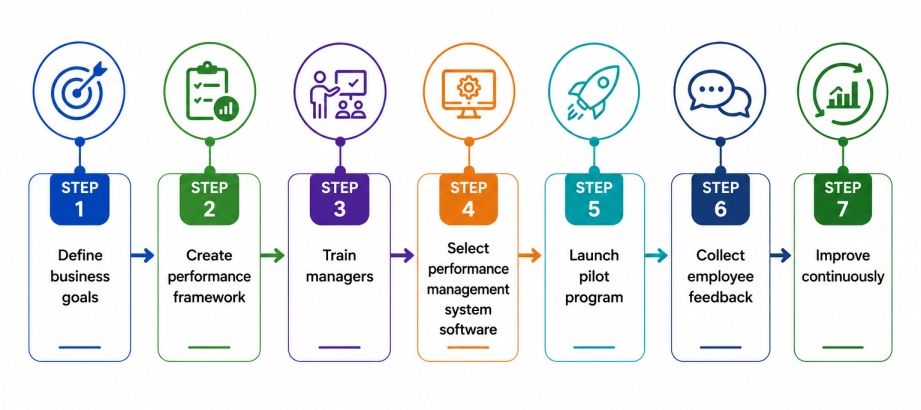
An effective performance management system in HRM is when employees think that the platform is a way to help them get better at their jobs, the employees work well.
Some organizations combine development, recognition, coaching, and a transparent performance management and reward system. These organizations usually do better in the run than the ones that only care about giving ratings to the employees. This combination is good when it is fair and clear to everyone.
The technology was helpful for the process. It was the leadership commitment that really made a big difference.
Let's take an example of a mid-sized IT company replacing annual appraisals with quarterly reviews. Managers met employees every month for short coaching conversations.
Within one year:
Also Read: Learning Management System (LMS): Meaning, Features & Examples (2026)
A performance management system is no longer limited to annual appraisals. It has evolved into a continuous process that helps employees grow while helping organizations achieve strategic goals. The most successful organizations focus on clear expectations, regular feedback, meaningful coaching, measurable outcomes, and fair rewards.
Whether you're implementing your first process or upgrading an existing one with performance management system software, remember that technology supports performance, but conversations drive it. A thoughtful performance management system in HRM creates trust, improves productivity, and builds stronger teams for the future.
The four pillars of a performance management system are goal setting, continuous feedback, performance evaluation, and employee development. Together, these pillars help organizations measure progress, improve productivity, and encourage long-term growth rather than focusing only on annual appraisals.
In HR, a Performance Management System (PMS) is a structured framework used to set employee goals, monitor performance, provide regular feedback, conduct evaluations, and support career development. It also helps organizations make informed decisions about rewards, promotions, and training.
KPIs are measurable indicators used within a performance management system to evaluate employee or business performance. A PMS uses KPIs to track progress toward goals while balancing them with competencies, behaviors, and overall business impact.
The four common stages are planning, monitoring, reviewing, and rewarding or developing. Some organizations add a fifth stage for continuous improvement, but these four stages form the core cycle used across most businesses.
The 5 C's commonly refer to Clarity, Communication, Coaching, Collaboration, and Continuous Improvement. Together, they encourage transparent expectations, regular conversations, stronger teamwork, and ongoing employee development.
Most organizations now prefer quarterly or monthly check-ins instead of relying only on annual reviews. Frequent conversations allow managers to resolve issues early, recognize achievements faster, and provide timely coaching that supports employee growth.
Performance appraisal is usually a formal evaluation conducted periodically. Performance management is a continuous process that includes planning, coaching, monitoring, feedback, development, and appraisal, making it a broader and more strategic approach.
Good performance management system software should offer goal management, continuous feedback, 360-degree reviews, analytics, reporting dashboards, review automation, and integration with HR systems. Ease of use is equally important for employee adoption.
Many initiatives fail because of unclear goals, inconsistent feedback, poor manager training, rating bias, or lack of employee trust. A successful system focuses on transparency, coaching, and continuous improvement rather than administrative compliance.
Yes. Small businesses often benefit even more because regular feedback improves communication and helps employees grow quickly. A simple process with clear goals and monthly discussions is usually enough to create measurable improvements.
Employees stay more engaged when they understand expectations, receive regular recognition, and see a clear connection between performance and rewards. A transparent performance management and reward system builds trust, motivates high performance, and supports career progression.
1011 articles published
We are an online education platform providing industry-relevant programs for professionals, designed and delivered in collaboration with world-class faculty and businesses. Merging the latest technolo...
Speak with MBA expert
By submitting, I accept the T&C and
Privacy Policy
From MBA to Dream Job - Explore Our Alumni Success Stories
Top Resources
Master's Degree
12 Months
Master's Degree
15 Months
Master's Degree
13 Months