AI Benchmark: A Complete Guide to Measuring AI Performance
By Sriram
Updated on Jun 03, 2026 | 9 min read | 8.31K+ views
Share:

All courses
Certifications
More
By Sriram
Updated on Jun 03, 2026 | 9 min read | 8.31K+ views
Share:
AI benchmarks are standardized tests, datasets or evaluation frameworks meant to benchmark the performance of artificial intelligence systems. It measures important factors such as: Accuracy, Speed, Efficiency, Reasoning abilities , Usage of resources in the same conditions
AI benchmarks are typically divided into two categories. Software benchmarks evaluate AI models including large language models, computer vision systems, and machine learning algorithms. Hardware benchmarks measure the AI processing capabilities of smartphones, CPUs, GPUs, NPUs and other AI accelerators used to run AI workloads efficiently.
In this blog, you'll learn what AI benchmarks are, how they work, how AI benchmark scores are measured, and why tools like Antutu AI benchmark matter.
Build job-ready AI skills with upGrad’s Artificial Intelligence Courses and gain hands-on experience in machine learning, generative AI, and real-world projects.
Popular AI Programs
An AI benchmark is a formal way to evaluate how well an AI system performs under controlled conditions. It evaluates things like speed, accuracy, energy efficiency and hardware optimization. Benchmarks provide measurable results instead of guessing which model is better.
At its core, an AI benchmark is a straightforward question: how does this AI actually compare to others?
This is where it matters. AI systems are not just software. They rely on the hardware such as GPUs, NPUs, and mobile AI accelerators. Two systems running the same model can yield very different results depending on optimization.
For example, a smartphone running a lightweight vision model may outperform a more powerful phone if its chipset has a better AI processing unit. This is where tools like Antutu AI benchmark come in. They test real device performance using standardized AI workloads.
What AI benchmarks usually measure
Current AI benchmarks are primarily concerned with:
Some benchmarks go deeper, simulating real-world usage as opposed to isolated tasks. That’s important because raw speed itself doesn’t represent real usability.
Why AI benchmarks are important
AI benchmarks are useful to various stakeholders in different ways:
But benchmarks are not perfect. A system may perform well on a benchmark and still struggle in real-world environments due to unpredictable inputs or data variations. That gap between controlled testing and real usage is something every AI engineer eventually deals with.
Free Courses
AI benchmarking works by running a system through a fixed set of tasks and measuring performance using consistent metrics. These tasks are designed to simulate real AI workloads but in a controlled environment.
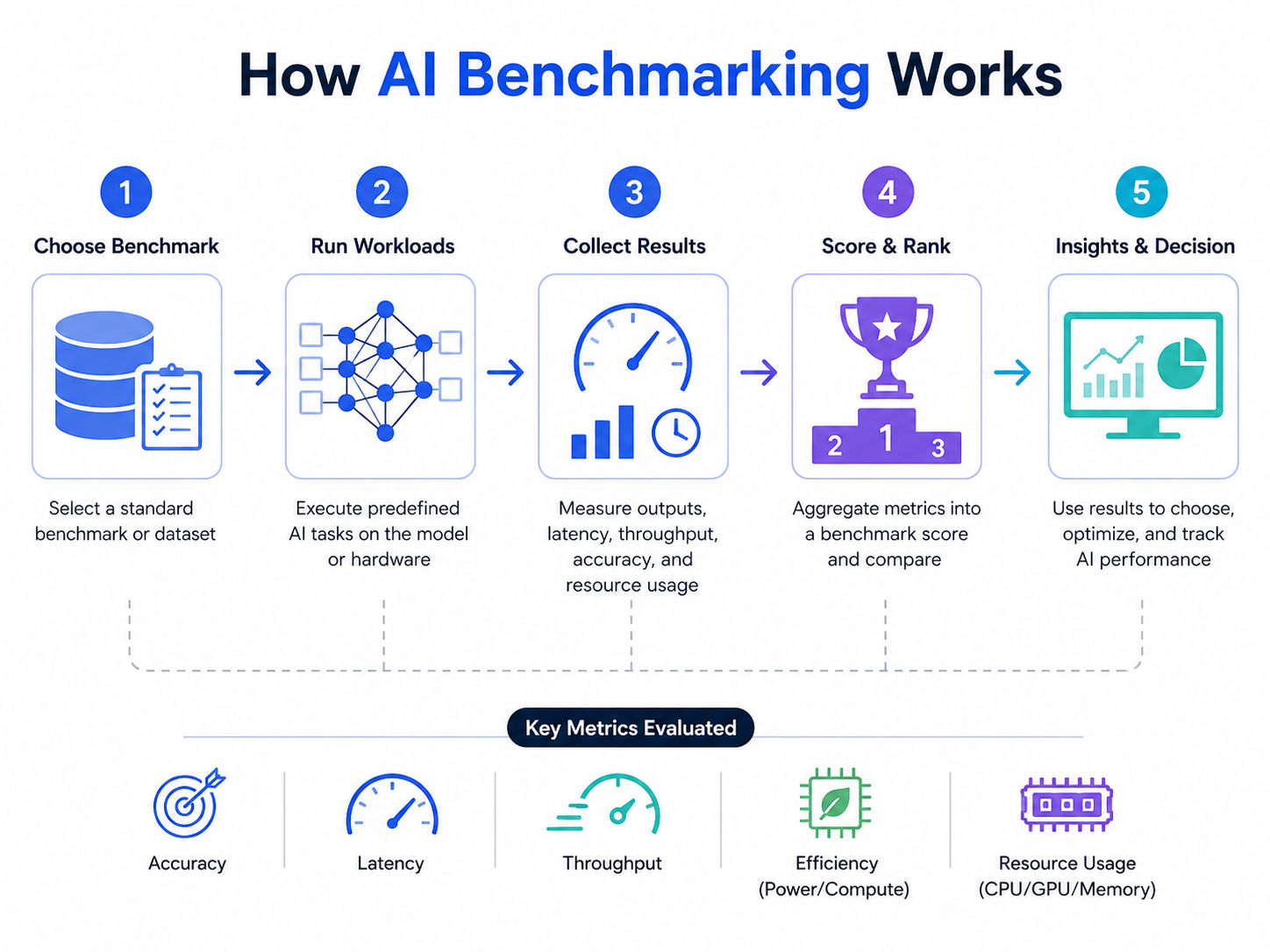
Most benchmarks follow a simple flow:
The final output becomes an AI benchmark score, which represents overall performance.
To understand AI benchmark systems properly, you need to look at what they measure:
Some benchmarks also include memory usage, which becomes critical for mobile and edge devices.
Let’s say two models run an object detection task:
Now the benchmark system decides how to weight speed vs accuracy. Depending on the scoring formula, either model could win. That’s why benchmark design matters as much as model performance.
Many AI benchmarks use synthetic datasets instead of real-world data. This keeps testing consistent, but it can also reduce realism. A model trained on benchmark-friendly data may not handle noisy or messy real-world inputs well.
That’s one of the biggest limitations in modern AI benchmarking systems.
Do read : Types of AI: From Narrow to Super Intelligence with Examples
AI Courses to upskill
Explore Artificial Intelligence Courses for Career Progression
An AI benchmark score is a single number that summarizes performance across multiple tests. It’s designed to make comparison easy, but it often hides important tradeoffs.
A higher score generally means better performance, but it doesn’t always mean better real-world usability.
How AI benchmark scores are calculated
Most scoring systems combine multiple metrics:
Each benchmark tool assigns different weights. That’s why scores from different platforms are not directly comparable.
For example:
| System | Speed Score | Accuracy Score | Final AI Benchmark Score |
| Model A | High | Medium | 85 |
| Model B | Medium | High | 87 |
Even though Model A is faster, Model B may win due to better accuracy weighting.
Common misunderstanding
A lot of people assume the AI benchmark score is absolute. It is not.
It depends on:
This is why two benchmarks can show different winners for the same model.
Real-world limitation
In production systems, data rarely behaves like benchmark datasets. For example:
A model with a slightly lower benchmark score may perform better in real usage because it generalizes better.
That’s why engineers rarely rely on a single AI benchmark score when choosing models.
Also read : Applications of Artificial Intelligence and Its Impact
The Antutu AI benchmark is one of the most widely used tools for evaluating mobile AI performance. It is part of the broader Antutu benchmarking suite, which also tests CPU, GPU, and memory performance.
Unlike general AI benchmarks that focus on cloud systems or research models, Antutu AI benchmark focuses on on-device AI performance.
It typically evaluates:
These tests simulate real mobile use cases like camera enhancements, photo filters, and voice processing.
Modern smartphones rely heavily on AI for:
So, a strong AI benchmark score in Antutu often indicates better real-world performance in these areas.
Even though it is widely used, it has limitations
As AI shifts toward large language models and generative systems, mobile benchmarks like Antutu are slowly evolving but still lag behind cloud-scale evaluation methods.
Must read : AI Developer Roadmap: How to Start a Career in AI Development
AI benchmark systems are useful, but they are not perfect indicators of real-world performance. As AI systems become more complex, the gap between benchmarks and reality has grown.
Key limitations
A real-world example
A model may perform extremely well on image classification benchmarks but struggle with:
That’s because real-world data is far more unpredictable than benchmark datasets.
Why this matters for developers
If you rely only on AI benchmark results, you might:
That’s why production AI systems always include live testing alongside benchmark evaluation.
Also read : Explore Top Free AI Courses with Certificate in 2026
The proper use of AI benchmark results is as a starting point, not a final decision.
Most developers and engineers supplement benchmarks with real-world testing.
Best practice
A good workflow looks something like this:
This way you don't get too dependent on synthetic results.
Where benchmarks still shine
Even with limitations, AI benchmarks are extremely useful for:
They give a structured way to measure improvement over time.
AI benchmark systems are important in how we measure AI performance today. They provide structured model, device, and workload comparisons, making it easier to track progress in a rapidly changing field.
But they are not absolute truths. The AI benchmark score is only part of the story. Real-world performance is affected by data quality, deployment environment, and complexity of use-case.
Understanding the tools such as Antutu AI benchmark and the general benchmarking systems helps developers make smarter choices. The trick is to think of benchmarks as guidance, not the final word.
Want personalized guidance on AI and upskilling? Speak with an expert for a free 1:1 counselling session today.
An AI benchmark uses standardized datasets and testing conditions to compare different AI systems fairly. A performance test often measures how a specific model or device behaves in a particular environment. Benchmarks help with comparison, while performance testing helps determine whether a system meets your real-world requirements and workload expectations.
Several benchmarks evaluate large language models, including MMLU, HumanEval, GSM8K, ARC, and HellaSwag. Each benchmark focuses on different capabilities such as reasoning, coding, problem-solving, or language understanding. Researchers typically combine multiple benchmarks because no single test can accurately measure every aspect of a model's performance.
Not always. A model may achieve excellent benchmark scores yet struggle with real-world tasks that involve noisy data, unexpected inputs, or domain-specific requirements. Benchmark results should be viewed as one evaluation factor rather than a guarantee of production performance. Real-world testing remains essential before deployment.
Software updates, driver improvements, model optimizations, and benchmark version changes can significantly affect results. A smartphone or AI chip may score differently after an update because the manufacturer improved resource allocation or neural processing efficiency. Benchmark scores reflect both hardware and software performance.
Most organizations should benchmark AI systems whenever they update models, change infrastructure, adopt new hardware, or introduce major features. Regular testing helps identify performance regressions and optimization opportunities. In fast-moving AI environments, quarterly benchmarking is often more valuable than annual evaluations.
The evaluation process is generally the same. Both model types can be tested using identical datasets and benchmark frameworks. The difference is usually in transparency. Open-source models often allow deeper inspection and reproducibility, while proprietary systems may provide limited information about training methods and architecture.
Several factors can distort results, including outdated datasets, over-optimized test environments, inconsistent hardware settings, and benchmark-specific tuning. In some cases, models are trained on benchmark-related data, which can artificially improve scores. Reviewing testing methodology is just as important as reviewing the final score.
AI benchmarks provide useful insights into processing speed, inference latency, memory utilization, and cost efficiency across different cloud platforms. They help teams estimate how workloads will perform before committing to infrastructure investments. This reduces deployment risks and improves resource planning for AI projects.
Yes. New benchmark frameworks evaluate capabilities such as text generation quality, factual accuracy, reasoning consistency, code generation, and multimodal understanding. Traditional benchmarks often fail to capture these abilities, which is why specialized evaluation methods have become increasingly important for modern generative AI systems.
Comparisons can be useful, but only when testing conditions are similar. Differences in datasets, scoring methods, hardware configurations, and software optimization can lead to misleading conclusions. Before comparing results, verify that the benchmark methodology and evaluation criteria align across all platforms involved.
Benchmark scores provide useful data, but they should not be your only consideration. You should also assess reliability, scalability, inference cost, security, explainability, maintenance requirements, and performance on your own datasets. A balanced evaluation often reveals strengths and weaknesses that benchmark numbers alone cannot capture.
724 articles published
Sriram K is a Senior SEO Executive with a B.Tech in Information Technology from Dr. M.G.R. Educational and Research Institute, Chennai. With over a decade of experience in digital marketing, he specia...
Speak with AI & ML expert
By submitting, I accept the T&C and
Privacy Policy
Top Resources
Master's Degree
18 Months
Executive Diploma
12 Months
IIIT Bangalore
Executive Programme in Generative AI & Agentic AI for LeadersIndia’s #1 Tech University
Dual Certification
5 Months