Open Source AI Agents: A Complete Guide to Autonomous AI Systems
By Sriram
Updated on Jun 23, 2026 | 5 min read | 4.51K+ views
Share:

All courses
Certifications
More
By Sriram
Updated on Jun 23, 2026 | 5 min read | 4.51K+ views
Share:
Table of Contents
Open source AI agents are autonomous software systems powered by large language models that can understand goals, plan actions, access memory, use external tools, and complete tasks with minimal human supervision. They range from specialized coding assistants to advanced multi-agent frameworks, enabling developers and businesses to automate complex workflows while maintaining full control over deployment and customization.
This blog explores what open source AI agents are, how they work, their different types, benefits, use cases, challenges, and future trends.
Build expertise in Open Source AI Agents with upGrad's AI and Agentic AI programs. Learn LLMs, agentic AI, workflow automation, and real-world AI applications through hands-on training.
Agentic AI Courses to upskill
Explore Agentic AI Courses for Career Progression
IIIT Bangalore
Executive Diploma in Machine Learning and AI360° Career Support
Open source AI agents are autonomous software systems whose source code is publicly available for developers to inspect, modify, and distribute.
Unlike traditional AI models that primarily generate outputs based on prompts, AI agents can:
Because they are open source, developers have full visibility into how these systems operate, making them easier to customize for specific requirements.
Read: RAG Agents: What They Are, How They Work, and What They Actually ost
AI agents follow a goal-oriented workflow rather than responding to single prompts.
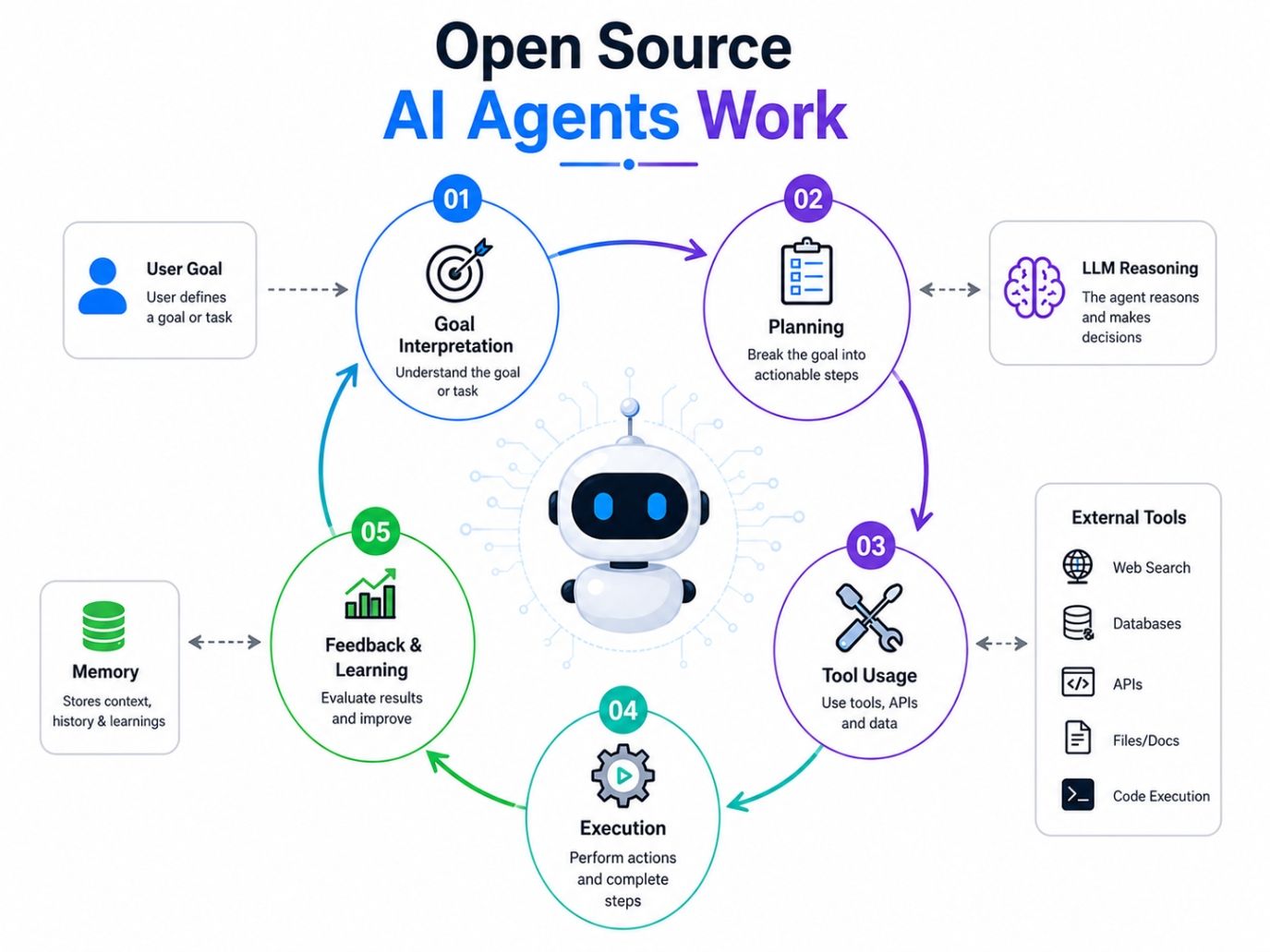
This ability to act independently is one reason why open source AI agents are becoming increasingly valuable for automation projects.
Must Read : Agentic AI Design Patterns: Building Smarter AI Sysems
Organizations are increasingly adopting open source AI agents due to their flexibility, transparency, and cost-effective approach to AI automation.
Open source AI agents come in different forms, each designed to handle specific tasks such as automation, coding, research, customer support, and business operations. Understanding these categories helps organizations choose the right agent for their goals.
The table below highlights the most common types of open source AI agents and their primary use cases:
Type of AI Agent |
Description |
Examples |
| Task Automation Agents | Execute tasks autonomously based on user goals. | AutoGPT, AgentGPT |
| Multi-Agent Systems | Multiple agents collaborate on complex workflows. | CrewAI, MetaGPT |
| Coding Agents | Assist with development, testing, and debugging. | OpenHands, Open Interpreter |
| Research Agents | Gather, analyze, and summarize information. | Haystack Agents |
| Customer Service Agents | Automate support interactions and ticket management. | Dify Agents |
| Data Analysis Agents | Process data and generate insights. | LlamaIndex Agents |
| Personal Assistant Agents | Handle productivity and scheduling tasks. | AgentGPT |
| Enterprise Workflow Agents | Automate business operations. | SuperAGI |
| RAG-Based Agents | Retrieve external knowledge before responding. | Haystack, LlamaIndex |
| Decision-Making Agents | Evaluate options and recommend actions. | LangGraph Agents |
Each type serves a different purpose depending on organizational requirements.
Also Read: How to Build Your Own AI System: Step-by-Step Guide
The rapid growth of agentic AI has led to the emergence of several powerful open-source frameworks. These platforms help developers build, deploy, and manage autonomous AI agents for automation, software development, research, and enterprise workflows.
Open Source AI Agent Framework |
Description |
Best For |
| AutoGPT | One of the earliest autonomous AI agent frameworks that enables goal-driven task execution with minimal human intervention. | Workflow automation, autonomous task management |
| CrewAI | A multi-agent framework where specialized AI agents collaborate and coordinate to achieve shared objectives efficiently. | Team-based AI workflows, business automation |
| LangGraph | Provides stateful workflow management and advanced orchestration capabilities for building complex agent systems. | Multi-step workflows, agent orchestration |
| OpenHands | An open-source AI platform focused on software development tasks such as coding, debugging, and project management. | Software engineering, coding assistance |
| MetaGPT | Simulates an entire software development team using multiple AI agents with specialized roles and responsibilities. | AI-driven software development projects |
| SuperAGI | A framework for building, deploying, monitoring, and managing enterprise-scale AI agents across business operations. | Enterprise automation, large-scale AI deployments |
Also Read: What Is Agentic AI? The Simple Guide to Self-Driving Software
Open source AI agents provide organizations with greater flexibility, control, and scalability when building AI-powered solutions.
Their transparent and customizable nature makes them an attractive choice for businesses looking to automate processes and accelerate innovation.
Organizations can tailor AI agents to specific workflows, business objectives, and operational requirements.
AI agents can automate repetitive tasks and streamline workflows with minimal human intervention.
Businesses maintain ownership of their deployments, integrations, and data without relying heavily on a single vendor.
Active open-source communities continuously contribute new features, updates, and improvements.
AI agent systems can easily grow alongside changing business needs and increasing workloads.
Many open-source frameworks reduce licensing costs while providing access to advanced AI capabilities.
These advantages are driving more organizations to adopt open source AI agents as part of their long-term AI and automation strategy.
Do read : AWS Agentic AI: A Beginner’s Guide
While open source AI agents offer significant advantages, organizations must also address several technical and operational challenges.
Challenge |
Description |
| Security Risks | Agents often access sensitive data and systems, making strong security measures essential. |
| Deployment Complexity | Setting up autonomous agent workflows may require specialized technical expertise. |
| Infrastructure Requirements | Large-scale implementations can demand substantial computing power and storage resources. |
| Governance and Compliance | Organizations need clear policies to monitor agent actions and ensure regulatory compliance. |
| Reliability Issues | AI agents may occasionally generate inconsistent outputs or unexpected behaviors. |
| Integration Challenges | Connecting agents with existing enterprise software and databases can be complex. |
| Maintenance Overhead | Open-source projects require regular updates, monitoring, and performance optimization. |
Open source AI agents are helping organizations automate workflows, improve productivity, and streamline operations across various domains.
Do read : AI Agent Marketplace: Guide for Businesses and Developers
As AI technology advances, open source AI agents are becoming more capable, collaborative, and autonomous. Several emerging trends are expected to shape their future development and adoption.
Multiple specialized agents will work together to complete complex tasks more efficiently and accurately.
Organizations will deploy connected networks of AI agents that can communicate and automate workflows across departments.
AI agents will take on larger portions of business processes, reducing manual effort and improving productivity.
Dedicated platforms will emerge to manage, coordinate, and govern multiple AI agents within an organization.
Future agents will retain context more effectively, enabling better decision-making and personalized interactions.
Also read : Top 15 Agentic AI Books for Beginners to Advanced Learners
If you are new to AI agents, start with a clear objective.
A practical approach includes:
Starting small helps organizations understand capabilities before scaling deployments.
The rise of open source AI agents marks a significant shift in how AI systems operate. Instead of simply generating responses, these agents can plan, reason, collaborate, and execute tasks across multiple environments. With growing community support, increasing enterprise adoption, and rapid technological advancements, open-source agent frameworks are becoming a key part of modern AI infrastructure. Whether your goal is workflow automation, software development, research, or business process optimization, these systems offer a flexible foundation for building autonomous AI solutions.
Want personalized guidance on AI and upskilling? Speak with an expert for a free 1:1 counselling session today
Yes, many open source AI agents are beginner-friendly and come with detailed documentation, tutorials, and community support. Frameworks such as CrewAI and Flowise offer relatively simple setup processes, allowing newcomers to experiment with AI automation without building everything from scratch. Starting with small projects is often the best approach.
Some open source AI agents can run entirely offline if they are connected to locally hosted language models and tools. This setup is particularly useful for organizations that prioritize data privacy, security, or compliance requirements. However, certain features may still require internet access for external integrations.
The required skill level depends on the framework you choose. Visual platforms and low-code tools require minimal programming knowledge, while advanced frameworks often need experience with Python, APIs, and AI workflows. Understanding basic automation concepts can help you get better results regardless of technical expertise.
Several industries are actively investing in AI agent solutions, including healthcare, finance, software development, retail, and logistics. These sectors often deal with repetitive processes, large datasets, and complex workflows, making them ideal candidates for AI-powered automation and operational efficiency improvements.
Yes, most modern agent frameworks support integration with business tools through APIs and connectors. Organizations commonly connect agents to CRM systems, databases, communication platforms, project management tools, and analytics software to automate workflows and improve productivity across teams.
Traditional automation tools usually follow predefined rules and workflows. Open source AI agents can analyze context, make decisions, adapt to changing conditions, and perform multi-step tasks. This added flexibility allows them to handle more complex scenarios that standard automation systems may struggle with.
Hardware requirements vary depending on the model size and workload. Smaller projects can often run on standard laptops or cloud environments, while advanced deployments may require dedicated GPUs, high-memory servers, or scalable cloud infrastructure to support multiple agents and larger workloads.
Yes, many frameworks support multi-agent collaboration. Different agents can specialize in planning, research, execution, or validation while working toward a shared objective. This approach helps distribute responsibilities and often improves the quality and efficiency of task completion.
Security depends largely on implementation and governance practices. Organizations should establish access controls, monitor agent activities, encrypt sensitive data, and regularly update frameworks. When properly managed, open source AI agents can be deployed securely within enterprise environments.
Professionals can benefit from developing skills in:
These skills help you build, customize, and manage AI agent systems more effectively.
The future of open source AI agents is likely to focus on stronger reasoning, better memory management, multi-agent collaboration, and deeper enterprise integration. As frameworks become more mature, businesses are expected to use them for increasingly complex workflows, making autonomous AI systems a larger part of everyday operations.
730 articles published
Sriram K is a Senior SEO Executive with a B.Tech in Information Technology from Dr. M.G.R. Educational and Research Institute, Chennai. With over a decade of experience in digital marketing, he specia...
Speak with AI & ML expert
By submitting, I accept the T&C and
Privacy Policy
Open Source LLMs: A Complete Guide for Developers and AI Professionals
03 Jun 2026 | 11 min read