Machine Learning Pipeline: A Complete Guide to Building Reliable ML Systems
By Sriram
Updated on Oct 21, 2026 | 10 min read | 4.67K+ views
Share:

All courses
Certifications
More
By Sriram
Updated on Oct 21, 2026 | 10 min read | 4.67K+ views
Share:
Table of Contents
A Machine Learning Pipeline is a structured workflow that organizes the process of building, training, evaluating and deploying machine learning models. It combines multiple stages into a repeatable system that makes ML projects easier to manage and maintain.
Pipelines automate tasks such as data preparation, feature engineering, model training and monitoring , reducing manual effort and minimizing errors. This standardized way helps teams improve efficiency, ensure consistency and scale machine learning solutions more effectively.
In this blog, you’ll learn what is pipeline in machine learning, the stages involved, key components, practical implementation considerations, and best practices used in real-world projects.
Want to go beyond notebooks and build ML systems that scale? Take your first step with upGrad’s Machine Learning course Online and learn Python, model building and deployment through practical projects.
Popular AI Programs
If you’ve ever built a machine learning model manually, you’ve probably seen how quickly the process gets out of hand. Different data sources, changing preprocessing steps, and data management can all impact model performance.
Here is where a Machine Learning Pipeline comes in. It organizes the entire machine learning process in a chain of steps.
Think of it like a machine learning assembly line.
The pipeline runs a series of steps automatically instead of doing every step by hand every time.
A typical pipeline includes:
Stage |
Purpose |
| Data Collection | Gather raw data |
| Data Cleaning | Remove errors and inconsistencies |
| Feature Engineering | Create meaningful inputs |
| Model Training | Train algorithms on prepared data |
| Evaluation | Measure performance |
| Deployment | Deliver the model to production |
| Monitoring | Track performance after deployment |
The goal is not simply automation.
The real value comes from consistency and reproducibility.
For example, imagine a retail company predicting product demand.
Without a pipeline:
With a pipeline:
This is why modern machine learning projects rely heavily on pipeline-based development.
Must read: Automated Machine Learning Workflow: Best Practices and Optimization Tips
Free Courses
Many machine learning beginners focus heavily on algorithms.
In practice, algorithms often represent only a small portion of the work.
Most project time goes into:
A machine learning pipeline helps manage these activities efficiently.
For example, a fraud detection model in a banking application might receive millions of transactions daily. The system cannot depend on manual intervention every time new data arrives.
The pipeline automatically:
This repeatable workflow allows organizations to deploy machine learning at scale.
Also read: Best Approach for an End-to-End Machine Learning Project
AI Courses to upskill
Explore Artificial Intelligence Courses for Career Progression
Many teams initially build machine learning models using ad hoc processes.
This approach works for experimentation but becomes problematic in production environments.
Traditional Workflow |
Machine Learning Pipeline |
| Manual execution | Automated workflow |
| Difficult to reproduce | Consistent and repeatable |
| Higher risk of errors | Better quality control |
| Harder to scale | Easier to scale |
| Limited monitoring | Continuous monitoring |
As projects grow, structured pipelines become essential rather than optional.
They help data scientists spend less time on repetitive tasks and more time improving model performance and solving business problems.
Do read: Best Approach for an End-to-End Machine Learning Project
Every machine learning project follows a sequence of steps before a model can generate useful predictions. A machine learning pipeline organizes these steps into a structured workflow that improves consistency and reduces manual effort.
While the exact implementation varies across projects, most pipelines contain the following stages.
The process starts with gathering data from relevant sources.
These sources may include:
The quality of the final model depends heavily on the quality of collected data. Even sophisticated algorithms struggle when trained on incomplete or inaccurate information.
Raw data often contains missing values, duplicates, formatting issues, and incorrect records.
Data cleaning helps improve reliability by:
For example, an e-commerce dataset may contain incomplete customer records that need correction before training begins.
Feature engineering transforms raw data into meaningful inputs for machine learning models.
Examples include:
This stage often has a greater impact on model performance than changing algorithms.
The prepared dataset is used to train one or more machine learning algorithms.
During training, the model learns patterns from historical data and develops predictive capabilities.
Common algorithms include:
Before deployment, teams evaluate model performance using validation datasets.
Common evaluation metrics include:
Problem Type |
Common Metrics |
| Classification | Accuracy, Precision, Recall, F1 Score |
| Regression | MAE, RMSE, R² Score |
| Ranking Systems | NDCG, MAP |
Evaluation helps determine whether the model performs well enough for real-world use.
Once approved, the model moves into production.
Deployment allows applications and users to access predictions.
The work does not stop there.
Models require continuous monitoring because data patterns change over time. A model that performs well today may become less effective several months later due to shifting customer behavior or market conditions.
Also read: Machine Learning Free Online Course with Certificate
A machine learning pipeline consists of multiple interconnected components that work together to automate and manage the lifecycle of a model.
Understanding these components helps developers design more reliable systems.
Data Ingestion Layer
This component collects information from different sources and prepares it for processing.
In production systems, data ingestion may occur:
The chosen approach depends on business requirements.
Data Processing Layer
The processing layer handles transformations and feature generation.
Tasks often include:
Consistency is critical here. The same transformations applied during training must also be applied during inference.
Training Environment
This stage manages model training and experimentation.
Teams may train multiple models simultaneously and compare results before selecting the best-performing version.
Many organizations use cloud-based infrastructure to accelerate training workloads.
Model Registry
A model registry stores approved model versions and related metadata.
It helps teams:
Without proper version control, managing machine learning systems becomes difficult as projects grow.
Infrastructure for Deployment
Deployment infrastructure pushes trained models to production environments.
Typical deployment methods include:
It often depends on the latency requirements and the architecture of the system .
Monitoring and Feedback Systems
Monitoring makes sure the model is still performing as expected.
Key monitoring areas are:
Accuracy of prediction
Feedback loops enable teams to retrain models when performance drops.
Many learners search for a machine learning pipeline diagram to better understand how different stages connect. While implementations differ, most pipelines follow a similar architecture.
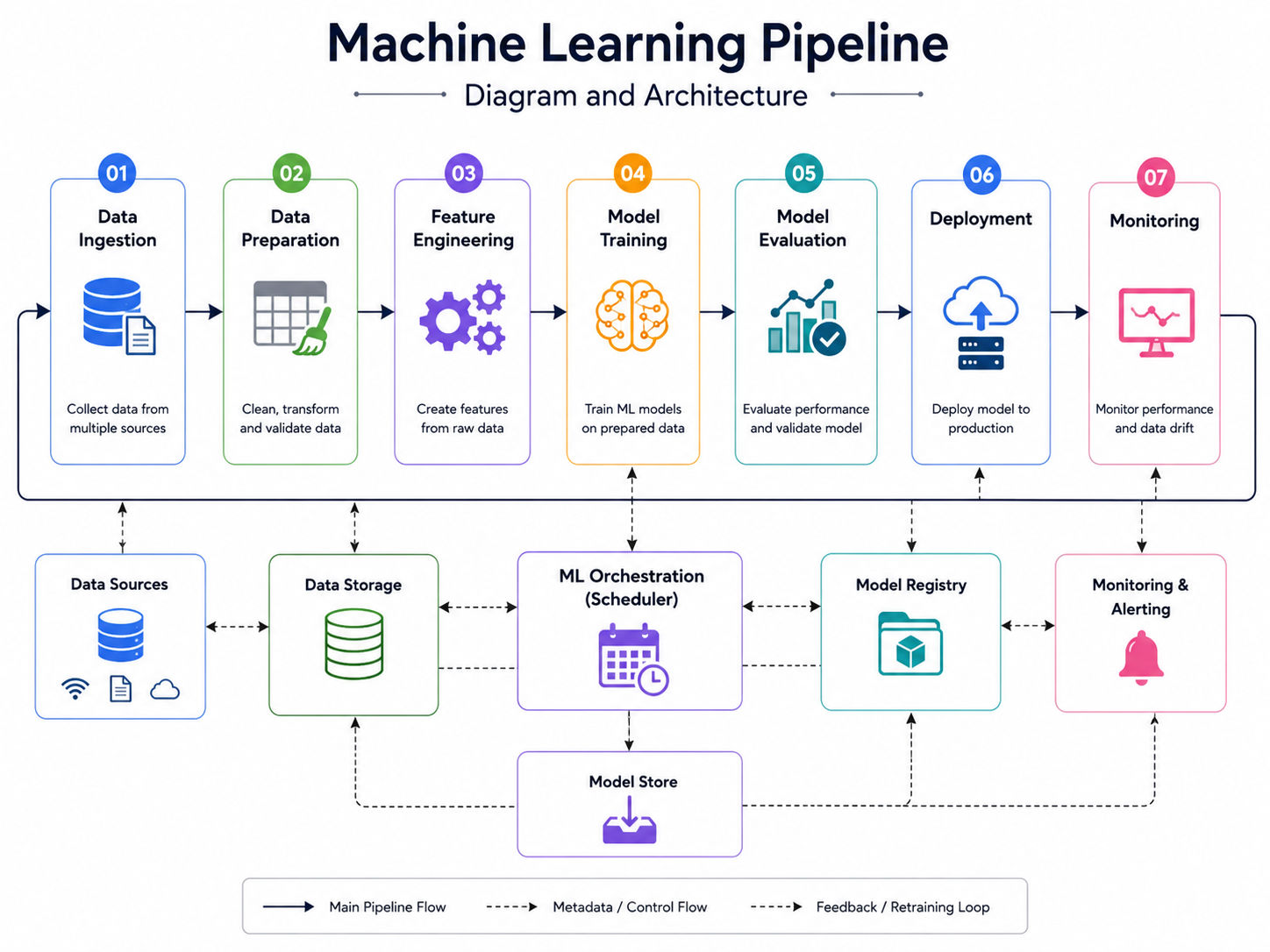
Each stage passes outputs to the next stage while maintaining consistency throughout the workflow.
Example: Customer Churn Prediction Pipeline
Consider a telecom company predicting customer churn.
The pipeline may operate as follows:
Pipeline Stage |
Activity |
| Data Collection | Gather customer usage records |
| Data Cleaning | Remove invalid entries |
| Feature Engineering | Calculate engagement metrics |
| Model Training | Train churn prediction model |
| Evaluation | Measure prediction accuracy |
| Deployment | Integrate with CRM system |
| Monitoring | Track prediction quality |
This structured approach reduces manual intervention and supports continuous improvement.
Explore :Data Preprocessing in Machine Learning: 11 Key Steps You Must Know!
As machine learning projects grow, architecture becomes increasingly important.
A poorly designed workflow may lead to:
Well-designed pipelines help organizations maintain reliability as datasets, teams, and model complexity increase.
Do read : Agentic AI Certification
Machine learning pipelines offer substantial advantages, but they also introduce implementation challenges.
Understanding both sides helps teams make informed decisions.
Benefits of Machine Learning Pipelines :
Better reproducibility
All the workflows have the same sequence of operations.
This makes results more easily reproducible and verifiable.
Quicker Development Velocity
Automation removes the need for repetitive manual labor.
This frees teams up to spend more time on improving models vs prepping data again and again.
More scalable
For larger datasets, manual workflows are not ideal; pipelines are more appropriate here.
Automated processes are increasingly valuable as data volumes grow.
People make fewer mistakes
Standardized workflows help prevent inconsistencies that can occur when doing tasks manually.
Challenges of Machine Learning Pipelines
Initial Setup Difficulty
Building a robust pipeline requires planning and investment in infrastructure.
Initially, this may prove time-consuming for smaller projects.
Maintenance Needs
Pipelines need to be continually updated for the following reasons:
Overhead Monitoring
Production systems need to be monitored all the time.
Model drift can degrade the quality of predictions over time, unless there is proper oversight.
Challenges of Integration
Integrating multiple systems, databases, APIs and cloud services can present technical challenges.
The most successful teams treat pipelines as evolving systems, not one-time implementations.
Building an effective machine learning pipeline involves more than connecting technical components.
Several best practices can improve reliability and long-term maintainability.
Automate Wherever Possible
Manual steps often become bottlenecks.
Automating repetitive processes improves consistency and reduces operational effort.
Version Everything
Track:
Version control helps teams reproduce results and manage changes effectively.
Monitor Beyond Accuracy
Many teams focus only on model performance metrics.
Production monitoring should also include:
Keep Pipelines Modular
Each component should perform a specific task.
Modular pipelines are easier to update, debug, and scale.
Plan for Retraining
Real-world data changes over time.
Establishing retraining workflows helps maintain model performance as business conditions evolve.
Also read: Top 10 Agentic AI Frameworks to Build Intelligent AI Agents in 2026
Conclusion
Machine Learning Pipeline The Machine Learning Pipeline is a structured framework for converting raw data into reliable machine learning models. Teams can improve consistency and scalability by connecting data preparation, training, evaluation, deployment, and monitoring into a repeatable workflow.
If you’re building AI systems for the real world, it’s important to understand what is pipeline in machine learning. As the adoption of machine learning continues to grow, well-designed pipelines will remain an essential foundation for delivering accurate, maintainable, and production-ready models.
Want personalized guidance on AI and upskilling? Speak with an expert for a free 1:1 counselling session today.
A machine learning pipeline ensures that every stage of the workflow follows the same process each time the model runs. This consistency reduces errors caused by manual intervention and helps teams reproduce results more easily. When data preparation and model training remain standardized, performance becomes easier to track and improve over time.
Most modern pipelines include logging, monitoring, and failure-handling mechanisms. If a stage fails due to missing data, processing errors, or infrastructure issues, the pipeline can stop execution, send alerts, and record diagnostics. This makes troubleshooting faster and prevents inaccurate outputs from moving further through the workflow.
Basic programming knowledge is usually helpful, especially in Python. However, many modern platforms provide visual workflow builders and low-code tools that simplify pipeline creation. As projects become more advanced, coding skills become increasingly important for customization, automation, and integration with existing systems.
Machine learning pipelines are a core part of MLOps because they automate data preparation, model training, deployment, and monitoring. Instead of handling these tasks manually, teams can create repeatable workflows that improve collaboration between data scientists, machine learning engineers, and operations teams while maintaining consistency across environments.
Yes. Many production pipelines process data from multiple sources simultaneously. For example, a retail company may combine customer transactions, website behavior, and inventory records within the same workflow. Proper orchestration helps ensure that all datasets remain synchronized before model training begins.
Cloud platforms provide scalable infrastructure for data processing, model training, storage, and deployment. Instead of purchasing expensive hardware, organizations can allocate computing resources as needed. This flexibility becomes particularly useful when training large models or processing growing volumes of data.
Batch pipelines process data at scheduled intervals, such as hourly or daily. Real-time pipelines handle incoming data immediately and generate predictions within seconds or milliseconds. The choice depends on business needs. Fraud detection systems often require real-time processing, while monthly sales forecasting can rely on batch workflows.
Success goes beyond model accuracy. Teams should evaluate factors such as deployment speed, workflow reliability, data quality, monitoring effectiveness, and maintenance effort. A pipeline that consistently delivers reliable predictions while minimizing operational overhead often provides greater long-term value than one focused only on performance metrics.
Feature engineering converts raw information into meaningful inputs that machine learning models can learn from effectively. Even a powerful algorithm may perform poorly if features do not capture useful patterns. Well-designed features often improve prediction quality more than switching to a more complex model architecture.
Security measures typically include access controls, data encryption, audit logs, authentication systems, and continuous monitoring. Organizations also restrict permissions for sensitive datasets and production models. These practices help prevent unauthorized access while ensuring that machine learning workflows remain compliant with business and regulatory requirements.
Recent developments focus on automation, MLOps adoption, cloud-native architectures, and continuous model monitoring. Organizations increasingly use automated retraining, data drift detection, and workflow orchestration tools to manage models at scale. These improvements help teams deploy machine learning systems faster while maintaining reliability and governance.
710 articles published
Sriram K is a Senior SEO Executive with a B.Tech in Information Technology from Dr. M.G.R. Educational and Research Institute, Chennai. With over a decade of experience in digital marketing, he specia...
Speak with AI & ML expert
By submitting, I accept the T&C and
Privacy Policy
Top Resources
Master's Degree
18 Months
Executive Diploma
12 Months
IIIT Bangalore
Executive Programme in Generative AI & Agentic AI for LeadersIndia’s #1 Tech University
Dual Certification
5 Months