Machine Learning Methods: A Complete Beginner's Guide
By Sriram
Updated on Jun 23, 2026 | 9 min read | 2.53K+ views
Share:

All courses
Certifications
More
By Sriram
Updated on Jun 23, 2026 | 9 min read | 2.53K+ views
Share:
Table of Contents
Machine learning methods are the foundation of modern artificial intelligence. Netflix uses these methods to suggest shows and voice assistants like Siri or Alexa understand what you say. They also help detect fraud and make self-driving cars work. These methods let machines find patterns in data and make decisions on their own.
In this article, you'll learn the most important machine learning methods, how they work, where they are used, and how to choose the right approach. We'll also cover specialized techniques such as kernel methods in machine learning, tracking methods in machine learning, distance-based methods in machine learning, and classification methods in machine learning.
Master Machine Learning methods with upGrad’s industry-aligned Machine Learning Courses Online and build real-world AI skills, earn certifications, and accelerate your career growth today.
Popular AI Programs
Machine learning methods are ways that computers can learn from information and get better at what they do over time. They do not just follow rules that never change. Machine learning methods look for patterns, in the information try to guess what will happen and change what they do based on information they get.
At a level we can put machine learning methods into a few groups based on how they learn from the information they get.
Organizations make a lot of data every day. Machine learning helps turn that data into things that people can actually use. According to research done by IBM machine learning is now one of the used artificial intelligence technologies in all kinds of industries because it can make decisions on its own and get things right more often.
Some common applications include:
Also Read: Top 5 Machine Learning Models Explained For Beginners
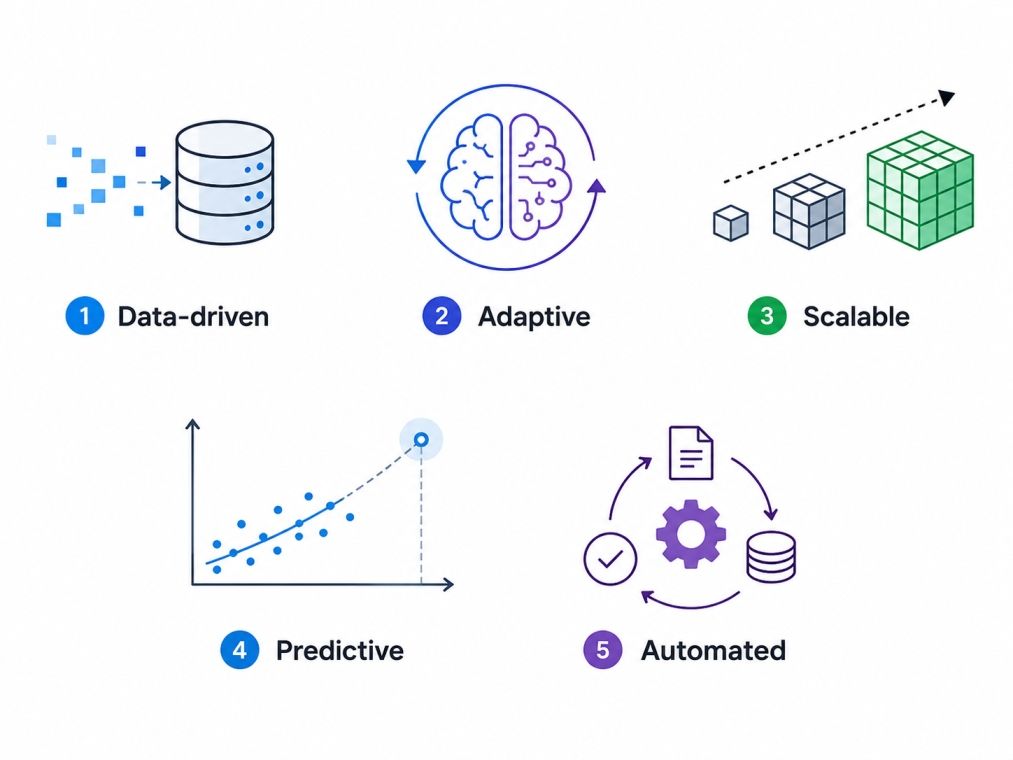
Characteristic |
Description |
| Data-driven | Learns patterns from data |
| Adaptive | Improves with experience |
| Scalable | Handles large datasets |
| Predictive | Makes future predictions |
| Automated | Reduces manual intervention |
Imagine you are teaching a kid to recognize apples.
You show the kids apples, and you say that each one of these things is an apple. After a while the kid starts to learn what apples look like.
This is similar to how learning works.
Now imagine giving the kid a basket that has lots of fruit in it, but you do not say what any of them are. You just ask the kid to put the fruits that're similar together in groups. This is like learning.
When you understand how supervised learning and unsupervised learning work, it is easier to learn about the complicated machine learning methods that people use in real systems that people use every day, like machine learning systems.
Free Courses
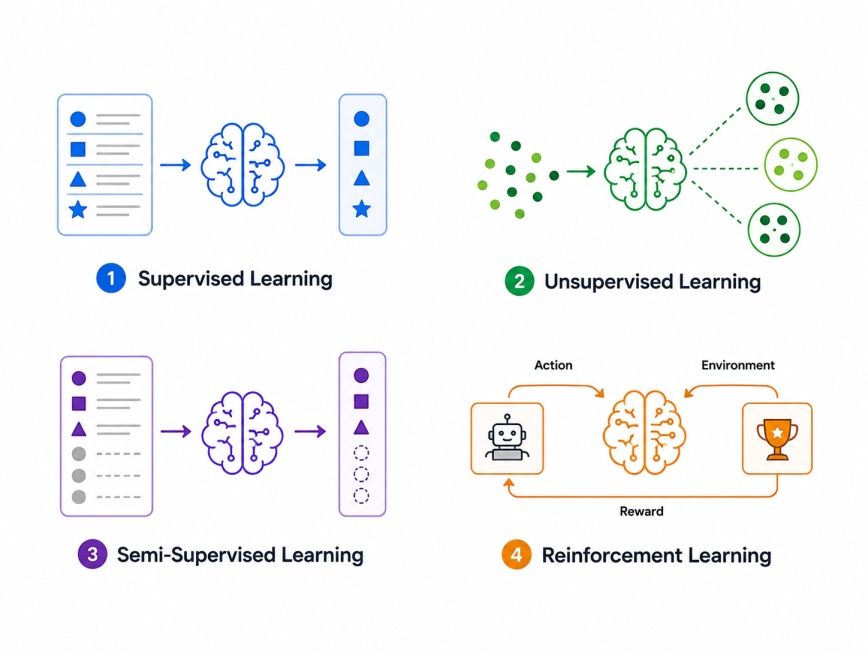
Type |
Learning Approach |
| Supervised Learning | Uses labeled data |
| Unsupervised Learning | Finds hidden patterns |
| Semi-Supervised Learning | Uses limited labels |
| Reinforcement Learning | Learns through rewards |
Different problems need ways of learning. The method you choose matters for a machine learning project to succeed. You have to pick the right approach for your specific problem.
Machine learning projects can only succeed if you choose the method. The right method makes all the difference.
Supervised learning uses data with labels to train models. This method helps the model learn from examples. Labeled data is key here.
Many machine learning classification methods are supervised for learning. This is because they put inputs into categories that are already defined.
Examples include:
Popular algorithms include:
Unsupervised learning works without labeled data. The goal of learning is to discover hidden structures in data.
Many machine learning methods that are based on distance are used for tasks. This is because these methods can measure similar data points to each other.
Common tasks include:
Popular algorithms include:
Real-world datasets usually have a little labeled data. This method helps to lower the costs of labeling data and still gives results. It keeps working even with less labeled data.
Semi-supervised learning combines:
Reinforcement learning is about making decisions. The agent interacts with the environment. It learns from the rewards it gets and the penalties it receives. Reinforcement learning is about this process of learning from the environment.
Applications include:
A practical observation is that businesses often start with supervised learning because labeled business data is easier to interpret and evaluate.
Learning Type |
Data Requirement |
Example Use Case |
| Supervised | Labeled data | Email filtering |
| Unsupervised | Unlabeled data | Customer segmentation |
| Semi-Supervised | Mixed data | Medical imaging |
| Reinforcement | Reward-based feedback | Robotics |
Also Read: How to Learn Machine Learning – Step by Step
AI Courses to upskill
Explore Artificial Intelligence Courses for Career Progression
Once you understand the major learning categories, the next thing to do is look into specific machine learning ways that drive today's AI systems. Machine learning is key here.
Classification methods in machine learning help predict categories or labels. Many organizations rely on classification methods in machine learning because they are relatively easy to deploy and interpret.
Examples include:
Popular classification algorithms include:
Algorithm |
Best Use |
| Logistic Regression | Binary classification |
| Decision Tree | Explainable predictions |
| Random Forest | Complex datasets |
| Naive Bayes | Text classification |
| Support Vector Machine | High-dimensional data |
Distance-based methods in machine learning determine similarity using mathematical distance measures.
Common distance metrics include:
Popular algorithms include:
For example, a recommendation system may use distance-based methods in machine learning to suggest products similar to a user's previous purchases.
Kernel methods in machine learning are really helpful. They take data. Move it to a bigger space to solve tricky problems.
Lots of researchers like kernel methods in machine learning. They are good at finding relationships that're not straight lines. Traditional algorithms might not catch these.
The most famous example is the Support Vector Machine (SVM).
Common kernel types include:
Tracking methods in machine learning focus on monitoring objects, behaviors, or movements over time. Computer vision systems need to be good at tracking things in dynamic environments. So, they use machine learning and deep learning models together to improve accuracy.
Applications include:
Popular techniques include:
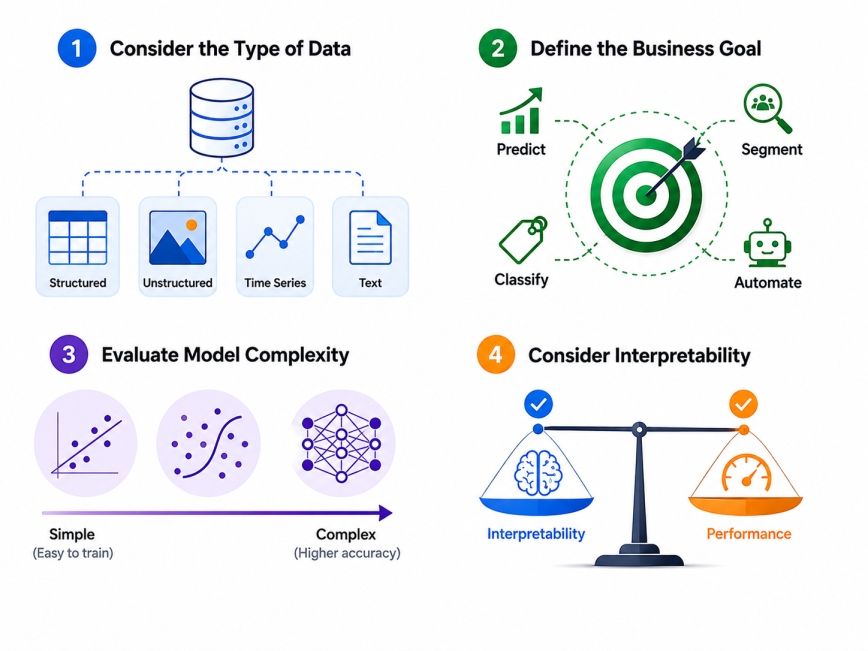
Selecting the right machine learning method is really important. It is more important than picking the most advanced algorithm.
A simple machine learning model that works well with the data can do a job than a complex machine learning model that has a lot of extra stuff that is not needed.
Start by asking:
Your answers help narrow down suitable machine learning methods.
Different objectives require different approaches.
Goal |
Recommended Method |
| Predict numbers | Regression |
| Predict categories | Classification |
| Find patterns | Clustering |
| Optimize actions | Reinforcement Learning |
Complex models may deliver higher accuracy but require:
Sometimes simpler machine learning methods provide better business value.
Industries such as healthcare and finance often need explainable predictions. Decision Trees and Logistic Regression are generally easier to understand than deep neural networks.
Improving data quality often helps more than switching to an algorithm to look at the data quality.
Follow these steps:
Machine learning methods provide the foundation for building intelligent systems that learn from data and improve over time. From supervised and unsupervised learning to advanced techniques such as kernel methods, tracking methods, distance-based methods, and classification methods, each approach serves a specific purpose.
The best machine learning solution is rarely the most complex one. It is the method that aligns with your data, business goals, and operational requirements. By understanding the strengths and limitations of different machine learning methods, beginners can make better decisions and build more effective AI solutions.
Want to explore more about Machine learning methods? Book your free 1:1 personal consultation with our expert today.
The four main types of machine learning methods are supervised learning, unsupervised learning, semi-supervised learning, and reinforcement learning. Each type uses a different learning approach and is suitable for specific business problems. Together, they form the foundation of modern machine learning systems.
Machine learning methods include regression, classification, clustering, dimensionality reduction, reinforcement learning, neural networks, ensemble learning, and probabilistic models. The choice depends on the nature of the data and the desired outcome. Different methods excel in different scenarios.
The four pillars of machine learning are data collection, model selection, training, and evaluation. High-quality data provides the foundation, while proper model development and testing ensure accurate and reliable predictions in production environments.
Supervised learning is often considered the best starting point for beginners. Algorithms such as Linear Regression and Decision Trees are relatively easy to understand. They also provide clear examples of how machine learning learns patterns from labeled data.
Classification methods in machine learning learn from labeled examples and assign new inputs to predefined categories. They identify patterns that distinguish one class from another. These methods are widely used in fraud detection, healthcare, and customer analytics.
Kernel methods in machine learning are useful when relationships in data are nonlinear. They transform data into higher-dimensional spaces where patterns become easier to separate. This makes them effective for complex classification and pattern recognition tasks.
Distance based methods in machine learning are commonly used for clustering, recommendation systems, and similarity analysis. They measure how close data points are to one another and use that information to group or classify observations.
Tracking methods in machine learning help systems monitor objects across multiple frames in videos. They maintain object identity over time, making them essential for surveillance systems, autonomous vehicles, and real-time analytics applications.
Yes. Some machine learning methods perform well on small datasets, particularly simpler models such as Decision Trees and Logistic Regression. However, data quality remains critical, and careful validation is needed to avoid overfitting.
Machine learning methods often rely on manually engineered features, while deep learning automatically learns feature representations from raw data. Deep learning typically requires larger datasets and greater computing resources than traditional machine learning techniques.
Industries such as healthcare, finance, retail, manufacturing, transportation, and telecommunications benefit significantly from machine learning methods. These techniques help organizations automate processes, improve predictions, reduce costs, and enhance customer experiences.
730 articles published
Sriram K is a Senior SEO Executive with a B.Tech in Information Technology from Dr. M.G.R. Educational and Research Institute, Chennai. With over a decade of experience in digital marketing, he specia...
Speak with AI & ML expert
By submitting, I accept the T&C and
Privacy Policy
Top Resources
Master's Degree
18 Months
Executive Diploma
12 Months
IIIT Bangalore
Executive Programme in Generative AI & Agentic AI for LeadersIndia’s #1 Tech University
Dual Certification
5 Months