Causal AI: A Complete Beginner's Guide
By Sriram
Updated on Jun 15, 2026 | 5 min read | 2.61K+ views
Share:

All courses
Certifications
More
By Sriram
Updated on Jun 15, 2026 | 5 min read | 2.61K+ views
Share:
Table of Contents
Causal AI is made to answer a question that a lot of AI systems still have trouble with: Why did something happen? Causal AI does not just look at things that seem to be connected. It really tries to figure out what causes something to happen and what effects it has.
Causal AI is, about understanding cause and effect. The result is something more useful for real-world decisions, where knowing what happened matters less than understanding what drove it.
This blog will walk you through what causal AI is, how it works, how it differs from standard AI, and where people are actually putting it to use. You'll also pick up the basics of causal inference, see some concrete examples, and get a sense of where this field is heading.
Explore Artificial Intelligence Courses from upGrad and discover why causal AI is becoming one of the most valuable tools for business leaders who want to move beyond guesswork and make decisions that actually hold up.
Popular AI Programs
Causal AI is a type of intelligence that focuses on finding out what causes something to happen and what the effects are.
A regular AI system might notice that people who buy one thing often buy another thing too. Artificial intelligence is good at finding patterns in data. If we give it a lot of examples, it can guess what will happen next with good accuracy.
Causal AI goes a bit further and asks a tougher question: Did buying the first product really make someone buy the second product?
This difference is really important because correlation and causation are not the same thing, even when they look identical in a dataset. Causal AI is used to find what really causes something to happen, not what seems to happen together.
Also Read: How AI is Transforming Digital Marketing?
Free Courses
Most machine learning models are trained to find patterns in data. Machine learning models are good at predicting what will happen. Machine learning models often cannot tell you why it happens.
Here's a quick comparison:
Scenario |
Traditional AI |
Causal AI |
| Marketing campaign | Predicts higher sales | Determines whether the campaign caused growth |
| Healthcare treatment | Predicts recovery likelihood | Establishes whether the treatment improved outcomes |
| Customer churn | Predicts who might leave | Explains what's actually driving them away |
Also Read: Top 20 Challenges of Artificial Intelligence: Key Issues and Solutions for 2026
A few things define how causal AI approaches problems differently:
AI Courses to upskill
Explore Artificial Intelligence Courses for Career Progression
The engine inside causal AI is something called causal inference. This refers to the methods used to estimate cause-and-effect relationships from data, even when you can't run a perfectly controlled experiment.
Standard AI asks: What is likely to happen?
Causal inference AI asks: What would happen if we did something different?
This change, from prediction to intervention, is what makes this approach strong. Gartner states that causal AI is an emerging technology that is going to be important, and researchers across industries are considering causal reasoning as a big part of making AI systems that people can really trust. Causal AI is getting a lot of attention because it helps us make AI systems that're trustworthy, and that is a big deal, for causal AI.
Related Article: Problem Solving in Artificial Intelligence
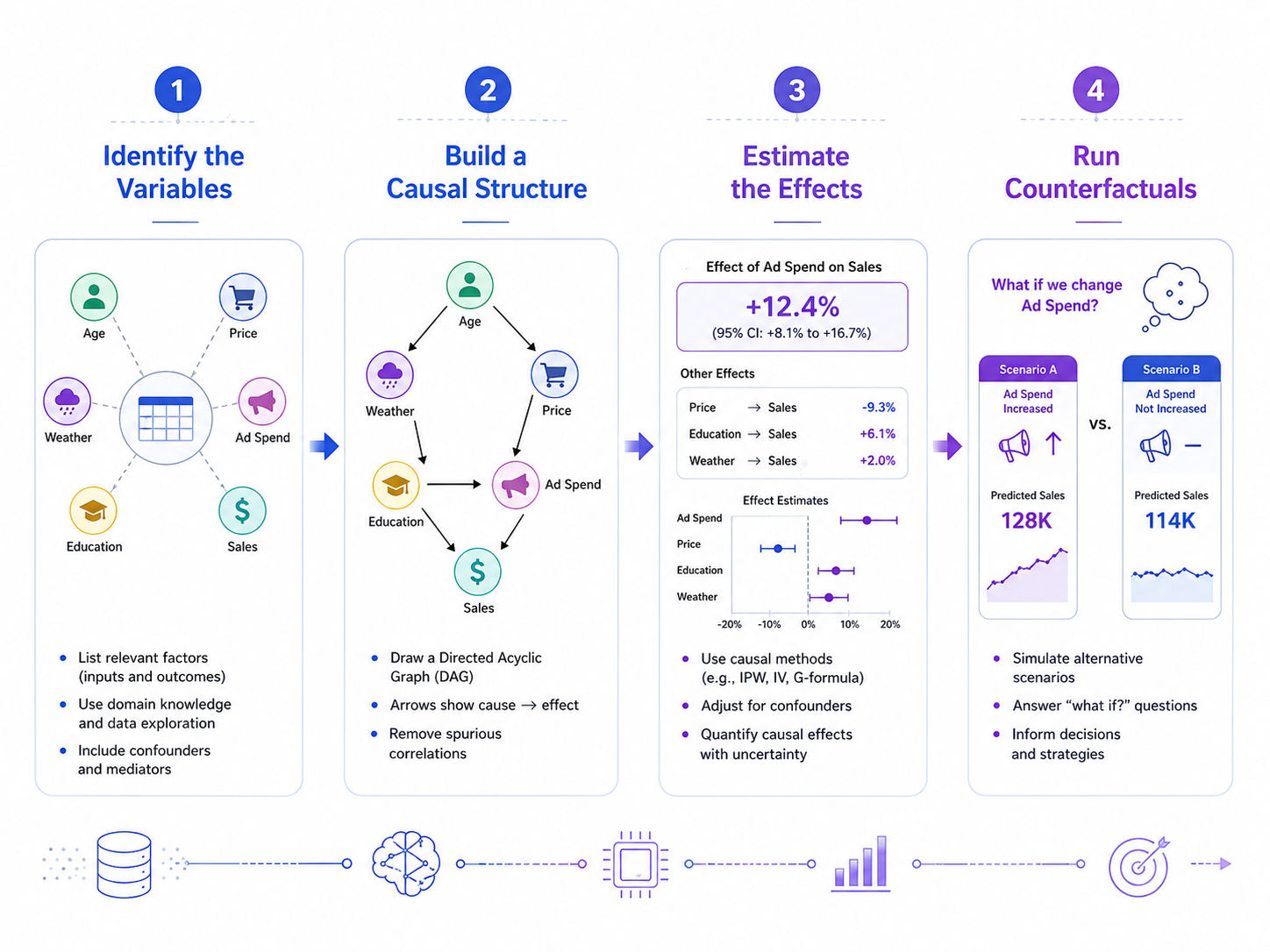
The process isn't magic. It breaks down into a few logical steps.
To begin with, you need to think about the things that can affect what happens. When we talk about employees staying with a company, there are a lot of things to consider. The employee retention is what we are looking at here.
For example, salary, career development, workplace culture, management quality, and job satisfaction. Then there is the workplace culture, which is also important. The quality of management is something that plays a role.
We cannot forget about job satisfaction, which is how happy people are with their jobs. Any of these can make a difference whether an employee stays with the company or decides to leave the company. Employee retention is really what we are trying to understand.
When we look at things that change together, causal AI does something. It makes a model that shows how these things affect each other. We usually show these connections as graphs or directed acyclic graphs (DAGs). You can also call them or structural causal models.
Think of these things like maps that show us what causes something to happen and what happens because of it. Causal AI is really good at making these maps and helps us understand how things are connected.
This is where causal inference does its job. The system looks at the variables. Decides which ones are really making things happen. It determines how big an impact each one has.
Then it figures out if the changes we see are actually caused by these variables or if they just happen to occur at the time. Causal inference is what helps us understand this.
Counterfactual reasoning is a way of thinking ourselves "what-if"
We use this kind of analysis to let decision-makers pressure-test their options before deciding what to do.
Also Read: Topological Sorting in DAGs: Algorithms, Applications, and Step-by-Step Guide
Say a retailer notices that sales go up whenever customers receive discount coupons.
A traditional model concludes: Coupons and sales are correlated.
Causal AI asks: Did the coupon actually drive the purchase, or were those customers already planning to buy?
That one question, properly answered, can save a company millions in wasted promotions.
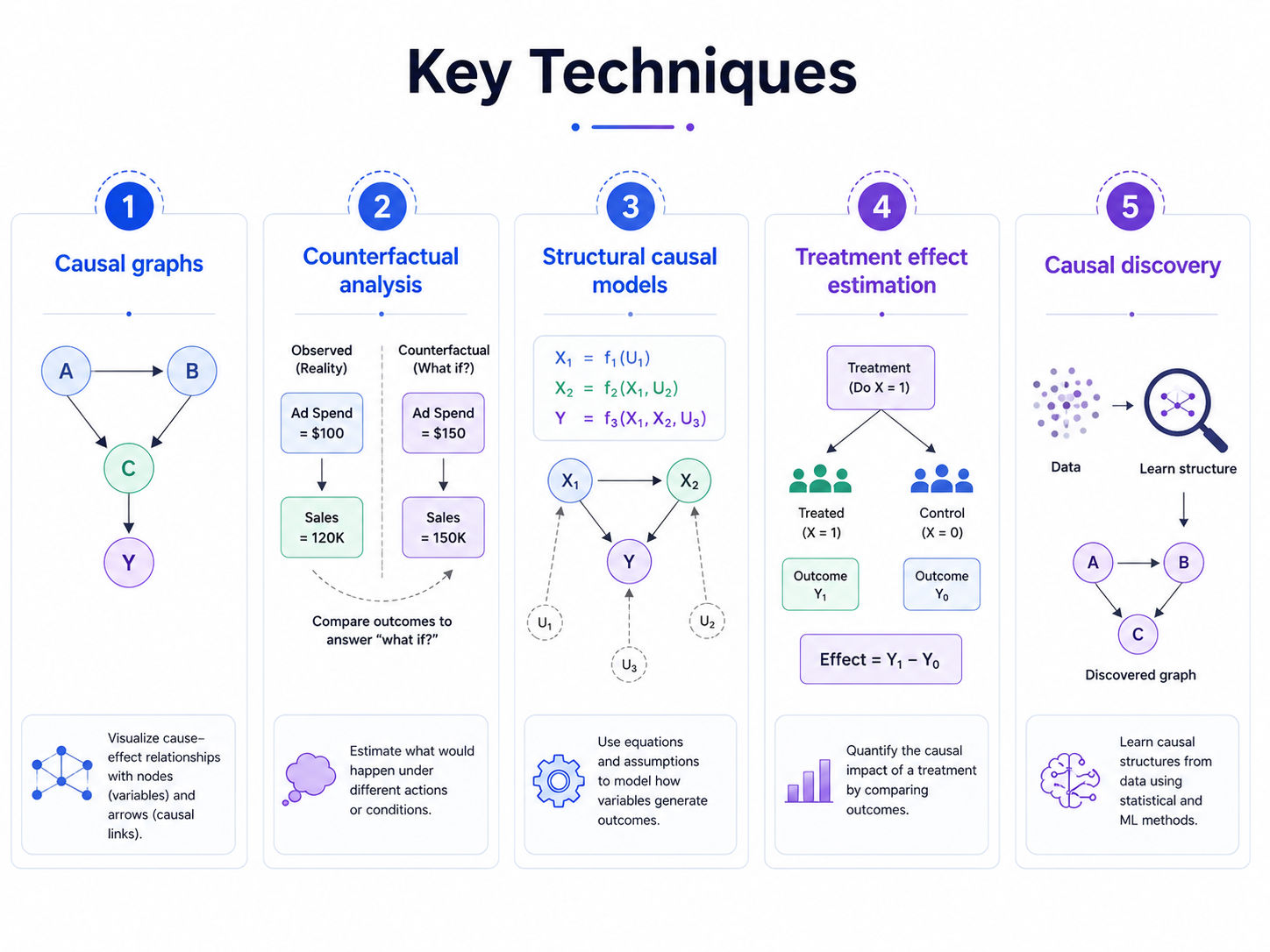
Technique |
What It Does |
| Causal graphs | Maps relationships between variables |
| Counterfactual analysis | Tests alternative outcomes |
| Structural causal models | Represents underlying causal mechanisms |
| Treatment effect estimation | Measures the impact of specific actions |
| Causal discovery | Identifies probable causal relationships from data |
Subscribe to upGrad's Newsletter
Join thousands of learners who receive useful tips
The global causal AI market is projected to grow rapidly over the next decade, driven largely by the demand for AI that can explain itself and support real decisions, not just generate predictions.
The practical applications are broad and growing.
Medical teams really want to know if treatment is effective. They need to be sure it is the treatment that makes people better, not just that the people who got the treatment happened to get better anyway.
Causal AI can help answer questions like: Did this treatment actually make things better for patients? Did the treatment improve the outcomes, for the patients who received it? Which approach worked best? What factors are driving patient results?
Banks and insurers use causal AI for credit risk assessment, fraud detection, customer retention strategies, and evaluating investment decisions. When you can understand what's actually driving financial outcomes, you're in a much better position to manage risk.
Which campaigns actually moved the needle? Which channels are genuinely driving revenue? Causal AI helps marketing teams cut through the noise and figure out what's working and what just looked like it was working.
Delays and disruptions have a lot of causes. These causes are not always easy to figure out. The thing that helps companies find out what is going on is Causal AI.
Causal AI helps organizations find the problem to see if a fix will work and stop things from getting stuck over and over again. Causal AI is very useful for this.
When something goes wrong on a production line, manufacturers need to find out the reason it happened. They need to know the root cause, not a list of things that happened at the same time.
Causal AI provides that, along with insights for quality improvement and equipment maintenance.
The government is under a lot of pressure to show that their programs are really working. The government needs to know if the programs they are implementing are actually helping people. Causal AI helps the people who make decisions for the government to see if the things they are doing with education and jobs and healthcare and social welfare are really making a difference.
Causal AI gives government the tools they need to look at these programs and see what is working and what is not working.
Better decision-making is the obvious one. Organizations can do things that really make a difference, not things that seem to work.
Causal AI is better than systems because it can tell us why something happens. It also works better over time because it looks at what causes things to happen, not just what seems to happen together.
This means that Causal AI can help us plan for the future carefully and find problems in the data that we might not see otherwise. Causal AI is really good at finding hidden biases in the data.
Causal AI is not something you can just use. It needs data and you have to think carefully about what you are assuming. There are things that can affect the results that you might not be measuring, and these hidden variables can really mess things up.
To make Causal AI models that you can trust you usually need to know a lot about the area you are working in. It is really tough to prove that something is causing something else, in the real world where things are complicated. Causal AI is hard to get right because it is easy to miss things that are not being measured. Causal AI requires a lot of work to get results.
Feature |
Traditional AI |
Causal AI |
| Focus | Prediction | Explanation and intervention |
| Learns | Correlations | Cause-effect relationships |
| Explainability | Limited | Higher |
| What-if analysis | Weak | Strong |
| Decision support | Moderate | High |
Related Articles: Generative AI vs Traditional AI: Which One Is Right for You?
A few trends are pushing causal AI forward: growing demand for explainable AI, regulatory pressure for transparent decision-making, deeper adoption in healthcare and finance, integration with large language models, and better tools for discovering causal structures automatically.
Market research estimates that the global causal AI sector could grow at a compound annual rate exceeding 39% through 2033. As organizations shift from prediction toward genuine decision intelligence, causal AI is increasingly seen as a core capability, not a niche tool.
Causal AI is a meaningful step forward from conventional machine learning. Where traditional AI identifies patterns, causal AI asks why those patterns exist and what you can do about them.
By pairing machine learning with causal reasoning, organizations can act with more confidence, explain their decisions more clearly, and evaluate potential actions before they commit. The growing role of causal inference further signals a broader shift: AI that doesn't just predict the future but helps you understand it and shape it.
For businesses looking for AI, they can trust and act on. Causal AI is one of the more promising developments in the field right now.
Want to explore more about Causal AI? Book your free 1:1 personal consultation with our expert today.
Causal AI is a type of artificial intelligence that identifies cause-and-effect relationships rather than just patterns. It helps explain why something happened and predicts what may happen if conditions change. This makes decision-making more reliable and actionable.
Traditional machine learning focuses on finding correlations within data. Causal AI focuses on understanding whether one factor directly influences another. This allows organizations to move beyond prediction and make intervention-based decisions.
Causal inference AI refers to techniques that estimate causal relationships using data. It helps determine whether an action causes a specific outcome. These methods are fundamental to building effective causal AI systems.
Businesses need to know what drives outcomes, not just what predicts them. Causal AI helps identify the real impact of decisions, campaigns, policies, and operational changes. This leads to better resource allocation and improved results.
Yes. One of the main advantages of causal AI is its ability to explain decisions. By showing causal relationships, it provides greater transparency than many traditional machine learning models.
Healthcare, banking, retail, manufacturing, logistics, and public policy are among the leading adopters. These industries often require reliable decision-making where understanding causes are just as important as making predictions.
Not always. While larger datasets can improve analysis, success depends more on data quality and the accuracy of causal assumptions. Domain expertise often plays a critical role in building useful causal models.
Yes. Researchers are increasingly exploring ways to combine causal reasoning with large language models and generative AI systems. This may improve reasoning, reliability, and decision support capabilities in future AI applications.
Counterfactuals are alternative scenarios that explore what might have happened under different conditions. For example, a business might ask what sales would have looked like if a marketing campaign had not been launched.
The biggest challenges include hidden variables, data limitations, model assumptions, and proving causality from observational data. These issues require careful analysis and domain knowledge to address effectively.
Many experts believe causal AI will become a core component of advanced AI systems. As organizations demand greater explainability, fairness, and decision intelligence, causal reasoning is expected to play a much larger role in AI development.
727 articles published
Sriram K is a Senior SEO Executive with a B.Tech in Information Technology from Dr. M.G.R. Educational and Research Institute, Chennai. With over a decade of experience in digital marketing, he specia...
Speak with AI & ML expert
By submitting, I accept the T&C and
Privacy Policy
Top Resources
Master's Degree
18 Months
Executive Diploma
12 Months
IIIT Bangalore
Executive Programme in Generative AI & Agentic AI for LeadersIndia’s #1 Tech University
Dual Certification
5 Months