Financial Risk Management: A Complete Beginner's Guide
By upGrad
Updated on Jun 10, 2026 | 8 min read | 2.59K+ views
Share:

All courses
Certifications
More
By upGrad
Updated on Jun 10, 2026 | 8 min read | 2.59K+ views
Share:
Table of Contents
Financial risk management is the process of identifying, assessing, and controlling risks that can harm the business. Every business has to deal with uncertainty. Things like market fluctuations, credit defaults, economic downturns, and operational failures can all affect profits of a business. Financial risk management helps businesses get ready for uncertainties and make better decisions.
In this guide, you will learn what financial risk management is, types, why it is important, and steps to manage financial risks. Financial risk management is a growing field; this article will give you a clear understanding of financial risk management.
Explore Management Courses from upGrad to learn about financial risk and become an expert in financial risk management.
Popular Management Programs
Financial risk management is about finding out what could go wrong with money and doing something about it. You do not try to make all the risks go away because that is just not possible. What you do is try to understand what the risks are and deal with them in a way.
When a company takes financial decisions, there is always a 50/50 chance that things will not work out. If a company puts money into a market or lends money to someone or starts selling a new product, there are financial risks involved.
Good financial risk management means that these financial risks do not get too big to handle. Financial risk management helps companies keep risks under control. Financial risk management is important for companies to make sure that financial risks are managed properly.
Also Read: Financial Management Course: Learn Finance, Risk & Strategy in 2025
A lot of people thought that risk management is going to be a deal. In fact, according to a 2024 global risk careers survey, 73% of professionals expect opportunities in risk management over the next year and a half, highlighting the growing importance of financial risk management.
Strong financial risk management helps organizations:
Also Read: Financial Management: Objectives, Scope, and Importance
Free Courses
Finance is a part of our lives. One thing that is really important in finance is the idea of risk and return when it comes to managing money.
When you try to get returns on your investment, you usually must take bigger risks. People and businesses who invest their money always try to find a balance between risk and return. They do not want to take much risk but expect a profitable outcome.
For example:
Investment |
Risk Level |
Expected Return |
| Government Bonds | Low | Low |
| Corporate Bonds | Medium | Medium |
| Stocks | High | High |
| Startups | Very High | Very High |
Understanding risk and return in financial management helps businesses allocate resources wisely and avoid unnecessary exposure.
Also Read: Essential Functions of Financial Management for Effective Business Strategy
Management Courses to upskill
Explore Management Courses for Career Progression
IIIT-B & IIM, Udaipur
Chief Technology Officer & AI Leadership ProgrammeIIM Kozhikode
PCP in AI for Business ProfessionalsFor Understanding financial risk management properly, and for an effective financial risk management, it is crucial to Know the types of financial risks:
Market risk arises when asset prices change unexpectedly. When there is a sudden drop in stock prices, there is significant affect in investment portfolios.
Examples include:
Credit risk occurs when borrowers fail to repay their obligations. Banks and financial institutions devote significant resources to managing credit risk.
Common examples include:
Liquidity risk occurs when a company cannot meet short-term financial obligations. A business may have valuable assets but still struggle if it lacks immediate cash.
Operational risk results from failures in internal processes, systems, or human actions. Modern organizations increasingly focus on operational resilience.
Examples include:
Companies must comply with laws and regulations.
Failure to do so can lead to:
Also Read: What is Strategic Financial Management? Importance, Functions, and Career Opportunities
Financial risk management follows a structured process. Organizations use this framework to identify, measure, and control risks.
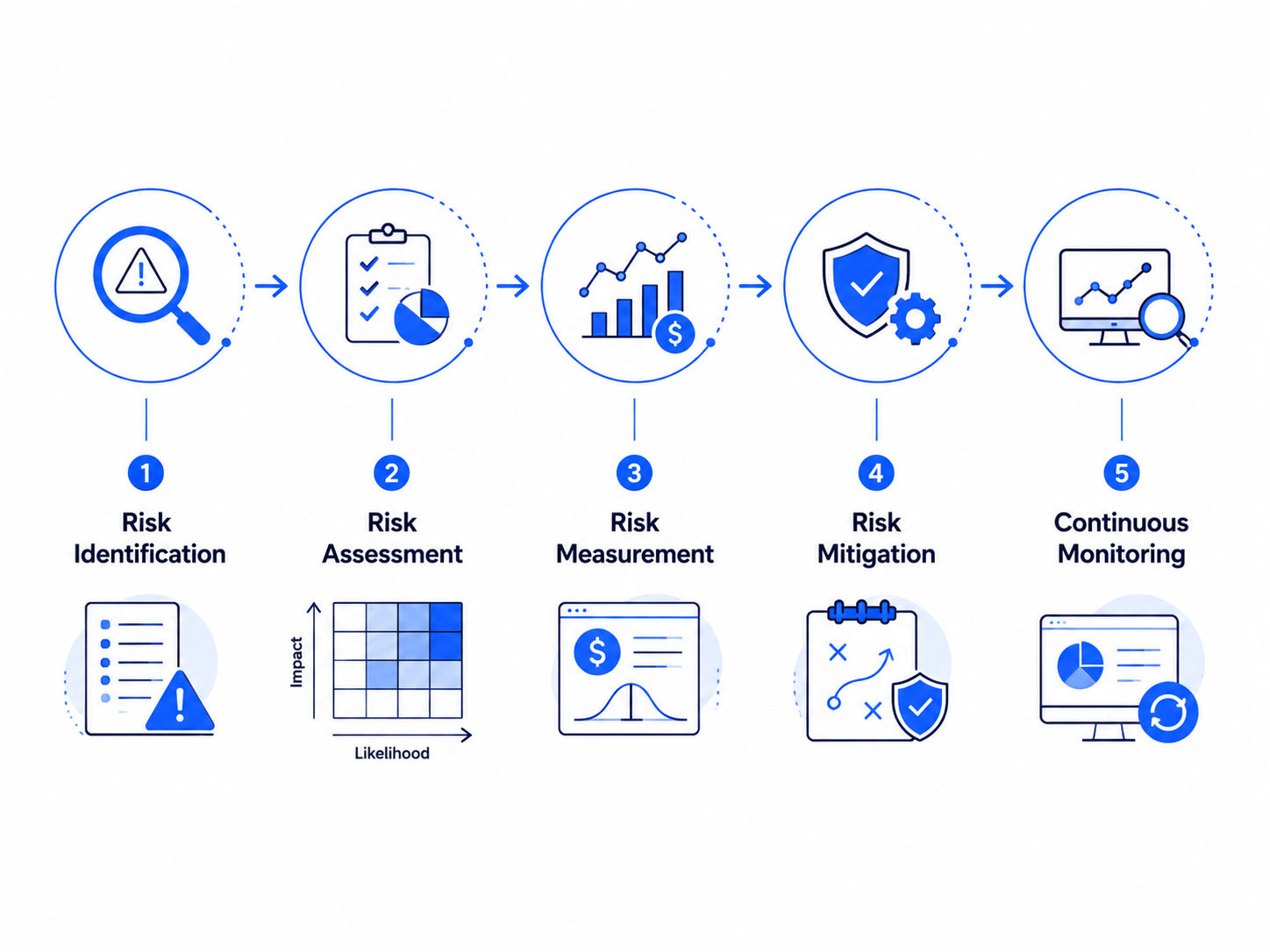
The first step is identifying potential threats.
Questions include:
After identifying risks, organizations evaluate:
This helps prioritize risks.
Various tools help quantify risk exposure.
Examples include:
Organizations implement strategies to reduce risk.
Common approaches include:
Financial risk management is not a one-time exercise.
Businesses must continuously monitor:
Also Read: Top 10 Risk Management Strategies You Need to Follow for Success!
The need for risk experts keeps increasing across different industries. Banks, investment firms, and fintech companies are looking for experts in risk management. Insurance providers and consulting firms also need these experts.
Multinational corporations want experts in financial risk management too.
Some common roles include:
Also Read: Scope of Financial Management: Future Prospects and Career Opportunities
The amount of money a financial risk manager gets paid depends on how they have been doing the job, where they live what qualifications, they have and what kind of business they work for.
Industry reports suggest that certified risk professionals often earn a salary premium compared to non-certified peers.
Experience Level |
Salary Range |
| Entry Level | ₹7–13 LPA |
| Mid-Level | ₹16–30 LPA |
| Senior Level | ₹32–60+ LPA |
A structured financial risk management course can improve both technical knowledge and employability.
A financial risk management course helps learners understand:
When evaluating a financial risk management course, consider:
Interest in a financial risk management course in India has grown significantly as banks and financial institutions expand their risk functions.
Many learners choose the course in India to prepare for specialized risk roles or professional certifications.
A good financial risk management course in India typically covers:
For professionals interested in finance, banking, investments, or analytics, a financial risk management course can provide a strong career advantage.
The growing demand for risk expertise means that employers increasingly value candidates who understand financial risk management principles.
Also Read: Financial Manager Job Description: Roles & Responsibilities
Financial risk management has become a critical function in today's business environment. Organizations face growing uncertainty from economic changes, market volatility, technology disruptions, and regulatory developments.
The concepts of risk and return in financial management remain central to every financial decision, making risk management skills valuable across industries.
For students and professionals, pursuing a financial risk management course can open doors to rewarding career opportunities. With rising demand, competitive financial risk manager for salary prospects, and increasing industry relevance, the field offers strong long-term potential.
Want to explore more about financial risk management? Book your free 1:1 personal consultation with our expert today.
Financial risk management is the process of identifying and controlling risks that can affect an organization's finances. It helps businesses reduce losses, improve decision-making, and protect long-term profitability. Companies use different tools and strategies to manage uncertainty effectively.
The primary objective is to minimize financial losses while supporting business growth. Financial risk management helps organizations understand potential threats, improve stability, comply with regulations, and make informed investment and operational decisions.
Risk management covers all organizational risks, including operational, strategic, and reputational risks. Financial risk management specifically focuses on risks related to money, investments, credit, markets, liquidity, and financial performance.
Risk and return in financial management helps investors and businesses evaluate whether a potential reward justifies the level of risk involved. It serves as a foundation for investment decisions, capital allocation, and portfolio management strategies.
Financial risk management professionals are hired by banks, insurance companies, fintech firms, investment management companies, consulting organizations, regulatory bodies, and large corporations. Risk expertise is valuable across many sectors of the economy.
Strong analytical abilities, financial knowledge, quantitative skills, problem-solving, data interpretation, and communication skills are highly valuable. Understanding financial markets and risk measurement techniques is also important for success.
Financial risk manager salary levels vary based on experience and industry. Entry-level professionals may earn ₹7–13 LPA, while experienced professionals can earn significantly more. Specialized expertise and certifications often improve compensation potential.
A financial risk management course builds practical knowledge in risk assessment, financial markets, and risk mitigation techniques. It also helps candidates develop industry-relevant skills that employers increasingly seek in finance and banking roles.
Look for a curriculum aligned with industry needs, experienced faculty, practical case studies, project-based learning, and career support. A strong financial risk management course in India should combine theory with real-world applications.
Yes. Demand for risk professionals continues to grow as organizations face increasing market, regulatory, and technological challenges. Industry surveys show strong hiring expectations and expanding opportunities across multiple risk disciplines.
Absolutely, many organizations hire graduates for analyst-level positions. Completing a financial risk management course, gaining analytical skills, and understanding risk and return in financial management can help candidates secure entry-level opportunities.
1223 articles published
We are an online education platform providing industry-relevant programs for professionals, designed and delivered in collaboration with world-class faculty and businesses. Merging the latest technolo...
Get Free Consultation
By submitting, I accept the T&C and
Privacy Policy
Top Resources
Certification
3 Months
Certification
6 Months
O.P. Jindal Global University
Masters in International Accounting and Finance (Accredited by ACCA, UK)Master's Degree
12 Months