Human Artificial Intelligence: A Complete Beginner's Guide
By Sriram
Updated on Jun 10, 2026 | 8 min read | 2.58K+ views
Share:

All courses
Certifications
More
By Sriram
Updated on Jun 10, 2026 | 8 min read | 2.58K+ views
Share:
Table of Contents
Human artificial intelligence is really changing how people work, learn things, create, ideas and find solutions to problems. It is not taking the place of humans. Rather, modern artificial intelligence is made to work with people. This means it uses machines, like how fast and efficient they are and the good things about humans like our ability to make judgments, creative and understand emotions.
In this guide, you’ll learn what human artificial intelligence is about, how it is different from the ideas of AI, how humans and smart systems work, and examples in real world applications.
Explore Artificial Intelligence Courses from upGrad and get a simple and easy understanding overview of human artificial intelligence and what it means for people.
Popular AI Programs
Human artificial intelligence is about people working together with artificial intelligence systems. We should not think of intelligence as something that replaces humans. Instead, human artificial intelligence is about how humans and machines collaborate. Humans have strengths and artificial intelligence systems have certain strengths too.
When humans and artificial intelligence systems work together, they can do things better than they can on their own. Human artificial intelligence is a way for humans and machines to complement each other.
Humans excel at:
AI excels at:
When you put these capabilities together, organizations can achieve better results than humans or AI can achieve on their own.
Also Read: Top 20 Types of AI in 2026 Explained
The term "human artificial intelligence" often talks about systems where humans are still in charge of making decisions while AI supports them by giving suggestions or operating some tasks automatically.
This partnership model is really important for industries nowadays. It is increasingly used across industries.
For example:
Human Role |
AI Role |
| Doctor diagnoses patients | AI analyzes medical images |
| Teacher guides learning | AI personalizes lessons |
| Marketer develops strategy | AI analyzes customer behavior |
| Financial analyst makes decisions | AI identifies trends |
According to a report from Stanford AI Index 2025, most organizations are now using AI. In fact, 78% reported use of AI, which is a big jump, from 55% last year. Researchers also consider that AI can really help us get our work done if we use it the right way.
The main point is that organizations profit the most out of AI when humans and AI work together, not when they compete against one another.
The concept of closely related is human-centered AI. This approach is about creating AI systems that focus on people. When AI gets more powerful, it is more important to have humans oversee it.
This makes sure that humans are in control which helps in building trust, in AI systems. AI should help people not replace them.
Also Read: How to Learn Artificial Intelligence: A Step-by-Step Roadmap
Free Courses
People often wonder how machines stack up against thinking. When we talk about intelligence vs human intelligence, it gives us clarity about what artificial intelligence can and cannot do.
Artificial intelligence can do some things better than humans, yet it still lacks a lot of things that make us human. People are waiting to see if artificial intelligence will ever be able to think like humans.
Key Differences
Feature |
Human Intelligence |
Artificial Intelligence |
| Learning | Learns from experience and context | Learns from data and algorithms |
| Creativity | Original and intuitive | Pattern-based generation |
| Emotions | Has emotional understanding | Simulates emotional responses |
| Adaptability | Handles uncertainty naturally | Works best with defined inputs |
| Ethics | Uses moral judgment | Follows programmed rules |
| Speed | Slower processing | Extremely fast processing |
Humans possess certain abilities that remain hard for AI to replicate.
People can tell how others are feeling, social cues, whereas AI cannot understand this. Humans can be kind and care about others in ways that computers cannot genuinely feel.
Humans just know what to do in real life. They know what is going on in everyday situations. AI often gets confused when they see something outside its training data.
AI can generate content, like stories and pictures, yet people are usually the ones who come up with brand new ideas. This is because people are curious, have imaginations, and they have experienced a lot of things in their lives.
Also Read: AI vs. Human Intelligence: Key Differences & Job Impact in 2025
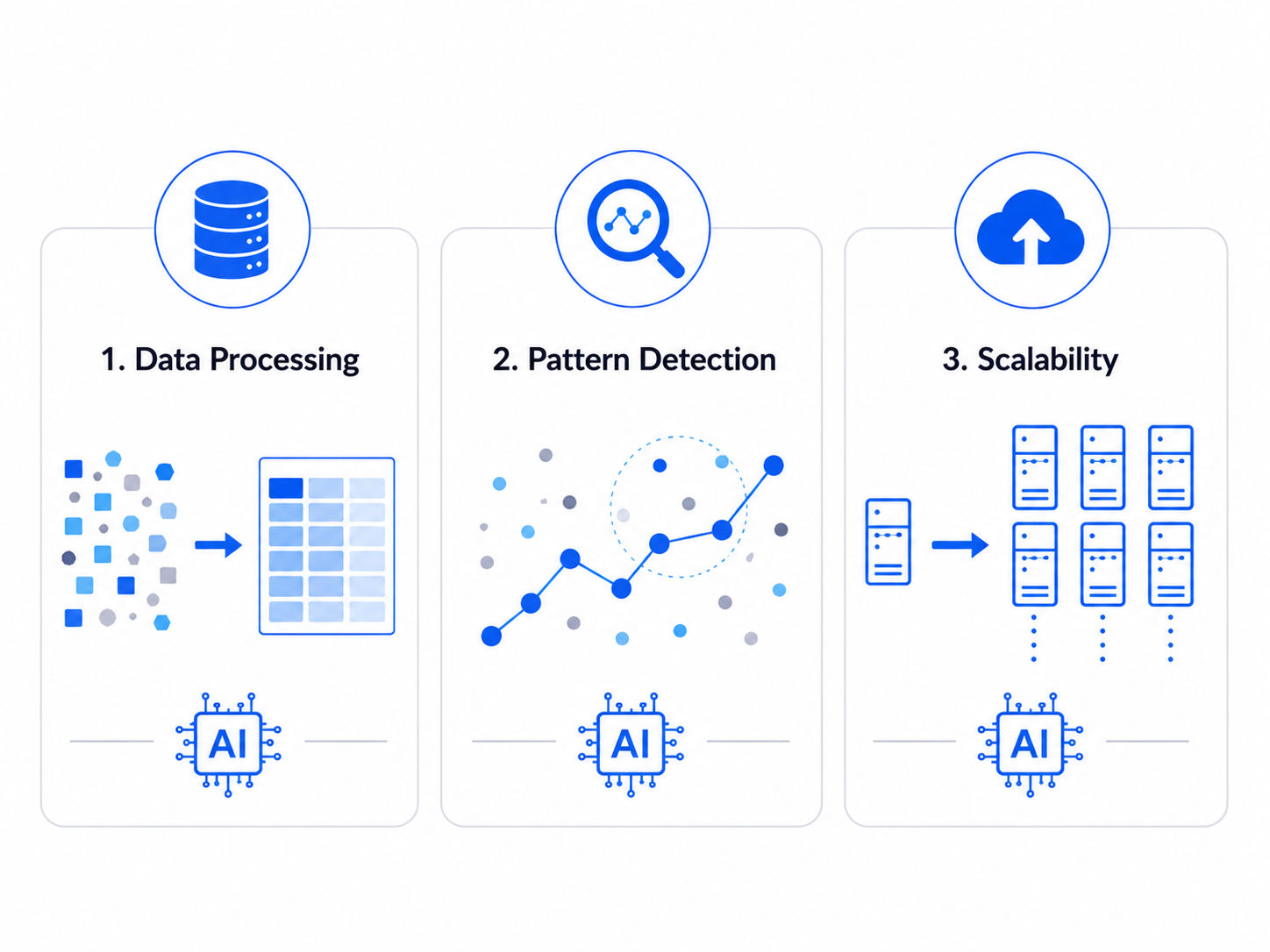
AI demonstrates clear advantages in several areas.
1. Data Processing: AI can analyze millions of records within seconds.
2. Pattern Detection: Humans might miss certain patterns whereas machine learning systems can identify patterns easily.
3. Scalability: AI can perform the same task repeatedly without fatigue.
The debate around AI and human intelligence is not really about choosing one over the other. The future is not about people competing with machines. It is about people using machines to become more capable, productive, and informed.
This perspective is becoming more important every day as AI tools is widely used in offices, schools, hospitals and our daily lives.
AI Courses to upskill
Explore Artificial Intelligence Courses for Career Progression
Lots of people use AI made by humans every day without even realizing it. Artificial intelligence is already a part of the tools and services that people use.
Doctors are increasingly using Artificial Intelligence systems to help them assist with diagnosis and to plan the course of treatment.
AI gives doctors some ideas. The doctors are the ones who make final decisions about what to do.
Examples include:
AI-powered learning platforms are helpful for students because they get to learn at their own pace. Teachers still remain very important because they give students the guidance and mentorship they need. Teachers also motivate students to keep going and do their best.
Applications include:
Organizations use Artificial Intelligence to help them make smarter decisions and work faster. Human teams still oversee strategy and customer relationships.
Common examples include:
AI coding assistants are everywhere these days.
But when it comes to things like architecture and quality control and figuring out problems, you still need a human touch. You still need human expertise for these things, like architecture and problem-solving, and quality control.
Developers use AI for:
Research from Stanford's AI Index shows that AI helps get more work done in many industries when used in the right way. Many organizations combine automation with humans; this way AI can improve productivity across industries.
The AI Index finds that using AI and people together makes workflows better. It is not about automation but also about human oversight.
You may already use human artificial intelligence through:
These tools help people make better decisions while keeping humans in control.
Also Read: Artificial Intelligence in HR: How AI Is Revolutionizing HRM
Like any transformative technology, human artificial intelligence offers significant advantages alongside important challenges.
Understanding both sides helps individuals and organizations use AI responsibly.
Improved Productivity
AI can automate repetitive tasks, allowing people to focus on higher-value work.
Examples include:
Better Decision-Making
AI can process vast amounts of information and surface useful insights. This helps professionals make more informed decisions.
Increased Accessibility
AI tools make information and services more accessible through:
Faster Innovation
Human creativity combined with AI analysis can accelerate research, product development, and problem-solving.
Bias and Fairness: AI systems learn from data. If training data contains bias, AI outputs may reflect those biases.
Privacy Concerns: Many AI systems require large amounts of data. Organizations must ensure responsible data collection and protection.
Overreliance on Technology: Excessive dependence on AI may weaken critical thinking and problem-solving skills. Human judgment remains essential.
Trust and Transparency: Users often want to understand how AI reaches its conclusions. Transparent systems help build confidence and accountability.
The goal is not to eliminate these challenges but to manage them responsibly.
Benefit |
Potential Risk |
| Faster work | Overdependence |
| Better insights | Bias |
| Increased efficiency | Job disruption |
| Greater accessibility | Privacy concerns |
| Automation | Reduced human oversight |
The future of AI will likely be defined by collaboration rather than replacement. Experts increasingly view AI as an augmentation tool that expands human capabilities.
Emerging Trends:
1. AI Agents
New AI systems can perform more complex tasks with limited supervision. Researchers continue to study how these systems can operate safely and transparently.
2. Personalized Experiences
AI will continue improving personalization across:
3. Human-AI Teams
Organizations are shifting toward hybrid workflows where humans and AI share responsibilities. This model often delivers stronger outcomes than either working alone.
Skills That Will Matter
As AI adoption grows, people will need skills that complement technology.
Important capabilities include:
Also Read: Why AI Is The Future & How It Will Change The Future?
Subscribe to upGrad's Newsletter
Join thousands of learners who receive useful tips
Human artificial intelligence is not about machines replacing people. It is about combining the strengths of human intelligence with the capabilities of AI systems.
As AI continues to evolve, understanding the relationship between artificial intelligence versus human intelligence will become increasingly important. The organizations and individuals that thrive will be those who learn how to collaborate effectively with AI while maintaining strong human oversight.
Ultimately, the future belongs not to humans or machines alone, but to human-centered partnerships that use technology to solve meaningful problems.
Want to explore more about Human artificial intelligence? Book your free 1:1 personal consultation with our expert today.
Human artificial intelligence refers to the partnership between humans and AI systems. Instead of replacing people, AI helps them make better decisions, work faster, and solve problems more effectively. Humans still provide judgment, creativity, and ethical reasoning.
Traditional AI discussions often focus on automation. Human artificial intelligence focuses on collaboration. In this model, AI assists people while humans remain involved in important decisions, oversight, and strategic thinking.
The answer depends on the task. AI can process data and recognize patterns much faster than humans. However, humans remain superior in creativity, emotional intelligence, ethics, and understanding complex social situations.
Artificial intelligence versus human intelligence compares the capabilities of machines and people. While AI excels at speed and data analysis, humans excel at judgment, adaptability, and innovation. Both have unique strengths.
In most cases, AI is more likely to transform jobs than eliminate them entirely. Many roles will evolve as AI handles repetitive tasks while humans focus on higher-level responsibilities that require critical thinking and interpersonal skills.
Healthcare, education, finance, retail, manufacturing, marketing, and technology all use human artificial intelligence. In these industries, AI supports professionals rather than replacing their expertise and decision-making abilities.
Human oversight helps prevent errors, bias, and unintended outcomes. AI systems can make mistakes or produce misleading results, so human review ensures accountability, fairness, and ethical use of technology.
Some major concerns include bias, privacy issues, misinformation, lack of transparency, and overreliance on automation. Organizations must implement safeguards to reduce these risks while maximizing AI benefits.
Critical thinking, communication, creativity, leadership, emotional intelligence, and ethical decision-making are becoming increasingly valuable. These skills complement AI capabilities and remain difficult for machines to replicate.
Artificial intelligence a guide for thinking humans encourages people to view AI as a support tool rather than a replacement for human judgment. The goal is to use AI thoughtfully while maintaining independent thinking and responsibility.
The future will likely involve closer collaboration between people and AI systems. Human-AI partnerships are expected to become common across workplaces, education, healthcare, and daily life, creating new opportunities for innovation and productivity.
698 articles published
Sriram K is a Senior SEO Executive with a B.Tech in Information Technology from Dr. M.G.R. Educational and Research Institute, Chennai. With over a decade of experience in digital marketing, he specia...
Speak with AI & ML expert
By submitting, I accept the T&C and
Privacy Policy
Top Resources
Master's Degree
18 Months
Executive Diploma
12 Months
IIIT Bangalore
Executive Programme in Generative AI & Agentic AI for LeadersIndia’s #1 Tech University
Dual Certification
5 Months